


Choosing a 3PL provider means evaluating far more than warehouse location and pick-and-pack rates. The right third-party logistics partner handles receiving, storage, order fulfillment, returns, and carrier management at the service levels your brand has promised customers. YouParcel, which processes 10,000-plus orders a day across multiple marketplaces, works with brands that have moved from underperforming 3PLs and consistently cite the same blind spots: hidden billing lines, vague SLAs, weak integrations, and contract terms that make exiting painful. This guide gives you the exact questions to ask before you sign.
- Evaluate a 3PL on contract specifics, not sales decks: receiving windows, SLA definitions, billing line items, and exit clauses matter more than brochure language.
- Integration depth determines how much manual work your team inherits; always test against your actual tech stack before committing.
- Peak-season capacity and carrier diversification are the two most common failure points; get written commitments on both.
- A structured set of 15 questions lets you compare providers on the same criteria and spot gaps before they become operational problems.
Why the Shortlisting Stage Determines Your Outcome
Most operations leads regret decisions made during due diligence, not after go-live. Once inventory is in a warehouse and orders are flowing, switching costs, restocking fees, and customer disruption make a bad provider tolerable longer than it should be. A disciplined question list applied during the request-for-proposal stage narrows the field to providers who can actually perform at your volume, on your timelines, with your sales channels.
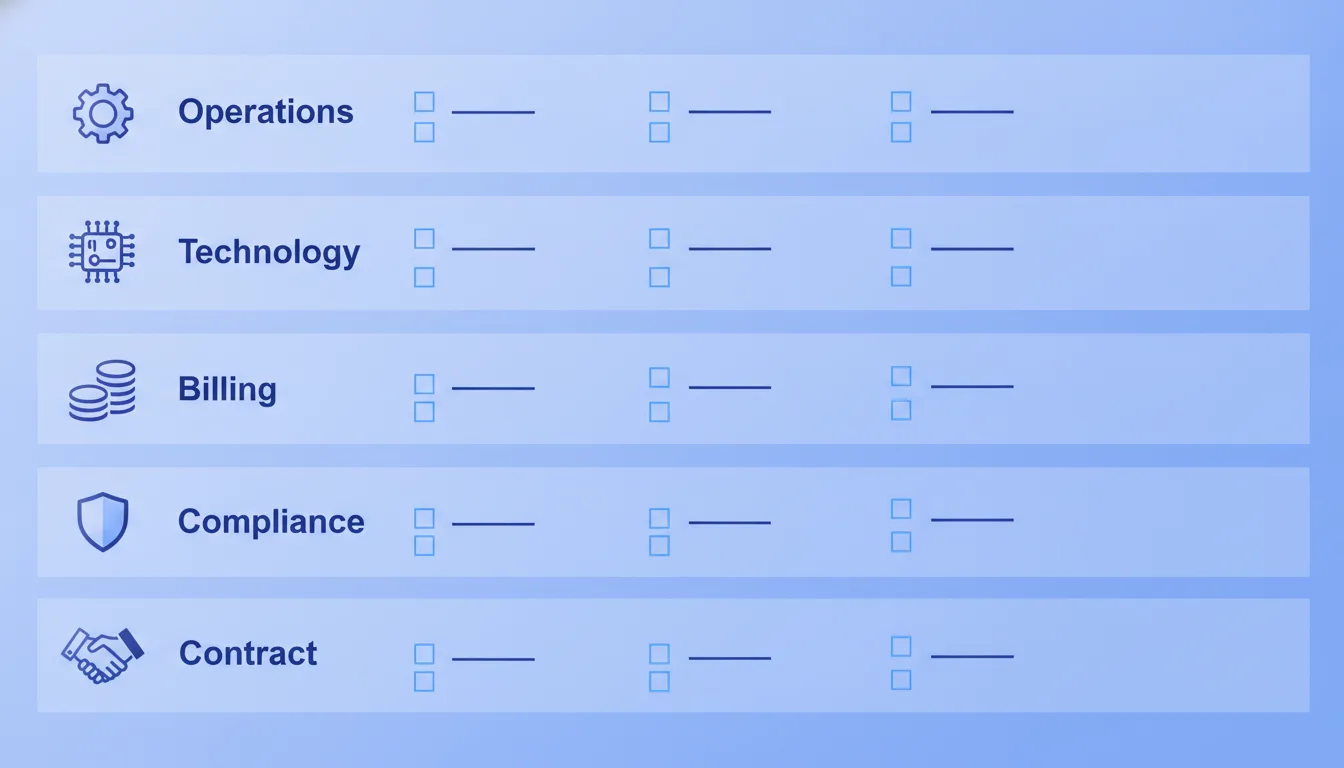
The questions below are organized into six evaluation areas: operations and receiving, technology and integrations, billing transparency, capacity and scalability, compliance and special requirements, and contract and exit terms. Work through them in order; each area builds on the last.
Area 1: Operations and Receiving
Question 1: What is your receiving SLA, and is it written into the contract?
Receiving SLA (service-level agreement) refers to the time between a carrier delivering freight to the warehouse dock and inventory being available to fulfill orders. An industry-standard target for small parcel inbound is 24 to 48 business hours for non-peak periods; LTL (less-than-truckload) and full-container freight typically runs 48 to 72 hours after the shipment is unloaded and counted. Ask for the exact language the contract uses, because vague terms like "prompt receiving" are unenforceable. Providers worth shortlisting state the SLA in hours, distinguish between parcel and freight, and specify what remedies apply if they miss it.
Question 2: How do you handle receiving discrepancies, and who bears the cost?
Receiving discrepancies, meaning differences between the purchase order quantity and the actual unit count received, are common. Ask whether the 3PL photographs inbound freight, generates a discrepancy report, and notifies you within a defined window. Understand whether your account is charged for recount labor when a dispute arises. Well-run providers photograph pallets on arrival, log discrepancies by SKU in their WMS (warehouse management system), and share the report before charging any corrective labor fees.
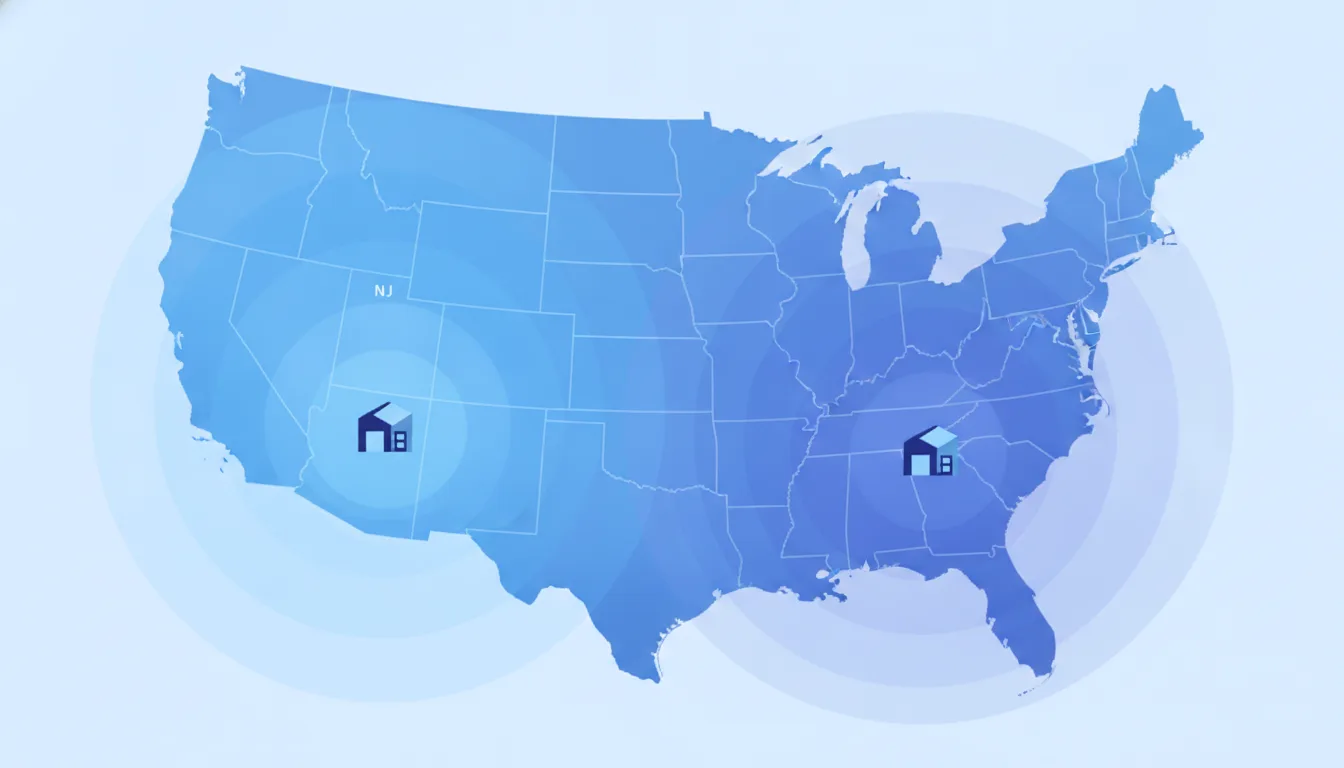
Question 3: Where are your fulfillment centers, and how does location affect my shipping zones?
Carrier shipping zones in the United States are calculated from origin ZIP code to destination ZIP code. Zone 1 is the closest band; Zone 8 is coast to coast. Every zone step up adds cost and transit time. A brand shipping primarily to the Northeast from a single California warehouse is paying Zone 7 or Zone 8 rates on a large share of its volume. Ask the provider to model your order file against their network and show you a zone distribution. YouParcel operates fulfillment centers in New Jersey (20 Farinella Dr, East Hanover, NJ 07936), Southern California (3700 S. Riverside Ave, Rialto, CA 92324), and Illinois, which covers the three major domestic shipping corridors and reduces average zone distance for most U.S. order profiles.
Question 4: What are your pick-and-pack capabilities, and do you support kitting and assembly?
Pick-and-pack describes the process of pulling specific SKUs from shelves (picking), placing them into the correct packaging with any inserts or branded materials (packing), and sending the parcel to the outbound carrier sort area. Kitting is the assembly of multiple SKUs into a single sellable unit before an order is placed; assembly refers to light manufacturing steps performed on-site. If your product line includes bundles, subscription boxes, or promotional kits, confirm the provider has dedicated kitting stations, trained labor, and a documented quality-check step. Not all 3PLs offer this, and those that do vary significantly in throughput capacity and per-unit rates.
Area 2: Technology and Integrations
Question 5: Which platforms and marketplaces do you integrate with natively?
A native integration means the 3PL's WMS exchanges order, inventory, and tracking data with your sales channel through a maintained API connection, without middleware that you manage. Ask for a current list of native integrations and confirm the version of each connector. A provider with 70-plus platform integrations, such as YouParcel's connections to Shopify, Amazon, Salesforce, Tableau, and others, reduces the engineering burden on your team significantly. Middleware solutions can bridge gaps, but they add latency, failure points, and ongoing maintenance cost. Test any integration against your actual SKU catalog and order volume in a sandbox environment before go-live.
Question 6: How does your system handle multi-channel inventory in real time?
Multi-channel inventory management means a single pool of physical stock is allocated correctly across all active sales channels simultaneously, with no overselling or channel-specific mismatch. Ask the provider to demonstrate the latency between a sale on one channel and the inventory decrement visible on another. Latency above five minutes is a risk for high-velocity SKUs. Also ask how the system handles backorders, holds for B2B purchase orders, and lot-number tracking for regulated goods.
Question 7: What reporting and analytics do you offer, and can I access raw data?
Operational BI (business intelligence) from a 3PL should include, at minimum: units received by date, units shipped by date, on-hand inventory by SKU, order accuracy rate, and carrier service mix. Ask whether reports are available in a self-serve dashboard, how frequently data refreshes, and whether you can export raw data for your own analysis tools. Providers that lock reporting behind weekly email summaries or charge separately for data access create blind spots that compound over time. YouParcel offers real-time tracking and BI analytics as standard, not as add-ons.
Area 3: Billing Transparency
Question 8: What are every billing line item, and how is each one triggered?
This is the single most important financial question in the evaluation. Ask the provider for a complete billing schedule, not just the headline pick-and-pack and storage rates. Common line items that appear on invoices but not in initial quotes include: receiving labor (per hour or per pallet), non-standard carton fees, address correction charges from carriers, return processing fees, long-term storage surcharges, account minimum fees, bin or SKU slot fees, special project labor, and tech/API access fees. Build a model using your actual order and SKU profile against every line item. The gap between quoted and actual monthly cost is where most brands are surprised in the first 90 days.
Question 9: How is storage billed, and how do you handle dimensional weight?
Storage is typically billed either by cubic foot per month or by pallet position per month. Cubic-foot billing is generally more favorable for brands with irregular or high-density product. Pallet-position billing may be simpler but punishes brands with products that do not fill a standard 48-by-40-inch pallet efficiently. Dimensional weight (dim weight) is a separate issue on the outbound shipping side: carriers calculate a package's billable weight as the greater of its actual weight or its dimensional weight, using the formula (length x width x height in inches) divided by a divisor, typically 139 for domestic USPS, 139 for FedEx and UPS ground, and 139 for UPS/FedEx air on most domestic services. Ask the 3PL how they select packaging dimensions for each SKU and whether they optimize carton selection to minimize dim weight charges on your behalf.
Question 10: What carrier relationships do you have, and how are carrier rates passed to me?
3PL logistics companies aggregate volume across their client base to negotiate carrier rates below what an individual shipper could obtain. Ask whether carrier discounts are passed through at cost, marked up by a fixed percentage, or marked up by a variable amount by service level. Also ask which carriers the provider has contracts with. A provider working with USPS, FedEx, DHL, Aramex, and EasyPost, as YouParcel does, gives you flexibility to route orders by cost, speed, or destination country rather than being locked into a single carrier's network. Carrier diversification also provides resilience when one carrier experiences service disruptions.
Area 4: Capacity and Scalability
Question 11: How do you handle peak-season volume surges, and what is your written capacity commitment?
Peak season for most U.S. e-commerce brands runs from mid-October through early January, with the highest concentration of orders in the Cyber Five period (Thanksgiving through Cyber Monday). Ask the provider: what is your maximum daily shipment capacity per facility, what percentage of your current client base peaks in the same window I do, and what specific labor and space commitments do you make in writing for Q4? Providers that cannot answer with numbers, or who offer only verbal assurances, have not operationally planned for your growth. Get capacity commitments in the contract, with a defined escalation process if they are breached.
Question 12: How do you support international shipping and cross-border fulfillment?
If any portion of your order volume ships outside the United States, ask how the provider handles international parcel routing, customs documentation, and duties. Confirm which countries they ship to, what Incoterms (International Commercial Terms, the standardized trade definitions published by the International Chamber of Commerce) they support, and how they generate commercial invoices and HS (Harmonized System) codes for customs classification. Note that as of mid-2025, U.S. de minimis duty-free entry for low-value imports has been suspended, meaning duties and fees now apply to a broader range of inbound shipments; if you are shipping into the U.S. from overseas, factor customs costs into your landed cost model. YouParcel ships to 100-plus countries and can advise on international routing. On IOR (importer of record) requirements, which involve a legal entity accepting liability for a shipment's customs compliance in the destination country, YouParcel does not act as IOR; your freight forwarder or a specialist IOR service handles that role, and your logistics counsel can advise on the right structure for your markets.
Area 5: Compliance and Special Requirements
Question 13: Do you support EDI, retailer compliance routing guides, and labeling requirements for wholesale and B2B orders?
EDI (electronic data interchange) is the standardized machine-to-machine exchange of business documents such as purchase orders (850), advance ship notices (856), and invoices (810) between a brand and its retail trading partners. Major retailers including big-box chains require EDI compliance and enforce specific routing guides that dictate carton labeling formats, pallet configurations, and delivery appointment windows. Non-compliance typically triggers chargebacks, which are financial penalties deducted from the retailer payment. If your business includes wholesale or omnichannel distribution, confirm the 3PL supports EDI transactions, manages GS1-standard labeling (including SSCC-18 pallet labels and GS1-128 carton labels), and has experience with the specific retailers in your channel mix. YouParcel supports EDI and retailer compliance for wholesale and omnichannel accounts.
Area 6: Contract and Exit Terms
Question 14: What are the contract term, auto-renewal, and minimum volume or spend commitments?
Many 3PL contracts include auto-renewal clauses that lock you into another 12-month term if you do not provide written notice of non-renewal within a defined window, sometimes 60 to 90 days before the contract end date. Ask for the exact notice period, the auto-renewal term length, and whether minimum monthly spend or minimum order volume commitments apply. Minimums can be structured as a monthly floor billed regardless of activity, or as a ratchet that increases your rate if volume falls below a threshold. Model these against your slowest months, not your average or peak, to understand the true downside.
Question 15: What are the exit terms, including inventory return, data export, and transition timelines?
Exit terms define what happens when the relationship ends, whether by your choice, the provider's choice, or a breach. Ask specifically: how long does inventory return or transfer take, who pays for outbound freight to move your stock to a new provider, what format is client data exported in and within how many days, and are there early-termination fees and if so how are they calculated. A reasonable transition timeline for a mid-size brand (10,000 to 50,000 SKUs) is 30 to 60 days for inventory transfer with parallel operation; anything contractually shorter than that is a risk if the provider relationship deteriorates quickly. Have legal counsel review exit clauses before signing, particularly indemnification language around lost or damaged inventory during the transition period.
How to Compare Providers After Collecting Answers
Once you have answers from two or three providers, structure the comparison so that every criterion uses the same unit of measure. The table below shows the framework.
| Evaluation Area | What to Measure | Red Flag | Strong Signal |
|---|---|---|---|
| Receiving SLA | Hours from dock to available inventory | No contractual definition | SLA in hours with remedy clause |
| Integration depth | Native connections to your channels | Manual CSV upload required | Live API with sandbox test environment |
| Billing transparency | Complete line-item schedule provided upfront | Rates quoted without full schedule | Full schedule plus modeled estimate on your data |
| Peak capacity | Written daily shipment capacity commitment | Verbal assurance only | Contractual capacity floor with escalation process |
| Carrier network | Number of carrier contracts and rate pass-through model | Single carrier or opaque markup | Multi-carrier with transparent pass-through |
| Exit terms | Transition timeline, data export format, termination fees | No defined transition timeline or high early-exit penalty | 30 to 60 day transition, standard data export, proportional fees |
What Makes a 3PL Worth Shortlisting in the First Place
Before investing time in a full RFP process, apply a quick filter. A 3PL provider worth shortlisting should be able to confirm, without hesitation: network coverage that matches your customer geography, native integrations with your current and planned sales channels, documented SLAs in writing, and a reference or profile from a brand at a similar order volume and product complexity. YouParcel handles 10,000-plus orders a day across multiple marketplaces, integrates with 70-plus platforms, and operates fulfillment centers on both coasts and in the Midwest, which positions it for brands that need geographic reach without running their own warehouse network. Learn more about the full scope of 3PL fulfillment services at YouParcel, or explore enterprise-grade supply chain solutions for operations running at higher volume and complexity. For deeper context on how fulfillment fits into a broader ecommerce logistics strategy, see the guide to ecommerce fulfillment.
The Council of Supply Chain Management Professionals (CSCMP) publishes definitions and benchmarks for logistics operations that can anchor your SLA and performance expectations during provider negotiations; their Supply Chain Management Definitions and Glossary is a useful reference. For EDI transaction standards, the GS1 organization maintains authoritative documentation on barcode and data-exchange standards at gs1.org/standards.
Frequently asked questions
What is the most important thing to check in a 3PL contract?
The receiving SLA and exit terms are consistently the two most consequential clauses. A vague receiving SLA creates inventory availability disputes from day one; punitive exit terms trap you with a provider that is not performing. Both should be specific, measurable, and carry defined remedies before you sign.
How do I evaluate whether a 3PL can handle my peak season volume?
Ask for a written capacity commitment that states the maximum daily shipment output per facility during Q4, and ask what percentage of their current client base peaks in the same October-to-January window. If they cannot provide a number or will not put a capacity floor in the contract, treat that as a disqualifying signal.
What billing line items do 3PLs most commonly omit from initial quotes?
The items most often absent from headline quotes include address correction fees (charged by carriers and passed through), long-term storage surcharges triggered after 90 or 180 days, receiving labor per pallet or per hour, return processing fees, and special project or kitting labor rates. Always request the full billing schedule and model it against your own order and SKU data.
How many fulfillment center locations do I actually need?
The right number depends on your order geography. For most U.S. brands, two to three strategically placed nodes, such as one on the East Coast, one on the West Coast, and one in the Midwest, cover the majority of the population within two shipping days at ground rates. Run a zone distribution analysis on your last 90 days of orders to see where a second or third node reduces your average zone and therefore your per-shipment cost.
Can I switch 3PLs without disrupting my customers?
Yes, but it requires a parallel-operation period during which both the old and new provider are active while inventory transfers. A realistic timeline for a mid-size brand is 30 to 60 days. The critical steps are: negotiate a defined transition timeline in your exit clause before signing the original contract, confirm your new provider has capacity to receive your inbound inventory during their own peak period, and communicate expected delivery windows to customers if any delays are anticipated during the cutover.
Ready to evaluate YouParcel as your next 3PL provider? Talk to an expert and get a fulfillment assessment built around your actual order volume, SKU profile, and growth plans.