

Third party logistics (3PL) is the practice of outsourcing warehousing, order fulfillment, shipping and returns to a specialized provider rather than managing those operations in-house. For ecommerce brands, a 3PL like YouParcel handles every physical step between receiving inventory and delivering a parcel to the customer, so your team can focus on growth instead of logistics.
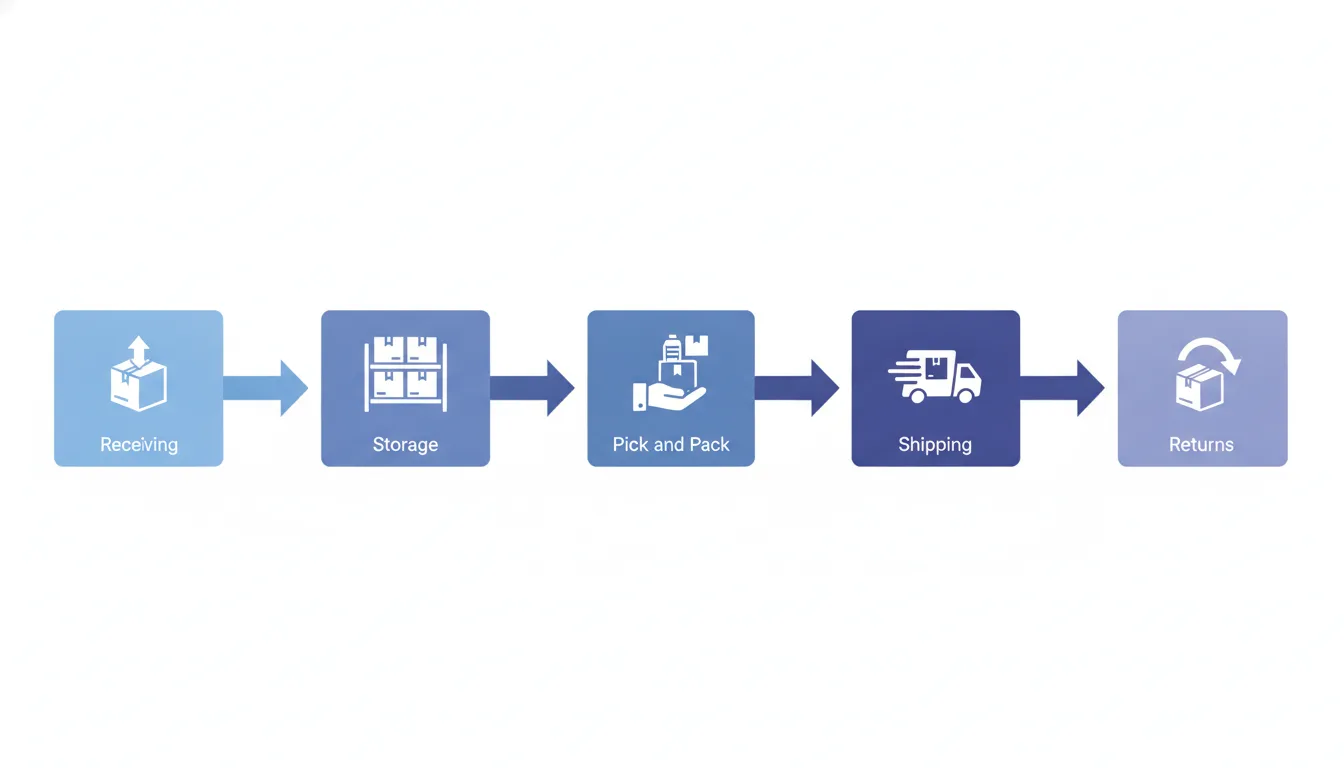
- A 3PL covers receiving, storage, pick and pack, carrier handoff and reverse logistics on your behalf.
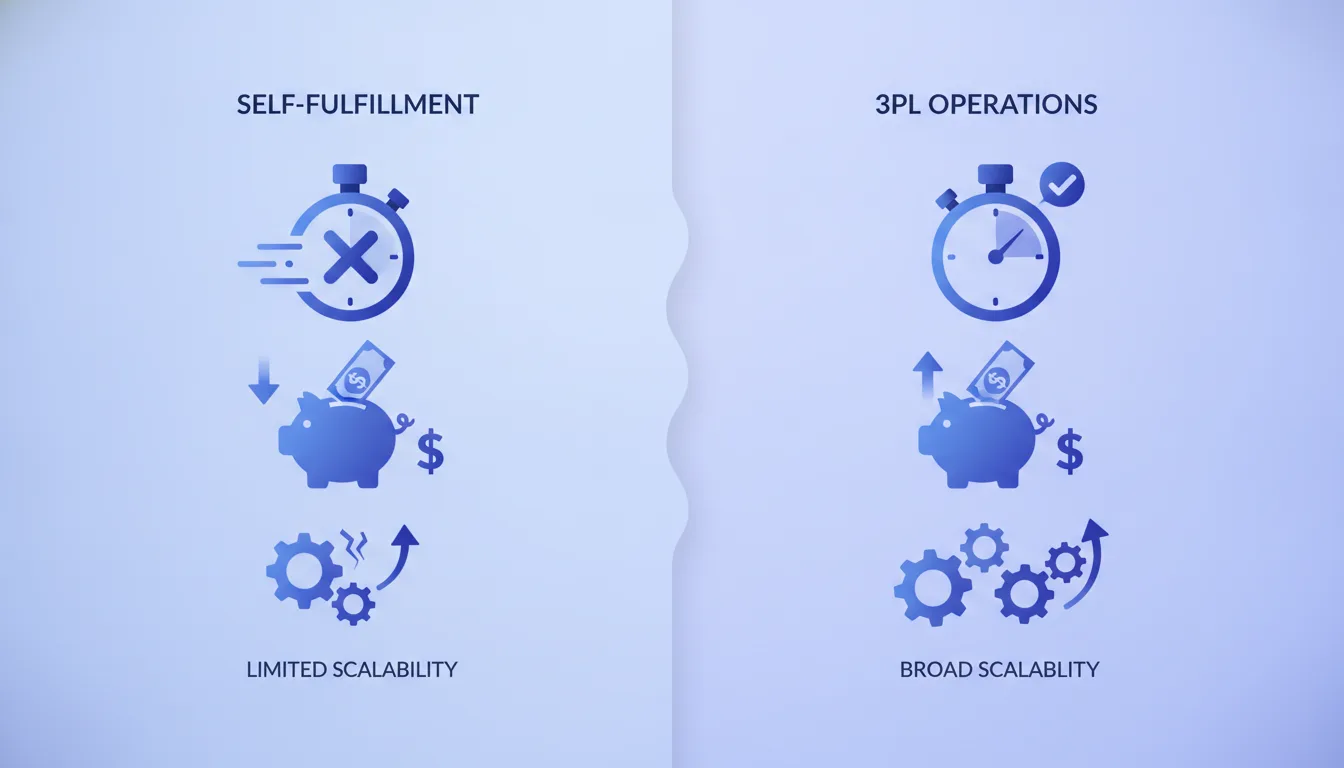
- Brands typically move to a 3PL when self-fulfillment consumes too much time, space or capital to scale further.
- The right 3PL integrates with your sales channels, gives you real-time inventory visibility and scales with order volume without requiring you to sign a long warehouse lease.
- YouParcel processes 10,000-plus orders per day across multiple marketplaces and ships to more than 100 countries from fulfillment centers in New Jersey and California.
What does 3PL stand for, and where does it fit in logistics?
The term 3PL stands for third-party logistics. The numbering comes from supply chain theory: the first party is the shipper (you), the second party is the carrier (USPS, FedEx, DHL), and the third party is the logistics provider sitting between you and the carrier to coordinate the full operation. A 4PL (fourth-party logistics provider) goes one level further by managing multiple 3PLs on your behalf, but for most growing brands a well-integrated 3PL is the right starting point.
The Council of Supply Chain Management Professionals (CSCMP) defines third-party logistics as "a firm that provides multiple logistics services for use by customers" and notes that these services are "integrated, or bundled together" by the provider. That bundling is the core value: instead of contracting separately with a warehouse operator, a freight broker and a returns processor, you work with one partner who coordinates all of it.
External reference: CSCMP Supply Chain Management Definitions and Glossary.
The five core functions a 3PL performs
1. Receiving and inbound freight
Receiving is the process of accepting inventory from your manufacturer or supplier, verifying quantities, inspecting for damage and booking stock into the warehouse management system (WMS). A good 3PL logs each SKU, records lot numbers or expiry dates where relevant, and flags discrepancies in a receiving report before goods go to a putaway location. At YouParcel's fulfillment center at 20 Farinella Dr, East Hanover, NJ 07936, inbound shipments are processed and made available for order fulfillment quickly so that stock does not sit idle on a dock.
2. Storage and inventory management
Once received, your inventory is stored in bin locations, shelving, pallet racking or climate-appropriate zones depending on product type. The 3PL assigns each SKU a location code so that pickers can find it efficiently. Real-time inventory counts sync to your connected sales channels, which reduces overselling and lets you reorder at the right time. YouParcel integrates with Shopify, Amazon, Salesforce and 70-plus other platforms so inventory data moves automatically rather than through manual spreadsheet updates.
3. Pick and pack
Pick and pack is the process of selecting the correct items for each order (picking) and then boxing, wrapping or poly-bagging them (packing) with the right dunnage, branded inserts or kitting components. Accuracy at this stage directly affects your customer experience and your return rate. A 3PL uses barcode scanning at the pick step to verify each item against the order, reducing mis-picks. Dimensional weight (DIM weight) matters here too: carriers calculate freight charges as the greater of actual weight and dimensional weight, where DIM weight equals length times width times height divided by a divisor (typically 139 for domestic UPS and FedEx ground, 166 for USPS). A 3PL that trains its pack team on box selection can meaningfully reduce your per-shipment cost.
4. Shipping and carrier management
The 3PL rates-shops across its carrier network, prints labels, manifests the shipment and hands it to the carrier. Because a 3PL aggregates volume from many clients, it negotiates carrier rates that individual brands cannot access on their own. YouParcel works with USPS, FedEx, DHL, Aramex and EasyPost, among others, and ships to more than 100 countries. Real-time tracking and automated alerts keep your customers informed at every scan event, reducing "where is my order" contacts to your support team.
5. Returns (reverse logistics)
Reverse logistics is the process of receiving returned parcels, inspecting the condition of the goods, restocking sellable units, quarantining damaged items and disposing of or liquidating unsellable inventory per your instructions. A clear return window (commonly 30 or 60 days from delivery) and a defined grading rubric (for example: Grade A equals sellable as new, Grade B equals sellable as open-box, Grade C equals unsellable) allow a 3PL to process returns consistently without needing you to make individual decisions on each parcel.
What services do 3PLs offer beyond the basics?
Many brands need capabilities beyond the five core functions. The table below shows common value-added services, what they involve and the types of brands that use them most.
| Service | What it involves | Who needs it most |
|---|---|---|
| Kitting and assembly | Combining individual SKUs into a pre-packaged bundle or subscription box before shipping | Subscription box brands, bundle-heavy DTC sellers |
| EDI and retailer compliance | Sending and receiving Electronic Data Interchange documents; meeting routing guides and labeling requirements from retail buyers | Wholesale and omnichannel brands selling into brick-and-mortar retail |
| Custom packaging and inserts | Using branded boxes, tissue paper, stickers or handwritten cards supplied by the brand | Premium DTC brands focused on unboxing experience |
| Cross-border fulfillment | International shipping with HS code classification, commercial invoice generation and Incoterms selection (commonly DDP or DAP) | Brands selling to international customers |
| Shop and ship | Providing a US, UK or Turkey warehouse address so customers can buy from stores that do not ship internationally, then consolidating and forwarding parcels | International shoppers and brands offering a white-label forwarding program |
| BI and analytics reporting | Dashboards showing inventory turns, order cycle time, carrier on-time performance and return rates | Operations leads at brands running high order volumes |
How is a 3PL different from a warehouse, a freight forwarder or a fulfillment center?
These terms overlap and are often used loosely, so it helps to distinguish them precisely.
A warehouse stores goods. It may or may not pick, pack or ship orders. A fulfillment center is a warehouse specifically designed for rapid order processing and outbound parcel shipping rather than long-term storage. A freight forwarder moves large shipments between countries or modes of transport (ocean, air, truck) but does not typically handle individual consumer orders. A 3PL bundles these capabilities: it stores inventory in a fulfillment center, processes individual orders, manages carrier relationships and may also coordinate inbound freight. YouParcel operates fulfillment centers in New Jersey (20 Farinella Dr, East Hanover, NJ 07936) and Southern California (3700 S. Riverside Ave, Rialto, CA 92324), giving brands bicoastal coverage for faster domestic transit times.
When is a brand ready for a 3PL?
There is no single order volume that triggers the switch, but the following signals consistently indicate that self-fulfillment is costing more than outsourcing would.
- Fulfillment is consuming founder or operator time. If you or a key team member spend more than a few hours per week on packing and shipping, that time has an opportunity cost measured in growth activities not taken.
- You are running out of space. Garage, basement or office fulfillment caps out faster than most founders expect. Renting additional square footage in an unoptimized space is rarely cost-effective compared to a 3PL's per-pallet or per-bin storage rate.
- Order volume is seasonal or unpredictable. A 3PL scales labor up and down with your volume so you do not pay for idle workers or scramble for temporary staff before peak periods like Q4.
- Shipping costs are rising faster than revenue. A 3PL's aggregated carrier volume often produces lower rates than you can negotiate independently, and its pack team's box-selection discipline reduces DIM weight charges.
- You want to reach new geographies. Adding a California fulfillment node when you only ship from New Jersey can cut average transit time for West Coast customers without you leasing a second building.
- Returns are becoming operationally disruptive. Processing returns yourself at scale is time-consuming and error-prone. A 3PL with a defined grading and restocking workflow recaptures inventory value more reliably.
For brands earlier in their growth journey, it is worth reviewing what YouParcel's fulfillment solutions for small businesses look like before assuming a 3PL is only for high-volume sellers.
What should you look for when evaluating a 3PL?
Technology integrations
Your 3PL must connect to your order management system (OMS) and sales channels without manual intervention. Look for native integrations to Shopify, Amazon and any other marketplace you sell on. Data latency matters: inventory updates that lag by hours rather than minutes can cause oversells during high-traffic periods.
Geographic footprint
Warehouse location affects transit time and shipping cost. A single East Coast facility serves a large portion of the US population within two days by ground, but adding a West Coast node typically reduces average transit time for orders to California, Oregon and Washington. YouParcel's New Jersey and Southern California facilities give brands bicoastal coverage on a single contract.
Accuracy and SLA transparency
Ask prospective 3PLs for their order accuracy rate (the percentage of orders shipped without a mis-pick, wrong address or damaged pack) and their same-day or next-day ship cutoff times. Vague answers to these questions are a signal worth noting.
Carrier flexibility
A 3PL locked to one carrier creates risk if that carrier raises rates or experiences service disruptions. A provider that works with USPS, FedEx, DHL and regional carriers can route-optimize per shipment and protect you from single-carrier dependency.
Scalability and custom solutions
Standard fulfillment workflows do not fit every product. If you sell oversized items, products requiring special handling or highly customized subscription boxes, confirm that the 3PL has handled similar requirements before. YouParcel offers custom solutions for complex operational problems and its leadership carries 50-plus years of combined experience across logistics disciplines.
Customer service quality
When something goes wrong (a carrier delay, a receiving discrepancy, a damaged shipment), you need a real person who can act quickly. Hands-on customer service, not just a ticket portal, matters at scale.
How does a 3PL handle cross-border and international shipping?
International fulfillment adds layers of complexity: export documentation, commercial invoices, HS code classification, duties and taxes, and Incoterms selection. Two Incoterms matter most for ecommerce:
- DDP (Delivered Duty Paid): The seller (or its 3PL partner) is responsible for all duties, taxes and customs clearance. The customer pays nothing at the door. This produces a better customer experience but requires the seller to collect duties at checkout and remit them correctly.
- DAP (Delivered at Place, also called DDU): Duties and taxes are the responsibility of the recipient. The parcel may be held at customs until the customer pays, which can generate complaints and returns.
Brands shipping into the US should work with a licensed customs broker or a 3PL experienced in international trade compliance to understand current duty obligations, including the status of the de minimis threshold. YouParcel does not act as importer of record (IOR); brands should engage a licensed customs broker for IOR services.
For a broader look at how international fulfillment connects to your domestic operations, see the YouParcel ecommerce fulfillment services overview.
What does working with a 3PL actually look like, step by step?
- Onboarding and integration: You connect your store (Shopify, Amazon or another channel) to the 3PL's platform. SKUs are mapped, packaging specs are confirmed and any special handling instructions are documented.
- Sending inventory: You ship inventory from your supplier or manufacturer to the 3PL's fulfillment center. You provide an advance shipping notice (ASN) so the warehouse team knows what to expect and can allocate storage space.
- Receiving: The 3PL counts, inspects and putaways your inventory. You receive a receiving report and your stock is available for order fulfillment in the system, typically within one to two business days of arrival depending on volume.
- Order routing: When a customer places an order on your store, it flows automatically to the 3PL's WMS. No manual CSV download or forwarding is required when integrations are set up correctly.
- Pick, pack and ship: The warehouse team picks the order, packs it per your spec, generates a carrier label and hands the parcel to the carrier at the daily pickup. Tracking information is pushed back to your store and to the customer.
- Returns processing: Returned parcels arrive at the 3PL, are graded against your rubric and either restocked, set aside for liquidation or disposed of. You receive a returns report and inventory counts update accordingly.
- Ongoing reporting: You access dashboards showing inventory levels, order cycle times, carrier performance and return rates. This data feeds your reorder decisions and operational improvements.
Frequently asked questions
What is the difference between a 3PL and Fulfillment by Amazon (FBA)?
FBA is Amazon's proprietary fulfillment network, available only for orders placed through Amazon. A 3PL is carrier- and channel-agnostic: it fulfills orders from your Shopify store, Amazon, your wholesale accounts and any other channel through one inventory pool. Brands often use a 3PL alongside FBA to avoid over-dependence on a single fulfillment channel.
How much does a 3PL cost?
3PL pricing typically includes receiving fees (per pallet or per hour), storage fees (per pallet, per bin or per cubic foot per month), pick-and-pack fees (per order plus per item) and outbound shipping at contracted carrier rates. Costs vary by provider, geography, product type and volume. For current pricing relevant to your operation, talk to a YouParcel fulfillment expert.
What order volume do I need to work with a 3PL?
There is no universal minimum, though most 3PLs have a floor that makes the economics work for both sides. Many brands move to a 3PL when they are shipping 50 to 200 orders per day, but the right trigger is operational pain (time, space, accuracy, cost) rather than a specific number.
Can a 3PL handle retail or wholesale distribution, not just DTC orders?
Yes. A 3PL with EDI capability and retailer compliance experience can fulfill both individual consumer orders and bulk purchase orders for retail buyers, applying the correct routing guide requirements, GS1 barcodes and pallet labels that each retailer mandates. YouParcel supports EDI and retailer compliance for wholesale and omnichannel brands.
What happens if my 3PL makes a fulfillment error?
A reputable 3PL will have a documented error resolution process: the provider acknowledges the mistake, arranges re-shipment or a replacement (depending on contract terms) and files a carrier claim if the error involved a lost or damaged parcel. Review the service level agreement (SLA) and liability terms carefully before signing any 3PL contract.
Ready to move your fulfillment to a 3PL that handles 10,000-plus orders per day and ships to more than 100 countries? Talk to a YouParcel fulfillment expert and get a solution scoped for your brand's volume, channels and growth plans.
Related reading: How to Choose a 3PL: 15 Questions to Ask Before You Sign