

Ecommerce fulfillment services are the end-to-end operational functions a third-party logistics (3PL) provider performs on behalf of an online brand: receiving inbound inventory, storing it, picking and packing individual orders, handing shipments to carriers, managing returns, and reporting on performance. YouParcel provides all of these functions from its fulfillment centers in New Jersey, California, and Illinois, handling 10,000-plus orders a day across multiple marketplaces for brands of every size.
- A fulfillment quote typically lists six to eight distinct service lines, each tied to a specific operational step that replaces in-house labor, space, or technology.
- Understanding what each line delivers helps brands compare 3PL quotes accurately and avoid unexpected charges after go-live.
- YouParcel integrates with 70-plus platforms, including Shopify, Amazon, and Salesforce, so every service line connects directly to your existing systems.
- For complex requirements, including EDI compliance, kitting, freight forwarding, and reverse logistics, a single fulfillment partner can replace multiple vendors.
What Is a Fulfillment Company and Why Does the Definition Matter?
A fulfillment company (also called a 3PL, third-party logistics provider, or order fulfillment service) warehouses your inventory and executes the physical steps between a customer placing an order and the product arriving at their door. The term is broad, and that breadth creates confusion when brands try to compare proposals side by side.
Two quotes can list "pick and pack" at very different price points because one includes dunnage and custom packaging while the other covers only labor. The section-by-section breakdown below gives you a consistent frame of reference for any quote you review.
Service Line 1: Inbound Receiving
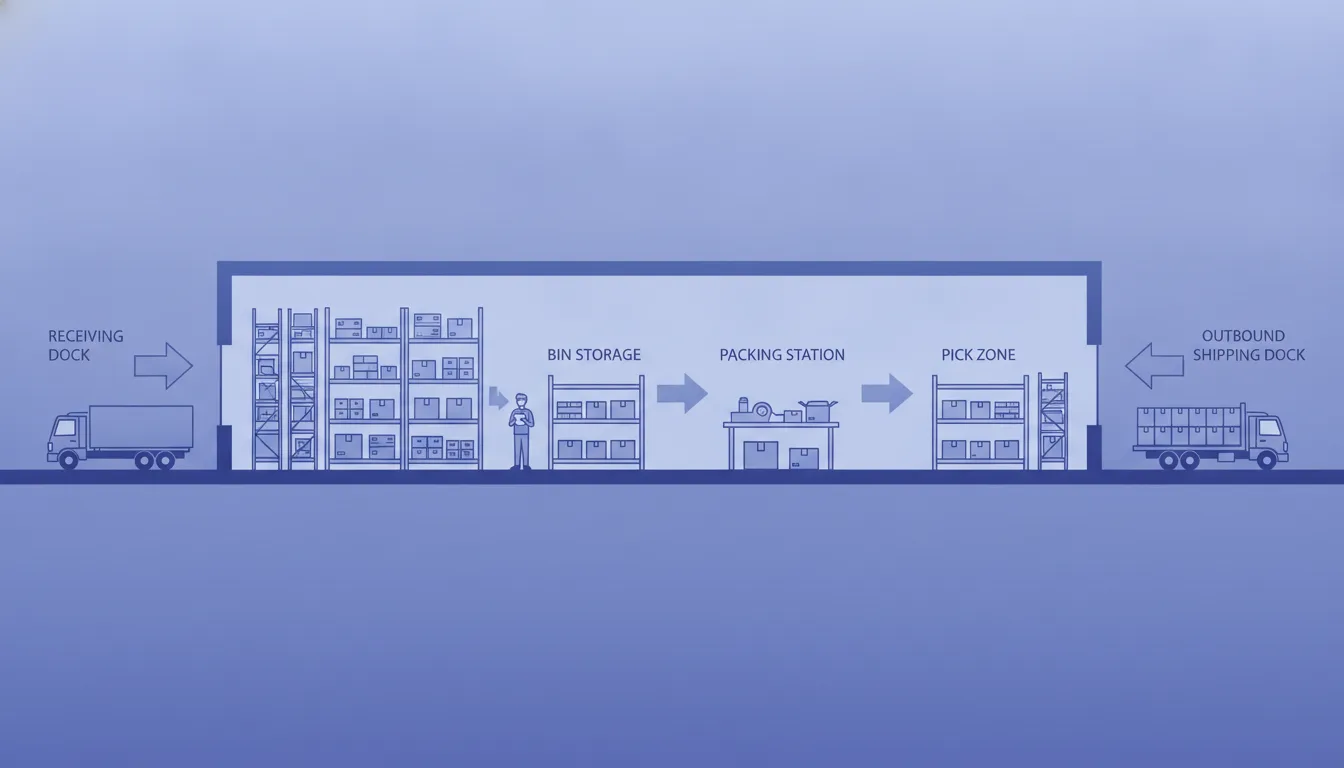
Receiving is the process of accepting, counting, inspecting, and booking your inventory into a warehouse management system (WMS). It is the first billable event in any fulfillment relationship and one of the most consequential: errors here propagate through every downstream step.
What happens in practice
- Your supplier or freight carrier delivers pallets or cartons to the fulfillment center dock.
- Warehouse staff count units against your advance shipping notice (ASN), a document you or your supplier sends ahead of the physical shipment.
- Staff scan barcodes and enter each SKU, quantity, and lot or expiry detail into the WMS.
- Any discrepancy (short shipment, damage, wrong SKU) is photographed and reported before inventory is put away.
- Units move to assigned bin locations and become available to fulfill orders, usually within one to two business days of receipt, depending on volume and complexity.
What your brand gets
Accurate real-time inventory counts from day one. Because YouParcel connects to Shopify, Amazon, and 70-plus other platforms, those counts sync directly to your storefronts, reducing oversell risk without manual reconciliation.
Receiving fees are typically quoted per pallet, per carton, or per hour. Charges spike when suppliers do not label cartons correctly or send without an ASN, so asking a potential partner about their ASN requirements before you sign is worthwhile.
Service Line 2: Warehousing and Storage
Storage fees cover the physical space your inventory occupies in an ecommerce fulfillment center. The most common billing models are per-pallet per month, per-bin per month, or cubic-foot per month.
Location and its effect on cost and speed
Fulfillment center geography directly affects both carrier cost and transit time. A brand shipping from a single East Coast location to a West Coast customer pays more and takes longer than one with split inventory. YouParcel operates warehouses in New Jersey, California, and Illinois, which means a brand can position fast-moving SKUs on the coast closest to the highest concentration of its customers.
YouParcel's publicly listed fulfillment center addresses are 20 Farinella Dr, East Hanover, NJ 07936 for the New York and New Jersey region and 3700 S. Riverside Ave, Rialto, CA 92324 for Southern California. The original flagship facility is in Saddle Brook, NJ.
Inventory carrying costs beyond the monthly fee
Long-term storage surcharges are common in the industry, particularly for SKUs that have not moved in 90 or 180 days. When you review a quote, look for the aging threshold, the surcharge rate, and whether the partner flags slow-moving inventory proactively so you can liquidate or consolidate before fees escalate.
Service Line 3: Pick and Pack
Pick and pack is the core labor function of order fulfillment services: a warehouse associate locates each item on an order (the pick), brings it to a packing station, places it in the appropriate packaging, and adds any required inserts or documentation (the pack). It is the service line with the most variability in how 3PLs price and execute it.
Pick methods and accuracy
Modern fulfillment centers use several picking strategies, including zone picking (associates stay in a fixed area), batch picking (pulling items for multiple orders in a single pass), and wave picking (coordinated release of order groups timed to shipping cutoffs). The method matters to you because it affects pick accuracy rates. Industry benchmark accuracy targets are typically 99.5 percent or higher; ask any prospective partner for their documented rate.
What affects your pick-and-pack fee
| Factor | Lower cost scenario | Higher cost scenario |
|---|---|---|
| Units per order | Single-unit orders | Multi-unit, multi-SKU orders |
| SKU count | Small, stable catalog | Large catalog with frequent new SKUs |
| Order volume | High, consistent daily volume | Highly seasonal or unpredictable spikes |
| Special handling | Standard poly mailer or box | Gift wrap, fragile items, inserts, serialization |
| Kitting required | No pre-assembly needed | Bundles assembled from components at pick time |
YouParcel supports kitting and assembly as part of its service mix, which matters for brands selling subscription boxes, promotional bundles, or retail-ready multipacks.
Service Line 4: Packaging and Materials
Packaging is often listed separately from pick-and-pack labor because materials carry their own cost and because packaging choices affect dimensional weight (DIM weight), which directly drives carrier charges.
Dimensional weight defined
Dimensional weight is a pricing technique used by major carriers that calculates a package's billable weight based on its size rather than its actual weight when the DIM weight exceeds the actual weight. The standard domestic DIM divisor used by FedEx and UPS is 139 (length x width x height in inches, divided by 139). A 12 x 10 x 8 inch box has a DIM weight of 6.9 lb. If the product inside weighs only 2 lb, you pay freight on 6.9 lb. Right-sizing packaging is one of the fastest ways to reduce outbound shipping costs.
Standard vs. custom packaging
Most 3PLs offer standard poly mailers, plain brown corrugated boxes, and bubble mailers from their own stock. Custom branded packaging, tissue paper, branded tape, and printed inserts are available but typically require minimum order quantities and a setup process. If brand presentation is a priority, confirm the partner's lead time for custom materials and how they handle reorder cycles before you run out of stock mid-peak season.
Service Line 5: Outbound Shipping
Shipping is where ecommerce fulfillment services connect to the customer experience. The fulfillment partner generates a shipping label, hands the parcel to a carrier, and transmits a tracking number back to your order management system and, ideally, directly to your customer.
Carrier mix and rate negotiation
YouParcel works with USPS, FedEx, DHL, Aramex, and EasyPost, among other carriers. A 3PL that aggregates volume across all its clients can often access rates a single brand could not negotiate independently. When comparing proposals, look at the all-in per-shipment cost (carrier charge plus any handling or label fee), not just the quoted carrier discount percentage.
International shipping from US fulfillment centers
YouParcel ships to 100-plus countries from its US fulfillment centers. International orders involve customs documentation, export compliance, and potentially import duties at the destination. Note that as of 2025, the US de minimis exemption that previously allowed low-value parcels to enter duty-free has been suspended, which affects cross-border flows in both directions. Brands shipping internationally should plan for duties and taxes as a standard part of the landed cost calculation, not an exception.
Real-time tracking
YouParcel provides real-time tracking and automated alerts so your customer service team and your customers have shipment visibility without manual lookup. This reduces inbound "where is my order" (WISMO) contacts, which typically represent 20 to 30 percent of ecommerce support volume according to industry surveys.
Service Line 6: Returns Processing (Reverse Logistics)
Reverse logistics describes the movement of goods from the customer back through the supply chain. For ecommerce brands, this means receiving returned parcels, inspecting them, grading condition, deciding on disposition (restock, refurbish, liquidate, or dispose), and updating inventory records. Returns processing is frequently underestimated at the contract stage and overcharged once volumes are live.
What a returns process line item should include
- Receipt and scan of the returned parcel at the fulfillment center.
- Inspection against your defined condition criteria (new, open-box, damaged).
- Disposition routing: restock to sellable inventory, quarantine for review, or removal.
- Inventory adjustment in the WMS and sync back to your sales channels.
- Exception reporting for items that arrive without a return merchandise authorization (RMA) or in unacceptable condition.
Some 3PLs charge a flat fee per return unit; others charge per action (receipt, inspection, restock each separately). Make sure the quote specifies which actions are included and what the per-unit cap is for inspection time before additional labor is billed.
YouParcel handles reverse logistics as part of its ecommerce fulfillment services, with disposition rules configured to match your brand's return policy. Learn more about the full service offering at YouParcel ecommerce fulfillment.
Service Line 7: Reporting, Business Intelligence, and Analytics
Reporting is not a bonus feature; it is the operational visibility layer that lets you manage inventory, forecast demand, and hold your fulfillment partner accountable. A quote that does not include reporting capabilities is a quote that hides performance problems.
Metrics a fulfillment partner should report on
| Metric | Why it matters to your brand |
|---|---|
| Order accuracy rate | Measures pick-and-pack error rate; drives return costs and customer satisfaction |
| On-time ship rate | Tracks whether orders leave the warehouse by the carrier cutoff for the promised delivery window |
| Inventory accuracy | Compares WMS counts to physical counts; catches shrinkage and mis-picks |
| Days of supply on hand | Helps you time replenishment orders and avoid stockouts |
| Return rate by SKU | Flags product quality or listing accuracy issues before they compound |
| Cost per order | Aggregates all fulfillment charges to show true unit economics |
YouParcel provides BI and analytics dashboards, and it integrates with Tableau and Salesforce for brands that consolidate reporting in their own systems. Connecting your fulfillment data to a broader analytics stack is straightforward through the YouParcel integrations platform, which supports 70-plus commerce, ERP, and analytics tools.
Additional Service Lines That Appear on Advanced Fulfillment Quotes
EDI compliance and retailer routing
Brands selling into wholesale or omnichannel retail channels often receive routing guides from large retailers specifying exact label formats, carton sizes, packing lists, and ship-window requirements. Non-compliance typically results in chargebacks. YouParcel supports EDI (electronic data interchange) and retailer compliance, including routing guide adherence and labeling requirements, for brands distributing to wholesale and retail accounts.
Freight forwarding
Some brands source inventory internationally and need help moving goods from a manufacturer to the fulfillment center. Freight forwarding covers ocean and air freight booking, customs brokerage coordination, and inland drayage. YouParcel offers freight forwarding as part of its logistics portfolio, which means fewer handoffs between vendors when your inbound supply chain and your domestic fulfillment are managed together.
Importer of record considerations
When goods cross into the US from abroad, a legal entity must act as the importer of record (IOR), taking responsibility for customs compliance and duty payment. YouParcel does not act as IOR. Brands typically use their own entity, their freight broker, or a licensed customs broker for this function. The US Customs and Border Protection importer guidance explains IOR obligations in detail.
How to Read a Fulfillment Quote: A Practical Checklist
- Confirm that receiving fees specify per-unit, per-carton, and per-pallet rates, and whether there is a minimum charge per inbound shipment.
- Identify the storage billing model (cubic foot, bin, or pallet) and the long-term storage aging threshold and surcharge rate.
- Check whether pick-and-pack fees include the first unit plus a per-additional-unit fee structure, which is standard, or a flat per-order rate, which favors low-unit orders.
- Confirm packaging materials are itemized separately so you can model DIM weight impact on carrier charges.
- Ask for the all-in carrier rate for your top two or three ship zones and package profiles, not just the discount percentage off a base rate.
- Verify returns processing specifies which actions are included at the base fee and what triggers additional labor charges.
- Confirm which reporting metrics are available in the WMS portal, which require custom configuration, and whether integration with your analytics tools is included or add-on.
- Ask about account management structure: is there a dedicated point of contact, and what are the SLAs for resolving discrepancies?
How YouParcel Structures Its Ecommerce Fulfillment Services
YouParcel's leadership brings 50-plus years of combined logistics experience to fulfillment operations that span warehouses in New Jersey, California, and Illinois. The platform handles 10,000-plus orders per day across multiple marketplaces and connects to Shopify, Amazon, Salesforce, Tableau, and 70-plus other tools out of the box.
For brands with complex requirements, including custom packaging programs, kitting, multi-channel retail distribution, international freight, or high-volume return flows, YouParcel builds custom solutions rather than forcing brands into a fixed service tier. Hands-on customer service and real-time tracking are included, not reserved for enterprise accounts.
YouParcel is also taking active steps toward carbon-neutral services, which matters to brands that publish sustainability commitments in their annual reporting.
The Council of Supply Chain Management Professionals (CSCMP) defines third-party logistics as "a firm which provides multiple logistics services for use by customers" and notes that these services are integrated rather than standalone functions. That integration is precisely what separates a true fulfillment partner from a warehouse that charges for space. You can review the CSCMP Supply Chain and Logistics Terms and Glossary for formal definitions of each service category discussed in this article.
Frequently Asked Questions
What is the difference between a fulfillment center and a warehouse?
A warehouse is a storage facility; a fulfillment center is a warehouse optimized for high-velocity order processing, including picking, packing, and same-day or next-day carrier handoff. Ecommerce fulfillment centers typically have more staff per square foot, more sophisticated WMS software, and shorter dwell times per unit than traditional storage warehouses.
How many fulfillment centers do I need for my ecommerce brand?
The answer depends on where your customers are concentrated and the transit-time commitment you make at checkout. A single well-located center covers most of the contiguous US in two to three business days via ground shipping. Brands with customers spread across both coasts typically benefit from at least two locations to balance speed and cost. YouParcel operates centers in New Jersey and California, and adding a second location is straightforward once your volume justifies the split inventory.
What does pick and pack cost for ecommerce orders?
Pick-and-pack pricing varies by 3PL, order profile, and volume. Most providers quote a base fee per order (covering labor for a single-unit pick) plus a per-additional-unit fee. Brands with higher volume, consistent daily order flow, and simple SKU sets typically negotiate lower per-order rates. For a quote based on your actual catalog and volume, reach out directly through a fulfillment partner's sales or expert consultation channel.
Can a fulfillment company handle both B2C and wholesale orders?
Yes, provided the 3PL supports EDI and retailer compliance in addition to standard ecommerce parcel shipping. B2C orders ship in individual consumer-facing parcels; wholesale or B2B orders ship in pallets or case packs with retailer-specific labels and documentation. YouParcel supports both channels, including routing guide compliance and EDI, which is essential for brands distributing to major retail chains.
How do I know if my current fulfillment partner is performing well?
Track four core metrics monthly: order accuracy rate, on-time ship rate, inventory accuracy percentage, and cost per order. If your partner cannot provide these numbers from their WMS, that absence is itself a performance signal. Benchmarks vary by category, but accuracy below 99 percent and on-time ship rates below 98 percent are worth investigating immediately.
Ready to map your specific fulfillment requirements to a service structure that works? Talk to an Expert at YouParcel to review your order profile, carrier mix, and growth plans with a logistics specialist.