


A 3PL provider agreement is a legally binding operations contract that governs order accuracy, shipping speed, inventory ownership, liability limits and the conditions under which either party can exit the relationship. Reviewing these terms carefully before signing protects your brand from service failures, unexpected charges and difficult transitions. YouParcel recommends that any brand evaluating 3PL services treat the contract review as seriously as the pricing negotiation.
- SLA metrics define measurable performance floors for order accuracy, ship speed and damage rates; get them in writing before you sign.
- Liability clauses cap what the 3PL owes you for lost or damaged inventory; negotiate realistic limits tied to your actual cost of goods.
- Inventory shrink terms set who bears the cost of missing stock and at what threshold the 3PL is responsible.
- Exit clauses determine how long you are locked in, what notice is required and how your inventory is returned or transferred.
Why the 3PL Contract Deserves as Much Attention as the Rate Card
Most brands spend hours comparing per-pick fees and storage rates, then skim the master service agreement. That order of priorities often reverses itself after the first major service failure. The rate card tells you what you will pay in a perfect scenario. The contract tells you what happens when things go wrong, and in logistics, things do go wrong. Carriers miss pickups. Warehouse systems miscount cycle counts. Staff errors create chargebacks from retail partners. The contract is the rulebook for all of it.
The Council of Supply Chain Management Professionals (CSCMP) defines a third-party logistics provider as a firm that provides multiple logistics services, ideally integrated and managed together, on behalf of a client. That integrated relationship means the 3PL touches your inventory, your customer data and your carrier accounts simultaneously. A well-drafted agreement protects your interests across all three areas.
Section 1: Service Level Agreements (SLAs) Every 3PL Contract Should Include
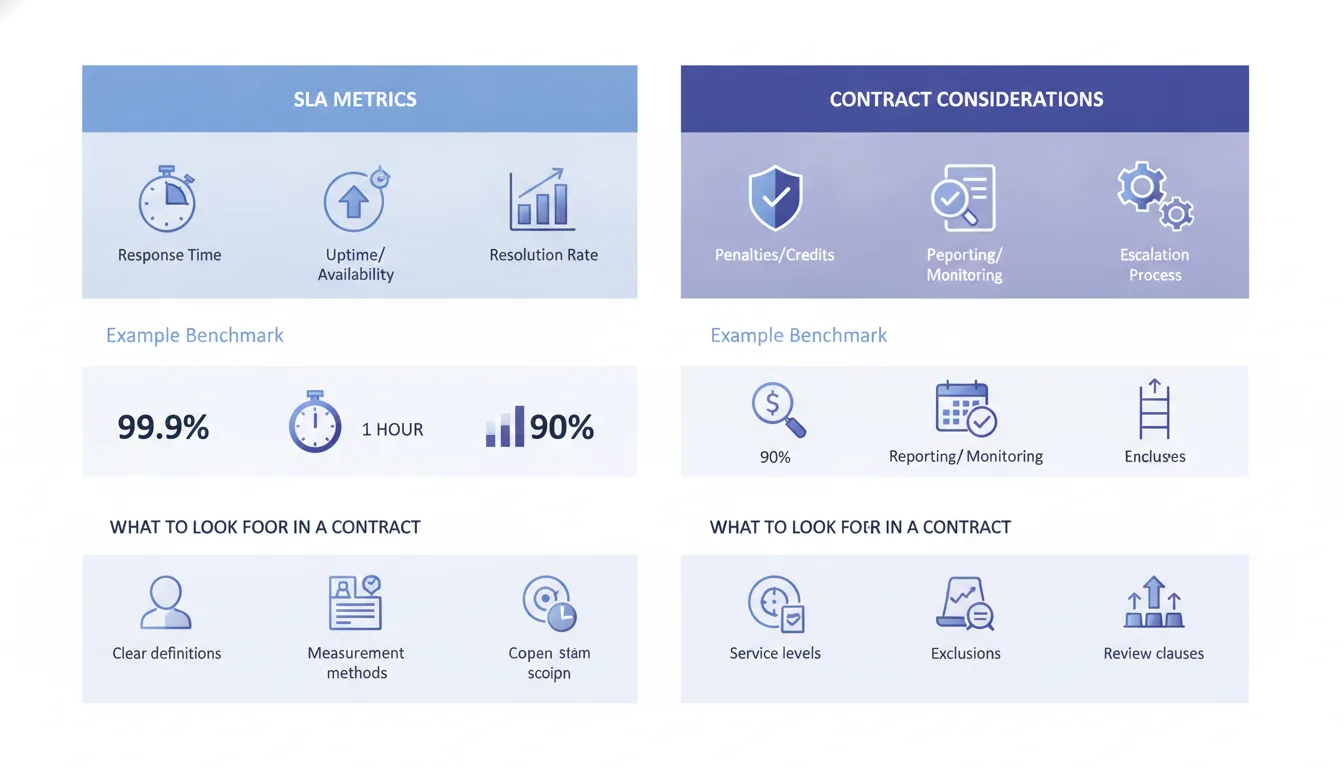
An SLA, or service level agreement, is the portion of the contract that defines measurable performance commitments. It converts vague promises into enforceable standards. When a 3PL logistics service agreement lacks specific SLAs, the provider has no contractual obligation to perform at any particular level.
Order accuracy rate
Order accuracy measures the percentage of outbound shipments that contain the correct items, quantities and packaging. Industry benchmarks for well-run fulfillment operations typically range from 99.5 percent to 99.9 percent. If a 3PL will not commit to a floor in writing, treat that hesitation as a signal. Your SLA should specify: the measurement period (weekly or monthly), how accuracy is calculated (units shipped correctly divided by total units shipped), and what remedies apply when the rate falls below the floor, such as a credit per mis-pick or a right to audit.
Ship-on-time rate and order cutoff windows
Ship-on-time rate is the percentage of orders shipped by the carrier pickup deadline on the same business day they were received before the order cutoff. Typical cutoff windows in fulfillment centers run between noon and 3 p.m. local time for standard processing. Your SLA should state the cutoff time explicitly, the ship-on-time rate floor (commonly 98 percent or above for high-volume operations), and whether that rate applies to all orders or only to orders received before cutoff.
Receiving turnaround time
Receiving turnaround is the time between a carrier delivering inbound freight to the warehouse dock and that inventory becoming available for picking in the warehouse management system (WMS). Delays here directly slow your ability to fulfill orders from new purchase orders or replenishment shipments. A reasonable SLA commits to a specific receiving window, commonly 24 to 48 business hours for standard palletized goods, with a longer window for items requiring labeling, kitting or inspection.
Damage and loss rate
This metric tracks the percentage of units damaged or lost within the warehouse environment, excluding carrier transit damage. Separate it from carrier transit claims in the contract so accountability is clear. Your SLA should define how damage is reported, what documentation is required and within what timeframe a claim must be filed.
Returns processing time
For any brand running ecommerce or DTC operations, returns are a core workflow, not an exception. The SLA should specify how quickly returned units are received, inspected and graded (restockable, refurbish, destroy), and how those dispositions are reflected in your inventory reporting. A common benchmark is 48 to 72 business hours from carrier delivery to disposition complete.
Reporting and visibility commitments
SLAs are only useful if you can measure them. Require the contract to specify reporting frequency (daily, weekly, monthly), the format of reports (portal dashboard, email, data export), and which metrics are included. If the 3PL integrates with your Shopify store, Amazon Seller Central or ERP, the agreement should also define the uptime commitment for those integrations and who is responsible for maintaining them when a marketplace API changes.
SLA remedies and measurement methodology
An SLA without a remedy is a wish list. For each metric, negotiate a clear consequence for underperformance. Common remedies include service credits (a percentage reduction in that month's invoice), a right to terminate for cause if the metric is missed for two or more consecutive periods, or a required remediation plan with a response deadline. Ensure the methodology for calculating each metric is written into the contract, not left to the 3PL's internal discretion.
Section 2: Liability Clauses and What They Really Mean
Liability in a 3PL contract defines the financial ceiling for what the provider owes you when something goes wrong. Almost every standard 3PL services agreement includes limitations of liability. The question is not whether limits exist; it is whether those limits are set at a level that actually covers your exposure.
Standard liability limitation language
Most 3PL provider contracts limit liability to the lesser of: (a) the actual replacement cost of the goods, or (b) a fixed dollar amount per unit, per pallet or per event, such as $0.50 per pound or $100 per occurrence. These defaults are often drawn from old warehouse legal standards like the Uniform Commercial Code or legacy carrier tariff language. They are almost always too low for branded goods or high-SKU-count ecommerce catalogs. Negotiate limits based on your actual cost of goods sold (COGS), not arbitrary weight-based formulas.
Consequential damages waivers
Nearly all 3PL contracts include a mutual waiver of consequential damages, meaning neither party can sue the other for lost profits, lost customers or downstream business harm. This is standard and largely unavoidable. What you can do is ensure the direct damages cap is high enough to cover your real exposure, and separately negotiate for specific remedies (like expedited re-shipment at the 3PL's cost) that sit outside the general liability cap.
Carrier vs. warehouse liability
Draw a clear line in the contract between warehouse liability (damage or loss while goods are in the 3PL's custody on the warehouse floor) and carrier liability (loss or damage after the carrier takes possession). Carrier claims are governed by the Carmack Amendment for domestic freight in the U.S., and by individual carrier tariffs for small parcels. Your 3PL agreement should specify who files carrier claims, who receives the proceeds and within what timeframe you must report a carrier loss to the 3PL so it can file on your behalf.
Insurance requirements
Require the 3PL to carry and maintain, at minimum, commercial general liability (CGL) insurance, workers compensation coverage and cargo or warehouse legal liability insurance. Ask for certificate of insurance (COI) naming your company as an additional insured. Review the coverage limits and renewal requirements annually. Also confirm whether the 3PL's cargo policy covers your goods on a declared value or replacement cost basis, and what the per-occurrence and aggregate limits are.
Section 3: Inventory Shrink Terms
Inventory shrink is the discrepancy between the inventory quantity the 3PL's WMS shows on hand and the quantity physically present after a cycle count or full physical inventory. Shrink happens due to mis-picks, mislabeling, theft, damage write-offs and system errors. The contract needs to address three specific questions: how shrink is measured, what shrink rate triggers 3PL financial responsibility, and how reimbursement is calculated.
Cycle count schedules and physical inventory
A cycle count is a rolling physical audit of a subset of SKUs conducted on a scheduled basis, typically covering the full inventory over a quarter or fiscal year. The contract should define the cycle count frequency, the method (ABC analysis, random or location-based), who bears the cost of the count and how results are reconciled against the WMS. For brands with high-value SKUs, quarterly full physical inventory audits are worth negotiating, even if the 3PL charges a fee for them.
Shrink thresholds and responsibility
Most 3PL logistics service agreements include a shrink allowance, a percentage of total inventory value below which the 3PL bears no financial responsibility for missing units. A common range is 0.1 percent to 0.5 percent of total inventory value per year. Any shrink above the agreed threshold should trigger 3PL reimbursement at your stated cost of goods, not the retail price. Negotiate the threshold down as low as the 3PL will accept, and tie it to a specific SKU-level reconciliation process rather than an aggregate inventory value calculation, which can mask localized losses.
Proof of loss and audit rights
Include an explicit right to audit clause. This gives you the contractual right to send your own team, or a third-party auditor, into the warehouse to conduct an inventory count at a specified notice period (commonly 48 to 72 hours). Without this clause, you are dependent entirely on the 3PL's own count data to substantiate a shrink claim, which creates an obvious conflict of interest.
Section 4: Exit Clauses and Transition Terms
Exit terms are the most negotiated and most ignored section of a 3PL contract. Brands focus heavily on setup and go-live, and give little thought to what leaving looks like. That changes when a relationship deteriorates and you realize you are locked in for another eight months with no clear path to migrating your inventory.
Contract term and auto-renewal
Initial contract terms for 3PL services typically run 12 to 36 months. Many agreements include automatic renewal clauses that roll the contract over for another full term unless you provide written notice of non-renewal within a specific window, often 60 to 90 days before the end of the term. Set a calendar reminder the day you sign. Missing the non-renewal window can cost you an entire additional contract year at existing rates, even if you have already selected a new provider.
Termination for cause vs. termination for convenience
Termination for cause allows either party to exit the contract early without penalty if the other party materially breaches the agreement, for example, by missing SLA thresholds for multiple consecutive periods. Termination for convenience allows you to exit early without a material breach, but typically requires a notice period (30 to 90 days) and may include an early termination fee. Negotiate both provisions carefully. Ensure your SLA remedies are written in a way that creates a clear path to termination for cause, so you are not forced to pay a convenience fee to exit a genuinely underperforming relationship.
Inventory return and transition timelines
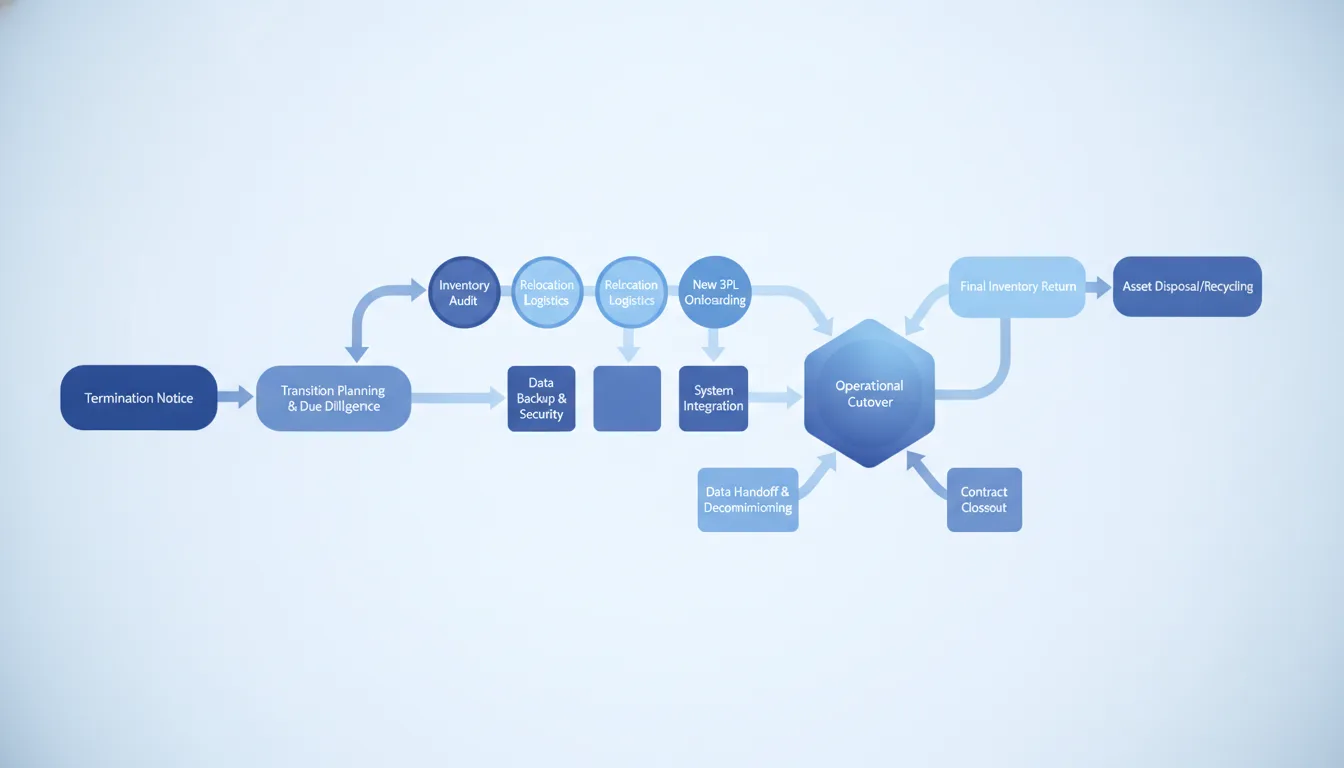
The exit clause should specify the maximum number of business days the 3PL has to return your inventory after notice of termination, the cost responsibility for outbound freight during the return (typically yours, but negotiable), and the format of the final inventory reconciliation report. For brands with multiple product lines or hazmat items, additional exit logistics may apply. Build in a contractual obligation for the 3PL to cooperate with your incoming provider during the transition period, including sharing system access and providing inventory feeds in a standard format such as CSV or EDI 846.
Data portability and system access
At contract end, you need your data back in a usable format. The contract should specify that order history, inventory records, receiving logs and returns data are yours, that you can export them in a standard format and that the 3PL will maintain read-only portal access for a defined period after your last shipment, commonly 30 to 90 days, to support your own records and any carrier claims in process.
Outstanding financial obligations at exit
Confirm how outstanding storage charges, accessorial fees and disputed invoices are handled at exit. Some contracts require full payment of all outstanding balances before the 3PL will release inventory. If there are billing disputes under review, the contract should specify a dispute resolution process that does not block your inventory return. A lien or hold-on-inventory clause that allows the 3PL to retain your goods for unpaid invoices is common; negotiate a threshold below which the hold does not apply, and require any lien to be subordinate to a bona fide billing dispute process.
Additional Contract Clauses Worth Reviewing
Force majeure and pandemic-era carve-outs
Force majeure clauses excuse performance during events outside a party's control: natural disasters, government orders, labor strikes and similar disruptions. Review the clause to understand whether pandemic-related shutdowns, port strikes or carrier embargoes are included or excluded, and what notice obligations apply. Some post-2020 agreements include carve-outs that narrow the definition significantly. You want clarity on whether the 3PL's SLAs are suspended during a force majeure event and for how long.
Confidentiality and data security
Your 3PL handles your customer order data, shipping addresses and potentially your product catalog pricing. The agreement should include a non-disclosure provision covering your proprietary business information and a data security clause requiring the 3PL to maintain reasonable security controls, notify you within a defined period (commonly 72 hours) of a data breach and indemnify you for losses resulting from the 3PL's security failures.
Minimum volume commitments
Some 3PL contracts include monthly minimum volume commitments, expressed as a minimum number of orders, units or storage pallets. If your actual volume falls below the minimum, you pay a shortfall fee. These clauses protect the 3PL's revenue projections but create downside risk for brands with seasonal demand or rapid growth trajectories in either direction. If minimums are unavoidable, negotiate a seasonal adjustment mechanism or a ramp period during onboarding before minimums apply.
Technology and integration terms
If your 3PL integrates with your Shopify store, Amazon Seller Central or other platforms, the contract should address who owns the integration build, who maintains it when the platform API changes and what the uptime commitment is. For enterprise brands using EDI with retail partners, confirm that the 3PL's EDI capabilities, including transaction sets like the 856 ASN (advance ship notice) and 810 invoice, are documented in scope within the agreement, not left as verbal commitments.
For more on what enterprise-scale fulfillment operations require from a technology and compliance standpoint, see how YouParcel's enterprise solutions approach multi-channel integration and retailer compliance.
How to Evaluate a 3PL Provider Before You Sign
Contract terms only matter if the 3PL can actually perform. Before you reach the negotiation stage, assess the provider's operational infrastructure, technology stack, carrier relationships and geographic coverage relative to your customer base. A 3PL with warehouse locations close to your highest-density shipping zones reduces both transit times and carrier costs.
Ask for references from brands in your product category, request a facility tour and review the 3PL's carrier portfolio. A well-connected provider will work with USPS, FedEx, DHL and regional carriers, giving you rate flexibility and service redundancy rather than dependence on a single carrier contract.
Look at how long the leadership team has been in operations. Experience in fulfillment is measurable in how a team handles exceptions: damaged freight, a carrier strike, a compliance chargeback from a major retailer. A provider whose leadership has decades of combined experience handles exceptions differently than one building processes from scratch.
To understand the full scope of what a fulfillment partnership involves beyond the contract, the YouParcel fulfillment services overview covers the operational workflows, technology integrations and carrier options that should be reflected in any agreement you sign.
A Practical Negotiation Checklist
Use the following checklist when reviewing a 3PL services agreement. Not every item will apply to every brand, but each should be consciously evaluated before signing.
| Contract Section | What to Confirm | Red Flag if Missing |
|---|---|---|
| Order accuracy SLA | Specific floor percentage, measurement method, remedy for breach | No numeric commitment in writing |
| Ship-on-time SLA | Cutoff time, rate floor, measurement period | No cutoff time defined |
| Receiving turnaround SLA | Hours to availability in WMS, exceptions for special handling | No receiving timeline commitment |
| Liability cap | Based on COGS, not weight; per-unit and per-event limits | Weight-based formula only |
| Inventory shrink | Allowance threshold, SKU-level reconciliation, audit rights | No audit right clause |
| Carrier vs. warehouse liability | Clear handoff point, claims filing responsibility | Ambiguous custody language |
| Insurance | COI with your company as additional insured, cargo coverage limits | No COI provision |
| Contract term and auto-renewal | Initial term length, non-renewal notice window | Auto-renewal with no notice window |
| Termination for cause | SLA miss triggers, cure period, no early termination fee | Termination for cause not defined |
| Inventory return at exit | Timeline, freight cost responsibility, final reconciliation format | No timeline specified |
| Data portability | Export format, post-termination portal access period | No data return provision |
| Minimum volume | Monthly minimums, shortfall fees, ramp period | No ramp or seasonal adjustment |
| Force majeure | Scope of events covered, SLA suspension rules, notice requirements | No notice obligation on 3PL |
| Data security and breach notice | Security standards, 72-hour breach notice, indemnification | No breach notification requirement |
Frequently Asked Questions
What SLA metrics should I require in a 3PL provider contract?
At a minimum, require numeric commitments for order accuracy rate, ship-on-time rate, receiving turnaround time and damage or loss rate. Each metric should include a defined measurement method, a performance floor and a stated remedy if the 3PL misses the floor for two or more consecutive periods.
How is liability for lost inventory typically handled in a 3PL agreement?
Most standard 3PL contracts cap liability at a fixed amount per pound or per occurrence, which is often far below the actual value of your goods. Negotiate a liability limit based on your actual cost of goods sold, and separate warehouse liability from carrier transit liability so accountability is clear for each loss scenario.
What is a reasonable inventory shrink allowance in a 3PL services agreement?
Shrink allowances typically range from 0.1 percent to 0.5 percent of total annual inventory value, below which the 3PL bears no financial responsibility for missing stock. Push for the lower end of that range, require SKU-level reconciliation rather than aggregate value calculations and negotiate an explicit right to conduct your own physical audit.
What should I look for in a 3PL contract exit clause?
Key exit provisions include the contract term length, the auto-renewal notice window, a termination for cause pathway tied to SLA failures, a maximum timeline for inventory return after notice, a final inventory reconciliation report and a post-termination data access period of at least 30 days.
Can I negotiate a 3PL contract even if the provider offers a standard template?
Yes. Standard templates are starting points, not final documents. Most 3PL providers expect negotiation on liability caps, SLA metrics, shrink thresholds, minimum volume commitments and exit terms. The willingness of a provider to negotiate these terms is itself a signal of how they will handle disputes during the relationship.
Reviewing a 3PL logistics service agreement thoroughly before signing takes time, but it is far less costly than discovering your contract offers no real recourse when accuracy rates slip or inventory goes missing. If you are evaluating fulfillment partners and want to understand how operational standards translate into contract language, talk to a YouParcel fulfillment expert to get your questions answered before you commit.