


Amazon FBA USA is the dominant way for UK sellers to reach American shoppers, but shipping every unit straight from the UK into Amazon's fulfillment network is expensive, inflexible and increasingly risky. A smarter model holds reserve inventory in a US third-party logistics (3PL) warehouse, preps and labels stock to Amazon's exact standards at that facility, and replenishes FBA in smaller, controlled shipments. YouParcel operates warehouses in New Jersey and California and handles FBA prep daily for international brands doing exactly this.
- Sending stock straight to FBA from the UK means you pay trans-Atlantic freight on every unit, including slow movers and seasonal lines you may have to remove later.
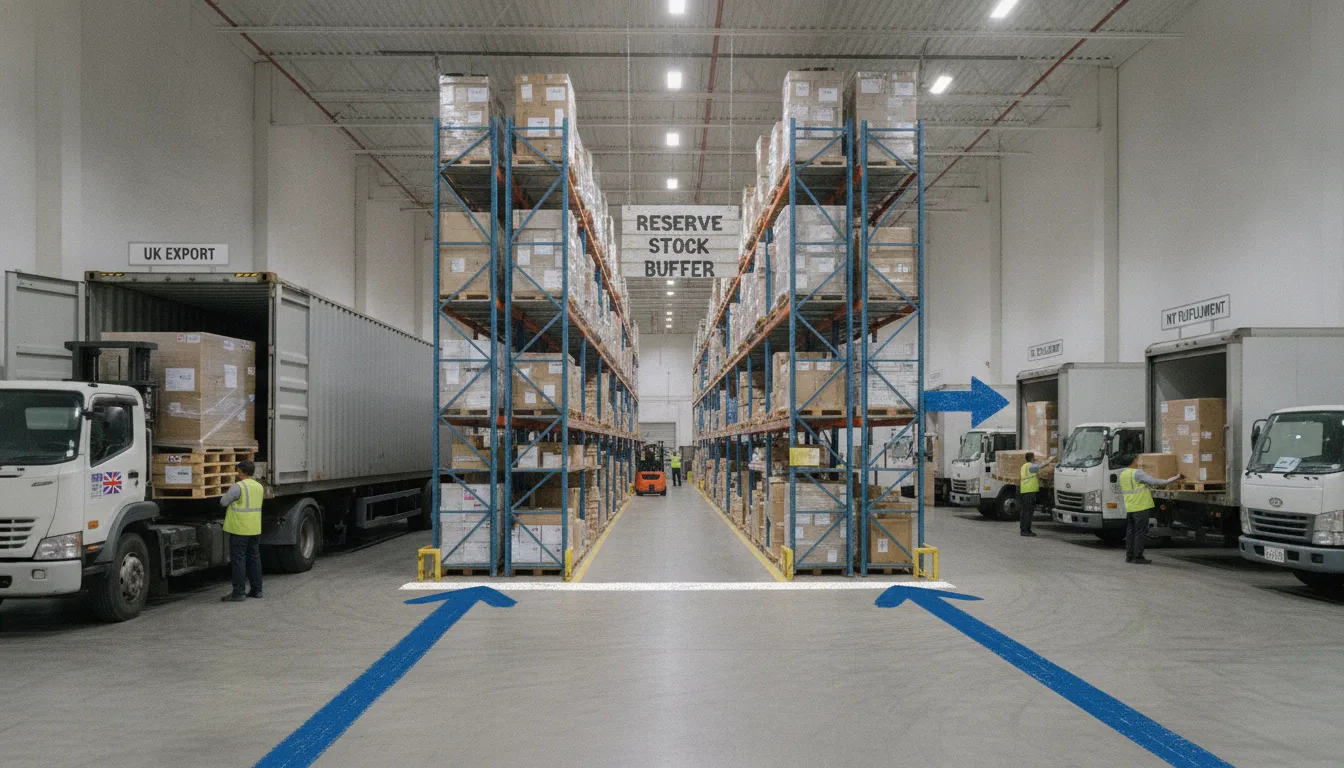
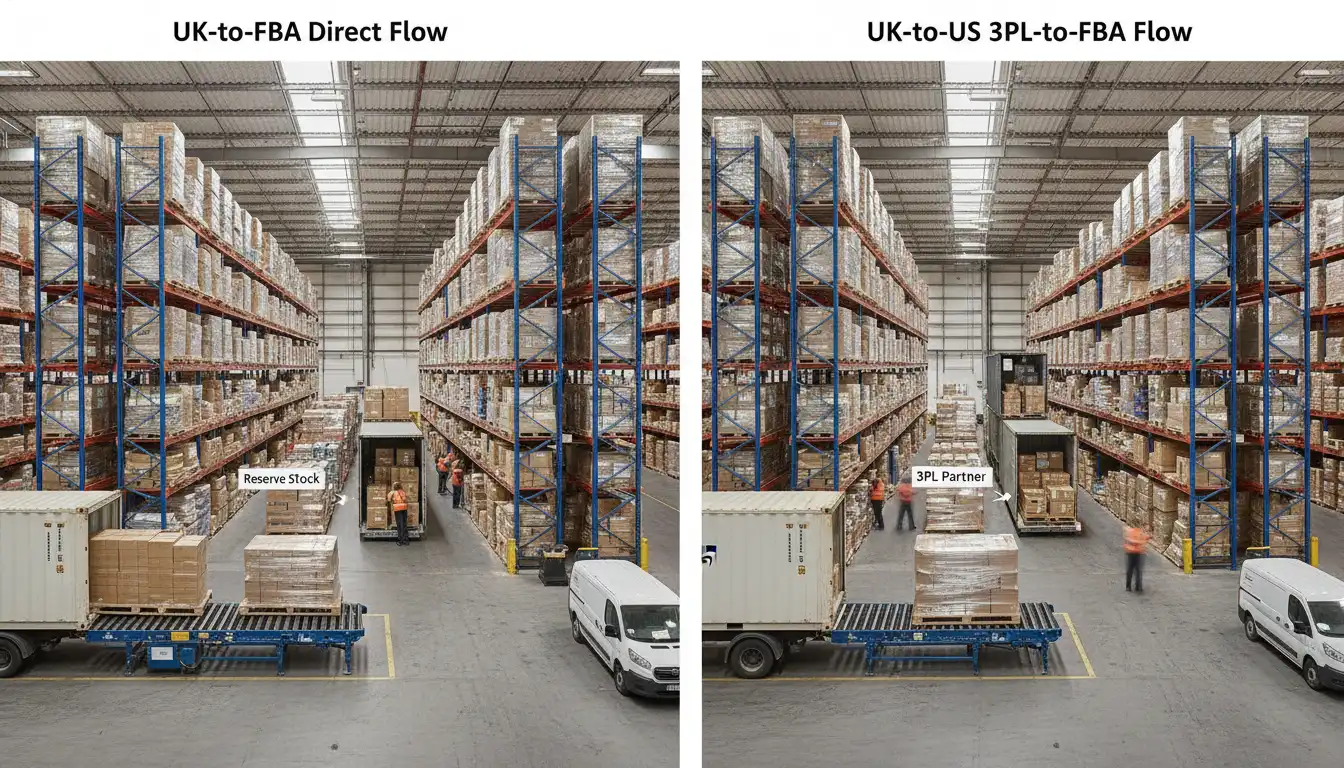
- A US 3PL acts as a buffer: you import one larger ocean or air shipment, store reserve inventory domestically, and drip inventory into FBA only when Amazon needs it.
- YouParcel's FBA prep service covers FNSKU labeling, poly-bagging, bubble-wrap, case-pack rebuilds and pallet building to meet Amazon's inbound shipment requirements.
- This model gives UK sellers predictable landed costs, faster replenishment cycles and protection against FBA restock limits or capacity restrictions.
Why the straight-to-FBA model breaks down for UK sellers
Many UK brands start by air-freighting stock directly into an Amazon fulfillment center. It works at low volume. As the business grows, the model creates three specific problems.
FBA capacity limits force you to hold stock somewhere
Amazon's Inventory Performance Index (IPI) and its FBA storage limits mean you cannot simply send unlimited units to Amazon and forget about them. Amazon can and does restrict how much inventory a given seller can hold across its fulfillment centers. If your IPI score falls below Amazon's threshold (typically 400 as of early 2026, though Amazon adjusts this), you face storage limits that can leave units stranded at your UK warehouse with no route into the US market. Holding a buffer in a US 3PL warehouse decouples your Amazon position from your total inventory position.
Amazon publishes current IPI thresholds and storage limit policies directly in Seller Central Help: Manage Your Inventory Performance.
Trans-Atlantic freight on small replenishments is disproportionately costly
Air freight from the UK to the US is priced per kilogram or per dimensional weight, whichever is greater. The dimensional weight divisor for most air carriers is 6,000 (metric: cubic centimeters divided by 6,000 equals volumetric kilograms). A box measuring 50 cm x 40 cm x 30 cm has a volumetric weight of 10 kg. If your product weighs 4 kg actual, you pay for 10 kg. Sending 20 units at a time to top up Amazon stock is expensive relative to consolidating a larger shipment and replenishing from a US location.
Since August 2025, low-value parcels no longer enter the US duty-free
The US de minimis exemption that previously allowed shipments valued under $800 to enter duty-free was suspended in 2025. Every commercial import now incurs duties and fees at the border regardless of value. That changes the per-unit economics of sending small replenishments directly from the UK and makes a consolidated import into a US warehouse followed by domestic FBA replenishment the more cost-effective route. For a detailed breakdown of the de minimis change and its implications for UK exporters to the US, UK Export Finance and the Department for Business and Trade publish guidance on US import rules relevant to UK exporters.
The US warehouse plus FBA replenishment model: how it works
The workflow below is what YouParcel's UK brand clients follow. Each step is sequential; skipping one typically causes delays or Amazon receiving errors.
- Consolidate and freight from the UK. Combine multiple SKUs into one ocean freight (FCL or LCL) or air consolidation shipment from your UK supplier or UK warehouse. One import customs entry covers the whole shipment, which is more efficient than multiple small entries. Your freight forwarder files the Importer Security Filing (ISF) at least 24 hours before loading, as required by US Customs and Border Protection.
- Clear US customs. You need a licensed customs broker to file your import entry and pay applicable duties and fees. YouParcel's freight team can coordinate this, but note that YouParcel does not act as importer of record (IOR). The IOR must be a US-based legal entity or, for foreign companies, a customs broker or a third party that agrees to take on IOR responsibility. Your customs broker can advise on the correct IOR arrangement for your business structure.
- Receive into the YouParcel US warehouse. Inventory arrives at YouParcel's East Hanover, NJ facility (20 Farinella Dr, East Hanover, NJ 07936) or the Rialto, CA facility (3700 S. Riverside Ave, Rialto, CA 92324), depending on where your stock should be positioned relative to Amazon's preferred receiving centers. Your inventory is logged by SKU and unit count in YouParcel's warehouse management system, which integrates with Amazon Seller Central and 70+ other platforms.
- Create your FBA inbound shipment plan in Seller Central. Log into Seller Central, use the Send to Amazon (StA) workflow, and generate your shipment plan. Amazon will assign specific fulfillment centers and issue shipping labels for each box or pallet. Download these and send them to YouParcel ahead of the prep work.
- FBA prep at the YouParcel warehouse. The YouParcel team applies FNSKU labels (printed from your Seller Central account) to each unit, poly-bags items that require it (Amazon requires poly-bagging for any item that could be lost, damaged or contaminated without a bag, including soft goods, shoes and plush items), applies suffocation warnings where required, adds bubble wrap or protective packaging for fragile items, and builds case packs to the quantity confirmed in your shipment plan. Mixed-SKU boxes are separated; Amazon will reject a shipment where units in a case pack do not match the declared ASIN.
- Build pallets or prepare boxes for LTL or small-parcel delivery to Amazon. For pallets, Amazon requires a standard 40 x 48 inch GMA pallet, stretch-wrapped, with shipment labels on all four sides. Box shipments go via small-parcel carriers. YouParcel arranges carrier pickup and provides tracking so you can confirm receipt in your Seller Central shipment dashboard.
- Replenish in batches, not all at once. Keep the remaining reserve stock at the YouParcel warehouse. When your FBA days-of-supply drops toward your reorder point, initiate another shipment plan and YouParcel preps and ships the next batch. This keeps your IPI score healthy by avoiding excess inventory flags while ensuring you never go out of stock.
What FBA prep actually involves: Amazon's requirements in detail
Amazon's inbound compliance requirements are strict. A non-compliant shipment can be refused at the fulfillment center, checked in with a defect, or result in a prep fee charged back to your account. Below is a reference table covering the most common prep categories.
| Product type | Amazon prep requirement | Common failure mode |
|---|---|---|
| Loose products (no retail packaging) | Poly bag with suffocation warning; bag opening must be 5 inches or smaller OR bear a warning label | No suffocation warning; bag too thin (must be at least 1.5 mil) |
| Products sold as sets (e.g. multipack) | Each set bagged or banded together; label reading "Sold as set, do not separate" | Individual units not identified as part of a set; Amazon staff separate them |
| Fragile items | Bubble wrap or foam; drop-test standard: 3 ft on all 6 faces without damage | Insufficient padding; items shift inside box during transit |
| Expiry-dated products (food, supplements, cosmetics) | Expiry date on outer packaging in MM/YYYY or MM/DD/YYYY format; must be legible without removing packaging | Date obscured by label; format not recognized by Amazon scanners |
| Shoes and footwear | Poly bag or box; "This is a complete unit" label; no loose items in the box | Shoelaces or insoles loose in the outer poly bag |
| Liquids (non-hazmat) | Sealed with cap secure; secondary containment bag; "This side up" label if applicable | Cap not torque-tested; no secondary containment |
| Case packs | All units in a box must be the same ASIN; case quantity must match the shipment plan | Mixed ASINs in one box; actual count differs from declared quantity |
Amazon's full prep requirements are documented in Seller Central Help: Packaging and prep requirements. Requirements change; always verify against Seller Central before a shipment run.
Choosing between the East Hanover NJ and Rialto CA warehouses
Where you position your US reserve stock affects both your replenishment lead time and your Amazon inbound freight cost. Amazon's fulfillment network is split across regions; the closer your 3PL warehouse is to the Amazon FC assigned in your shipment plan, the lower your inbound carrier cost and the shorter your transit time from prep to live inventory.
| Facility | Address | Best suited for | Amazon FC proximity |
|---|---|---|---|
| East Hanover, NJ | 20 Farinella Dr, East Hanover, NJ 07936 | Brands with strong East Coast and Midwest US sales; Amazon FCs in NJ, PA, CT, NY | Short ground transit to major Northeast FCs; same-day LTL pickup available |
| Rialto, CA | 3700 S. Riverside Ave, Rialto, CA 92324 | Brands with West Coast and Southwest US sales; Amazon FCs in the Inland Empire, Phoenix, Las Vegas corridors | Within the Southern California Amazon FC cluster; ground replenishment is fast and low-cost |
Many UK brands with significant US volumes split inventory across both locations, using YouParcel's multi-warehouse inventory visibility to monitor stock levels at each site and decide where to replenish first.
How the economics compare: direct-to-FBA vs. US warehouse buffer
The numbers below are illustrative; actual costs depend on your product dimensions, weight, freight terms, duty rates and Amazon storage tier. The purpose is to show the structure of the comparison, not to guarantee any specific saving.
| Cost element | Direct UK-to-FBA | UK to US 3PL, then FBA replenishment |
|---|---|---|
| Trans-Atlantic freight | Paid on every replenishment, including small top-ups | Paid once per consolidated shipment; lower per-unit rate on larger volumes |
| Customs entry and duties | One entry per shipment; duties paid on each import event | One entry per consolidated import; duties paid once on arrival |
| FBA inbound freight (domestic leg) | International carrier hands off to Amazon; rates vary | Short domestic ground or LTL move from US warehouse to FC; lower cost per unit |
| FBA long-term storage fees | High if you over-send to avoid stockouts | Lower: you send only what Amazon needs; reserve stock held at 3PL rates |
| Stockout risk | High if trans-Atlantic lead time is 4 to 6 weeks | Low: domestic replenishment from US warehouse in days, not weeks |
| Flexibility (SKU changes, removals) | Low: changing a SKU mid-shipment requires a new trans-Atlantic order | High: rework, relabeling or holding a SKU back is done at the 3PL before it enters Amazon |
Setting up the integration: connecting Seller Central to YouParcel
YouParcel integrates directly with Amazon Seller Central. Once connected, your inventory at the YouParcel warehouse is visible alongside your FBA inventory, giving you a single view of total US stock. You can trigger replenishment workflows from within the integration, and YouParcel's system updates your shipment status as prep and outbound steps are completed.
Beyond Amazon, YouParcel connects with Shopify, Salesforce, Tableau and 70+ other platforms. For UK brands running their own DTC site alongside Amazon US, this means the same US warehouse serves both channels: DTC orders ship direct to the US customer, and FBA replenishments ship into Amazon's network from the same reserve stock pool.
Learn more about how the full fulfillment service works on the YouParcel ecommerce fulfillment services page.
What to send to the US warehouse vs. what to keep back
Not every SKU in your range belongs in a US 3PL warehouse on day one. A practical allocation approach for UK sellers entering or scaling Amazon US:
- Core, proven ASINs with consistent US velocity: Send 60 to 90 days of forward demand based on your Amazon sales velocity report. These are the SKUs where a stockout directly costs you rank and Buy Box position.
- New or unproven ASINs: Send a smaller test quantity, perhaps 30 days of estimated demand, until the sales velocity is established. Holding too much of an unproven SKU in the US ties up cash and can attract FBA storage fees.
- Seasonal or promotional lines: Time the inbound shipment to arrive at the US warehouse 3 to 4 weeks before the anticipated Amazon replenishment date, allowing for FBA prep and transit time to the FC. For Q4 peak, Amazon typically tightens inbound receiving windows in October and November; plan your US warehouse inbound accordingly.
- Oversize and heavy items: Amazon charges higher FBA fees for oversize items. Assess whether FBA or Amazon Multi-Channel Fulfillment (MCF) from a 3PL is more cost-effective for items exceeding Amazon's standard size tier (longest side over 18 inches, or weight over 20 lb).
Managing returns from US customers back into sellable stock
FBA handles returns automatically, but Amazon's grading of returned units is not always accurate and its removal fees add up. A common practice for UK sellers is to request removal orders for returned units and have them sent to the YouParcel US warehouse rather than back to the UK. YouParcel can inspect, regrade and repack units that are in sellable condition and return them to FBA, or hold them for liquidation or disposal. This keeps your returns loop domestic and avoids the cost and complexity of shipping customer returns across the Atlantic.
For a deeper look at FBA prep specifics and the prep checklist UK sellers need before their first US shipment, see the complete guide to shipping to Amazon FBA.
Frequently asked questions
Do I need a US company to sell on Amazon US from the UK?
No. Amazon allows non-US entities to sell on Amazon.com. You will need a US bank account or a supported payment account, a valid tax identity (an Individual Taxpayer Identification Number or an Employer Identification Number is often required for tax reporting), and a customs arrangement for imports. Speak with a US customs broker and a tax adviser familiar with US sales tax obligations before you begin.
How long does FBA prep take at a US 3PL warehouse?
Standard FBA prep at YouParcel typically completes within 1 to 3 business days of your inventory being received and checked in, depending on the volume and prep complexity. Batches requiring extensive kitting, relabeling or case-pack rebuilds may take slightly longer. Plan this lead time into your replenishment schedule so you are not cutting it close on FBA stock levels.
What is the minimum volume YouParcel requires for FBA prep?
YouParcel works with brands ranging from early-stage sellers to operations processing 1,000+ orders a day. For specific volume thresholds and pricing structures, contact the fulfillment team directly at the link below.
Can YouParcel receive my shipment from China directly, rather than routing through the UK first?
Yes. If your factory or supplier is in China or another manufacturing market, you can consign the shipment directly to YouParcel's US warehouse, bypassing the UK entirely. This is often more efficient once your supply chain is established. YouParcel's freight team can coordinate inbound freight and customs clearance for direct factory-to-US-warehouse shipments.
How does holding stock in a US warehouse affect my duty liability?
Duties are assessed at the point of US customs entry, when your shipment crosses the border into the US, not when it moves from the 3PL warehouse to Amazon. You pay duty once on the import, regardless of how many times the stock subsequently moves domestically. This is general information; consult a licensed customs broker for advice specific to your products and HS codes.
Ready to set up FBA prep and US reserve stock for your Amazon US business? Talk to an Expert at YouParcel and get a workflow built around your product range, volumes and replenishment targets.