


The best ShipBob alternatives are US-based third-party logistics providers (3PLs) that offer comparable warehouse coverage, carrier access and platform integrations, but with the contract flexibility, service model or product handling capabilities that ShipBob does not provide for your specific operation. YouParcel is one such alternative, processing 10,000+ orders a day across multiple marketplaces from warehouses in New Jersey, California and Illinois.
- ShipBob works well for straightforward DTC brands at mid-range volumes, but its pricing structure, minimum requirements and standardized workflows can create friction for brands with complex SKU sets, B2B channels or international origin points.
- The right alternative depends on four variables: warehouse location relative to your customers, integration depth with your sales channels, the 3PL's ability to handle your product category, and how the provider prices receiving, storage and pick-and-pack.
- YouParcel operates fulfillment centers in New Jersey (20 Farinella Dr, East Hanover, NJ 07936) and Southern California (3700 S. Riverside Ave, Rialto, CA 92324), integrates with 70+ platforms including Shopify, Amazon and Salesforce, and ships to 100+ countries.
- Before switching 3PLs, run a structured evaluation covering warehouse network, integration stack, SLA terms, returns handling and cost-per-order, not just monthly storage rates.
Why brands start looking for ShipBob alternatives
ShipBob built significant brand recognition in the DTC fulfillment space. That recognition is useful for brand awareness, but it does not mean the platform fits every operation. The most common friction points that push brands to look elsewhere fall into five categories.
Pricing that becomes hard to predict at scale
ShipBob charges separately for receiving, monthly storage (per bin, shelf or pallet), pick-and-pack, special projects and returns processing. At low volumes these fees are manageable. As SKU count grows or seasonal inventory builds up, the line-item cost structure can produce monthly invoices that are difficult to forecast. Brands with 200+ active SKUs or bulky products frequently report that their effective cost-per-order is higher than the headline pick-and-pack rate suggests.
Minimum order volume thresholds
ShipBob has publicly documented minimum order requirements. Brands below those thresholds either pay higher per-unit rates or are declined outright. Early-stage brands and businesses launching a new product line in the US often need a 3PL that will work with them at current volumes and grow with them, rather than charging a premium for being small.
Product category limitations
ShipBob's standardized pick-and-pack workflow suits apparel, beauty and small consumer goods well. It is less suited for heavy items, long-form products, items requiring lot tracking and FEFO (first expired, first out) rotation, or products with complex kitting and assembly requirements. Brands in supplements, electronics, industrial goods or subscription boxes sometimes find that ShipBob's warehouse operating procedures were not designed for their category.
Limited B2B and wholesale support
ShipBob is built primarily for DTC shipping. Brands that also sell wholesale to retailers, run EDI-compliant B2B fulfillment or need to meet retailer routing guide requirements (specific label formats, pallet configurations, advance ship notices) often find the platform inadequate. A 3PL with genuine B2B capability needs to support EDI transaction sets (850, 856, 810 at minimum), GS1-compliant labeling and retailer-specific compliance documentation.
International brand needs
ShipBob does have international fulfillment nodes, but brands headquartered outside the US and using a US 3PL as their primary point of entry often need more than a warehouse address. They need a partner that understands inbound freight coordination, customs documentation handoffs and the difference between DDP (Delivered Duty Paid) and DDU (Delivered Duty Unpaid) shipping for their outbound US orders. That combination of freight-forwarding context and domestic fulfillment expertise is not always present in standardized platforms.
What to actually evaluate when comparing 3PL alternatives
The comparison process matters as much as the list of providers. Brands that switch 3PLs based on a rate card alone frequently encounter hidden costs or capability gaps within the first 90 days. The framework below gives operations leads a structured way to score any provider, including YouParcel.
Step 1: Map your customer geography against the warehouse network
Carrier transit time and shipping cost are both directly tied to the distance between the fulfillment warehouse and the delivery address. A single warehouse on one coast adds one to three days of ground transit time for customers on the other coast, which either raises costs (air upgrade) or hurts delivery speed perception.
The standard benchmark: if more than 30% of your orders ship to the opposite coast from your warehouse, you are likely paying excess zone charges or losing ground transit competitiveness. A two-node network (East Coast plus West Coast) typically covers 90%+ of US residential addresses within two to three business days by ground, depending on the carrier and service level.
YouParcel operates fulfillment centers in East Hanover, NJ (serving the NY/NJ metro and the entire Northeast) and Rialto, CA (serving Southern California and the broader West Coast). Both locations are accessible by major freight lanes, which matters for inbound as well as outbound.
Step 2: Audit your integration requirements before talking to any provider
Write down every system that needs to connect to your 3PL before you request a quote. The typical list for a mid-size DTC brand includes: one or two storefront platforms (Shopify, WooCommerce, BigCommerce), one or two marketplaces (Amazon, eBay, Walmart), an ERP or inventory management system (NetSuite, QuickBooks, SAP), and a returns management platform (Loop Returns, Happy Returns, Returnly).
Ask each provider specifically: is this a native integration or a middleware dependency? What is the sync frequency (real-time vs. batch)? Who owns the connection if something breaks? A 3PL that says it integrates with 70+ platforms via tested connectors is meaningfully different from one that integrates with five platforms natively and handles everything else through manual CSV uploads.
YouParcel integrates natively with Shopify, Amazon, Salesforce, Tableau and 70+ other platforms, including carriers such as USPS, FedEx, DHL, Aramex and EasyPost. Real-time tracking and alerts are available across the integration layer, which matters for customer-facing delivery visibility.
Step 3: Stress-test the SLA with your actual order profile
Every 3PL publishes a same-day or next-day cutoff and an order accuracy rate in its sales materials. Neither number tells you much without context. Ask the following:
- What is the cutoff time for same-day processing, and what happens to orders that arrive one minute after cutoff?
- How is order accuracy measured? Is it pre-shipment scan accuracy or post-delivery accuracy (accounting for carrier damage)?
- What is the SLA for receiving new inbound inventory (from the time a truck arrives at the dock to the time units are available to pick)?
- How are SLA credits calculated, and what documentation does the brand need to submit to claim them?
- What happens to your orders during peak season if the 3PL is at capacity?
For a deeper look at what to include in service level terms before you sign anything, the guide on 3PL agreements, SLAs, liability and exit terms covers the specific clauses that protect you when things go wrong.
Step 4: Evaluate product-specific handling capabilities
Generic fulfillment works for generic products. If your SKUs have any of the following characteristics, you need to confirm specific capabilities in writing before committing:
| Product characteristic | What to confirm with the 3PL |
|---|---|
| Lot numbers and expiry dates (supplements, food, beauty) | FEFO rotation, lot-level receiving scan, lot-level order allocation |
| Subscription boxes or recurring kits | Scheduled kitting runs, component pre-staging, wave pick capacity |
| High-value or fragile items (electronics, glass) | Double-box capability, declared value handling, damage rate data |
| Oversize or heavy items (furniture, industrial) | Pallet storage rates, LTL shipping relationships, dimensional weight handling |
| Multi-channel (DTC + wholesale + Amazon) | EDI support, retailer routing guide compliance, FBA prep capability |
| International origin inventory | Coordinated inbound freight, customs handoff, DDP vs. DDU outbound options |
Step 5: Build a real cost model, not a rate comparison
Rate cards are marketing documents. A cost model based on your actual order profile is what you need for a fair comparison. To build one, you need to know your monthly order volume, average units per order, average package weight and dimensions (which determine dimensional weight charges), SKU count and storage footprint, return rate and return processing complexity, and frequency of inbound shipments.
Dimensional weight (dim weight) is calculated by dividing the package volume in cubic inches by the carrier's dim divisor. FedEx and UPS use a divisor of 139 for domestic US parcels. USPS uses 166 for Priority Mail. If your dim weight exceeds the actual weight, you pay for the dim weight. A 3PL that helps you right-size packaging to reduce dim weight charges provides real savings that do not appear on any rate card comparison.
For a structured view of what drives 3PL costs, the ecommerce fulfillment services explained guide breaks down each cost component and what levers brands can control.
Step 6: Assess returns handling as a first-class capability
Returns are not an afterthought. For apparel, beauty and consumer electronics, return rates can run 15% to 40% of shipped volume. A 3PL that treats returns as a low-priority secondary function will create inventory inaccuracy, slow restocking cycles and frustrated customers.
Confirm the returns workflow: does the 3PL grade returned units (sellable, unsellable, repackageable)? What is the turnaround from return receipt to inventory credit? Does the system generate real-time notifications when returns arrive? Are returns processed in the same facility as outbound fulfillment, or shipped to a separate returns center that adds transit time?
How YouParcel compares to ShipBob on the key dimensions
Rather than making claims that cannot be verified, the table below maps what YouParcel offers against the most common ShipBob friction points that brands report. Use it as a starting point for your own due diligence conversations.
| Evaluation dimension | Common ShipBob friction point | YouParcel position |
|---|---|---|
| Warehouse coverage | Node selection not always aligned to brand's customer geography | NJ (East Hanover) and CA (Rialto) fulfillment centers; Illinois warehouse also operational |
| Order volume minimums | Published minimums can exclude early-stage or new-channel brands | Works with brands from small business to enterprise; discuss your volume directly with the team |
| Integration breadth | Strong Shopify and Amazon integration; gaps in ERP and B2B EDI | 70+ platform integrations including Shopify, Amazon, Salesforce, Tableau, SPS Commerce and TrueCommerce for EDI |
| B2B and wholesale | Platform built primarily for DTC; limited retailer compliance support | Supports EDI, routing guide compliance, retailer labeling requirements, kitting and assembly |
| International brands | US fulfillment without coordinated freight-in context | Freight forwarding service connects inbound international shipments to US fulfillment; ships to 100+ countries outbound |
| Kitting and assembly | Available but standardized; complex builds require special project fees | Kitting and assembly available; custom solutions built for complex product configurations |
| Returns processing | Returns handled but not always in the same node as outbound | Reverse logistics integrated with fulfillment operations; real-time tracking on returns |
| Analytics and reporting | Dashboard available; BI depth varies by plan tier | BI and analytics with Tableau and Power BI integrations; real-time tracking and alerts across the operation |
| Customer service model | Ticket-based support; account management access tied to volume tier | Hands-on customer service; leadership team with 50+ years of combined logistics experience |
When ShipBob is actually the right choice
A fair evaluation includes acknowledging where a competitor has genuine strengths. ShipBob is a well-resourced platform with significant warehouse capacity, a large carrier network and a well-documented onboarding process. It tends to work well for brands that ship primarily DTC in the US, have a straightforward SKU set (under 50 SKUs, consistent dimensions), want a self-service dashboard with minimal hand-holding, and are comfortable with a standardized workflow rather than a customized operating procedure.
If that description fits your operation, ShipBob may genuinely be the right fit. The point of this guide is not to claim otherwise. It is to give you the evaluation framework to make that determination based on your actual requirements rather than on brand recognition or a sales call.
What the 3PL onboarding process looks like when you switch
Switching 3PLs is operationally significant. The risk is not in the evaluation; it is in the execution. A poorly managed transition can result in inventory sitting in transit between facilities while orders back up, oversell events caused by inventory count discrepancies, and carrier account setup delays that interrupt shipping.
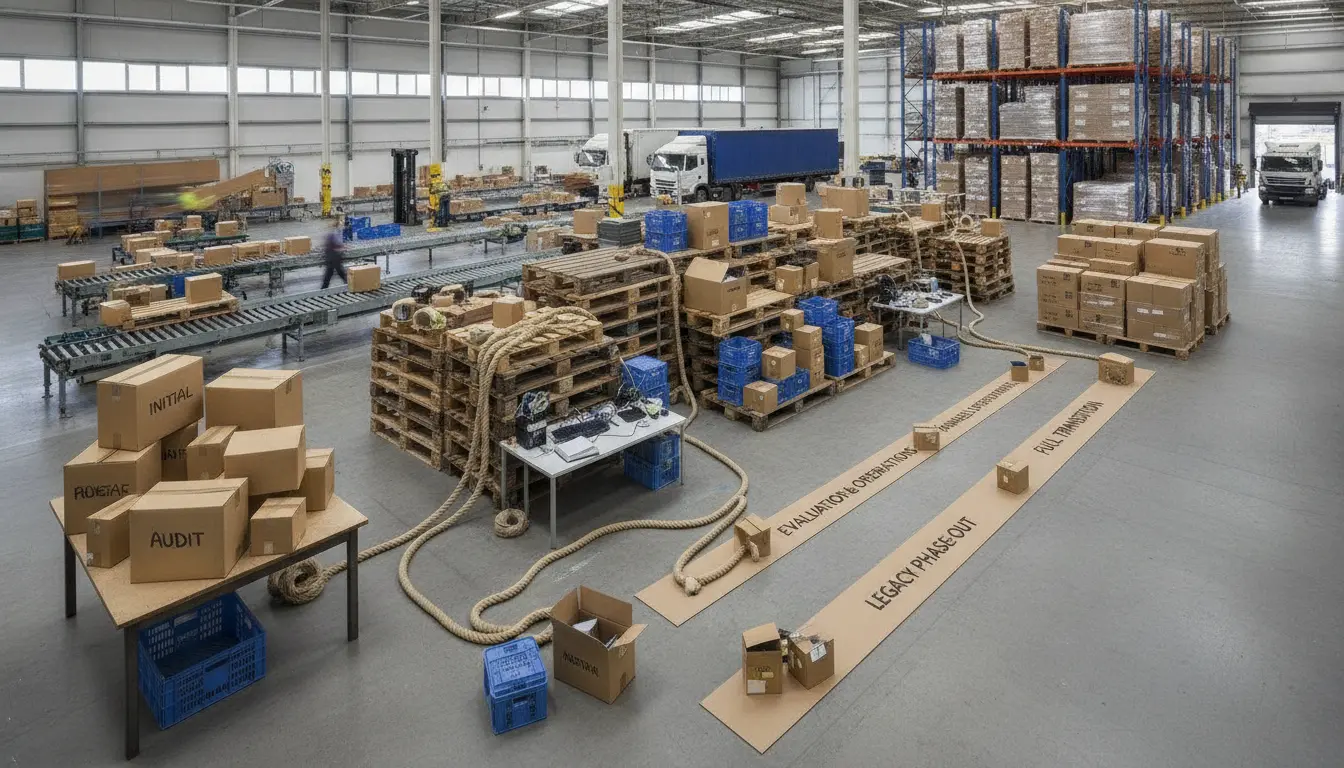
The standard transition sequence runs as follows:
- Sign the new 3PL agreement and confirm SLAs, liability terms and exit provisions before giving notice to your current provider.
- Run a full SKU-level inventory audit at your current facility. You need an accurate count before any inventory moves.
- Set up the integration layer (storefront, marketplace and ERP connections) in the new WMS before inventory arrives. Test with a small batch of orders in a sandbox environment if the provider offers one.
- Ship a pilot batch of inventory to the new facility while maintaining stock at the current facility. Do not send everything at once.
- Run parallel operations for two to four weeks: new orders routed to the new 3PL, backlog fulfilled from the old facility as that inventory depletes.
- Once inventory count and order routing are confirmed accurate at the new facility, give formal notice to exit the previous provider per your contract terms.
- Conduct a 30-day post-launch review of order accuracy, shipping times, receiving turnaround and cost-per-order against your pre-switch baseline.
For a detailed timeline of what happens during the first month with a new provider, the 3PL onboarding: what happens in the first 30 days guide covers the receiving process, system setup and what to track.
Questions to ask any ShipBob alternative before you commit
The 15-question framework in the how to choose a 3PL guide covers the full evaluation. For the specific context of switching from ShipBob, these questions deserve particular attention:
- Can you show me your receiving SLA and what happens when inbound freight arrives without an advance shipping notice (ASN)?
- How do you handle SKU proliferation? Is there a per-SKU setup fee, and how does slotting work for slow-moving vs. fast-moving products?
- What is your process when an order cannot be fulfilled because of a stock discrepancy? Who gets notified and in what timeframe?
- How are carrier rate increases passed through to clients? Is there a notice period?
- What does your exit process look like if I need to move inventory out of your facility? What are the outbound transfer fees and timeline?
A 3PL that answers these questions with specific numbers and documented procedures is in a different category from one that responds with general assurances. The answers tell you as much about the operational culture as the rate card does.
The ecommerce fulfillment picture for international brands seeking a US 3PL
One segment that frequently outgrows ShipBob's model is international brands using a US fulfillment partner to serve American customers. A UK brand shipping goods from a manufacturer in Asia to a US warehouse needs more than a pick-and-pack operation. It needs coordinated freight forwarding, customs documentation management, an understanding of current US import requirements, and outbound shipping that reflects the DDP or DDU preference of its US customer base.
YouParcel's freight forwarding service connects to its US fulfillment operations, which means inbound international freight and domestic order fulfillment can be managed through a single partner. For brands that have previously used ShipBob for the fulfillment piece and a separate freight forwarder for the inbound piece, consolidating those relationships can reduce handoff complexity and improve inventory visibility.
Note on US import requirements: all commercial imports into the US require a formal customs entry regardless of value. The US de minimis threshold that previously allowed duty-free entry for low-value shipments has been suspended as of August 29, 2025. Brands should plan their landed cost models accordingly. For specific guidance on duties, tariffs and customs entry requirements, consult a licensed customs broker or refer to the US Customs and Border Protection importer resources. YouParcel does not act as importer of record (IOR); brands are responsible for arranging IOR services separately.
Frequently asked questions
What are the main reasons brands switch away from ShipBob?
The most common reasons are unpredictable cost-per-order at scale, limited support for B2B and wholesale channels, insufficient product-handling capabilities for complex SKUs, and the need for a 3PL that can coordinate inbound freight alongside domestic fulfillment. Brands switching for pricing reasons alone should build a full cost model before assuming the alternative will be cheaper.
How long does it take to switch from one 3PL to another?
A managed transition with parallel operations typically takes four to eight weeks from signed agreement to full cutover. The timeline depends on the complexity of your integration setup, the volume of inventory to transfer and the exit notice period in your current contract. Rushing the transition to avoid overlap costs is one of the most common causes of stockout events and order accuracy problems during a switch.
Does YouParcel have a minimum order volume requirement?
YouParcel works with brands across a wide range of order volumes, from growing small businesses to enterprises processing thousands of orders per day. Specific volume requirements and pricing depend on your product type, storage footprint and service configuration. The best way to get accurate information is to talk to an expert with your actual order profile in hand.
Can a ShipBob alternative handle both DTC and B2B wholesale orders?
Yes, but not all 3PLs are equally capable on both channels. B2B fulfillment requires EDI integration, retailer-specific routing guide compliance, GS1-compliant labeling and the ability to build pallet configurations to retailer specifications. Confirm these capabilities specifically, as a 3PL that excels at DTC parcel shipping may have a very limited B2B workflow.
What should I look for in a 3PL's returns process when evaluating alternatives?
Look for unit-level grading (sellable, unsellable, repackageable), documented turnaround time from return receipt to inventory credit, real-time visibility into returns as they are processed, and whether returns are handled in the same facility as outbound fulfillment. A returns process that runs separately from your main inventory creates reconciliation delays and can lead to oversell events on items that are physically back in stock but not yet credited in the system.
Ready to see whether YouParcel fits your operation better than your current provider? Create an account and bring your order volume and product details to the conversation.
Related reading: US Fulfilment Centre for EU Brands: The 2025 Framework, End of De Minimis and Bulk Entry
Related reading: Indian Exporters and D2C Brands: US Warehousing vs Per-Order Courier Shipping