


B2B and wholesale fulfillment is the process of picking, packing, labeling and shipping large or pallet-level orders to retailers, distributors or other businesses, in strict compliance with each trading partner's EDI transaction requirements, routing guides and labeling standards. YouParcel handles this for brands selling to major US retailers, operating from fulfillment centers in New Jersey and California with the integration depth and compliance tooling that retail buyers demand.
- EDI (Electronic Data Interchange) is the mandatory data language of retail: orders, invoices, shipping notices and acknowledgments all flow as structured transaction sets, not emails or spreadsheets.
- Routing guides dictate exactly how, when and with which carrier a vendor must ship; non-compliance triggers chargebacks that can erase the margin on an entire purchase order.
- YouParcel supports EDI and retailer compliance, including routing guides and labeling requirements, for brands in retail and wholesale distribution.
- Getting these processes right before your first shipment, not after the first chargeback, is what separates brands that scale in retail from those that lose the account.
What is EDI and why does every retailer require it?
EDI stands for Electronic Data Interchange, the standardized format for exchanging business documents between trading partners. Rather than emailing a purchase order as a PDF, a retailer sends a structured data file, typically conforming to the ANSI X12 or EDIFACT standard, that your warehouse management system (WMS) or order management system (OMS) can parse and act on automatically.
Retailers require EDI because it eliminates manual data entry, accelerates order cycles and creates an auditable paper trail for chargebacks. For a brand, the practical implication is straightforward: if your 3PL cannot receive and respond to EDI transactions in the formats your retail partners specify, you cannot ship to those retailers at all.
The core EDI transaction sets for wholesale fulfillment
| Transaction Set | Common Name | What It Does | When It Fires |
|---|---|---|---|
| EDI 850 | Purchase Order | Retailer sends order details: SKUs, quantities, ship-to location, requested dates | Retailer places an order |
| EDI 855 | Purchase Order Acknowledgment | Vendor confirms receipt and acceptance (or flags exceptions) | Within hours of receiving the 850 |
| EDI 856 | Advance Ship Notice (ASN) | Detailed manifest of what is in each carton and pallet before it arrives | Before or at the moment of shipment |
| EDI 810 | Invoice | Vendor invoices the retailer for the shipped goods | After shipment, often same day as ASN |
| EDI 997 | Functional Acknowledgment | Confirms that a transaction set was received without structural errors | Response to any inbound transaction |
| EDI 753/754 | Routing Request / Instructions | Vendor requests routing authorization; retailer responds with carrier and account number | Before booking freight on collect-freight shipments |
The EDI 856 (ASN) is the transaction set most likely to generate chargebacks if it is wrong or late. Retailers use the ASN to pre-receive inventory, slot product into their DCs and flow goods directly to the sales floor. A missing or inaccurate ASN forces a manual receiving process, and the chargeback typically covers that labor cost, at rates that can reach several hundred dollars per incident depending on the retailer's vendor agreement.
What is a routing guide and what does it actually contain?
A routing guide (also called a vendor routing guide or freight routing guide) is the document a retailer publishes to tell all of its vendors exactly how to ship. Think of it as a contract inside the contract: it specifies carriers, service levels, shipment consolidation rules, appointment scheduling procedures, labeling formats and packing standards. Routing guides are typically 20 to 80 pages long and are updated at least annually, sometimes quarterly.
The eight areas every routing guide covers
- Freight terms and payment: Whether the retailer pays freight (collect) or the vendor pays (prepaid), and which carrier accounts to use. Collect shipments require the vendor to obtain routing authorization via EDI 753 before booking.
- Carrier and service level requirements: Approved carriers by shipment type and weight break, for example USPS for parcels under 1 lb, a named LTL carrier for shipments between 151 and 19,999 lb, and a specific truckload carrier above that threshold.
- Shipment mode thresholds: Most guides define parcel, LTL (Less-than-Truckload) and TL (Truckload) cutoffs by weight or cube. A common structure is parcel up to 150 lb, LTL from 151 to 19,999 lb, TL above 20,000 lb.
- Packing and carton requirements: Maximum carton weight (often 50 lb or 70 lb), required inner pack configurations, whether mixed-SKU cartons are permitted and whether floor-loaded or palletized delivery is required.
- Pallet standards: Pallet type (GMA standard 40 x 48 inch is most common in the US), maximum pallet height (usually 60 inches including pallet), pallet weight limits and overhang tolerances.
- Labeling requirements: Carton labels, pallet labels and, for certain categories, inner pack labels. Most major retailers require GS1-compliant labels with specific barcode symbologies (typically Code 128 or GS1-128), human-readable fields and exact placement zones on the carton face.
- Appointment scheduling: Whether the delivery requires a dock appointment, how far in advance to schedule it, and what systems to use (retailer portals, phone, or automated scheduling via EDI).
- Chargeback schedule: A full list of non-compliance events and the associated deduction amounts or percentages. This section is the most important one to read before your first shipment.
Retailer compliance labeling: GS1, SSCC and UCC-128
Labeling is where many first-time retail vendors stumble. The industry standard for carton and pallet labeling is GS1-128 (historically called UCC-128), a barcode format that encodes the Serial Shipping Container Code (SSCC). The SSCC is an 18-digit number that uniquely identifies each physical shipping unit, whether a single carton or a full pallet, and ties it to the corresponding EDI 856 ASN line.
A compliant carton label for most major US retailers includes:
- The SSCC-18 barcode in Code 128 symbology, minimum 1.5 inches tall and printing at a resolution that passes scanner verification
- Human-readable fields for PO number, department, vendor number, GTIN (Global Trade Item Number, either 12-digit UPC-A or 14-digit ITF-14), quantity, item description and ship-to location
- The GS1 Company Prefix (assigned by GS1 US) embedded in the SSCC and GTIN
- Placement on the lower-right quadrant of two adjacent carton faces (the specific quadrant varies by retailer but this is the most common instruction)
Pallet labels follow a similar structure but encode pallet-level data and must appear on two adjacent sides of the pallet at a height that is legible to a forklift-mounted scanner, typically 15 to 48 inches from the floor. For GS1 standards, the authoritative reference is GS1's published GS1-128 application standard.
How B2B wholesale fulfillment differs from DTC fulfillment
| Dimension | DTC / Ecommerce Fulfillment | B2B Wholesale Fulfillment |
|---|---|---|
| Order size | 1 to 5 units per order | Dozens to thousands of units per PO |
| Ship-to destinations | Individual consumer addresses | Retailer DCs, store locations, Amazon FCs |
| Shipping mode | Small parcel (USPS, FedEx, UPS, DHL) | Small parcel, LTL and TL depending on PO size |
| Labeling | Carrier label plus brand packing slip | GS1-128 carton and pallet labels tied to ASN |
| Data exchange | OMS/Shopify API | EDI 850, 855, 856, 810 transaction sets |
| Timing pressure | Same-day or next-day ship SLA | Must-arrive date with dock appointment; early or late deliveries both trigger chargebacks |
| Compliance risk | Low (carrier surcharges, wrong address) | High (chargebacks per non-compliant carton or late ASN) |
| Inventory flow | Continuous replenishment, small batches | Bulk inbound, wave-pick to PO, bulk outbound |
The operational and systems gap between these two modes is significant. A warehouse set up for DTC pick-and-pack cannot simply pivot to wholesale fulfillment without EDI capability, GS1 labeling infrastructure and the operational discipline to meet must-arrive dates. This is why brands that grow from DTC into retail often need a 3PL partner with explicit B2B wholesale capabilities rather than a DTC-only fulfillment house.
How YouParcel handles B2B wholesale fulfillment
YouParcel's B2B and wholesale fulfillment service is built around the operational requirements of retail distribution, not adapted from a DTC model. The key capabilities that matter for retail compliance work as follows.
EDI connectivity and trading partner setup
YouParcel connects to retailers and their EDI networks through integrations with platforms such as SPS Commerce, TrueCommerce and CommerceHub. These platforms act as EDI translation layers: they convert the retailer's raw X12 transaction sets into order data that feeds directly into the fulfillment workflow, and they convert outbound ASN and invoice data back into the correct X12 format for each trading partner.
Setup for a new retail trading partner typically involves mapping the retailer's specific field requirements, confirming GS1 company prefix and SSCC number ranges, and running test transactions before any live POs are processed. This pre-go-live validation step is where compliance problems get caught before they generate chargebacks.
Routing guide adherence and carrier coordination
YouParcel works with carriers including FedEx, USPS, DHL and Aramex for small parcel shipments, and coordinates LTL and truckload movements for larger wholesale orders. When a retailer routing guide specifies collect freight with a named carrier, YouParcel's team manages the routing authorization request (EDI 753) and books under the retailer's account as instructed. When the guide specifies prepaid freight, YouParcel selects the approved carrier and service level that meets the must-arrive date without paying for excess transit speed.
GS1-compliant labeling and ASN generation
Carton and pallet labels are generated at the point of packing using the GS1 Company Prefix associated with each brand's account. The SSCC assigned to each carton is recorded in the WMS and transmitted to the retailer in the EDI 856 ASN before or at the moment of shipment. The ASN line-level detail, carton contents by GTIN and quantity, is built from the pick confirmation data, so there is no manual re-keying step that could introduce errors between what was packed and what was reported.
Kitting and assembly for retail pack configurations
Retailers often require products to be pre-packaged in inner packs (for example, 6 units per inner, 12 inners per master carton) that differ from how the brand normally ships DTC. YouParcel's kitting and assembly capability handles these configurations at the fulfillment center, applying retail-specific packaging, inserts or hang tags before cartons are labeled and palletized. This is particularly common for seasonal retail programs, gift sets and promotional bundles.
Chargeback dispute support
When a retailer issues a compliance deduction, the ability to defend against it depends on documentation: scan logs confirming when cartons were labeled, ASN transmission timestamps, carrier pickup confirmations and packing records. YouParcel's real-time tracking and BI and analytics tools create the audit trail that brands need to dispute invalid chargebacks with evidence, not just assertions.
Omnichannel fulfillment: running DTC and wholesale from one inventory pool
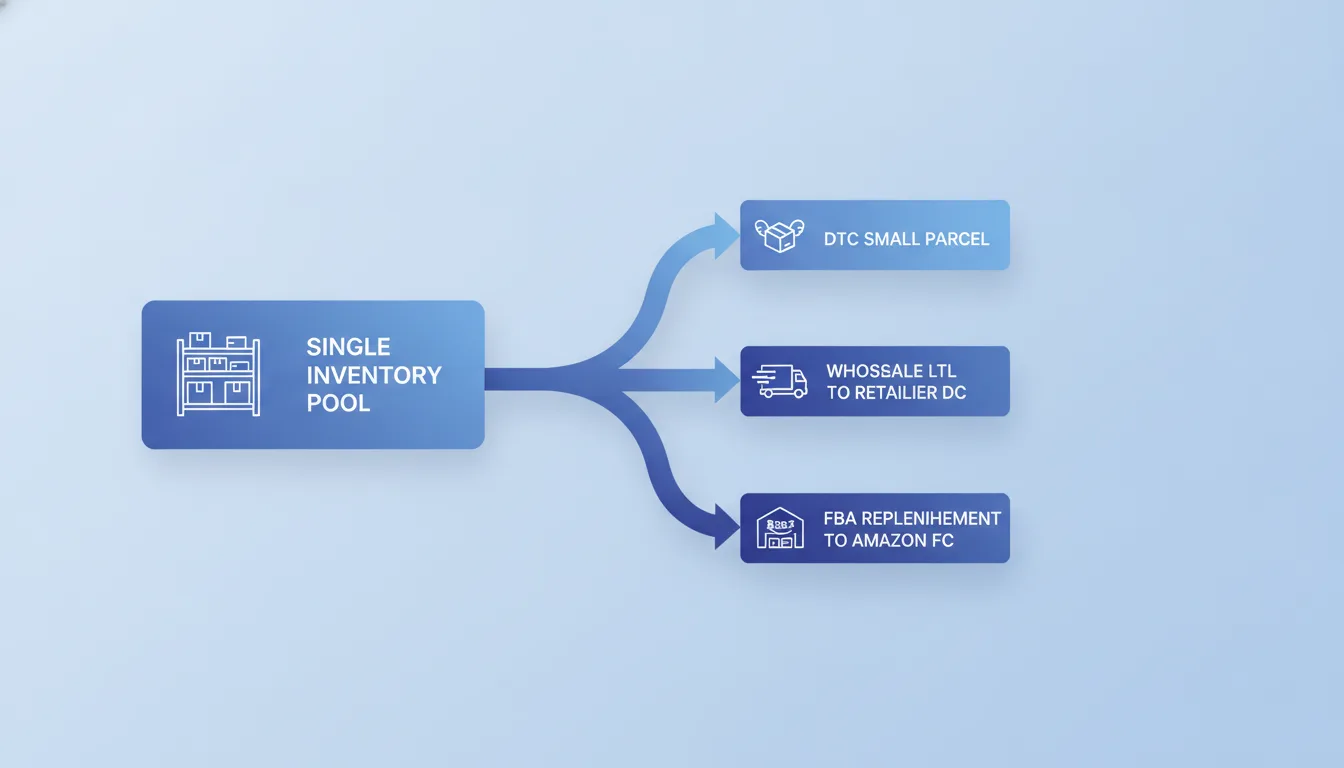
Many brands reach a point where they are shipping DTC orders through Shopify, wholesale orders to retailers, and replenishment shipments to Amazon FCs, all from the same SKU base. Managing this from a single inventory pool, rather than siloing stock by channel, is the difference between capital-efficient inventory and chronic stockouts or overstock.
YouParcel's omnichannel fulfillment approach holds inventory in one WMS record and allocates it across channels based on order priority and channel-specific rules. The Shopify integration handles DTC orders; EDI handles wholesale POs; the Amazon integration handles FBA replenishment. Real-time inventory visibility, supported by integrations with Salesforce, Tableau and 70+ other platforms, means operations leads can see channel-level stock positions and act before a stockout affects a retail replenishment cycle.
For brands that distribute to Target, Home Depot, Lowe's, Wayfair or Walmart, YouParcel has direct integrations with those retailers' supplier portals and EDI networks. See the full integrations directory for the current list of connected platforms.
What happens operationally when a wholesale PO arrives
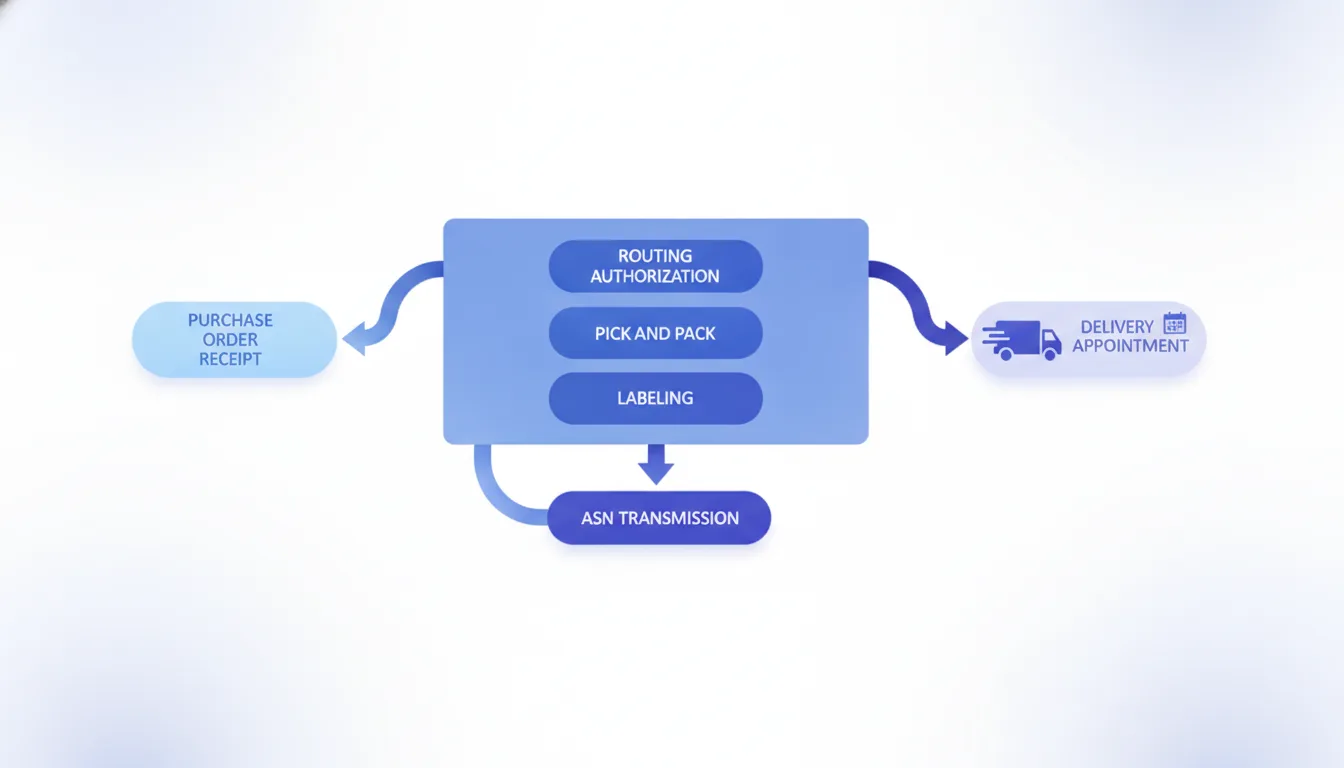
- EDI 850 receipt and acknowledgment: The purchase order arrives via the EDI network. The WMS parses SKUs, quantities, must-arrive dates and ship-to locations. An EDI 855 acknowledgment is sent back to the retailer, confirming the order or flagging any SKU or quantity discrepancies.
- Inventory reservation and wave planning: Inventory is reserved against the PO. If the order requires kitting or assembly (for example, building retail-specific inner packs), the kitting work order is triggered at this stage.
- Routing authorization (if collect freight): For collect-freight shipments, an EDI 753 routing request is sent to the retailer. The retailer responds with an EDI 754 specifying the carrier, service level and account number to use.
- Pick and pack: Warehouse staff pick to the PO, pack to the retailer's specified carton configuration and apply GS1-128 carton labels. Each carton's SSCC is captured by scan.
- Palletizing and pallet labeling: Cartons are palletized to the retailer's height and weight specs. Pallet labels encoding pallet-level SSCC and contents are applied to two adjacent sides.
- Dock appointment scheduling: A pickup or delivery appointment is booked with the carrier or the retailer's DC receiving team, depending on the routing guide instructions.
- ASN transmission: The EDI 856 ASN is generated from WMS data and transmitted to the retailer's EDI system before the freight physically departs. The ASN maps every carton SSCC to its PO line, GTIN, quantity and pallet assignment.
- Invoice generation: An EDI 810 invoice is sent to the retailer's accounts payable system, referencing the same PO and shipment identifiers as the ASN.
- Delivery confirmation and receipt: The retailer's DC receives the shipment, scans carton labels and matches them to the pre-received ASN. Any discrepancy between the ASN and the physical carton scan triggers an exception that may result in a chargeback if the error is on the vendor side.
Common chargeback triggers and how to prevent them
| Chargeback Trigger | Root Cause | Prevention at the 3PL Level |
|---|---|---|
| Late or missing ASN | ASN transmitted after freight departed or not sent at all | Automated ASN generation from pack scan; transmission triggered at label print |
| ASN/carton mismatch | Physical carton contents differ from ASN line data | WMS-driven pack confirmation; no manual data entry between scan and ASN |
| Non-compliant label | Wrong barcode symbology, unreadable print quality, missing fields or wrong placement | Label templates locked to retailer spec; print verification at pack station |
| Routing guide violation | Wrong carrier, service level or freight terms used | Routing rules encoded per trading partner in OMS; carrier selection validated before booking |
| Early or late delivery | Shipment arrives outside the retailer's must-arrive window | Must-arrive date drives ship date calculation; appointment confirmed before tender |
| Non-compliant pallet | Overhang, wrong pallet type, mixed PO pallets where single-PO pallets are required | Palletizing specs enforced in warehouse work instructions per trading partner |
| Short shipment | Quantity shipped less than PO quantity without a prior acknowledgment exception | Shortage flagged in EDI 855 acknowledgment; partial shipment authorized before execution |
Vendor compliance programs at major US retailers
Each major US retailer operates its own vendor compliance program, and the penalty structures vary considerably. The Supply Chain Brain research on retail vendor compliance consistently shows that labeling and ASN errors account for the majority of chargeback volume. Understanding the specific compliance programs of your retail partners before you ship is not optional preparation; it is the work that determines whether a retail channel is profitable.
A few patterns that appear across most major programs:
- Chargeback rates for labeling violations typically range from $0.20 to $2.00 per carton, which can represent a meaningful percentage of margin on low-cost goods.
- ASN-related chargebacks are often flat fees per incident rather than per-carton rates, making a single missed ASN transmission a significant cost event.
- Some retailers operate a scorecard system where vendors with a compliance score below a threshold face additional audit scrutiny or restricted routing options.
- Routing guide violations on collect-freight shipments, where the vendor books freight outside the approved carrier without authorization, can result in the retailer refusing to pay the freight invoice entirely.
International brands entering US retail: additional compliance considerations
For international brands that have won their first US retail PO and need a US fulfillment partner to execute it, the compliance requirements are identical to those for domestic brands. The difference is in how inventory arrives at the fulfillment center. Goods typically arrive via ocean freight (FCL or LCL) or air freight, clear US customs, and are received into the YouParcel warehouse before any retail POs are picked and shipped.
YouParcel does not act as Importer of Record (IOR). The IOR is the legal entity responsible for ensuring goods comply with US import laws and paying applicable duties and taxes. International brands typically serve as their own IOR, work with a licensed customs broker to act as IOR on their behalf, or use a freight forwarder that offers IOR services. YouParcel's freight forwarding service can connect brands with appropriate brokerage support for the inbound leg. For the outbound retail compliance execution, once goods are in the warehouse, YouParcel handles all EDI, labeling and routing guide requirements.
For a full picture of how international brands structure their US supply chain, the ecommerce fulfillment services guide covers inventory positioning, inbound freight and the end-to-end fulfillment model in detail.
Frequently asked questions
What is EDI compliance in wholesale fulfillment?
EDI compliance means sending and receiving the correct Electronic Data Interchange transaction sets (such as the 850 purchase order, 855 acknowledgment, 856 advance ship notice and 810 invoice) in the exact format, timing and content that each retail trading partner requires. Non-compliance typically results in financial chargebacks deducted from the vendor's invoice payment.
What is a routing guide and who issues it?
A routing guide is a document published by a retailer that specifies which carriers to use, what freight terms apply, how shipments must be packed and palletized, how labels must be formatted, and how deliveries must be scheduled. Every major US retailer has one, and following it precisely is a contractual obligation for vendors.
Can a 3PL handle both my DTC and wholesale orders from the same inventory?
Yes. A 3PL with omnichannel capability, like YouParcel, holds inventory in a single warehouse location and allocates it to DTC, wholesale and marketplace channels based on incoming order data. The WMS and OMS apply channel-specific rules (small parcel for DTC, LTL with GS1 labels and EDI for wholesale) without the brand needing to split physical inventory by channel.
What causes retail chargebacks and how can I avoid them?
The most common causes are late or inaccurate ASN transmissions, non-compliant carton or pallet labels, wrong carrier selection and delivery outside the must-arrive window. Preventing them requires a 3PL with retailer-specific routing rules encoded in its WMS, automated ASN generation tied directly to pack scans, and GS1-compliant label templates locked to each trading partner's specifications.
Does YouParcel support EDI for retailers like Target, Walmart, Home Depot and Wayfair?
YouParcel integrates with major retail EDI networks and has connections to retailer supplier portals including Target, Walmart, Home Depot, Lowe's and Wayfair. Trading partner setup involves mapping each retailer's specific transaction set requirements before any live purchase orders are processed, so compliance is validated before the first shipment rather than discovered after the first chargeback.
If your brand is preparing to fulfill its first retail purchase order, scaling an existing wholesale channel or bringing B2B fulfillment in-house to a 3PL partner, create a YouParcel account to get started, or talk to an expert about your specific retailer requirements and compliance setup.
Related reading: Fulfillment KPIs to Review Every Month With Your 3PL