

Indian sellers targeting Amazon FBA USA now face a materially different duty picture after the US Supreme Court struck down IEEPA-based tariffs on February 20, 2026, and the White House responded four days later with a Section 122 temporary 10 percent import surcharge. A US-based third-party logistics (3PL) provider such as YouParcel, with in-country FBA prep services, lets Indian brands import inventory in bulk, clear customs once per shipment, and replenish Amazon fulfillment centers on a rolling basis, reducing both duty complexity and per-unit landed cost.
- The Supreme Court ruled 6-3 in Learning Resources v. Trump (February 20, 2026) that IEEPA does not authorize tariffs; Section 301 and Section 232 duties were unaffected, and duty-free de minimis entry for low-value parcels was not restored.
- A Section 122 temporary 10 percent across-the-board import surcharge took effect February 24, 2026, and is scheduled to run through July 24, 2026; Indian-origin goods carry this surcharge on top of any applicable Most Favored Nation (MFN) rate.
- US de minimis was suspended for all countries effective August 29, 2025; every commercial shipment entering the United States is now a formal duty event regardless of value.
- A US 3PL with FBA prep capabilities consolidates your inventory under one formal customs entry, handles Amazon-compliant labeling and packaging, and replenishes fulfillment centers on both US coasts on demand.
What changed: the IEEPA ruling and Section 122 surcharge explained
The Supreme Court ruling of February 20, 2026
In Learning Resources v. Trump, the Supreme Court ruled 6-3 that the International Emergency Economic Powers Act (IEEPA) does not grant the executive branch authority to impose tariffs. The broad IEEPA-based tariff schedules introduced in 2025 were struck down as of the ruling date. If you had been relying on those rates in your landed-cost models, those specific duties fell away as of that decision.
What the ruling did not do is equally important for Indian sellers:
- Section 301 duties on goods of Chinese origin were unaffected. Indian-origin goods were generally not subject to Section 301, so this is less directly relevant, but it shapes the broader competitive landscape on Amazon US.
- Section 232 duties on steel and aluminum remained intact.
- The end of US de minimis was not reversed. CBP CSMS #66065494 confirmed suspension of the Section 321 duty-free threshold effective August 29, 2025, and that remains in force.
For the full analysis of the ruling, see the Foley Hoag alert published February 20, 2026: U.S. Supreme Court Strikes Down IEEPA Tariffs (foleyhoag.com).
Section 122: the 10 percent temporary surcharge, effective February 24, 2026
Four days after the ruling, a new executive action imposed a 10 percent across-the-board import surcharge under Section 122 of the Trade Act of 1974. Section 122 authorizes the president to impose a temporary surcharge of up to 15 percent for up to 150 days to address a balance-of-payments deficit. The surcharge applies to imports from all countries, including India, and runs from February 24, 2026, through July 24, 2026.
For Indian sellers, the effective duty on a typical apparel or consumer-goods shipment now stacks: the applicable MFN duty rate, plus any product-specific add-on, plus the Section 122 surcharge. See the GHY Trade Compliance summary published February 24, 2026, for a detailed breakdown: US 10% Section 122 Tariff (ghy.com).
What MFN rates look like for Indian-origin goods
India benefits from standard MFN treatment in the United States. MFN rates vary by Harmonized Tariff Schedule (HTS) chapter. The table below shows illustrative base rates for categories commonly exported by Indian sellers, along with the Section 122 add-on that applies to shipments entering before July 24, 2026.
| Product category | HTS chapter | Typical MFN base rate | Section 122 add-on (through Jul 24, 2026) |
|---|---|---|---|
| Cotton apparel (T-shirts, kurtas) | 61 | 16.5% | +10% |
| Leather handbags and accessories | 42 | 6 to 9% | +10% |
| Jewelry (gold, silver, gemstone) | 71 | 5.5 to 6.5% | +10% |
| Home furnishings (bed linen) | 63 | 5.8% | +10% |
| Spices and packaged foods | 09, 21 | 0 to 6.4% | +10% |
These are illustrative base rates only. Always confirm the precise HTS classification and applicable rate with a licensed US customs broker before committing to a landed-cost model. Misclassification is one of the most common and costly errors in cross-border trade.
Why shipping parcels directly from India to US customers no longer works at scale
Before August 2025, many Indian sellers used a direct-to-consumer postal model: ship each order individually from India, rely on the Section 321 de minimis threshold to avoid formal entry and duty, and price accordingly. That model is no longer available.
Every commercial parcel entering the United States is now a formal duty event, regardless of declared value. At scale, paying duty parcel-by-parcel through postal channels is operationally expensive, creates inconsistent landed costs, and generates customer-experience problems when parcels are held for customs assessment.
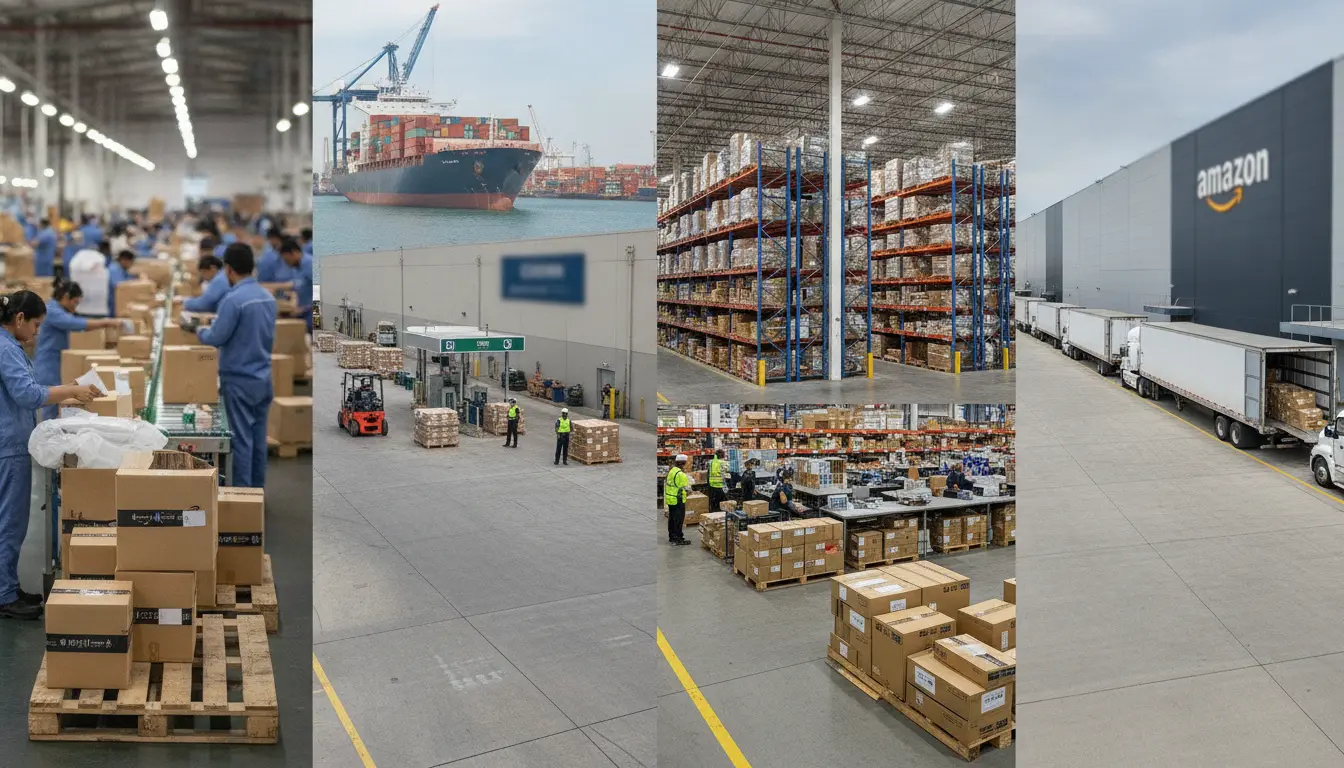
The alternative that makes economic and operational sense at growth volumes is bulk importation into a US warehouse. You pay duty once per inbound freight shipment under a single formal customs entry, gain control of inventory in-country, and fulfill US orders domestically. Duty does not disappear under this model. It is paid upfront on the commercial invoice value of the inbound shipment. The advantage is predictability and the amortization of customs brokerage costs across many units, not duty avoidance.
How Amazon FBA USA works for international sellers
Fulfillment by Amazon (FBA) means Amazon stores your inventory in its fulfillment centers and picks, packs, and ships orders on your behalf. Your listings become Prime-eligible, which materially affects conversion rates. Amazon charges storage fees (assessed monthly, by cubic foot) and fulfillment fees (per unit, based on size and weight tier).
What Amazon does not do is prepare your inventory for its own fulfillment centers. Inventory arriving at an Amazon receiving dock must meet strict requirements: a correct FNSKU (Fulfillment Network Stock Keeping Unit) label on each unit, specific carton markings, pallet configuration to Amazon's pallet specification (40 inches by 48 inches, 72-inch height limit for standard pallets), and in some categories additional requirements such as poly-bagging, bubble-wrapping, or suffocation warning labels on polybag openings larger than 5 inches.
If a shipment does not meet these requirements, Amazon will reject the delivery, charge a non-compliance fee, or in some cases dispose of non-compliant units. This is where FBA prep services become operationally critical for sellers sourcing and shipping from India.
What FBA prep services cover and why you need them in the US
An FBA prep service is a facility, typically operated by a 3PL, that receives your inbound freight after customs clearance, inspects and prepares each unit to Amazon's current requirements, and then ships the inbound shipment to the Amazon fulfillment center network according to the shipping plan you create in Seller Central.
Core FBA prep tasks follow this sequence:
- Receive and count inbound freight. The 3PL receives your container or LTL shipment, verifies unit counts against your packing list, and notes any discrepancies or damage before signing the carrier bill of lading.
- FNSKU labeling. Each sellable unit receives an FNSKU barcode label generated from your Amazon Seller Central account. This is the label Amazon scans at receiving; without it, Amazon cannot associate the unit with your seller account.
- Poly-bagging and suffocation warnings. Soft goods, clothing, and items that could pose a suffocation risk need poly-bagging with a printed suffocation warning if the bag opening exceeds 5 inches.
- Bubble-wrap and fragile protection. Glass, ceramics, and fragile items need additional cushioning per Amazon packaging requirements.
- Set creation and bundling. If you sell multi-unit sets (for example, a three-piece bedding set from an Indian textile manufacturer), the 3PL assembles and seals the set so Amazon receives it as a single ASIN (Amazon Standard Identification Number).
- Carton building and labeling. Units are packed into master cartons at the correct quantity, with Amazon required carton labels (shipment ID, FBA shipment ID, carton number) applied to all four sides.
- Pallet building and stretch-wrapping. For large shipments moving as Less-than-Truckload (LTL) or Full Truckload (FTL), pallets are built to Amazon specification and stretch-wrapped for transit stability.
- Inbound shipment creation and carrier booking. The 3PL or the seller creates the inbound shipment plan in Seller Central, books the carrier delivery appointment at the assigned Amazon fulfillment center, and coordinates the final leg.
Performing this prep work in India before the shipment leaves creates a practical problem: Amazon's FNSKU labels are generated when the shipment plan is created in Seller Central, which means the destination fulfillment center is not confirmed until after the plan is submitted, often after the inventory has already left India. Routing inventory from India to a specific Amazon fulfillment center, only to have Amazon direct you to a different one, means a costly redirect or a non-compliance situation. In-country US prep solves this cleanly: your inventory lands at a US 3PL warehouse, customs clears, and then you create your shipment plan and prep for whichever Amazon fulfillment center is assigned.
The landed-cost comparison: bulk import versus parcel-by-parcel
The table below compares the two models for an Indian apparel seller at growth volume, using cotton T-shirts (HTS 6109.10, MFN rate approximately 16.5%, plus Section 122 10% for shipments entering before July 24, 2026) as an example.
| Cost component | Parcel-by-parcel from India | Bulk import to US 3PL, then FBA |
|---|---|---|
| Duty per unit | Assessed parcel-by-parcel on declared value; inconsistent, delay risk | Assessed once on commercial invoice value at formal entry; predictable per-unit cost |
| Customs handling cost | Per-parcel informal or postal assessment; high per-unit cost at volume | Single formal entry per shipment; broker fee amortized across all units |
| US customer delivery speed | 10 to 20-plus days transit from India, subject to customs holds | Prime 1 to 2 day delivery from Amazon FBA once inventory is positioned in-country |
| FBA and Prime eligibility | Not possible under a direct postal model | Full FBA and Prime eligibility |
| Return handling | International returns are operationally complex and costly to process | Amazon manages FBA returns domestically; 3PL can handle FBA removal orders |
Who acts as Importer of Record for Indian sellers?
The Importer of Record (IOR) is the entity legally responsible for the imported goods: filing the entry with US Customs and Border Protection (CBP), paying duties, and complying with all applicable requirements. This is a critical question for Indian sellers who do not have a US legal entity.
YouParcel does not act as Importer of Record. Your options as an Indian seller without a US entity typically include the following:
- Establish a US entity. A US LLC or corporation can act as IOR. Many Indian sellers who are serious about the Amazon US market incorporate in Delaware or in the state where their 3PL warehouse is located.
- Use a freight forwarder or customs broker who offers IOR services. Some licensed customs brokers provide IOR-as-a-service for foreign entities, taking on the legal liability for a fee. Confirm this arrangement carefully; IOR liability is significant.
- Ship under a DDP (Delivered Duty Paid) Incoterm with your freight forwarder. Under DDP, the seller (the Indian exporter) retains IOR responsibility. The freight forwarder handles the entry on your behalf using your bond or their bond under a power of attorney.
This is general information, not legal or customs advice. Consult a licensed US customs broker to determine the right IOR structure for your business before your first shipment.
How YouParcel supports Indian sellers on Amazon FBA USA
YouParcel operates fulfillment centers in New Jersey, California, and Illinois, with public addresses at 20 Farinella Dr, East Hanover, NJ 07936 (serving the NY/NJ metro and the Eastern US) and 3700 S. Riverside Ave, Rialto, CA 92324 (serving Southern California and the Western US). Both locations are positioned for efficient inbound from major port hubs and for replenishment of Amazon fulfillment centers across the country.
For Indian sellers, YouParcel's FBA prep services cover the full workflow described above: receive, inspect, FNSKU label, poly-bag, carton-build, pallet-build, and route to Amazon. The operation processes over 10,000 orders per day across multiple marketplaces and integrates directly with Amazon Seller Central among 70-plus platform integrations. Real-time tracking and inventory visibility are available through YouParcel's BI and analytics tools, so you can monitor stock levels, inbound receipts, and Amazon replenishment shipments from India without waiting for manual reports.
Beyond FBA prep, YouParcel can hold buffer stock between Amazon replenishment cycles (FBA overflow storage), handle FBA removal order processing, and manage multi-channel fulfillment for non-Amazon US orders, all from the same inventory pool. This is particularly useful for Indian sellers who sell on both Amazon US and their own Shopify storefront simultaneously.
For a full picture of how ecommerce fulfillment works end to end, see YouParcel's ecommerce fulfillment services. For the specific steps involved in preparing an inbound shipment to Amazon FBA, see the detailed guide to shipping to Amazon FBA.
Step-by-step: how an Indian seller sets up FBA prep through a US 3PL
- Register as an Amazon US seller. Create an Amazon Seller Central account for the Amazon.com marketplace. You will need a valid bank account in a country Amazon supports for disbursements, tax identification information (or the equivalent for a foreign entity), and a product catalog ready for listing.
- Classify your products and confirm duty rates. Work with a licensed US customs broker to confirm the correct HTS code, MFN duty rate, and any applicable add-ons (including the Section 122 surcharge if your shipment will arrive before July 24, 2026) for each SKU you plan to import.
- Arrange freight forwarding from India. Book ocean freight (FCL, or Full Container Load, or LCL, Less than Container Load, depending on volume) or air freight from your Indian factory or consolidation warehouse to the US. Confirm your IOR arrangement with your freight forwarder or customs broker before the shipment leaves India. Ensure your commercial invoice and packing list are accurate; CBP assesses duty on the transaction value declared on these documents.
- Deliver inbound freight to the YouParcel US fulfillment center. Route your container or LTL delivery to the East Hanover, NJ, or Rialto, CA, facility. Your YouParcel account team will confirm receiving appointments and inbound shipment details in advance.
- Create your Amazon inbound shipment plan in Seller Central. Once inventory is received and counted at the 3PL, create your shipment plan in Seller Central. Amazon will assign the destination fulfillment center or centers. Generate FNSKU labels for each SKU and share them with YouParcel.
- FBA prep and shipment build. YouParcel applies FNSKU labels, applies required poly-bagging or protective packaging, builds cartons to Amazon specification, applies Amazon carton labels, and palletizes if the shipment requires it.
- Carrier booking and delivery to Amazon. YouParcel books the inbound delivery appointment at the assigned Amazon fulfillment center and ships. Amazon typically confirms receipt within two to five business days of delivery.
- Monitor inventory and trigger replenishment. Use Seller Central's inventory health dashboard and YouParcel's real-time inventory reports to track days of cover and initiate the next replenishment shipment from India before stock runs low.
Inventory placement strategy: East Coast versus West Coast
A common question for Indian sellers is whether to send all inventory to one US warehouse or split it across both coasts. The practical answer depends on where your Amazon orders originate and how Amazon's Inventory Placement Service (IPS) routes your shipments.
Amazon's IPS (a fee-based option in Seller Central) allows you to ship all units of a given SKU to one Amazon receiving center; Amazon then redistributes internally. Without IPS, Amazon typically splits your shipment plan across two or more fulfillment centers, which means your 3PL must build and ship to multiple destinations per inbound plan.
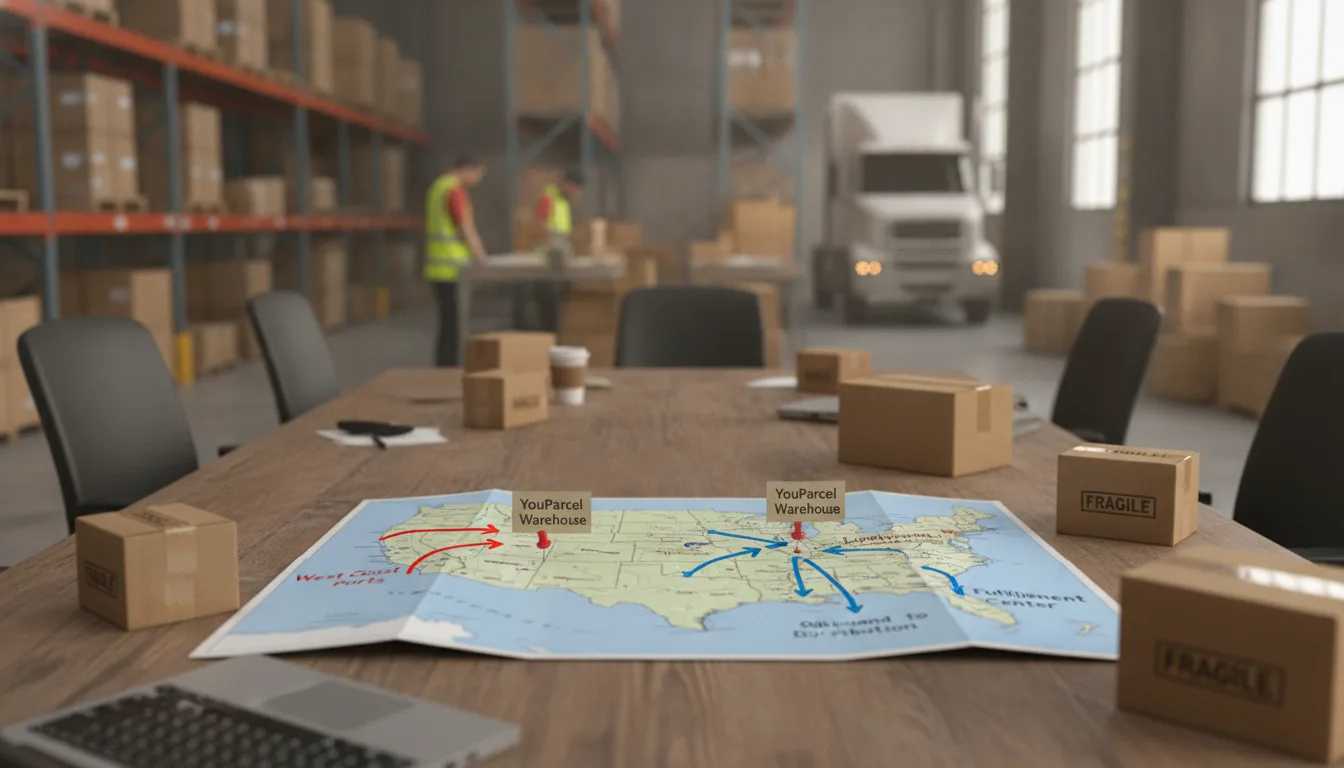
If you are landing freight on the US West Coast (arriving via the Port of Los Angeles or Long Beach), routing the container to YouParcel's Rialto, CA facility keeps drayage short and cost predictable. If you are landing on the East Coast (Port of New York/New Jersey), the East Hanover, NJ facility is the natural receiving point. Having access to both coasts through a single 3PL partner reduces coordination complexity and allows you to position inventory closer to your demand concentration as you learn your order geography over the first few months.
Common compliance risks for Indian sellers on Amazon US
Indian sellers new to Amazon FBA USA frequently encounter the following compliance problems. Awareness reduces costly mistakes before they happen.
- Incorrect HTS classification. A misclassified product can result in underpayment of duty (CBP can issue a demand for additional duties, interest, and penalties) or overpayment (recoverable through a protest, but time-consuming and costly to administer).
- Missing product compliance documentation. Some categories, including children's products, electronics, and food items, require specific certifications (CPSC, FCC, FDA) before Amazon will allow the listing or before CBP will release the goods. Confirm requirements by category before sourcing.
- Amazon listing suppression for non-compliant packaging. Indian exporters often design packaging for Indian retail. US packaging requirements differ: English-language labeling, specific font sizes for safety warnings, and country-of-origin marking in English on each unit.
- FBA stranded inventory. Units that arrive at Amazon without a valid active listing, or with a listing that has been suppressed, become stranded and incur storage fees without generating sales. Ensure every ASIN has an active, compliant listing before the inbound shipment arrives at the fulfillment center.
- Section 122 surcharge timing. The surcharge runs through July 24, 2026. For shipments with expected arrival near that date, confirm the precise CBP entry date (the date of importation, not the ship date) with your customs broker for duty calculation purposes.
Frequently asked questions
Does the IEEPA ruling mean Indian sellers pay less duty on goods exported to the USA?
Not as a straightforward reduction. The ruling struck down IEEPA-based tariff orders, which primarily affected Chinese-origin goods under the 2025 reciprocal tariff schedules. Indian-origin goods were already dutiable at MFN rates, not under IEEPA authority. The Section 122 10 percent surcharge, added February 24, 2026, applies to all countries including India and runs through July 24, 2026, so the net duty rate for most Indian exports to the US increased after the IEEPA ruling, not decreased.
Can I send my Indian inventory directly to an Amazon FBA warehouse without using a US 3PL?
Amazon allows direct manufacturer-to-FBA shipments for sellers who perform prep themselves, but several practical problems arise: you must know the destination Amazon fulfillment center before the shipment leaves India (the shipment plan assigns centers dynamically after submission), all FBA prep must be completed before the shipment departs origin, and any non-compliance means Amazon rejects or charges fees at receiving. A US-based 3PL with FBA prep services handles these issues after customs clearance, when the destination center is confirmed.
What is the Section 122 surcharge and how long does it last?
Section 122 of the Trade Act of 1974 allows the US president to impose a temporary import surcharge of up to 15 percent for up to 150 days to address a balance-of-payments deficit. The current 10 percent surcharge took effect February 24, 2026, and is scheduled to expire July 24, 2026. It applies to imports from all countries, including India, on top of existing MFN rates.
Do I need a US company to sell on Amazon US from India?
Amazon allows non-US individuals and entities to register as sellers on Amazon.com, but you will need a bank account in a country Amazon supports for disbursements and you need to resolve the Importer of Record question for your inbound freight. Many Indian sellers at growth scale incorporate a US entity, often a Delaware LLC, to simplify banking, IOR, and tax compliance. Consult a US-licensed attorney and customs broker for advice specific to your situation.
What is an FNSKU label and where do I get it?
FNSKU stands for Fulfillment Network Stock Keeping Unit. It is Amazon's internal barcode that links a physical unit to your specific seller account and ASIN. You generate FNSKU labels from your Amazon Seller Central account under the Manage Inventory section; each label is unique to your seller account and cannot be reused across accounts. Your FBA prep service provider applies these labels to each unit before the shipment is sent to Amazon.
Ready to set up US-based FBA prep and warehousing for your Indian brand on Amazon? Talk to an Expert at YouParcel to discuss inbound freight, prep workflow, and inventory strategy for your Amazon US launch.