


Omnichannel fulfillment is the practice of receiving, picking, packing and shipping orders from every sales channel, whether direct-to-consumer (DTC), retail wholesale, or marketplace, through a single shared inventory pool and warehouse network. YouParcel operates as an omnichannel fulfillment 3PL, handling 10,000-plus orders per day across multiple marketplaces and channel types from warehouses in New Jersey, California and Illinois.
- A single omnichannel 3PL eliminates duplicate inventory buffers by letting DTC, retail and marketplace orders draw from the same physical stock.
- True omnichannel sync requires shared order management technology, EDI connectivity for retail partners, and carrier flexibility across parcel, LTL and FTL modes.
- YouParcel integrates with Shopify, Amazon, Salesforce and 70-plus other platforms to pull orders from all active channels into one workflow.
- Brands that split fulfillment by channel typically carry 15 to 30 percent more safety stock than necessary; consolidation recovers that working capital.
What does omnichannel fulfillment actually mean for operations?
The term gets used loosely. In practice, omnichannel fulfillment means a single unit of inventory can satisfy any demand signal: a Shopify checkout, an Amazon order, a Target purchase order, or a wholesale replenishment shipment. The operational challenge is that each channel has fundamentally different requirements.
DTC orders are typically single-unit or small multi-unit parcels with a residential delivery address, a branded insert and a consumer-facing tracking link. Retail wholesale orders arrive as purchase orders (POs) through EDI (Electronic Data Interchange, the machine-to-machine format retailers use to transmit orders), and they require compliance with the retailer's routing guide, including specific labeling formats, GS1 barcodes, pallet configurations and appointment-based freight delivery. Marketplace orders such as Amazon seller-fulfilled prime or eBay sit somewhere in between: they are parcel-size but carry marketplace-mandated service-level expectations.
Running these through separate third-party providers, or through separate internal teams, creates three persistent problems: inventory becomes siloed by channel, so the same SKU carries redundant safety stock in multiple locations; fulfillment cost per order rises because volume is fragmented across vendors; and operational data never lands in one place, making decisions about replenishment, carrier selection and promotions slower than they need to be.
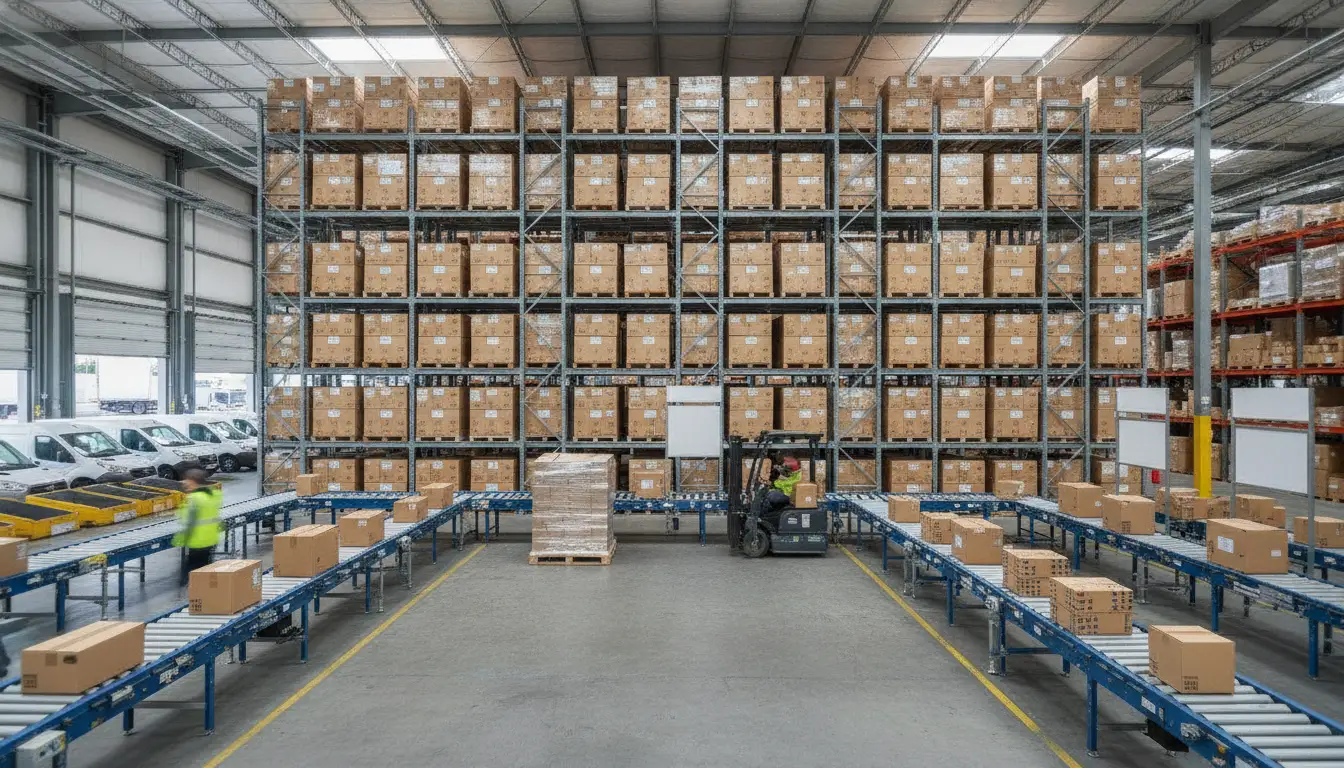
How inventory sync works across channels
The technical foundation is a Warehouse Management System (WMS) that maintains a single on-hand quantity per SKU and decrements that quantity in real time regardless of which channel placed the order. When YouParcel receives an inbound shipment, units are counted, barcode-scanned and slotted to bin locations within the facility. From that moment, every connected channel sees the same available inventory figure.
Integration is where omnichannel breaks down most often in practice. Platforms do not all speak the same language. A Shopify store sends orders via webhook in JSON format. Amazon Seller Central sends them through its own API. A retailer like Walmart or Home Depot transmits POs through EDI, often using an EDI 850 transaction set, and expects an EDI 856 advance shipment notice (ASN) in return. Without a 3PL that can natively handle all three formats, brands end up manually re-entering orders or paying for middleware that adds latency and failure points.
YouParcel connects to Shopify, Amazon, Salesforce, and 70-plus platforms, plus EDI-capable partners such as SPS Commerce and CommerceHub, so orders from every channel flow into a single queue without manual intervention. The WMS processes them in priority order based on rules the brand configures: same-day DTC orders, then marketplace SLA windows, then retailer ship-by dates.
Channel-by-channel fulfillment requirements: a comparison
| Channel type | Order format | Unit count per shipment | Packaging requirement | Carrier mode | Compliance requirement |
|---|---|---|---|---|---|
| DTC / Shopify | API / webhook | 1 to 5 units typical | Branded box or poly mailer, optional insert | Parcel (USPS, FedEx, UPS, DHL) | Consumer protection; return label |
| Amazon seller-fulfilled | Amazon SP-API | 1 to 3 units typical | Amazon ASIN label; frustration-free option | Parcel; buy shipping preferred | Amazon seller metrics; late shipment rate |
| Retail wholesale (e.g., Target, Walmart) | EDI 850 PO | Case or pallet quantities | GS1-128 carton label; UCC-128 pallet label | LTL or FTL; appointment delivery | Routing guide; ASN (EDI 856); chargeback risk |
| Marketplace (eBay, Etsy, Walmart.com) | Platform API | 1 to 4 units typical | Generic or branded; marketplace policies vary | Parcel | Platform feedback score; tracking upload |
| B2B / wholesale distributor | EDI or email PO | Case to full pallet | Master carton; inner pack count per spec | LTL, FTL or parcel depending on order size | Trading partner agreement; EDI 810 invoice |
The six operational steps for syncing orders at a 3PL
- Inbound receiving and SKU mapping. Every unit entering the warehouse is scanned against a master SKU list. If the same physical product sells under different identifiers on different channels (for example, an ASIN on Amazon and a variant ID on Shopify), the WMS maps them to a single internal SKU. This prevents phantom inventory discrepancies where one channel shows stock that another already sold.
- Integration configuration and order routing rules. During onboarding, each channel connection is configured with its credentials, webhooks or EDI trading-partner IDs. The brand defines priority rules: which orders ship same day, which can ship next business day, and how to handle channel-specific packaging profiles.
- Order import and queue management. Orders from all channels arrive in a single fulfillment queue. The WMS applies the routing rules and generates pick tasks. DTC and marketplace orders are batched for wave picking (a technique where multiple orders are picked simultaneously across bin locations to reduce picker travel time). Retail POs generate separate packing workflows that include carton-count verification and label compliance checks.
- Pick, pack and compliance labeling. Pickers follow directed paths optimized for bin slotting. For DTC, the pack station applies the brand's chosen packaging and any inserts or kitting components. For retail wholesale, the station applies GS1-128 carton labels, verifies inner pack counts and builds pallets to the retailer's specification. YouParcel supports kitting and assembly for pre-built multipacks or promotional bundles that exist across both DTC and retail channels.
- Carrier selection and shipment creation. A single 3PL working across channels can apply carrier selection logic at the order level rather than at the channel level. A DTC order might route to USPS for economy or FedEx for expedited. A retailer's routing guide might mandate a specific carrier or require the 3PL to book freight through the retailer's own carrier account. YouParcel works with USPS, FedEx, DHL, Aramex and EasyPost, plus LTL freight carriers for wholesale shipments.
- Tracking, reporting and inventory reconciliation. Once shipments leave the facility, real-time tracking events are pushed back to the originating channel (the Shopify order, the Amazon order detail, the EDI 856 ASN) and to the brand's analytics stack. YouParcel connects to Tableau and Salesforce for BI reporting, giving operations leads a single view of fill rate, on-time shipment, inventory turns and returns volume across all channels simultaneously.
Retail compliance: the part most 3PLs underestimate
Retail routing guide compliance deserves its own section because chargebacks from non-compliance can meaningfully erode wholesale margin. Major retailers publish routing guides that specify dozens of requirements: which carrier to use on prepaid shipments, how to label master cartons with a GS1-128 barcode that encodes GTIN (Global Trade Item Number), quantity and PO number, how many units constitute an inner pack, how to build mixed-SKU pallets, and what the advance shipment notice window is (commonly 24 to 48 hours before delivery).
A 3PL that primarily handles DTC orders will often treat retail POs as an afterthought. The team lacks routing guide expertise, the WMS does not generate compliant labels automatically, and the first chargeback arrives on invoice two. At YouParcel, EDI connectivity and retailer compliance support, including routing guide adherence and GS1-compliant labeling, are built into the B2B fulfillment workflow rather than bolted on. The B2B and wholesale fulfillment guide covers the EDI transaction set specifics in detail.
Inventory placement across multiple warehouses
Omnichannel brands with significant DTC volume typically benefit from splitting inventory between an East Coast facility and a West Coast facility to reduce parcel transit time and shipping cost. YouParcel operates fulfillment centers in East Hanover, NJ (20 Farinella Dr, East Hanover, NJ 07936) and Rialto, CA (3700 S. Riverside Ave, Rialto, CA 92324), as well as a facility in Illinois.
The split-inventory decision is primarily a math problem. If more than 30 to 35 percent of DTC orders ship to addresses west of the Mississippi, placing at least a portion of inventory in California typically reduces average zone distance and therefore average parcel cost. For retail wholesale, placement is driven by where the retailer's distribution centers are located: most major US retailers receive at a regional DC, so proximity matters for LTL cost and lead time.
A single omnichannel 3PL running multiple warehouses can rebalance inventory between locations without the brand managing separate relationships, purchase orders or WMS logins for each facility. Inventory rebalancing (moving units from one DC to another in response to demand shifts) is visible in a single dashboard rather than requiring manual reconciliation across vendor systems.
Returns in an omnichannel environment
Returns add complexity because the return reason and disposition path differ by channel. A DTC return typically carries a prepaid label, arrives at the warehouse within 30 days, and can be inspected and restocked for resale if it passes a grading check (unit intact, packaging intact, no signs of use). A retailer-initiated return or return-to-vendor (RTV) shipment arrives on a freight pallet with a vendor authorization number and may contain units from multiple POs. A marketplace return follows the platform's return window and condition rules.
When returns from all channels arrive at the same facility, the WMS can apply consistent grading criteria and route units to the right disposition: restock to sellable inventory, transfer to a secondary channel, quarantine for vendor review, or liquidate. This is meaningfully more efficient than managing separate return flows per channel. YouParcel handles returns processing, grading and restocking as part of its reverse logistics services, which integrates with the same WMS that handles outbound fulfillment.
Technology: what integrations actually matter for omnichannel
The integration layer is often where brands feel the most friction when consolidating to a single 3PL. The question to ask any prospective omnichannel 3PL is not just which platforms it connects to, but how: native API connection, EDI VAN (Value Added Network) connectivity, or a middleware aggregator that introduces its own latency and failure modes.
Key integrations for an omnichannel brand typically include:
- Storefront: Shopify, WooCommerce, BigCommerce, Magento or Squarespace
- Marketplace: Amazon Seller Central, eBay, Walmart Marketplace, Etsy, Newegg
- Retail EDI: SPS Commerce, CommerceHub, TrueCommerce, or direct VAN connections to specific retailers
- ERP or inventory management: Oracle NetSuite, SAP, QuickBooks, Zoho Inventory
- Analytics: Tableau, Salesforce, Power BI, Zoho Analytics
- Returns: Loop Returns, Returnly, Happy Returns, Narvar
YouParcel integrates with all of the above categories. The ecommerce fulfillment services overview explains how these integrations fit into the broader fulfillment workflow for brands at different stages of growth.
For a deeper look at how omnichannel selling specifically affects platform selection, the omnichannel industry page outlines the service configuration options available to brands with complex channel mixes.
When does consolidating to one omnichannel 3PL make financial sense?
The consolidation case is strongest when a brand meets two or more of the following conditions:
- It is paying pick-and-pack fees to one 3PL for DTC and storage fees to another for retail inventory, with no shared rate benefit on either.
- It spends more than four hours per week manually reconciling inventory counts between channel dashboards.
- It has received retailer chargebacks in the past 12 months for label errors, early or late delivery, or ASN discrepancies.
- Its DTC carrier rates are negotiated on DTC volume alone, leaving wholesale and marketplace shipments at list rates.
- Returns are arriving at a facility that has no restocking workflow, creating dead inventory.
According to the U.S. Census Bureau retail trade data, omnichannel retail continues to represent a growing share of total US retail sales, which means the operational gap between brands that have consolidated logistics and those that have not widens each year. Brands managing 500-plus orders per day across three or more channels typically see the clearest ROI from consolidation because fixed costs (integration setup, WMS licensing within the 3PL fee structure) are spread across larger volume.
For a framework on evaluating 3PL providers specifically for omnichannel capability, the Council of Supply Chain Management Professionals publishes annual state-of-logistics benchmarks that contextualize fulfillment cost as a percentage of revenue by channel type.
Practical configuration: what to set up before go-live
- SKU rationalization. Before sending inventory to a new 3PL, audit your SKU list. Remove discontinued variants, consolidate SKUs that share the same physical unit, and confirm that every SKU has a scannable barcode (GS1 GTIN or UPC). A 3PL cannot accurately receive what it cannot scan.
- Channel credential handoff. Provide API credentials for each storefront and marketplace. For EDI channels, identify the trading partner IDs and the ISA qualifier your existing EDI provider or the retailer's VAN uses.
- Packaging profile configuration. Define at least one packaging profile per channel type: box dimensions and weight for DTC, branded insert specs, poly mailer dimensions for light SKUs, and master carton specs for wholesale. These drive dimensional weight calculations and carrier rate shopping at the order level.
- Routing guide library. If you sell to two or more retail accounts, compile their routing guides into a single document set and hand them to your 3PL's compliance team before the first PO arrives. Do not wait for the first shipment to discover label format discrepancies.
- Return disposition rules. Define grading criteria: what condition makes a unit restockable, what triggers quarantine, and what the liquidation threshold is. These rules should be in writing and loaded into the WMS before the first return arrives.
- Analytics access. Confirm which team members need reporting access and to which data objects: inventory on hand, order status, shipment tracking, returns volume. Connect your Tableau, Salesforce or equivalent instance to the 3PL's data feed during onboarding, not after.
Frequently asked questions
What is the difference between multichannel fulfillment and omnichannel fulfillment?
Multichannel fulfillment means shipping from separate inventory pools dedicated to each channel: one stock position for DTC, another for Amazon, another for retail. Omnichannel fulfillment uses a single shared inventory pool that any channel can draw from, reducing safety stock requirements and eliminating the risk of overselling on one channel while another channel holds surplus units.
Can one 3PL really handle both DTC parcel orders and retail wholesale pallet shipments?
Yes, but only if the 3PL has the technology and physical infrastructure for both. Retail wholesale requires EDI connectivity, GS1-compliant labeling, routing guide expertise and access to LTL or FTL freight carriers in addition to parcel. YouParcel supports EDI, retailer compliance and both parcel and freight carrier modes from the same warehouse facilities.
How does a 3PL handle inventory allocation when one channel sells faster than expected?
A properly configured WMS applies channel allocation rules: for example, reserving a minimum quantity for open retail POs before allowing DTC orders to draw down the same units. These rules are set during onboarding and can be adjusted in real time. Real-time inventory visibility ensures that no channel is overselling against stock that is already committed to another.
What happens to returns from retail partners in an omnichannel 3PL model?
Retailer return-to-vendor (RTV) shipments are received on freight, logged against the original PO, and graded by the same inspection criteria as DTC returns. Units that pass grading can be restocked into the shared inventory pool and resold through any channel. Units that do not pass are segregated for liquidation, vendor dispute or disposal per the brand's instructions.
How long does it take to onboard an omnichannel brand to a new 3PL?
A straightforward DTC-only onboarding can take two to four weeks. Adding EDI retail channels typically extends the timeline by two to four additional weeks for trading partner setup and compliance testing. Brands with a large number of active retail accounts, complex kitting requirements or multiple WMS integrations should plan for six to ten weeks total, with a parallel-run period before cutting over fully from the previous provider.
If your brand is managing DTC, retail and marketplace orders through separate providers and the reconciliation overhead is growing faster than the business, it is worth a direct conversation about what consolidation would look like for your specific channel mix. Create a YouParcel account to get started, or reach out through our Talk to an Expert page to discuss your omnichannel fulfillment requirements with the team.
Related reading: Amazon FBA USA for Indian Sellers After the IEEPA Ruling: FBA Prep and a US 3PL