

Shipping from Australia to USA means sending individual orders internationally from an Australian origin, incurring customs duties on every parcel under current US trade rules. For Australian DTC brands, the more cost-effective long-term alternative is pre-positioning stock inside a US fulfillment center like YouParcel, which ships domestically to American customers, cutting transit times and eliminating per-order import complexity.
- Australia Post partially suspended US-bound postal goods from 26 August 2025, disrupting brands that relied on postal channels; a phased resumption was reported by 9 September 2025 but carrier reliability remains a live concern.
- The US de minimis exemption (duty-free treatment for shipments under USD 800) was suspended for all countries effective 29 August 2025 under Executive Order 14324, meaning every parcel now carries potential duty liability regardless of value.
- Shipping per order from Australia remains viable for low-volume, high-margin or made-to-order products, provided landed costs and customs compliance are built into pricing from the start.
- A US warehouse operated by a 3PL eliminates per-order cross-border complexity, compresses delivery windows and typically lowers unit shipping costs at meaningful order volumes.
What changed in mid-2025 and why Australian brands are re-evaluating
Two regulatory events landed in quick succession and changed the economics of selling into the US from Australia.
First, Australia Post partially suspended acceptance of postal goods destined for the United States from 26 August 2025. The disruption stemmed from uncertainty around new US customs data requirements. A phased resumption via Zonos was reported around 9 September 2025, according to coverage in The New Daily (The New Daily, 9 September 2025). Even with partial resumption, the episode exposed how fragile a single-carrier postal strategy can be.
Second, and more structurally significant, the United States suspended de minimis duty-free entry for shipments from all countries. Under the previous rule, parcels valued under USD 800 entered the US duty-free under Section 321. Executive Order 14324 and the accompanying CBP CSMS Notice #66065494, effective 29 August 2025, ended that treatment (CBP CSMS #66065494, 29 August 2025). Every commercial shipment entering the US now requires a formal entry and is subject to applicable duties and fees. For Australian brands that relied on low-value parcel exemptions to keep landed costs attractive, the margin impact is material.
These two events together make September 2025 a natural decision point: do you continue shipping per order from Australia, absorbing the new cost and compliance layer, or do you pre-position inventory inside the US?
How each model works in practice
Model A: Ship each order from Australia
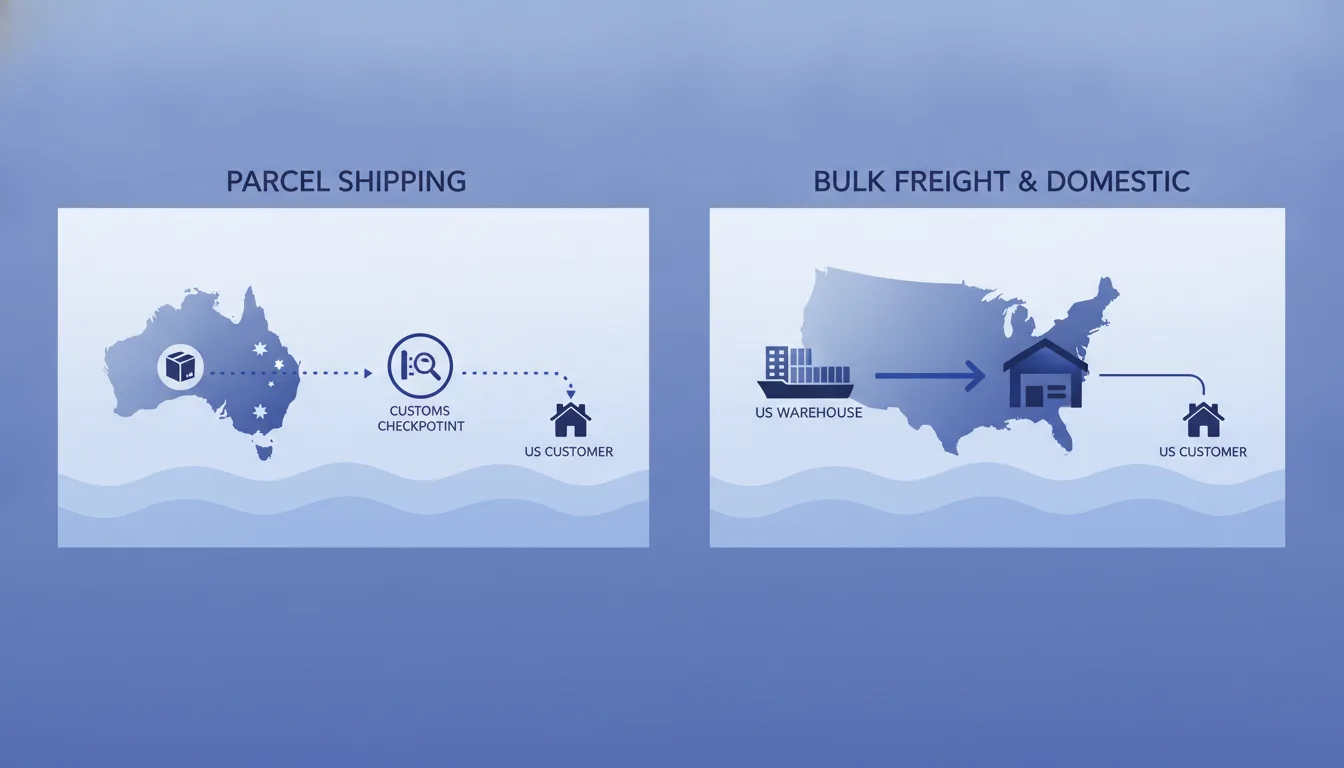
Under this model, you hold inventory in Australia and ship individual orders internationally to US customers after each sale. Carriers typically used include DHL Express, FedEx International, and Aramex. Express services can deliver in roughly three to seven business days from Australia; economy options run longer, often ten to twenty-one days, depending on service level and customs clearance.
Each parcel enters the US as a commercial importation. Duties are assessed on the declared customs value using the applicable Harmonized System (HS) tariff code. The importer of record (IOR) is typically the end customer under Delivered Duty Unpaid (DDU) Incoterms, meaning they receive a duty demand before delivery, which generates friction, cart abandonment and returns. Under Delivered Duty Paid (DDP) Incoterms, you collect duty at checkout and remit it, which smooths the customer experience but requires accurate duty calculation upfront. YouParcel does not act as importer of record; brands operating DDP models should work with a licensed customs broker or a carrier with embedded customs brokerage services to manage IOR obligations correctly.
Dimensional weight (dim weight) is relevant here. International carriers calculate freight charges as the greater of actual weight or dim weight. The standard international divisor is 5,000 cubic centimetres per kilogram (or 139 cubic inches per pound for US-unit billing). A 30 cm x 25 cm x 20 cm box has a dim weight of 3.0 kg. If your product weighs 1.2 kg actual, you are billed at 3.0 kg. Packaging optimisation has a direct dollar impact on every shipment.
Model B: Pre-position stock in a US fulfillment center
Under this model, you ship a consolidated freight consignment from Australia to a US warehouse, clear customs once at the bulk level, and then ship individual orders domestically to US customers from that warehouse. The domestic leg uses carriers such as USPS, FedEx or UPS at domestic parcel rates, with typical transit times of one to five business days across the continental US.
The inbound freight from Australia is a commercial import, so you still need to handle US customs clearance, pay applicable duties and work with a licensed customs broker or freight forwarder. The critical difference is that you pay duties once on the bulk shipment rather than on every individual order. YouParcel's freight forwarding service can manage the inbound ocean or air freight leg from Australia into its US fulfillment network; you can find more detail at international freight forwarding with YouParcel.
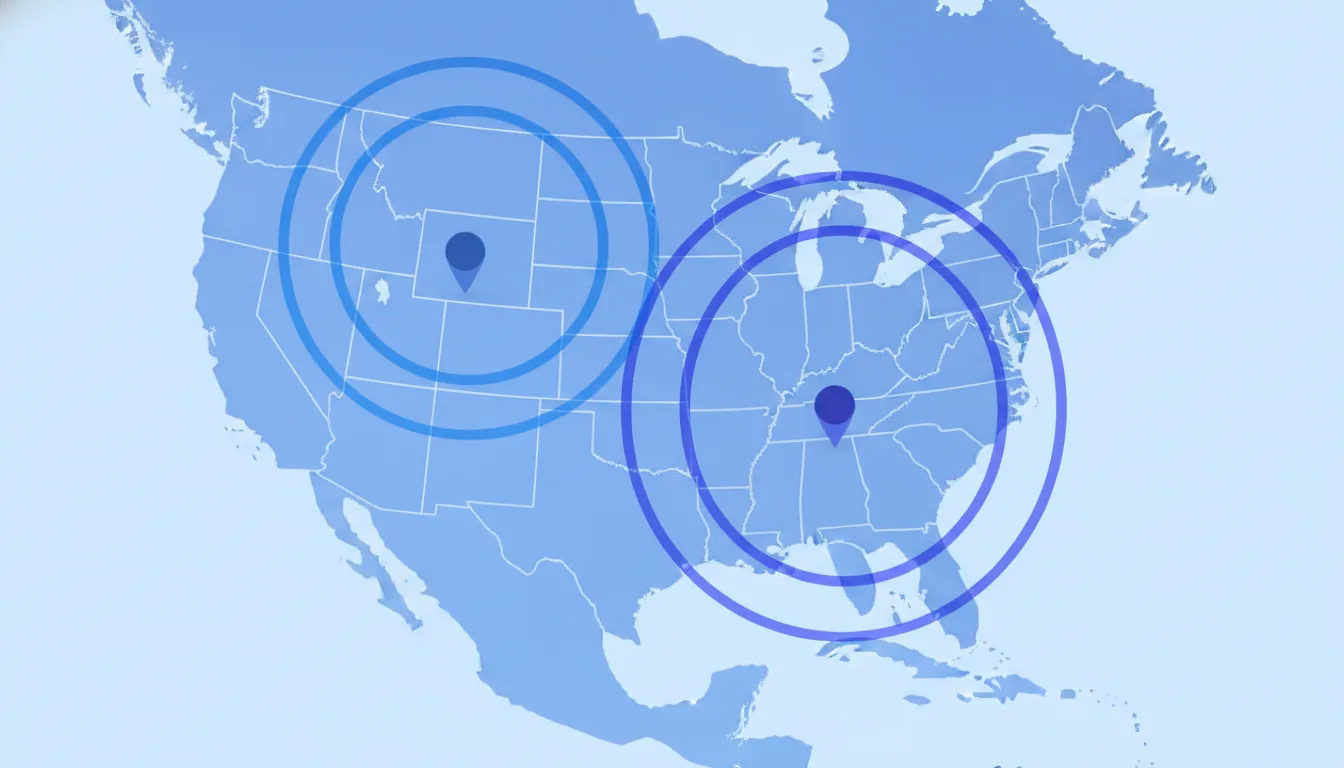
Once stock is on the ground in the US, YouParcel's fulfillment centers in New Jersey (serving the NY/NJ corridor and East Coast) and California (serving the West Coast and international gateway traffic) handle pick, pack and dispatch. The New Jersey facility is located at 20 Farinella Dr, East Hanover, NJ 07936, and the Southern California facility is at 3700 S. Riverside Ave, Rialto, CA 92324. Choosing the right facility, or splitting inventory across both, depends on where your US customer base is concentrated.
Head-to-head comparison
| Factor | Ship per order from Australia | US fulfillment center (3PL USA) |
|---|---|---|
| Customs duty per order | Yes, on every parcel; IOR complexity for each shipment | Paid once on bulk inbound freight; domestic orders are duty-free |
| Delivery speed to US customer | 3 to 21 business days depending on service | 1 to 5 business days (domestic parcel) |
| Carrier disruption risk | High: a single postal or carrier suspension halts all orders | Low: domestic multi-carrier options (USPS, FedEx, DHL) |
| Per-unit shipping cost at scale | Higher: international express rates per parcel | Lower: bulk inbound amortised; domestic rates at volume |
| Inventory capital requirement | Low: ship from existing stock in Australia | Higher: need US stock buffer and inbound lead time |
| Cash flow and demand forecasting | Simple: make-to-order or reactive restocking | Requires demand forecasting to avoid overstock or stockouts |
| Returns handling | Complex: international returns are expensive and slow | Straightforward: US domestic reverse logistics |
| Customer experience | Risk of duty demands at delivery under DDU | Consistent domestic delivery expectations |
| Minimum viable volume | Any volume; good for testing | Best from roughly 200 to 300+ US orders per month |
When shipping per order from Australia still makes sense
Not every Australian brand should immediately move stock into a US warehouse. Shipping per order from Australia works well when:
- You are testing the US market and US order volume is not yet predictable or consistent.
- Your products are made-to-order, personalised or perishable, making pre-positioned stock impractical.
- Average order values are high enough that express shipping costs and prepaid duties represent a small percentage of revenue.
- Your product range changes frequently, making large inbound freight shipments to a US warehouse commercially risky.
In these cases, the immediate priority is customs compliance and carrier redundancy. Working with a licensed Australian customs broker and an international freight forwarder ensures you have the right HS code classifications, correct valuation, and the paperwork that CBP requires under the post-de-minimis regime. Using multiple carriers (not solely Australia Post postal channels) reduces the kind of disruption seen in August 2025.
When a US warehouse (3PL USA) is the right call
Moving inventory into a US fulfillment center becomes the more logical model when:
- You are consistently shipping more than a few hundred US orders per month and want to reduce per-unit landed costs.
- Your customers expect two-to-five-day delivery, which is difficult to promise from an Australian origin.
- You are selling on Amazon US, where Prime eligibility requires domestic fulfillment.
- Returns are generating friction: a US-based reverse logistics process is far cheaper and faster than routing returns to Australia.
- You want to reduce exposure to currency fluctuations on shipping invoices billed in AUD for international freight.
YouParcel's US ecommerce fulfillment service handles the full domestic cycle: inbound receiving, storage, pick and pack, multi-carrier dispatch and returns processing. The platform integrates with Shopify, Amazon and 70+ other platforms, so orders from your Australian Shopify store or Amazon US listing flow directly into the fulfillment workflow without manual intervention. Real-time tracking and BI analytics give you visibility across inventory levels, order status and carrier performance.
The inbound freight step that Australian brands often underestimate
Moving stock from Australia to a US warehouse is itself a logistics and customs event that requires planning. The two main modes are ocean freight (lower cost, longer lead time, typically four to six weeks port-to-port from major Australian ports to the US West Coast) and air freight (faster, typically five to ten business days, but significantly more expensive per kilogram).
On arrival in the US, a customs entry must be filed. For shipments with a total value over USD 2,500, a formal entry is required and a customs broker must be engaged. You need accurate HS codes for all SKUs, a commercial invoice, packing list and, depending on the product category, possibly import permits or certifications (for example, USDA permits for certain materials). A licensed customs broker handles the entry filing and duty payment; YouParcel does not act as importer of record but can connect you with freight forwarding options through its freight forwarding service to coordinate the inbound leg.
The key forecasting input is lead time: if your inbound freight takes five to six weeks, your US safety stock needs to cover that replenishment cycle plus a buffer for demand variability. Getting this wrong means stockouts on Amazon or your Shopify store, which damages ranking and customer trust.
A practical decision framework for Australian brands
- Quantify your current US volume. Pull your last three to six months of US order data. Calculate total units, average order value, and average shipping cost per order from Australia including any duty collected or absorbed.
- Model the landed cost under both scenarios. For the per-order model, add international freight, duty at the applicable tariff rate for your HS codes, and any brokerage or disbursement fees. For the US warehouse model, add inbound freight amortised across expected units, US 3PL storage and pick-and-pack fees, and domestic outbound shipping. Compare total cost per order delivered to the US customer under each model.
- Assess your demand predictability. If US demand is stable and growing, the inventory risk of pre-positioning stock in the US is manageable. If demand is lumpy or seasonal, consider a hybrid: maintain a base level of fast-moving SKUs in the US warehouse and fulfill slow-moving or new SKUs from Australia until demand signals are clear.
- Audit your HS code library. Every SKU needs a correct 10-digit HTS (Harmonized Tariff Schedule) code for US import. Errors lead to wrong duty rates, delays and potential penalties. A licensed customs broker should validate these before you scale either model.
- Review your returns policy. If your current returns rate is non-trivial, price the cost of Australian return routing into the per-order model comparison. US domestic returns processing through a 3PL is almost always cheaper.
- Choose your US fulfillment locations strategically. YouParcel operates fulfillment centers in New Jersey and California. If the majority of your US customers are on the East Coast, New Jersey minimises domestic transit time and cost. If they are broadly spread or concentrated on the West Coast, California or a split-inventory strategy works better.
What about returns? Reverse logistics from the US
Returns are often the last thing Australian brands plan for and the first thing that creates operational chaos at scale. Under the per-order-from-Australia model, a US customer who wants to return a product either ships it back to Australia at high cost (which you typically absorb or refund) or you write off the item and issue a refund without requiring a physical return. Neither is sustainable at volume.
With stock pre-positioned in a US fulfillment center, returns are processed domestically. YouParcel handles inbound returns: the item is received, inspected and either restocked, quarantined for quality review, or disposed of per your instructions. This creates a closed loop that keeps your US inventory accurate and reduces the cost and complexity of reverse logistics to a manageable domestic operation.
Frequently asked questions
Can I still ship from Australia to USA after the de minimis suspension?
Yes. Shipping from Australia to USA is still possible, but every commercial parcel now requires a formal customs entry and is subject to applicable US duties regardless of value. You need to account for duty costs in your pricing and either collect them at checkout (DDP) or risk delivery failures and customer disputes (DDU). Work with a licensed customs broker to ensure compliance.
How many US orders per month justify moving to a US warehouse?
There is no universal threshold, but most brands find the unit economics shift in favour of a US fulfillment center somewhere between 200 and 500 orders per month. Below that, the inventory capital requirement and inbound freight cost per unit can outweigh the savings. The best approach is to model both scenarios with your actual SKU weights, margins and shipping costs.
Does YouParcel act as importer of record for Australian brands shipping into the US?
No. YouParcel does not act as importer of record. Australian brands need to appoint a licensed US customs broker to file the import entry and serve as or arrange for the IOR. YouParcel can coordinate the freight forwarding leg to bring stock into its US warehouses, but customs brokerage is a separate engagement.
Which US fulfillment center location is better for Australian brands: New Jersey or California?
California is the natural first choice for Australian brands because inbound ocean freight from major Australian ports (Sydney, Melbourne, Brisbane) typically routes through the US West Coast, reducing inbound freight cost and transit time. If your US customer base is heavily concentrated on the East Coast, splitting inventory between California and New Jersey (or starting in New Jersey once you have an air freight inbound lane) can improve domestic delivery performance.
What carriers does YouParcel use for domestic US delivery?
YouParcel ships domestically via USPS, FedEx, DHL and other carriers depending on service level, parcel dimensions and destination. The platform selects carrier and service based on your requirements and uses real-time tracking so you and your customers have visibility at every stage.
If you are an Australian brand ready to evaluate a US fulfillment strategy, whether you are shipping a few hundred orders a month or scaling toward thousands, the clearest next step is a direct conversation about your volume, SKU profile and timeline. Talk to an expert at YouParcel to model the right approach for your business.