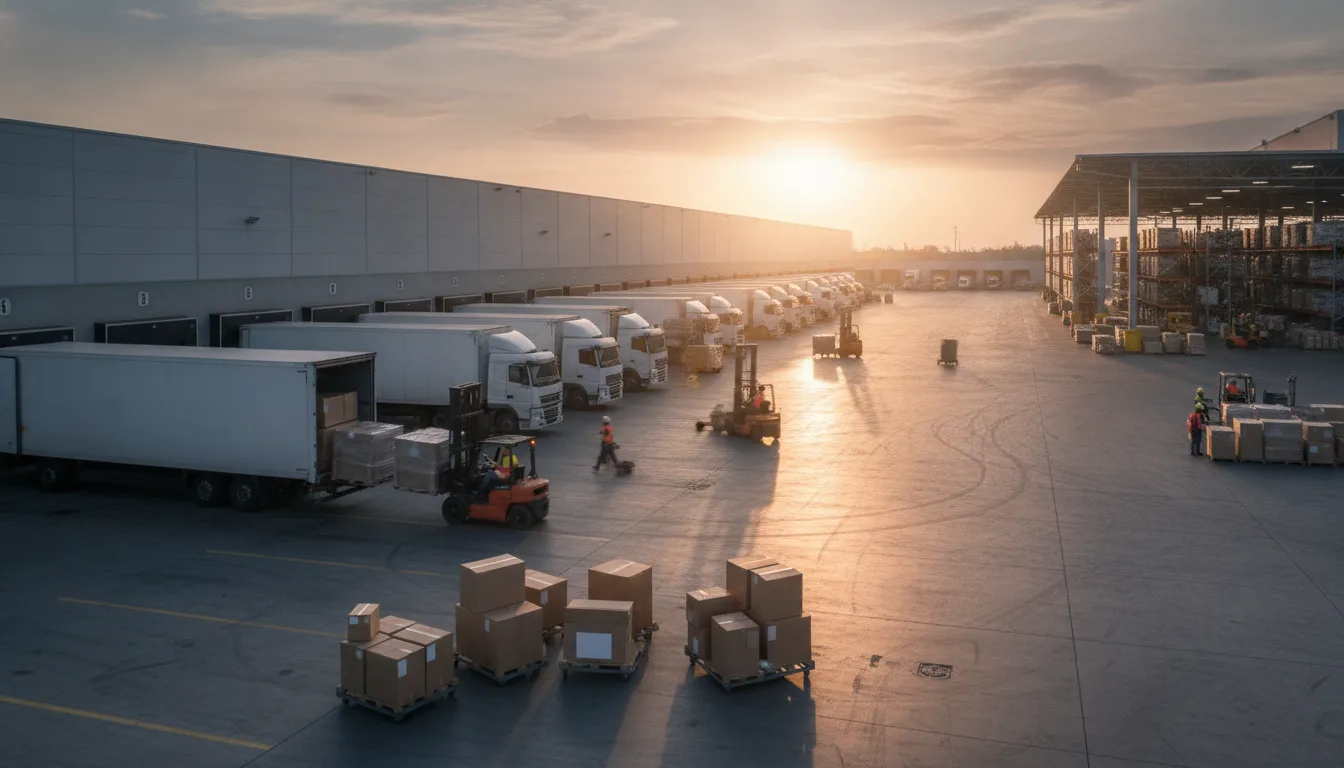


A 3PL USA strategy for Australian brands almost always starts on the West Coast. Because Australian exports travel east across the Pacific, ocean containers and air freight naturally arrive at California ports first, which means placing inventory at a California fulfillment center reduces inbound freight costs, shortens the domestic shipping leg to western US buyers, and gives you a faster path to your first American orders. YouParcel operates a fulfillment center at 3700 S. Riverside Ave, Rialto, CA 92324, positioned to receive Pacific inbound freight and reach West Coast consumers efficiently.
- Pacific inbound lanes (ocean and air) land in California first, making a West Coast fulfillment node the most cost-efficient entry point for Australian inventory.
- US customs rules changed significantly in 2025: low-value parcels no longer enter duty-free, so landed cost planning with a licensed customs broker is essential before your first shipment.
- A single California warehouse covers a meaningful share of the US population within one to two ground-shipping zones; adding an East Coast node extends that reach substantially.
- YouParcel offers both a Southern California and a New Jersey fulfillment center, so Australian brands can scale from a single node to a multi-warehouse model without changing partners.
Why Australian Brands Look to the US Market
The United States is the world's largest single ecommerce market by revenue. For Australian brands, particularly those in health, beauty, apparel, homewares and specialty food, American consumers represent a volume opportunity the domestic market cannot match at the same scale. The challenge is logistics: Australia sits roughly 12,000 kilometres from Los Angeles by air and considerably further by sea, and shipping individual parcels from Australia to US consumers is expensive, slow and increasingly complex from a customs standpoint.
The practical answer is to hold inventory inside the United States, fulfill orders domestically, and treat international freight as a bulk inbound movement rather than a per-order cost. That is the core proposition of working with a US fulfillment partner, sometimes called a third-party logistics provider (3PL): you ship a pallet or container to the warehouse, the 3PL receives and stores your stock, and US orders ship from inside the country using domestic carrier rates and transit times.
How Pacific Inbound Lanes Determine Your First Warehouse Location
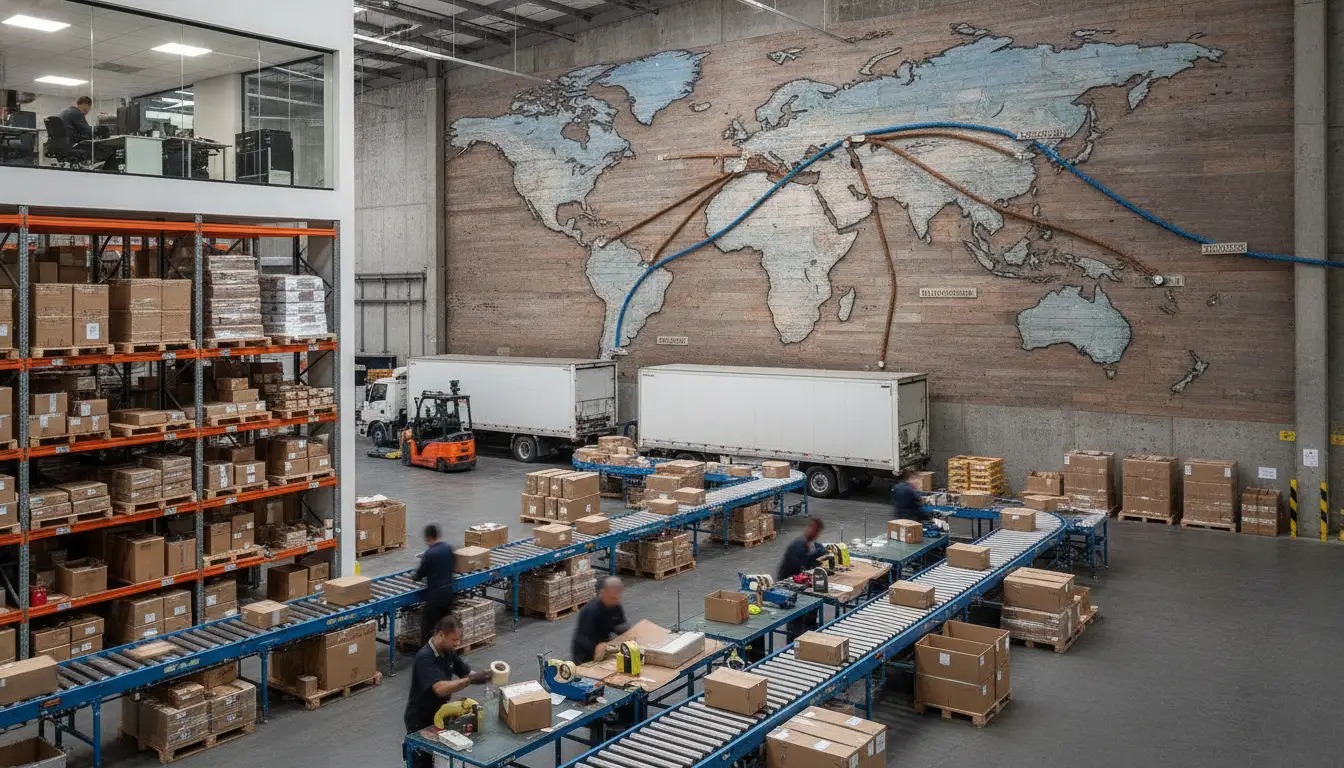
Freight routing is not arbitrary. When you consolidate goods in Sydney, Melbourne or Brisbane and book an ocean container or air freight shipment to the US, the cargo moves east across the Pacific. The dominant gateway ports on the US West Coast are Los Angeles and Long Beach in Southern California, which together handle a large share of trans-Pacific container volume. Seattle and Oakland handle additional Pacific traffic, but Southern California is the primary hub for Australian exporters.
Choosing a fulfillment center in California that sits close to one of these ports reduces drayage costs. Drayage is the short-haul truck movement from a port or rail terminal to a warehouse, typically charged per container, and it is one of the costs that brands underestimate when setting up US distribution. A warehouse in the Inland Empire region of Southern California, which includes the area around Rialto and Ontario, sits close to the Port of Los Angeles and Long Beach and is one of the most established logistics corridors in the country.
YouParcel's Southern California fulfillment center at 3700 S. Riverside Ave, Rialto, CA 92324 is located in this corridor. Inbound containers from Australian ports arrive nearby, which keeps drayage distances short and allows the warehouse team to receive and process inventory quickly after port clearance.
Air Freight Considerations
Some Australian brands, particularly those selling high-value, low-weight goods such as skincare or nutraceuticals, use air freight for initial stock or for replenishment when ocean lead times are too long. Los Angeles International Airport (LAX) and San Francisco International Airport (SFO) are the main Pacific air gateways. A California warehouse receives air freight quickly, processes it, and has stock available for orders within days of landing, which matters during launch periods or peak season restocking.
US Customs: What Changed for Australian Exporters
Australian brands entering the US market must understand that the duty-free de minimis threshold, which once allowed low-value shipments to enter the United States without customs duties, has been suspended. The suspension took effect on 29 August 2025, following a Federal Register notice, and applies broadly to goods regardless of country of origin.
This means individual parcels shipped directly from Australia to US consumers are now subject to formal customs entry and applicable duties, regardless of their declared value. The practical implication for brands considering a direct-to-consumer cross-border model is that duties, brokerage fees and compliance costs must be factored into every order's landed cost, making the economics of direct shipment from Australia considerably less attractive than they appeared before August 2025.
Placing inventory inside the United States through a 3PL changes this picture. Once goods clear US customs on arrival at the warehouse, they are in the domestic supply chain. Orders ship from a US address to a US address, so no additional customs events occur at the point of sale. The customs event happens once, on the inbound bulk shipment, and a licensed customs broker manages that process on your behalf.
YouParcel does not act as importer of record (IOR). The importer of record is the legal entity responsible for the accuracy of the customs entry, payment of duties and compliance with US import regulations. Australian brands typically need to establish a US legal entity to act as their own IOR, or appoint a licensed customs broker or a specialist IOR service provider to take on that role. This is a legal and compliance matter; consult a licensed US customs broker before your first inbound shipment. The US Customs and Border Protection guidance on importers of record is a useful starting point for understanding the obligations involved.
Your customs broker will also need to file an Importer Security Filing (ISF), sometimes called a 10+2 filing, for ocean freight at least 24 hours before cargo is loaded at the origin port. Late or inaccurate ISF filings attract CBP penalties, so coordinate this with your freight forwarder early in the planning process.
For goods of Australian origin, confirm the applicable Harmonized Tariff Schedule (HTS) codes and current duty rates with your broker. Tariff classifications and rates can change, and what applied to your product category in a previous year may not reflect the current schedule.
What a California Fulfillment Center Actually Does for Your Brand
A US ecommerce fulfillment center is more than a storage shed. The operational workflow from inbound receipt to customer delivery involves several distinct steps that affect your cost per order and your customer experience.
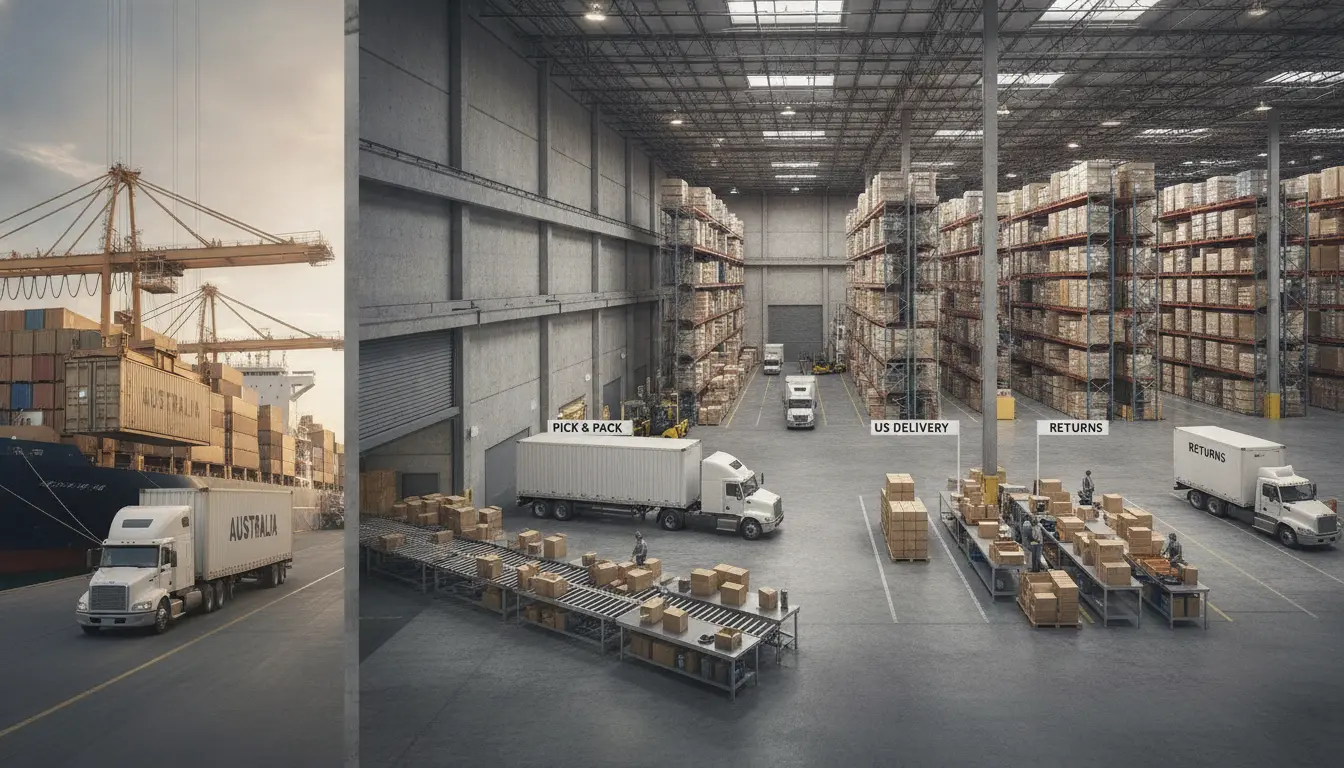
- Inbound receiving: The warehouse team unloads your container or pallets, counts units against your advance shipping notice (ASN), inspects for damage, and assigns stock to bin locations. Accurate receiving is critical: discrepancies found at this stage are far easier to resolve than inventory shrinkage discovered weeks later.
- Putaway and slotting: Units are placed in storage locations according to pick velocity and product dimensions. Fast-moving SKUs are slotted closer to the pick area to reduce travel time per order.
- Order management integration: Your orders flow in from Shopify, Amazon or other sales channels via direct integration. YouParcel integrates with Shopify, Amazon and 70+ other platforms, so orders appear in the warehouse management system automatically.
- Pick and pack: When an order is received, a picker retrieves the correct items and a packer prepares them for shipment, applying branded packaging, inserts or kitting instructions as specified.
- Kitting and assembly: If your product requires bundling, gift-set assembly or subscription box packing, these value-added services happen at this stage before items are packed for shipment.
- Carrier handoff: The packed order is labelled and handed to the outbound carrier: USPS, FedEx, DHL, Aramex, EasyPost or others, depending on the destination, weight and service level selected.
- Tracking and confirmation: Real-time tracking data flows back through the integration so your system and your customer both receive shipment confirmation and tracking numbers automatically.
YouParcel provides real-time tracking and alerts, BI and analytics reporting, and hands-on customer service, which gives Australian brand operators visibility into their US inventory and order flow without needing someone physically on the ground in California.
Dimensional Weight and Packaging for US Domestic Shipments
US domestic carriers bill on the greater of actual weight or dimensional weight (also called DIM weight). The dimensional weight formula for most domestic US carriers uses a divisor of 139 (imperial: length x width x height in inches, divided by 139). A box measuring 18 x 12 x 10 inches has a dimensional weight of 15.5 lb. If the actual product weighs 6 lb, you are billed at 15.5 lb.
Australian brands accustomed to Australia Post's domestic pricing structure may find US carrier dimensional weight billing materially affects their per-order costs. Right-sizing your packaging before the first shipment, and testing packaging specifications with your 3PL before launch, is worth the effort. A 10 percent reduction in box volume across 500 orders a month compounds into meaningful savings over a quarter.
Which US Regions Does a California Warehouse Serve Well?
| Region | Approximate population share | Ground shipping zones from Southern California | Typical ground transit range (indicative, no guarantee) |
|---|---|---|---|
| California, Nevada, Arizona | ~14% | Zone 1-2 | 1-2 business days |
| Pacific Northwest (WA, OR) | ~4% | Zone 3 | 2-3 business days |
| Mountain West (CO, UT, NM, ID) | ~4% | Zone 3-4 | 2-3 business days |
| Midwest (IL, OH, MI, MN) | ~17% | Zone 5-6 | 3-5 business days |
| South (TX, FL, GA) | ~20% | Zone 5-7 | 4-6 business days |
| Northeast (NY, NJ, MA, PA) | ~17% | Zone 7-8 | 5-7 business days |
Transit ranges above are general industry illustrations based on carrier zone maps and are not a guarantee of any specific delivery outcome. Actual transit times vary by carrier, service level, peak periods and destination address type.
A California-only distribution model works well when your customer base is concentrated in the western US or when your order volume does not yet justify the cost of a second warehouse. As volume grows and you gather data on where your US orders are coming from, the case for adding an East Coast node becomes clearer.
When to Add an East Coast or Midwest Location
Adding a second warehouse is not a decision to make on instinct. The relevant signals are order geography, carrier costs and customer satisfaction data.
Signals That Point to a Second Node
- Order concentration: If 40 percent or more of your US orders are shipping to addresses east of the Mississippi River, a significant share of those orders is traveling through high-cost, long-transit zones from California. A New Jersey node would serve those customers from a shorter distance.
- Carrier cost per order: Zone 7 and Zone 8 shipments from California carry substantially higher ground rates than Zone 2 or Zone 3 shipments. If your average order is shipping at Zone 6 or above, split inventory almost certainly reduces your blended carrier cost per order.
- Customer experience targets: Brands that compete on fast delivery and have a high share of eastern US customers may find that ground shipping from California cannot meet their delivery speed targets for those customers without upgrading to more expensive air or express services.
- Inventory volume: Operating two warehouses requires enough stock to keep both locations at safe inventory levels. Most operators find two-node inventory viable when they can maintain at least 30 to 60 days of cover at each location without tying up excessive working capital.
YouParcel's East Coast Option
YouParcel's New York and New Jersey fulfillment center is located at 20 Farinella Dr, East Hanover, NJ 07936. This facility serves the densely populated Northeast corridor and is positioned to reach a large share of the US population in the eastern states via ground shipping. For Australian brands that have established West Coast distribution and are seeing strong demand from New York, New England, the Mid-Atlantic states and the Southeast, the New Jersey facility provides a natural second node without the complexity of switching partners.
For a full overview of storage configurations, inbound receiving workflows and how inventory is managed across multiple locations, visit the YouParcel warehousing and storage service page.
Multi-Warehouse Inventory Allocation
When you operate two nodes, inventory allocation becomes an active management task. A common approach is to split SKUs proportionally to historical order geography: if 35 percent of orders ship to the East Coast, hold roughly 35 percent of each SKU's safety stock in New Jersey. Fast-moving SKUs with low replenishment lead times can be weighted more heavily toward the node that serves the majority of demand. Slow-moving or bulky SKUs may be consolidated at a single location to avoid double handling and storage costs.
YouParcel's BI and analytics reporting gives brands the order-level data needed to make these allocation decisions from real demand signals rather than estimates.
Incoterms and Freight Planning for Australian Exporters
Incoterms are internationally recognised trade terms that define where responsibility for goods, freight costs and risk transfers between a seller and a buyer. For Australian brands shipping inventory to a US fulfillment center, the two most common structures are:
- FOB (Free on Board) origin: Your responsibility ends when the goods are loaded onto the vessel at the Australian port. Your freight forwarder manages the ocean freight, and you or your customs broker handle US import clearance.
- DDP (Delivered Duty Paid): The seller is responsible for all costs and risk through to the named destination, including US import duties and customs clearance. This is less common for B2B inventory movements to a 3PL warehouse but is sometimes used for direct-to-consumer shipments where you want to control the full landed cost experience.
Most Australian brands shipping to a US 3PL warehouse use an FOB or similar structure and work with a freight forwarder who manages the ocean or air movement, and a licensed US customs broker who handles the customs entry. The International Chamber of Commerce publishes the current Incoterms 2020 rules, which are the authoritative reference for these terms.
Platform Integrations: Connecting Your Shopify or Amazon Store
Most Australian brands selling in the US run their DTC store on Shopify and may also sell on Amazon US, either through Fulfilled by Merchant (FBM) or as a hybrid alongside Fulfillment by Amazon (FBA). YouParcel integrates directly with Shopify and Amazon, as well as Salesforce, Tableau and 70+ other platforms, so order data flows automatically from your sales channels to the California warehouse without manual intervention.
For brands using Amazon FBA alongside a 3PL, the California location can serve as an FBA prep and inbound staging point: inventory arrives from Australia, is processed and prepped to Amazon's labeling and packaging requirements, and is then sent to Amazon's fulfillment network. This avoids sending non-compliant goods directly to an Amazon fulfillment center and risking receiving rejections or chargebacks.
Returns: Planning for US Customer Return Flows
US consumers expect easy returns. A California fulfillment center that ships outbound orders also handles inbound returns, which is called reverse logistics. When a customer in San Francisco or Seattle returns a product, it ships back to the California warehouse, where the returns team inspects, grades and either restocks, refurbishes or disposes of the item according to your returns policy.
Australian brands should define their returns policy for the US market before launch, not after the first returns come in. Key decisions include: the return window (30, 60 or 90 days is common in US ecommerce); whether you offer prepaid return labels; how you grade returned goods (sellable, damaged, unsellable); and what happens to unsellable stock. These parameters determine both your customer experience and your reverse logistics cost per return.
Getting Started: Practical Steps for Australian Brands
- Audit your product catalog: Confirm HS codes, product dimensions, weights and any US regulatory requirements (FDA registration for food or cosmetics, CPSC compliance for certain consumer goods, FCC for electronics). This affects both customs clearance and warehouse handling requirements.
- Appoint a licensed US customs broker: Do this before booking your first inbound shipment. Your broker will advise on current duty rates for your product category, ISF filing requirements and any admissibility issues specific to your goods.
- Establish your IOR status: Determine whether you will form a US entity to act as your own importer of record, or engage a specialist IOR service provider. This decision affects your customs entry documentation and your long-term tax and compliance obligations in the US.
- Plan your inbound freight: Work with a freight forwarder experienced in the Australia-to-US lane. Confirm whether ocean LCL (less than container load) or FCL (full container load) is appropriate for your initial volume, or whether air freight is justified for your first launch shipment.
- Agree on warehouse setup with your 3PL: Before your first container ships, confirm storage configuration, SKU labeling requirements, kitting or assembly instructions, packaging specifications and integration setup with your sales platforms.
- Set your inventory allocation: Decide how much stock to send to California based on your US demand forecast. Build in enough safety stock to absorb ocean freight lead times; typical transit from Australian east coast ports to Southern California by ocean freight runs several weeks, though actual times vary and are not guaranteed.
- Monitor demand geography: From your first quarter of US sales, track where orders are shipping. This data will tell you when and whether to add an East Coast node.
Frequently asked questions
Why should Australian brands use a California warehouse rather than shipping directly from Australia to US customers?
Shipping individual parcels from Australia to US customers involves international freight costs on every order, customs clearance on every shipment and, since the de minimis suspension in August 2025, duty obligations on every parcel. Holding inventory in California converts this into a single bulk inbound freight and customs event, with all US orders then shipping domestically at lower cost and with faster delivery.
Does YouParcel act as the importer of record for Australian brands?
No. YouParcel does not act as importer of record. Australian brands need to either establish a US legal entity to act as their own IOR or appoint a licensed customs broker or specialist IOR service provider. A licensed US customs broker can advise on the most appropriate structure for your situation.
When does it make sense to add a New Jersey warehouse alongside the California location?
The most common trigger is order geography: when a significant share of your US orders, typically 35 to 40 percent or more, are shipping to East Coast addresses, the carrier cost and transit time from California to those addresses often justify a second node. Your 3PL's order-level data is the most reliable basis for making this decision.
What platforms can YouParcel integrate with for Australian brands selling on Shopify or Amazon US?
YouParcel integrates directly with Shopify and Amazon, as well as Salesforce, Tableau and more than 70 other platforms. Orders flow automatically from your sales channels to the warehouse management system, and tracking information flows back to your store and your customers in real time.
Are there US regulatory requirements Australian brands should check before shipping inventory to a California fulfillment center?
Yes, depending on your product category. Food, dietary supplements and cosmetics may require FDA registration or prior notice. Electronics may need FCC authorisation. Certain children's products require CPSC compliance documentation. Confirm all applicable requirements with a licensed US customs broker or regulatory specialist before your first shipment, as non-compliant goods can be refused entry or detained at the port of arrival.
Ready to place your first Australian inventory in the US? Talk to an Expert at YouParcel about building a California fulfillment center strategy, and find out how our West Coast and East Coast warehouses can support your US growth from day one.