

Shipping from Canada to USA just got materially harder for DTC brands. As of August 29, 2025, the United States suspended duty-free de minimis entry for all countries under Executive Order 14324, and Canada Post workers shifted to rolling strike action on October 11, 2025. For Canadian brands filling US orders from Canadian stock, the combination means higher per-parcel duty costs and unreliable carrier access at the worst possible time of year. YouParcel helps Canadian brands move inventory into US fulfillment centers in New Jersey and California so US orders ship domestically, bypassing both issues entirely.
- The US no longer grants duty-free entry to low-value parcels from any country; every commercial shipment now requires formal or informal entry and applicable duties and taxes.
- Canada Post rotating strikes, which began September 25, 2025 and shifted to rolling action on October 11, 2025, create unpredictable delays for parcels originating in Canada.
- Stocking inventory at a US fulfillment center converts cross-border shipments into domestic ones, eliminating customs duty exposure on individual parcels and removing Canada Post from the outbound flow.
- YouParcel operates fulfillment centers in New Jersey and California and handles 10,000-plus orders per day, with integrations for Shopify, Amazon and 70-plus other platforms.
What ended on August 29, 2025: the de minimis suspension explained
De minimis (also written Section 321 or informal entry) was a US Customs and Border Protection provision that allowed goods valued at or below $800 to enter the United States duty-free and with minimal documentation. It was widely used by Canadian and other overseas brands to ship individual DTC parcels directly to US consumers without paying import duties on each order.
Executive Order 14324 and the accompanying CBP notice CSMS #66065494, effective August 29, 2025, suspended that treatment for all countries. CBP published the operational detail in a system message you can read directly on the CBP GovDelivery bulletin (CSMS #66065494). The result: every commercial parcel entering the US, regardless of value, now requires either a formal entry (for shipments valued above the formal-entry threshold) or an informal entry with applicable duties collected.
For a Canadian brand sending 500 individual orders a week directly to US customers, this means 500 separate duty calculations, 500 entries, and 500 sets of landed-cost exposure, all of which must be managed by a licensed customs broker or handled through a DDP (Delivered Duty Paid) arrangement with the carrier. The administrative load and the duty cost are both real. For more context on what the suspension means operationally, see our dedicated explainer on the end of the de minimis exemption.
A note on customs and trade advice: The information in this article reflects publicly available CBP and government sources as of October 14, 2025. It is not legal or customs advice. Work with a licensed customs broker for guidance specific to your products, their Harmonized Tariff Schedule (HTS) codes, and your trade situation.
The Canada Post strike: what happened and where things stood on October 14, 2025
Canada Post workers began a national strike on September 25, 2025. On October 11, 2025, the Canadian Union of Postal Workers (CUPW) shifted from a full work stoppage to rotating strike action, meaning mail began moving again in some locations but service remained unpredictable across the network. CP24 reported the shift to rolling action on October 14, 2025.
Rotating strikes are operationally difficult for ecommerce brands because there is no clean schedule. A parcel picked up in Toronto on a Tuesday may sit for days if the next sorting hub is on a strike day. For brands relying on Canada Post for outbound US parcels, that uncertainty translates directly into missed delivery windows and unhappy customers during the highest-volume weeks of the year.
Even brands using private couriers like FedEx or UPS for outbound parcels often rely on Canada Post for last-mile services or use it as a cost-effective lane for lighter parcels. The disruption ripples across the whole outbound stack.
Why these two problems compound each other for Canadian DTC brands
Taken individually, either problem is manageable. Taken together heading into Black Friday and Cyber Monday, they create a compounding cost and reliability problem:
| Issue | Impact on Canadian brand shipping direct to US customers | Impact if inventory is held in a US fulfillment center |
|---|---|---|
| US de minimis suspension | Every parcel requires customs entry; duties and taxes apply per order; landed cost rises per shipment | Inventory already in the US; individual parcels ship domestically with no cross-border customs event |
| Canada Post strike and rotating action | Outbound parcels face unpredictable delays; customer experience degrades; refund and reship costs rise | Outbound parcels originate from a US warehouse via USPS, FedEx, UPS or DHL; Canada Post is not in the flow |
| Peak season timing | Both problems peak simultaneously in October through December, the highest-revenue period of the year | Inventory already received and slotted before peak; order volume scales without cross-border risk |
The US inventory pool model: how it works for Canadian brands
Rather than shipping each order from Canada to a US customer, the US inventory pool model works like this: you ship a larger consolidated freight shipment from Canada into the US, clear customs once at the bulk level, store the inventory at a US fulfillment center, and then fulfill each US order domestically from that warehouse.
The customs event shifts from thousands of individual parcel entries to one or a few freight shipments per month. That bulk entry is handled by a licensed US customs broker. Each US order then ships via domestic US carriers with no cross-border customs exposure per parcel.
Step-by-step: moving Canadian inventory to a US fulfillment center
- Assess your US order volume. Look at the last 90 days of US orders. Volume, average order value, SKU mix and return rate all affect how much inventory to send and to which warehouse location.
- Classify your products for US import. Each product needs an HTS (Harmonized Tariff Schedule) code. The applicable duty rate depends on the HTS code, the country of origin (not necessarily Canada; many Canadian brands source product from Asia) and any applicable trade agreements. Canada and the US are both parties to the CUSMA/USMCA, which provides preferential duty rates for qualifying goods that meet rules of origin. A licensed customs broker can confirm eligibility and prepare the paperwork.
- Arrange freight from Canada to the US. This is typically an LTL (less-than-truckload) or FTL (full truckload) cross-border move, or ocean/air freight if product is coming from a third country through Canada. Cross-border truck freight between Canada and the US crosses at a bonded port of entry and requires a customs entry and a broker filing an ISF (Importer Security Filing) for ocean shipments.
- Identify your US importer of record (IOR). The IOR is the legal entity responsible for the goods at the US border. YouParcel does not act as importer of record. Your options include acting as your own IOR (which requires a US business entity or a surety bond arrangement), using a third-party IOR service, or working with your customs broker to advise on the right structure for your situation. This is a material decision: get qualified advice.
- Receive inventory at the US fulfillment center. YouParcel receives your inbound freight, counts and verifies units against your packing list, creates SKU-level records in the warehouse management system, and slots inventory for picking. Expect a receiving window after the shipment arrives; plan your inbound timeline accordingly to have stock ready before peak demand hits.
- Connect your sales channels. YouParcel integrates with Shopify, Amazon and 70-plus other platforms. Once inventory is live in the system, orders from your US channels route automatically to the warehouse for pick, pack and ship. No manual intervention required per order.
- Set up returns handling. US customers return to a US address. Having a US returns address removes the cross-border return friction that increases customer abandonment of returns and complicates restocking. YouParcel handles returns processing, grading and restocking so recoverable inventory goes back to available stock.
Which Canadian brands benefit most from a US inventory pool?
Not every Canadian brand needs to hold US inventory. The model makes the most financial sense when several of the following conditions are true:
- US orders represent a meaningful share of total revenue, typically 20 percent or more.
- Average order value is high enough that per-parcel duties and brokerage fees on direct Canada-to-US shipments add up to a significant cost disadvantage relative to domestic US competitors.
- Products have an HTS classification that carries a material duty rate under the current tariff schedule (not all products are equally affected).
- Products qualify for CUSMA/USMCA preferential treatment, which can reduce or eliminate duties on eligible goods. Canada, the US and Mexico are signatories; rules of origin must be met and documented. The CBP CUSMA/USMCA resource page provides current rules-of-origin guidance.
- Customer experience and delivery speed are competitive differentiators in your category.
- Return rates are high enough that a US returns address materially reduces friction and cost.
What about Incoterms and landed cost on the bulk inbound shipment?
When you ship inventory from Canada into a US fulfillment center, the Incoterms term on your freight contract determines who is responsible for costs and risk at each point in transit. For a Canadian brand importing into the US for its own account, the most common structure is DDP (Delivered Duty Paid), where you as the shipper arrange and pay for all costs including US customs clearance and duties, so the goods arrive at the fulfillment center with all obligations settled. This is different from DDU (Delivered Duty Unpaid, also known as DAP, Delivered at Place), where the receiver bears the duty cost.
For the purpose of stocking a US fulfillment center with your own inventory, DDP is generally the cleaner arrangement because it means the goods are fully duty-paid before they enter the warehouse and there is no ambiguity about who owes what to CBP. Your customs broker and freight forwarder will help you structure this correctly for each shipment.
Warehouse location: New Jersey or California for Canadian brands?
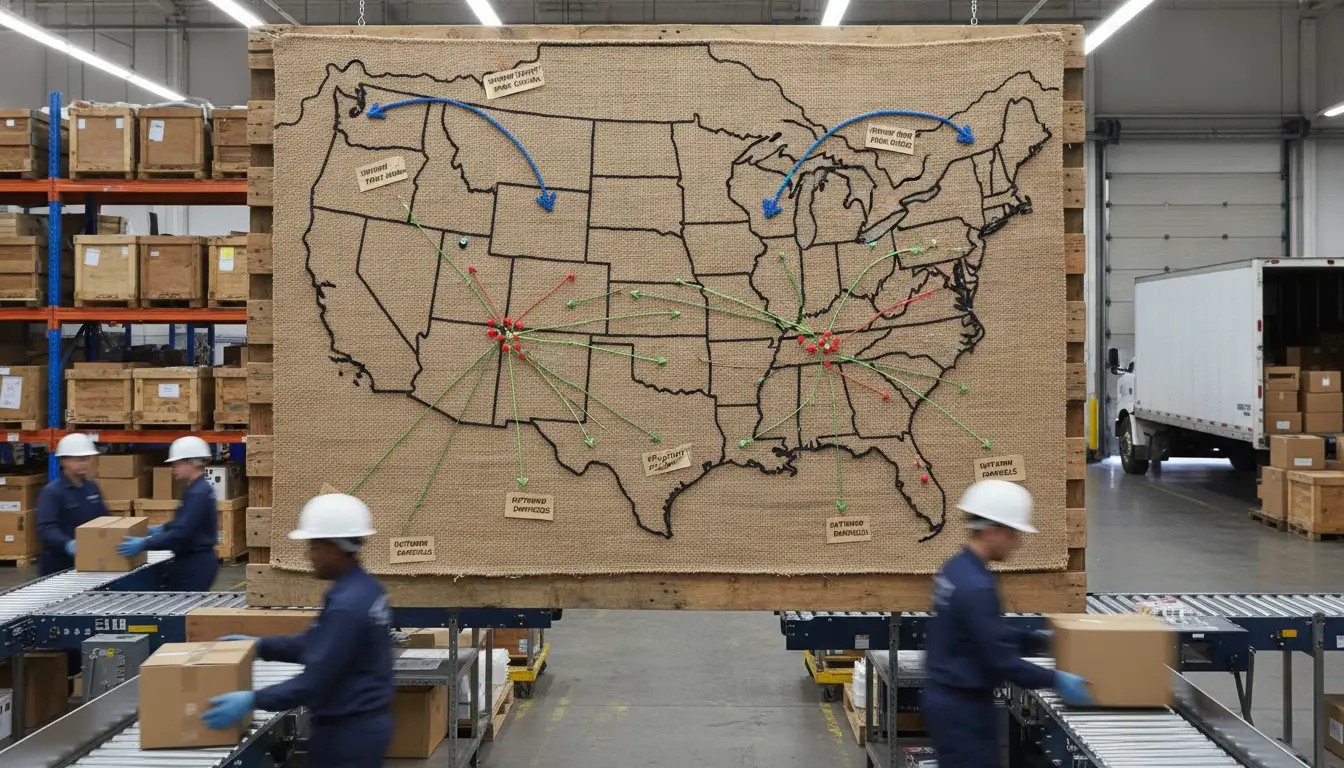
YouParcel operates fulfillment centers at 20 Farinella Dr, East Hanover, NJ 07936 and 3700 S. Riverside Ave, Rialto, CA 92324, as well as a warehouse in Illinois.
For Canadian brands, the right location depends on where US customers are concentrated. A brand with a customer base spread across the Eastern Seaboard and the Midwest will often find the New Jersey location advantageous for ground transit to those zones. A brand with strong concentration on the West Coast, particularly California, Washington and Oregon, may find the California facility more cost-effective for ground delivery times and shipping rates.
Many brands with meaningful US volume split inventory across both coasts, which reduces average transit time and can lower per-shipment carrier costs for zones that would otherwise require air or expedited ground service. YouParcel can advise on inventory distribution based on your actual order geography; this is a conversation best had with their team before you commit to a receiving plan.
Integrations: connecting Canadian platforms to US fulfillment
Most Canadian DTC brands run on Shopify or sell on Amazon.com. YouParcel integrates natively with both. Orders placed on your Shopify store or on Amazon route directly to the fulfillment center without manual processing. Real-time tracking and alerts keep your customer service team informed, and the platform supports BI and analytics so you can monitor inventory levels, order velocity and returns in one place.
If you use Salesforce for CRM or Tableau for reporting, YouParcel integrates with those as well. The goal is that moving fulfillment to a US warehouse does not require rebuilding your tech stack; it plugs into what you already have.
How to think about the duty cost tradeoff: bulk import versus per-parcel
The core financial question is whether the duty paid on a consolidated bulk import is less than the aggregate duty that would apply to individual parcels shipped directly from Canada. The answer depends on your HTS codes, the applicable duty rates and whether your goods qualify for CUSMA/USMCA preferential treatment.
As a general principle, duties are assessed on the declared customs value of the goods, which is typically your cost of goods (not retail price). On a bulk shipment of 1,000 units at a duty rate of, say, 5 percent, you pay duty once on the aggregate value. On 1,000 individual parcels, you would have paid duty 1,000 times on the retail or declared value of each parcel. Because retail value is higher than cost of goods, the per-parcel duty burden on individual shipments is often larger in aggregate than the duty on a bulk import at cost of goods, before accounting for the brokerage fees that apply to each individual informal or formal entry.
This is an illustration of the structure, not a guarantee of outcome for your specific situation. Run the numbers with your customs broker and your finance team using your actual HTS codes, duty rates and landed cost figures.
Peak season timing: why October is the decision point
Black Friday falls on November 28, 2025. Cyber Monday follows on December 1. For a Canadian brand that wants to stock a US fulfillment center for peak season, the inbound freight timeline from Canada to a US warehouse and through customs clearance typically takes one to three weeks depending on the freight mode, port of entry, customs processing time and warehouse receiving capacity.
That math makes October the practical window for getting inventory into position. Brands that delay past mid-November risk missing the highest-volume days of the year either because stock has not cleared customs, because receiving is backed up at the warehouse, or because the carrier network is at peak saturation and inbound freight is slower than normal.
Planning your inbound shipment now, connecting with a licensed customs broker this week to begin the HTS classification and entry preparation, and onboarding with a US 3PL before inventory ships gives you the best chance of being ready when orders spike. Learn more about what a full US ecommerce fulfillment setup looks like, including receiving, storage, pick-and-pack, shipping and returns.
Frequently asked questions
Can I still ship individual parcels from Canada to US customers without paying duty?
No. As of August 29, 2025, the US suspended de minimis duty-free treatment for all countries under EO 14324. Every commercial parcel entering the US now requires a customs entry and applicable duties and taxes. There is no value threshold below which parcels enter duty-free. Consult a licensed customs broker for guidance on your specific products and duty obligations.
Does the Canada Post strike affect all shipments from Canada, or just domestic mail?
The Canada Post rotating strike affects Canada Post operations, including parcels destined for the US that move through Canada Post's network. Brands using private couriers such as FedEx, UPS or Purolator for outbound shipping from Canada are less directly affected, but Canada Post is embedded in some carrier partnerships and last-mile services, so indirect disruption is possible.
What is a US importer of record and do I need one to stock a US fulfillment center?
The importer of record (IOR) is the legal entity responsible to US Customs for the goods entering the country, including payment of duties and compliance with import regulations. Yes, you need an IOR for the bulk freight shipment into a US fulfillment center. YouParcel does not act as IOR; your options include using your own US legal entity, a third-party IOR service or a structure your customs broker recommends for your situation.
Do my Canadian-made products qualify for lower duties under CUSMA/USMCA?
CUSMA (the Canada-United States-Mexico Agreement, known in the US as USMCA) provides preferential duty rates for goods that meet the applicable rules of origin. Whether your products qualify depends on their HTS classification, where they are manufactured and whether they meet the content and processing requirements. A licensed US customs broker can review your products and advise on eligibility and documentation requirements.
How quickly can YouParcel receive and start fulfilling Canadian brand inventory?
Onboarding timelines vary depending on SKU count, integration complexity and inbound freight scheduling. The best way to get a realistic timeline for your situation is to speak with the YouParcel team directly. Contact them through the link below to start the conversation before peak season inventory decisions are made for you by the calendar.
If you are a Canadian brand weighing a US inventory pool for the holiday season, the time to act is now, not after Black Friday. Talk to an Expert at YouParcel to discuss your US order volume, your product categories, and what a US fulfillment setup would look like for your brand this quarter.