


Ecommerce warehousing costs are the fees a third-party logistics provider (3PL) charges to receive, store, handle and ship your inventory. For most growing brands, these costs break into five categories: inbound receiving, ongoing storage, pick and pack, special handling (kitting, labeling, returns processing), and account or technology fees. YouParcel structures pricing around these same categories across its warehouses in New Jersey, California and Illinois, processing 10,000-plus orders a day across multiple marketplaces.
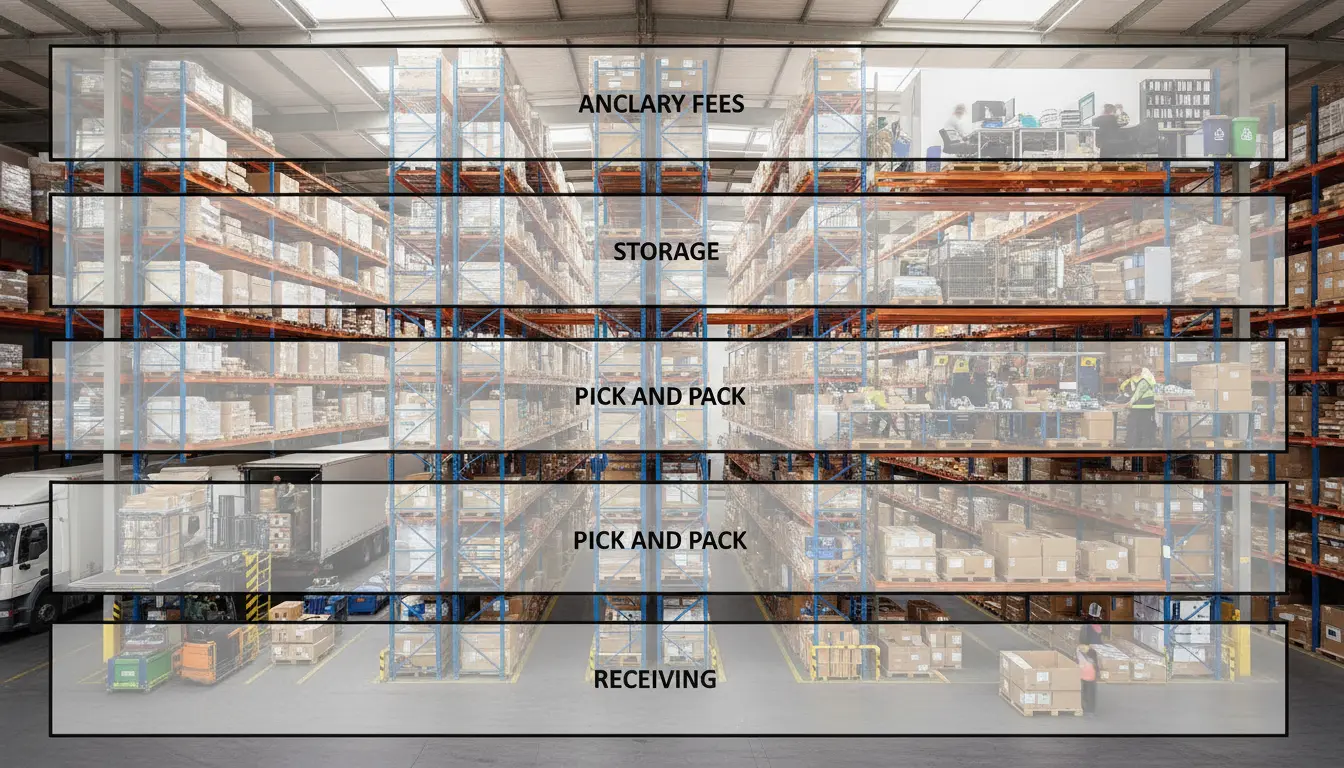
- Receiving, storage, pick and pack, special handling and ancillary fees are the five cost layers every brand should model before signing a 3PL agreement.
- Storage is charged by pallet, shelf bin or cubic foot, billed monthly; a fast-moving SKU that ships in days costs far less in storage than a slow-mover sitting for weeks.
- Pick and pack fees vary by units per order and SKU count, so order complexity, not just order volume, drives the bill.
- Understanding each fee type lets you negotiate intelligently, optimize your SKU mix and avoid surprise line items on your invoice.
Why warehousing costs matter more than shipping rates
Brands often focus exclusively on carrier rates when reviewing their logistics spend. Shipping rates are visible and easy to compare. Warehousing fees are less transparent, accumulate every month regardless of sales volume, and compound quickly as inventory grows. A brand storing 500 pallets at a 3PL pays for that space whether those pallets ship in 30 days or sit for 120. Getting warehousing costs under control is therefore a higher-leverage move than shaving a few cents off a postage label.
The five categories below cover every line item you are likely to see on a 3PL invoice. Each section explains how the fee is calculated, what drives it up, and what you can do operationally to reduce it.
1. Inbound receiving fees
Receiving (also called inbound processing) is the fee a warehouse charges to accept, count, inspect, barcode-scan and put away your inventory. It is the first cost you incur and sets the quality baseline for everything that follows.
How receiving is priced
3PLs price receiving in one of three ways, sometimes combined:
| Pricing unit | Typical scope | Best for |
|---|---|---|
| Per pallet | Flat fee per pallet unloaded and put away | Brands shipping full or partial pallets from a supplier |
| Per carton | Flat fee per master carton received | Mid-volume brands receiving loose cartons off a truck |
| Per unit | Fee per individual SKU counted | High-value items needing unit-level inspection |
| Per hour | Labor time billed at an hourly rate | Non-standard shipments: oversized, unlabeled or mixed SKUs |
What drives receiving costs up
Several supplier-side decisions dramatically increase receiving labor time and therefore cost. Shipments with missing or incorrect carton labels force warehouse staff to open and manually count boxes. Mixed-SKU cartons (where a supplier packs multiple product types into one master carton) require sorting before putaway. Shipments without an advance shipping notice (ASN) force staff to create the receipt from scratch rather than scan against a pre-built inbound order.
If your supplier ships from overseas, freight forwarding and customs clearance happen before receiving. That inbound leg affects when inventory arrives and whether it arrives in the condition expected. Our guide on moving inventory into a US warehouse from Canada covers the freight and customs entry steps that precede warehouse receiving in detail.
How to reduce receiving costs
- Require your supplier to apply GS1-compliant carton labels with a scannable barcode, SKU, quantity and purchase order number.
- Send an ASN to the 3PL 24 to 48 hours before the truck arrives so staff can pre-stage dock space and load the inbound order in the WMS.
- Ship one SKU per master carton wherever possible to eliminate manual sorting.
- Consolidate less-than-truckload (LTL) shipments to reduce the number of receiving events per month.
2. Storage fees: pallets, bins and cubic feet
Storage fees are the monthly charge for occupying space in a warehouse. They are recurring, meaning they compound every month inventory sits. This makes inventory velocity (how fast stock turns) the single biggest lever on your warehousing cost per unit.
The three main storage models
| Storage model | Unit billed | Typical use case |
|---|---|---|
| Pallet storage | Per pallet position per month | High-volume brands with consistent replenishment cycles |
| Shelf bin or tote storage | Per bin or shelf position per month | Small, light items: supplements, cosmetics, accessories |
| Cubic foot storage | Per cubic foot occupied per month | Irregular shapes, oversized items, mixed SKU profiles |
A standard GMA pallet measures 48 x 40 inches (1,219 x 1,016 mm) and can typically stack to 60 inches (1,524 mm) of usable height. A 3PL charges you for the pallet position regardless of whether your stack reaches that height. If your pallets are only 24 inches tall, you are paying for space you are not using. Some warehouses allow double-stacking or mezzanine storage for lighter goods, which can cut effective storage cost per unit significantly.
Inventory velocity and storage cost per unit
The math is straightforward. Suppose you pay a monthly pallet rate and hold 100 units per pallet. If those units sell and ship in 15 days, your storage cost per unit is roughly half the monthly rate divided by 100. If the same units sit for 60 days, you pay for two full months and storage cost per unit doubles. Demand forecasting, tighter purchase order quantities and seasonal clearance protocols are the operational answers.
Brands holding excess stock for Amazon replenishment often face a related problem: Amazon's own storage limits or aged-inventory surcharges push overflow stock into a 3PL. YouParcel offers short-term and on-demand warehousing and storage solutions for exactly this scenario, giving brands a buffer without long-term lease commitments.
Long-term storage surcharges
Many 3PLs add a surcharge for inventory that exceeds a defined age threshold, commonly 90, 120 or 180 days. This mirrors Amazon FBA's aged-inventory surcharges, which apply to units stored for 271 days or more at escalating rates per cubic foot per month (see Amazon Seller Central aged-inventory fee schedule for current figures). Whether you use FBA, a 3PL or both, long-dwell inventory is expensive everywhere. The fix is the same: tighten reorder points and run clearance before the surcharge clock runs out.
3. Pick and pack fees
Pick and pack (P&P) is the fee charged each time a warehouse operative locates, retrieves, packs and labels an individual order for shipment. It is the most directly order-volume-driven cost in your warehousing invoice and therefore scales with your sales, which is a structural advantage over fixed-cost in-house labor.
How pick and pack is structured
A typical 3PL pick and pack fee has two components:
- Order fee: A flat charge per shipment, covering the packing station, dunnage, box or poly mailer, and label application.
- Per-unit or per-line fee: An additional charge for each SKU line or individual unit included in the order, reflecting the extra pick time.
A single-item order (one SKU, one unit) carries only the base order fee. A four-line order with eight units total carries the base fee plus fees for each additional line or unit beyond the first. As order complexity grows, P&P cost per order grows with it.
Packaging materials
Some 3PLs include standard poly mailers or plain corrugated boxes in the pick and pack fee. Others charge separately for materials. Custom packaging (branded boxes, tissue paper, inserts) almost always carries an additional line item, sometimes called a kitting or assembly fee when assembly steps are involved. Brands investing in unboxing experience should budget for this separately and confirm exactly what the base P&P fee covers.
4. Special handling fees
Special handling covers any warehouse activity beyond standard receive-store-pick-pack. These fees are often where brands encounter the largest surprises on their invoices, because they are triggered by specific instructions rather than baseline volume.
Kitting and assembly
Kitting (combining multiple SKUs into a single shippable unit) and assembly (adding components, inserts or labels to create a finished bundle) are priced per kit or per labor hour, depending on complexity. A simple two-item kit with a shared poly bag costs less per unit than a 10-component gift set requiring tissue, ribbon and a hand-placed card. For a full breakdown of kitting economics, see our guide on kitting and assembly in fulfillment.
Labeling and relabeling
FBA prep, retailer compliance labeling (FNSKU barcodes, GS1-128 carton labels, price stickers) and relabeling of supplier-mislabeled goods all carry per-unit or per-carton fees. EDI-compliant routing guide requirements from major retailers (Target, Walmart, Home Depot) specify exact label formats and placement; non-compliance triggers chargebacks from the retailer, which cost far more than the labeling fee itself.
Returns processing
Reverse logistics generates its own fee schedule. A typical returns handling sequence and its associated charges looks like this:
- Return receipt: Scan the returned parcel into the WMS and match it to the original order.
- Inspection and grading: Assess condition (sellable, damaged, needs repackaging, destroy).
- Repackaging: If the item is resellable but the packaging is compromised, repack to resellable standard.
- Restocking: Return the unit to available inventory in the correct bin location.
- Quarantine or disposal: For unsellable goods, hold for brand decision or arrange disposal.
Each step carries a labor cost. 3PLs typically charge a flat per-return fee plus add-ons for repackaging, testing or destruction. High return-rate categories such as apparel (industry return rates of 20 to 30 percent for online fashion, per NRF consumer returns research) need to budget returns handling as a meaningful percentage of total warehousing spend.
Hazmat and temperature-sensitive handling
Lithium batteries, aerosols and certain supplements require segregated storage, special placarding and carrier-compliant packaging. Temperature-sensitive goods (some food, pharma, cosmetics) require climate-controlled zones. Both categories command a premium over standard pallet or bin rates. Always disclose product classifications during 3PL onboarding; undisclosed hazmat creates compliance exposure and often results in rejected shipments at the carrier level.
5. Ancillary and account fees
Beyond the core four categories, most 3PL contracts include a range of smaller fees that accumulate quietly:
| Fee type | What triggers it | How to manage it |
|---|---|---|
| Account or platform fee | Monthly charge for WMS access, reporting and integrations | Confirm what integrations are included; avoid paying per-integration fees for standard platforms like Shopify or Amazon |
| Minimum monthly charge | Billed when order volume is below a floor set in the contract | Negotiate a lower minimum if you are in a growth phase; review quarterly |
| Setup fee | One-time charge for account configuration, SKU setup and integration work | Reasonable for complex accounts; push back on high setup fees for standard integrations |
| Inventory reconciliation fee | Charged for cycle count or annual physical inventory | Understand the frequency and scope; request real-time inventory reports to reduce need for manual reconciliations |
| Carrier account fee | Markup on postage or separate handling fee per shipment | Compare the all-in delivered cost, not just the listed carrier rate |
| Peak or holiday surcharge | Applied during Q4 or other high-volume periods | Negotiate caps or confirm surcharge schedules before the contract is signed |
How to build a warehousing cost model
Before requesting a quote, pull three months of historical data and calculate the following inputs. These are the same numbers a 3PL will ask for during a scoping call, and having them ready shortens the quoting process considerably.
- Average monthly order volume: Total orders shipped per month, broken out by single-unit and multi-unit orders.
- Average units per order: Drives pick and pack complexity and cost per shipment.
- SKU count and average SKU velocity: A catalog with 500 SKUs where 20 percent of SKUs generate 80 percent of orders needs different slotting (bin placement strategy) than an even-velocity catalog.
- Average inventory on hand: In units and pallets (or cubic feet for irregular goods).
- Average inventory age: What percentage of your stock turns within 30 days, 60 days, 90 days and beyond.
- Return rate by category: Percentage of orders returned and typical condition on return.
- Special handling requirements: Kitting SKUs, FBA prep volume, hazmat classifications.
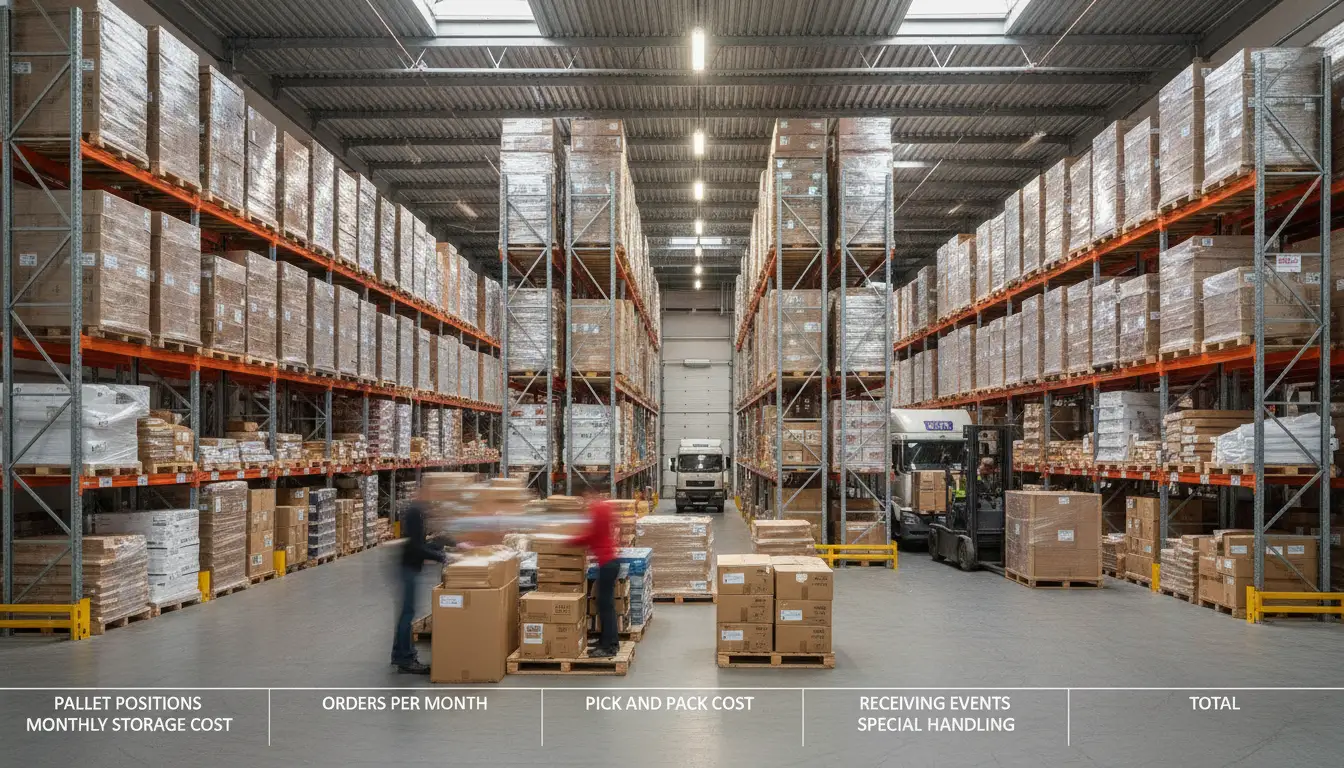
With these inputs you can build a simple monthly cost model: multiply average pallet positions by the pallet rate, multiply average orders by the pick and pack rate, add expected receiving events and any special handling volume, then sum the ancillary fees. Compare that total to your current in-house cost or existing 3PL invoice line by line.
Multi-warehouse inventory and cost distribution
Splitting inventory across warehouses on both the East and West Coasts increases the number of storage locations you pay for, but it typically reduces outbound shipping costs and transit times by placing stock closer to end customers. The net effect on total landed cost per order depends on your geographic demand split.
A brand with 60 percent of orders shipping to customers east of the Mississippi and 40 percent shipping to the West makes a strong case for stocking primarily in New Jersey, with a secondary position in California. The reverse demand profile argues for leading with the California location. YouParcel operates fulfillment centers at 20 Farinella Dr, East Hanover, NJ 07936 and 3700 S. Riverside Ave, Rialto, CA 92324, allowing brands to split inventory and optimize both storage and outbound costs without managing two separate 3PL relationships.
Warehousing costs versus leasing your own space
When a brand reaches a certain volume, finance teams naturally ask whether owning or leasing a warehouse would be cheaper than paying 3PL rates. The comparison is not simply rent versus storage fees. A direct lease also carries fit-out capital, racking, equipment, WMS software licensing, insurance, utilities and full-time labor, all of which are fixed costs that do not scale down when order volume drops. A 3PL converts most of those fixed costs into variable fees that flex with your actual activity. The right answer depends on volume stability, SKU complexity and management bandwidth. That decision framework deserves a dedicated analysis: see our article on 3PL vs in-house fulfillment for a side-by-side breakdown of the financial and operational trade-offs.
Frequently asked questions
What is a typical storage fee at a 3PL warehouse?
Storage fees vary by location, warehouse type and volume tier. Most 3PLs charge per pallet position per month, per shelf bin per month, or per cubic foot per month. Rates in high-cost metro markets (New York/New Jersey, Los Angeles) are higher than rates in lower-cost inland markets. Request itemized quotes from at least two or three providers with your actual inventory profile before comparing numbers.
How is pick and pack different from a handling fee?
Pick and pack refers specifically to the labor of locating, retrieving, packing and labeling an outbound order. A handling fee is a broader term that can refer to any special warehouse activity beyond standard P&P, such as kitting, relabeling, inspection or returns processing. Always ask a 3PL to define what each line item on their fee schedule covers.
Do warehousing costs include shipping?
No. Warehousing fees (receiving, storage, pick and pack, handling) are separate from outbound shipping costs. Shipping is charged based on package weight, dimensions, destination zone and carrier service level. A 3PL will pass through carrier rates, sometimes with a negotiated discount and sometimes with a markup. Confirm the billing method for postage before signing.
What is a minimum monthly charge and how do I negotiate it?
A minimum monthly charge is a floor billed when your activity does not generate enough fees to meet the 3PL's minimum revenue threshold for your account. Brands in early growth phases should negotiate a lower minimum or a time-limited waiver during ramp-up, with the minimum stepping up as volume grows.
How do long-term storage surcharges work at a 3PL?
Most 3PLs define a standard storage period (often 90 to 120 days) after which inventory aged beyond that threshold attracts a surcharge on top of the base rate. Review your slow-moving SKUs monthly and plan clearance or liquidation before the surcharge clock triggers to avoid paying two or three times the standard rate for dead stock.
Ready to get a clear, itemized picture of what warehousing would cost for your specific inventory profile? Create a YouParcel account and our team will walk through your SKU mix, order volume and storage needs to build a cost model tailored to your operation.