


The 3PL receiving process is the structured sequence a third-party logistics provider uses to accept, verify, record and put away incoming inventory. YouParcel and other fulfillment operators treat receiving as the foundation of inventory accuracy: a quantity discrepancy or a mislabeled pallet at this stage will propagate through every pick, pack and shipment until it is caught in a formal audit. Getting it right on day one is far cheaper than correcting it later.
- Receiving is where your physical stock count and your system record are either aligned or permanently mismatched.
- A proper receiving workflow includes advance shipment notification (ASN), physical count, condition inspection, label verification and put-away confirmation, in that order.
- Common receiving errors, such as short shipments, unlabeled cartons and missing ASNs, cause the majority of inventory discrepancies discovered during cycle counts or year-end audits.
- YouParcel handles 10,000+ orders a day across multiple marketplaces, which means inbound accuracy at the receiving dock directly protects outbound order accuracy at scale.

What does a 3PL receiving process actually involve?
Receiving is not just unloading a truck. It is a chain of verification steps, each of which produces a data record that feeds the warehouse management system (WMS). The WMS is the software layer that tracks every unit from the moment it arrives to the moment it ships. If any step is skipped, the WMS record and the physical reality diverge.
At a practical level, the process covers six distinct activities. Each is explained in the step-by-step section below.
The 3PL receiving process: step by step
- Advance shipment notification (ASN). Before the truck arrives, the brand or supplier sends the 3PL an ASN: a structured document or electronic data interchange (EDI) message that lists purchase order numbers, SKUs, quantities per carton, carton count, pallet count and expected delivery date. The ASN lets the WMS pre-populate an expected receipt record. Without an ASN, receiving staff work blind, which slows throughput and increases error rates. EDI 856 is the standard ASN transaction set used in retail and wholesale channels; for DTC brands, an ASN is often sent as a formatted spreadsheet or through a connected platform such as Shopify or a direct API call.
- Dock scheduling and appointment confirmation. The 3PL schedules a receiving window. Walk-in freight without an appointment is typically placed at the back of the queue, sometimes held until the following day. This matters for brands shipping time-sensitive inventory: confirm the appointment at least 48 hours in advance and share the carrier pro number or container number so the dock team can locate the inbound on a carrier portal.
- Physical unloading and carton count. When the truck arrives, dock staff or a lumper service unloads the freight and counts cartons against the bill of lading (BOL). The BOL is the carrier's contract and delivery receipt; it lists piece count and gross weight. If the physical count does not match the BOL, the receiver notes the exception on the BOL before signing. That notation is critical for filing a freight claim with the carrier later.
- Condition inspection. Each carton is inspected for damage: crushed corners, water damage, broken seals or signs of tampering. Any damaged unit is photographed, logged in the WMS and quarantined to a damage hold location. Some 3PLs charge a per-unit inspection fee for high-value or fragile categories; ask your provider upfront.
- SKU and barcode verification. Warehouse staff scan or manually verify each SKU against the ASN record. Standard barcodes used in ecommerce receiving are GS1-128 (case labels) and GS1-13 / UPC-A (unit barcodes). If a SKU arrives without a scannable barcode, the unit cannot be received into the WMS automatically. Many 3PLs offer a labeling or re-labeling service at this stage, but it adds time and cost. For supplement and wellness brands, this step also captures lot numbers and expiry dates so the WMS can enforce FEFO (first expired, first out) rotation.
- System receipt and put-away. Once verified, quantities are confirmed in the WMS and inventory becomes available. The WMS assigns a storage location based on the warehouse's slotting logic: fast-moving SKUs placed near the pick face, slow-movers in bulk storage. Put-away is not just carrying boxes to a shelf; it is a directed, scanned task that ties the physical location to the system record. A unit that is put away without a scan is effectively invisible to the WMS until it is found during a cycle count.
How receiving errors translate into inventory inaccuracy
Inventory accuracy is usually expressed as a percentage: the number of SKU-location combinations where the physical count matches the WMS record, divided by the total number of locations checked. Industry benchmarks for well-run fulfillment operations typically sit above 98%, according to the Warehousing Education and Research Council (WERC). Anything below 95% is a signal that systemic errors exist somewhere in the inbound or outbound workflow.
Receiving is the most common source of those errors. Here is how specific mistakes cascade:
| Receiving error | Immediate effect | Downstream consequence |
|---|---|---|
| Short shipment accepted without noting exception on BOL | WMS shows more units than physically exist | Overselling, back-orders, carrier claim cannot be filed |
| Missing ASN; units received against wrong PO | Units assigned to incorrect SKU in WMS | Wrong items shipped, high return rate, re-work cost |
| Unlabeled cartons received without scanning | Units put away without system location record | Phantom inventory: system shows stock, shelf is empty |
| Damaged units not quarantined | Sellable and unsellable units mixed in one location | Customer receives damaged product; return and refund |
| Lot numbers not captured at receipt | FEFO rotation cannot be enforced | Expired units ship to customers; regulatory risk for regulated categories |
| Put-away scan skipped | Location record missing from WMS | Units lost until next cycle count; affects fill rate |
What brands need to prepare before their first inbound
Most receiving problems originate on the brand side, not the warehouse side. A 3PL can only verify what it is given. The following preparation significantly reduces exceptions at the dock.
- Product catalog with barcodes: Send your 3PL a complete SKU list with UPC or EAN barcodes, unit dimensions (length x width x height in inches or centimeters) and weight (in pounds or kilograms). Dimensional data is used for storage location assignment and later for shipping rate calculation using dimensional weight (DIM weight), where the DIM divisor is typically 139 for domestic US carriers and 139 or 166 for international carriers.
- Case pack configuration: Specify how many units are in each inner pack and each master carton. Example: a SKU packed 6 units per inner, 24 units per master carton. This tells receiving staff what a complete carton looks like and flags a short carton immediately.
- ASN or packing list per shipment: Send the ASN before the truck leaves the origin. For international shipments, the commercial invoice and packing list must already exist for customs; share the same document with your 3PL so the ASN is consistent with what clears customs.
- Labeling requirements: Confirm the 3PL's preferred carton label format. Most use GS1-128 labels with PO number, SKU, quantity and destination warehouse code. If your factory labels differ, arrange re-labeling before shipment or at the dock.
- Special handling notes: Flag fragile, temperature-sensitive, hazardous or high-value items in advance. Lithium batteries, for example, require UN38.3 test documentation and may need specific storage segregation.
How a WMS connects receiving to real-time inventory visibility
The WMS is what makes receiving data actionable. When a unit is scanned into a confirmed location, that event is timestamped and the inventory record updates immediately. If your ecommerce platform integrates with the 3PL's WMS, that update propagates to your store's available stock in near real time.
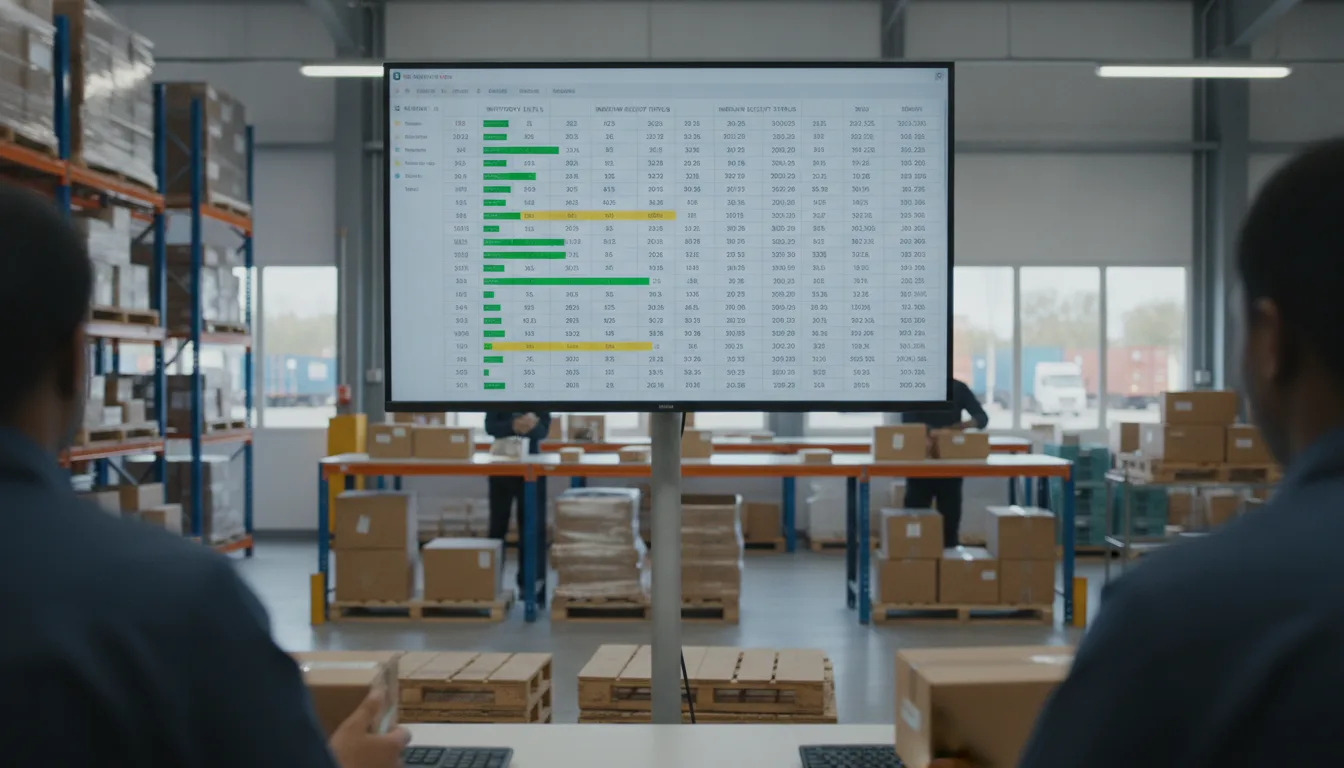
YouParcel integrates with Shopify, Amazon, Salesforce and 70+ other platforms, which means inventory received at the dock can reflect in your storefront within the same session. This eliminates the lag that causes overselling during high-volume periods, such as a product launch or a flash sale. The business intelligence and analytics tools that YouParcel provides let operations teams monitor inbound receipt rates, discrepancy percentages and put-away cycle times in one dashboard, rather than waiting for a weekly report.
Receiving for international brands shipping into US warehouses
For brands headquartered outside the US, the receiving process has an additional layer: the shipment must clear US customs before it can be received at the warehouse. The commercial invoice, packing list, bill of lading or airway bill (AWB) and, for ocean freight, the importer security filing (ISF, also called the 10+2 filing) must all be in order before cargo is released.
YouParcel does not act as importer of record (IOR). The IOR is the legal entity responsible for ensuring that imported goods comply with US laws and paying applicable duties. International brands typically appoint a licensed US customs broker as IOR, or they use their freight forwarder's brokerage service. Once customs releases the freight, it moves to the 3PL's dock under a standard domestic bill of lading and enters the normal receiving workflow. For a detailed walkthrough of this process for EU-based sellers, see the guide on shipping EU inventory to a US warehouse and what happens at first receipt.
YouParcel operates fulfillment centers in New Jersey (20 Farinella Dr, East Hanover, NJ 07936) and Southern California (3700 S. Riverside Ave, Rialto, CA 92324), with additional warehouse capacity in other US locations. International brands commonly split their first inbound between the East Coast and West Coast facilities to reduce transit times to end customers on both coasts. See the warehousing and storage service page for inbound routing details and how to request a dock appointment.
Receiving vs. putaway: understanding the distinction
These two terms are sometimes used interchangeably, but they describe different operations with different quality control points.
| Stage | What happens | Who is responsible | Key output |
|---|---|---|---|
| Receiving | Unloading, counting, inspecting, scanning against ASN | Receiving dock team | Receipt confirmation in WMS; discrepancy report if applicable |
| Put-away | Moving units from receiving staging area to assigned bin location | Put-away team or automated conveyor | Location record confirmed in WMS; unit available for picking |
The staging area is a temporary holding zone between the dock and the shelving. It is normal for units to sit in staging for several hours during a heavy receiving day. Units in staging are typically logged in the WMS as "received but not put away," meaning they are not yet available for order picking. Time in staging is a performance metric: a 3PL that leaves inventory in staging for 24 to 48 hours adds latency to your available stock and can delay order fulfillment for new arrivals.
Receiving fees and what they cover
Most 3PLs charge a receiving fee that is separate from storage and pick-and-pack fees. Common billing structures include a per-pallet fee, a per-carton fee, a per-unit fee or a flat fee per shipment. Some 3PLs bundle receiving into an all-in rate; others itemize it. For a detailed breakdown of how receiving fees fit into the overall warehousing cost structure, the article on ecommerce warehousing costs, including receiving, storage and handling fees covers each line item and what drives them up or down.
What receiving fees typically cover:
- Dock labor for unloading and staging
- Carton and unit counting
- ASN verification and WMS receipt entry
- Put-away to assigned location
What may incur additional charges:
- Re-labeling unlabeled or incorrectly labeled cartons
- Palletizing or de-palletizing floor-loaded containers
- Receiving without an ASN (some 3PLs charge a manual processing fee)
- Receiving outside scheduled hours or on a holiday
- Quarantine handling for damaged or non-conforming units
How to audit your 3PL's receiving performance
Brands often discover receiving problems only when customers complain or when a cycle count reveals a discrepancy. A proactive audit approach catches problems much earlier.
- Request a receiving discrepancy report monthly. This report lists every PO where the quantity received differed from the ASN quantity, the direction of the variance (over or short), and whether a BOL notation was made. A well-run 3PL tracks this internally; if yours does not, that is a signal worth investigating.
- Compare ASN quantities to WMS receipt quantities by SKU. Do this within 48 hours of each inbound to catch errors while the shipment is fresh and evidence (photos, driver notes) is still available.
- Review put-away cycle time. Ask your 3PL how long, on average, it takes from physical receipt to inventory being available for pick. Anything over 24 hours for standard palletized freight deserves an explanation.
- Run a cycle count on newly received SKUs. Spot-counting 10% to 20% of new arrivals is common practice in high-accuracy warehouses. The count compares WMS quantity at a location to a physical hand count. A discrepancy at this stage almost always points back to a receiving or put-away error, not a pick error.
The article on fulfillment KPIs to review every month with your 3PL provides a broader framework for tracking not just receiving accuracy but also order accuracy, return processing times and carrier performance, all in one review cadence.
According to the GS1 US standards body, consistent use of GS1 barcodes and ASN data across the supply chain is one of the most reliable ways to reduce receiving discrepancies, because it eliminates manual transcription errors that account for a large share of inbound exceptions.
Frequently asked questions
What is an ASN and why does my 3PL need it before my shipment arrives?
An advance shipment notification (ASN) is a document or electronic message that tells your 3PL exactly what is arriving: PO numbers, SKUs, quantities per carton, carton count and expected delivery date. Without it, receiving staff count manually against a printed packing list, which is slower, more error-prone and often results in units sitting in staging longer before they are available to pick.
How long does the 3PL receiving process typically take?
For a standard palletized inbound with a valid ASN, most 3PLs complete receiving and put-away within 24 to 48 business hours of the truck arriving. Floor-loaded containers, shipments without ASNs, or cartons that need re-labeling can extend that to 3 to 5 business days. Ask your 3PL for its stated receiving SLA before you sign a contract.
What happens if my shipment arrives short or damaged at the 3PL dock?
The receiving team notes the exception on the bill of lading before signing it, photographs the damage and logs a discrepancy in the WMS. That documented exception is what you need to file a freight claim with the carrier. Units that are visibly damaged are quarantined to a hold location and cannot be allocated to orders until you instruct the 3PL whether to destroy, return to vendor or rework them.
Can my 3PL receive inventory that ships directly from my overseas factory?
Yes, but the shipment must clear US customs first. Your factory ships to the US port or airport; a licensed customs broker handles the entry and duties; then the released freight moves to the 3PL's dock under a domestic bill of lading. YouParcel does not act as importer of record, so you will need a customs broker or freight forwarder who offers IOR services as part of the import arrangement.
How does receiving accuracy affect my customers' orders?
Every mis-received unit creates a gap between what the WMS thinks is on the shelf and what is actually there. When a picker goes to fulfil an order and the bin is empty or contains the wrong item, the result is a cancelled order, a substitution error or a delayed shipment. High receiving accuracy, typically 98% or above, is the prerequisite for high order accuracy at the outbound stage.
If you are evaluating a 3PL or preparing your first inbound shipment to a US warehouse, speaking with an operations specialist early saves time and avoids the most common receiving pitfalls. Create a YouParcel account to get started, or talk to an expert about your inbound requirements, expected volumes and SKU profile.