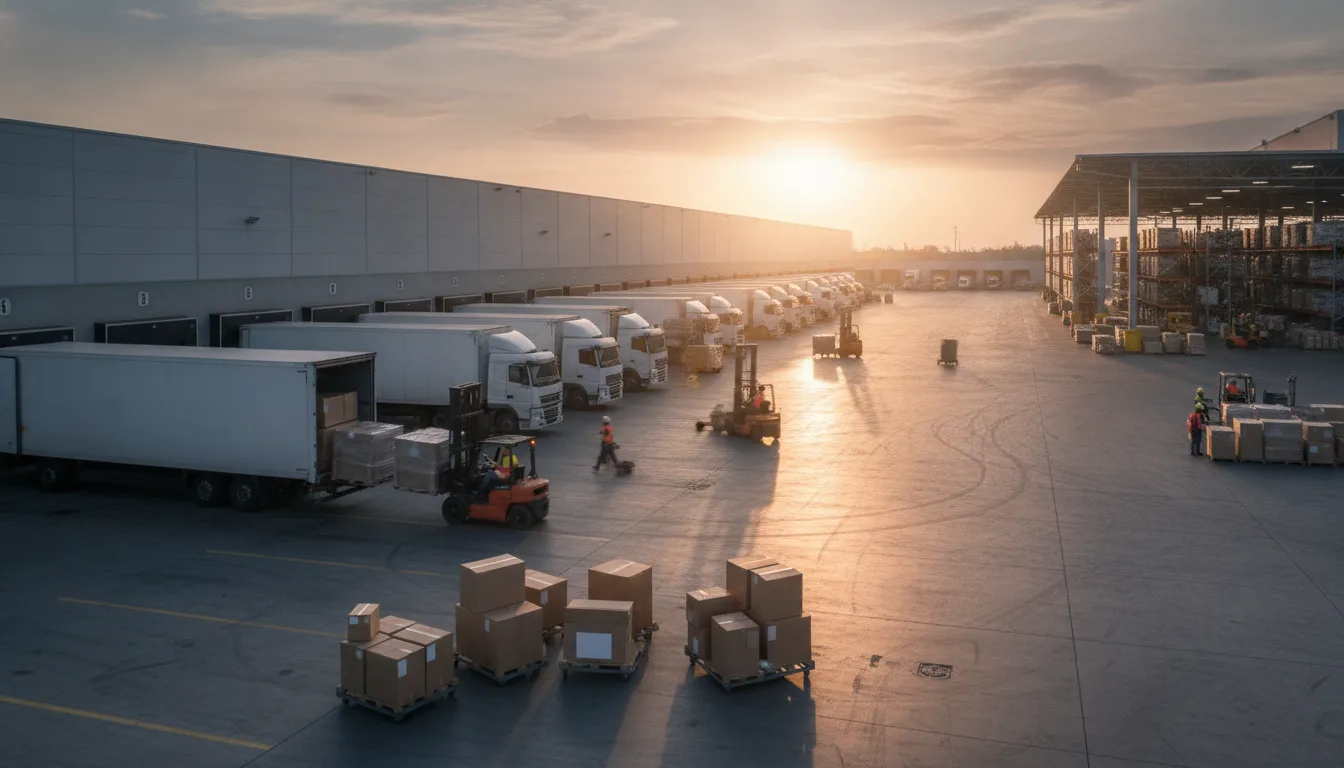


Shipping from Canada to USA into a third-party logistics (3PL) warehouse means crossing a commercial customs border, clearing a formal US entry, and delivering to a fulfillment center that needs to receive and put away your inventory correctly. YouParcel receives inbound truckloads from Canadian brands at its US fulfillment centers and processes 10,000-plus orders a day, so this guide walks through every step a Canadian brand must complete before that first pallet hits the dock.
- A formal US customs entry is required for every commercial shipment, regardless of value. Since August 29, 2025, the US Section 321 duty-free de minimis exemption no longer applies to any country, including Canada.
- CUSMA (the Canada-United States-Mexico Agreement, called USMCA on the US side) can reduce or eliminate duties on qualifying goods, but you must prepare a valid certification of origin before the shipment moves.
- A licensed US customs broker files the entry on your behalf. You are the importer of record (IOR), or you designate one. YouParcel does not act as IOR.
- Your 3PL receiving appointment, advance shipment notice (ASN) and labeling requirements must be confirmed before the truck departs Canada.
Why This Matters Now: The End of US De Minimis for Canadian Shippers
Until mid-2025, many Canadian brands shipped individual low-value parcels directly to US customers under the US Section 321 de minimis threshold, which allowed duty-free informal entry for shipments valued at 800 USD or less. That approach ended on August 29, 2025, when Executive Order 14324 suspended de minimis duty-free treatment for all countries. CBP confirmed the change in CSMS message #66065494.
The practical consequence for Canadian brands is significant. Sending inventory in bulk to a US fulfillment center and then shipping domestically within the US is now the most predictable cross-border model. You pay duty once at the border on the commercial shipment, and every outbound parcel to your US customer ships as a domestic parcel with no additional customs event. This guide covers that model from start to finish.
For a broader look at how YouParcel handles the full ecommerce fulfillment cycle once inventory is in-country, see the US ecommerce fulfillment service page.
Step 1: Classify Your Goods and Determine Duty Rate
Before you move a single pallet, you need the correct US Harmonized Tariff Schedule (HTS) code for each product. The HTS code is a 10-digit number under the US tariff schedule administered by the US International Trade Commission. It determines the duty rate your goods attract at the border.
- Look up your product in the USITC HTS online database. Use the first six digits (the international HS code) plus the four additional US-specific digits.
- Note the General (column 1) duty rate. This is the rate that applies to Canadian goods under normal trade conditions.
- Check whether your product is subject to additional Section 301 or Section 232 tariffs. These are listed as special duties in the tariff schedule alongside the base rate. As of early 2026, some product categories carry stacked duties that materially change landed cost.
- Record both the HTS code and the duty rate. Your customs broker will use these to calculate the estimated duty owed, which you must be prepared to pay, or bond against, at entry.
Classification is a legal determination. This guide presents it as information. A licensed customs broker should confirm your HTS codes before your first entry.
Step 2: Assess CUSMA (USMCA) Origin Eligibility
CUSMA is the trade agreement between Canada, the United States and Mexico that replaced NAFTA in 2020. When goods qualify as originating under CUSMA rules, the applicable duty rate is often zero or significantly reduced. Qualifying is not automatic: you must confirm that your product meets the relevant rule of origin and you must have documentation to prove it.
What Does Originating Mean Under CUSMA?
A product originates in Canada for CUSMA purposes if it is wholly obtained or produced in Canada, or if it satisfies the product-specific rule of origin in Annex 4-B of the agreement. The most common rule types are listed in the table below.
| Rule type | What it requires | Common example |
|---|---|---|
| Wholly obtained | 100% of the product is produced in Canada from Canadian-origin inputs | Canadian timber, maple syrup |
| Tariff shift (change in tariff classification, CTC) | Non-originating materials must shift to a different HTS chapter, heading or subheading through Canadian manufacturing | Apparel cut and sewn in Canada from imported fabric |
| Regional value content (RVC) | A minimum percentage, often 35 to 60%, of the product value must be CUSMA-region content | Electronics assembled in Canada |
| CTC plus RVC | Both a tariff shift and a minimum regional value content threshold must be met | Automotive parts and some consumer goods |
If your product is manufactured in China and simply warehoused or repackaged in Canada, it almost certainly does not qualify as CUSMA-originating. Confirm with your customs broker before claiming preferential treatment.
How Do You Certify CUSMA Origin?
Under CUSMA, there is no mandatory government-issued certificate form. Instead, you provide a certification of origin, which can appear on the commercial invoice or as a separate document. The certification must include the nine data elements specified in Annex 5-A of the agreement: importer, exporter and producer details; a description of the goods and the HTS code; the origin criterion; a blanket period if applicable; and an authorized signature with date.
Keep supporting records, including bills of materials, supplier declarations and costing sheets, for at least five years. CBP can audit origin claims retroactively.
Step 3: Engage a Licensed US Customs Broker
A US customs broker is a private individual or firm licensed by US Customs and Border Protection (CBP) to file customs entries on behalf of importers. For a Canadian brand that is not yet established as a US importer of record, this step is non-negotiable.
Here is what a customs broker does for a typical truck entry at a land border port of entry:
- Reviews your commercial invoice, packing list and CUSMA certification (if applicable).
- Confirms or corrects HTS classifications and calculates estimated duties and fees.
- Files a CBP Form 3461 (entry for immediate delivery) or CBP Form 7501 (entry summary) electronically through the Automated Broker Interface (ABI).
- Advises on whether a customs bond is required (it is, for formal entries above 2,500 USD) and arranges a single-entry or continuous bond.
- Coordinates with the truck driver or carrier on the release notice so the vehicle can cross.
- Files the liquidated entry summary within 10 working days and remits duties.
YouParcel does not act as importer of record and does not file customs entries. You must arrange your own customs broker. The National Customs Brokers and Forwarders Association of America (NCBFAA) maintains a member directory at ncbfaa.org where you can find licensed brokers at every major US-Canada border crossing.
If you also need help moving freight from your Canadian facility to the US border and onward to the warehouse, YouParcel's freight forwarding service can coordinate cross-border trucking and connect you with brokerage partners.
Step 4: Prepare the Full Document Set
Canadian brands are often surprised by how many documents a single truckload requires. Missing or incorrect paperwork causes border delays, which translate directly into late inventory receipts at the fulfillment center. Prepare all of the following before the truck is loaded.
| Document | Purpose | Who prepares it |
|---|---|---|
| Commercial invoice | Declares goods, value, origin, buyer and seller for CBP | You (the Canadian seller and exporter) |
| Packing list | Lists carton count, quantities per SKU, gross and net weights, dimensions | You or your warehouse |
| CUSMA certification of origin | Claims preferential duty rate under the trade agreement | You (as exporter or producer) |
| Bill of lading (BOL) | Carrier receipt and contract of carriage; referenced at the border | Your carrier or freight broker |
| Canada Export Declaration (B13A) | Required by CBSA for shipments valued over 2,000 CAD leaving Canada | You or your freight forwarder via CERS |
| US customs bond confirmation | Guarantees duty payment to CBP for formal entries | Your customs broker |
| Advance shipment notice (ASN) | Alerts the receiving warehouse to the inbound shipment; includes SKUs, quantities and carton labels | You, submitted to the 3PL |
What Goes on the Commercial Invoice?
CBP requires commercial invoices to state: the date of sale; seller and buyer names and addresses; a detailed description of the goods (not just a brand name); the quantity per unit of measure; the purchase price in the currency of sale; the country of origin for each line item; and the HTS code (recommended, not mandatory on the invoice itself, but essential for the broker's entry filing). List each SKU on a separate line. Combining 40 SKUs into one line labeled "apparel assortment" will trigger a CBP query.
Step 5: Choose the Right Freight Mode for the Lane
For most Canadian brands shipping their first US truckload, the practical choice is between full truckload (FTL) and less-than-truckload (LTL). The right mode depends on shipment size, budget and transit time tolerance.
| Mode | Typical shipment size | Key consideration for Canada-to-US |
|---|---|---|
| FTL (full truckload) | 12 or more pallets, or roughly 15,000 kg and above | Single border crossing, no interline hand-offs, fastest transit for large volumes |
| LTL (less-than-truckload) | 1 to 11 pallets, or under roughly 15,000 kg | Consolidated with other shippers; a border crossing is still required per load; the carrier handles it |
| Intermodal | Full 20 ft or 40 ft container | Cost-effective for very large volumes; longer door-to-door time than truck |
For a first shipment into a US fulfillment center, LTL is common. Confirm that your carrier is cross-border capable and has a bond or brokerage partner at the port of entry. Not all domestic Canadian LTL carriers offer cross-border service under their own authority.
Pallet standards matter at receipt. Most US 3PL facilities expect 48-by-40-inch GMA pallets. Non-standard pallet sizes can result in rework charges at the warehouse.
Step 6: Book a Receiving Appointment With the US Fulfillment Center
Most 3PL fulfillment centers in the US operate scheduled receiving docks. Arriving without an appointment, or arriving at the wrong time, can result in the truck being turned away, which creates a rebooking cost and a customs timing problem if the entry has already been filed.
Here is the standard appointment process for a first inbound at a YouParcel US fulfillment center:
- Submit an advance shipment notice (ASN) through the warehouse management system (WMS) portal or via EDI (Electronic Data Interchange, the standardized format for computer-to-computer document exchange between trading partners). The ASN must include a purchase order number or inbound reference, all SKUs, units per carton, carton count and total unit count.
- Confirm pallet and carton labeling requirements. Each carton must carry a scannable barcode label in the format the WMS expects. Non-compliant labels cause manual receiving delays.
- Receive a dock appointment date, time window and dock door assignment. Share this with your carrier so the driver can plan the border crossing time accordingly. Crossing a land border and driving to a fulfillment center in New Jersey or California adds hours to the schedule.
- Send the bill of lading reference number to the receiving team so they can match it to the ASN on arrival.
YouParcel's fulfillment centers in East Hanover, NJ (20 Farinella Dr, East Hanover, NJ 07936) and Rialto, CA (3700 S. Riverside Ave, Rialto, CA 92324) handle inbound freight from Canada. The East Hanover location serves the Northeast US market and is the logical destination for Canadian brands in Ontario and Quebec. The Rialto facility serves the Western US.
Step 7: Understand the First Receipt Process
First receipt is what happens after the truck backs into the dock. Understanding it helps you set up correctly so receiving is fast and accurate.
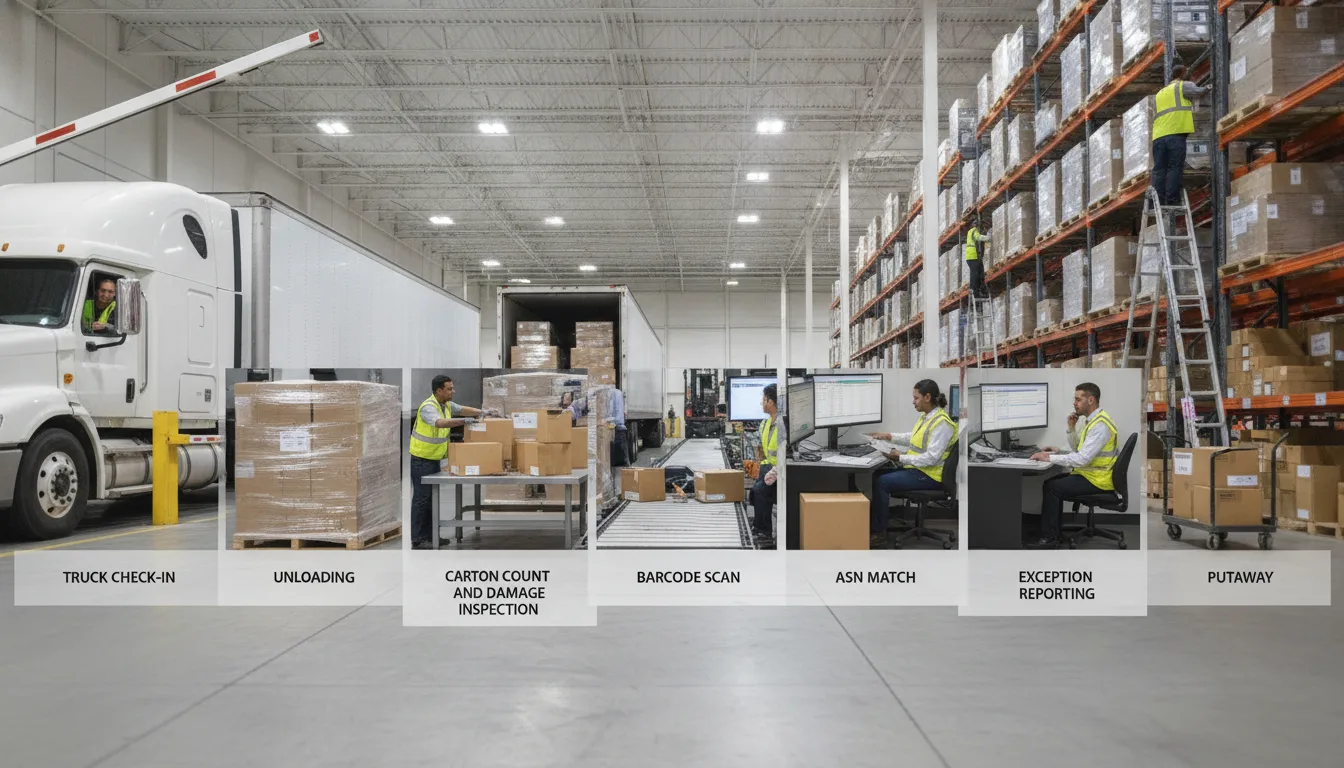
- Check-in. The driver presents the bill of lading. Receiving staff verify the truck seal number against the BOL and record the arrival time.
- Unloading. Pallets are unloaded to a staging area. If the shipment is floor-loaded (loose cartons stacked in the trailer without pallets), unloading takes significantly longer and some 3PLs charge a floor-load handling fee.
- Carton count and damage inspection. Receiving staff count cartons and note any visible damage before signing the BOL. Any shortage or damage noted at this stage is essential for a freight claim against the carrier. Do not waive inspection.
- Barcode scan and ASN match. Each carton label is scanned and matched against the ASN in the WMS. Discrepancies are flagged and a receiving exception report is generated.
- Putaway. Once the receipt is confirmed and the WMS inventory is updated, cartons are moved to pick locations or bulk storage. After putaway, inventory is live and available for outbound order allocation.
The time from dock arrival to inventory being live in the WMS varies by shipment size, complexity and current dock volume. For a standard palletized LTL shipment with compliant labels and a matching ASN, most 3PLs complete putaway within one to two business days of physical receipt.
Importer of Record: Your Options
The importer of record (IOR) is the entity legally responsible to CBP for the accuracy of the customs entry, payment of duties and compliance with all US import regulations. CBP requires that every formal entry have a designated IOR.
YouParcel does not act as importer of record. Canadian brands have three practical options, presented here as information only. Consult a licensed customs broker and legal counsel to determine the right structure for your business.
| IOR option | How it works | Consideration |
|---|---|---|
| Canadian company as IOR (foreign importer) | CBP allows a foreign entity to be IOR using a foreign importer bond. Your customs broker arranges this. | Standard for most Canadian brands doing occasional shipments; requires a CBP-assigned importer number (IRS number or CBP-assigned number) |
| US subsidiary or entity | If you have incorporated a US legal entity, it can hold the importer bond and act as IOR. | Simplifies ongoing compliance; requires a US EIN from the IRS |
| Third-party IOR service provider | Specialist IOR providers take on legal responsibility for a fee; useful for brands without a US entity. | Adds cost; the IOR provider will require indemnity and detailed product information. Confirm with your fulfillment partner that they accept shipments under a third-party IOR before proceeding. |
Common Mistakes on a First Truckload From Canada
- Undervaluing the commercial invoice. Declaring a lower value to reduce duty is customs fraud. CBP cross-references transaction values and can detain the shipment, require a binding ruling or assess penalties.
- Claiming CUSMA origin without documentation. If CBP audits and you cannot produce supporting records, you owe back duties plus interest and potential penalties.
- Sending the truck before the entry is filed. At most Canada-US land border crossings, the customs entry must be presented to CBP before or at arrival. Sending the truck without a confirmed entry filing wastes driver hours and risks the truck being held.
- Not confirming receiving requirements before shipping. Labels in the wrong format, wrong pallet size or a missing ASN can turn a clean delivery into a two-day receiving exception.
- Ignoring additional tariffs. Section 301 tariffs on certain goods with Chinese components or origin apply based on the country of origin of the goods, not the country from which they were shipped. Canadian transshipment does not avoid Section 301 duties on Chinese-origin goods.
Landed Cost: What to Plan For on a Canada-to-US Shipment
Landed cost is the total cost of getting inventory to your US fulfillment center, including the purchase price, freight, duties, brokerage fees and any warehousing charges. For planning purposes, the components are:
- Freight cost: Depends on weight, volume, mode (LTL vs. FTL) and lane. Toronto to East Hanover, NJ is a different rate than Vancouver to Rialto, CA.
- Customs duty: The HTS rate applied to the customs value, generally the transaction value in USD converted at CBP's weekly exchange rate.
- Customs broker fee: Entry filing fee plus disbursements for bond premiums and government fees. The merchandise processing fee (MPF) is 0.3464% of the entered value, with a minimum of 31.67 USD and a maximum of 614.35 USD for formal entries as of early 2026. The harbor maintenance fee (HMF) applies to ocean entries, not truck.
- 3PL receiving fee: Your fulfillment center charges a fee per pallet or per carton for inbound receiving and putaway.
If your goods qualify for CUSMA preferential treatment and duty is reduced to zero, the remaining costs are freight, brokerage and receiving. For goods that do not qualify, duty is the largest variable in landed cost and should be modeled before committing to the channel.
Frequently Asked Questions
Do I need a customs broker to ship from Canada to a US warehouse?
For commercial shipments above 2,500 USD, which require a formal CBP entry, you are not legally required to hire a broker, but you are strongly advised to. Filing your own formal entry requires a CBP-issued filer code, electronic ABI access and detailed knowledge of tariff classification. A licensed customs broker handles all of this and reduces the risk of costly errors or delays at the border.
Can my goods still enter the US duty-free from Canada?
No. The US Section 321 de minimis duty-free exemption was suspended for all countries on August 29, 2025, under Executive Order 14324. All commercial shipments entering the US, regardless of value or origin country, are now subject to formal customs entry and applicable duties. This applies to Canadian shipments the same as any other country.
How do I know if my products qualify for CUSMA preferential duty rates?
Qualification depends on your product's HTS code and whether it meets the product-specific rule of origin in CUSMA Annex 4-B. Your customs broker can review your product's bill of materials and manufacturing process against the relevant rule and advise on whether a CUSMA certification is supportable. Claiming CUSMA without a documented basis is a compliance risk.
What is an advance shipment notice and why does a 3PL require it?
An advance shipment notice (ASN) is a structured document you send to your fulfillment center before a shipment arrives, listing every SKU, unit count and carton. The warehouse management system uses it to pre-allocate dock resources, generate putaway instructions and immediately match scanned barcodes to expected inventory. Without an ASN, receiving becomes a manual, time-consuming process that delays inventory going live for outbound orders.
Should I ship all my US inventory to one warehouse or split it across locations?
For a first shipment, a single US fulfillment center is simpler to manage and keeps customs and receiving complexity contained. Once you understand your US order geography, splitting inventory between an East Coast and West Coast facility reduces average shipping zones and can lower your per-order shipping cost. YouParcel operates fulfillment centers in New Jersey and California, which covers both coasts from a single 3PL partner.
Ready to move your first truckload of Canadian inventory into a US fulfillment center? Talk to an Expert at YouParcel to discuss your inbound freight, customs documentation and receiving requirements.