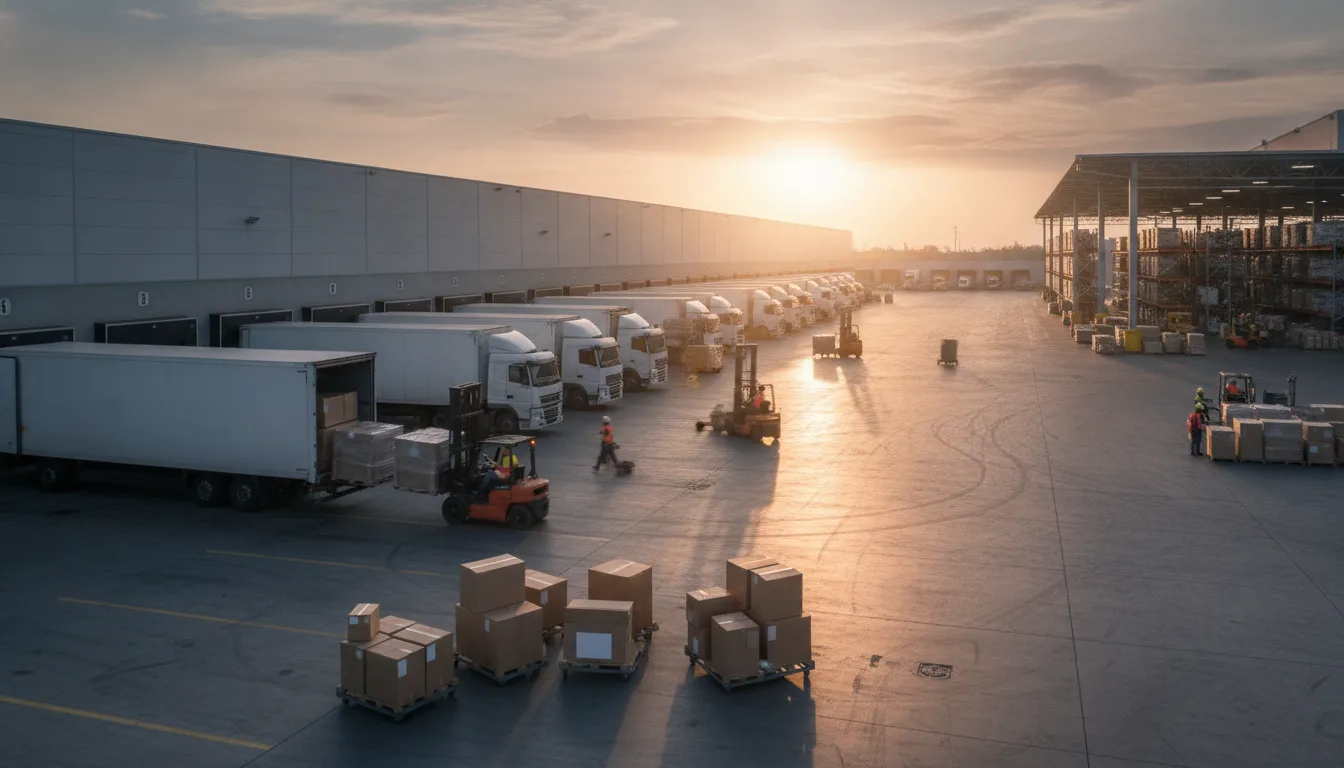


A distribution center moves bulk inventory to retailers or other facilities in large outbound shipments; a fulfillment center picks, packs and ships individual customer orders directly to consumers or businesses; and a warehouse stores inventory for weeks or months without necessarily processing orders. YouParcel operates fulfillment centers and warehousing facilities across New Jersey, California and Illinois to handle all three functions for growing brands.
- Warehousing in logistics means long-term bulk storage with minimal order processing and low throughput velocity.
- Fulfillment centers are optimized for speed: individual picks, carrier handoffs and returns processing happen daily.
- Distribution centers serve B2B and retail channels, shipping pallets or cases to stores, Amazon FCs or wholesale buyers.
- Many brands need more than one model at the same time, and a capable 3PL partner can operate them all under one contract.
Why the Terminology Matters for Your Operations
Logistics professionals often use these three terms interchangeably, but they describe genuinely different operating models. Choosing the wrong model for your order profile leads to slow ship times, high labor costs, retailer chargebacks or excess storage fees. Getting the terms right also helps when writing a 3PL RFP, reviewing carrier invoices or negotiating a service-level agreement.
The Council of Supply Chain Management Professionals (CSCMP) defines a distribution center as a facility used primarily for receiving, storing and redistributing product to other facilities or customers, while a fulfillment center is associated with direct order fulfillment and value-added services. The distinction matters in practice, not just in glossaries.
Below is a side-by-side comparison of the three facility types across the dimensions that affect your costs and service levels.
| Dimension | Warehouse | Distribution Center | Fulfillment Center |
|---|---|---|---|
| Primary function | Long-term bulk storage | Bulk-to-bulk redistribution | Single-unit order processing |
| Typical customer | Manufacturers, importers | Wholesale and retail brands | DTC, ecommerce, omnichannel |
| Inbound shipment type | Full container (FCL) or pallet | FCL, LCL or truckload | FCL, LCL, pallet or small parcel |
| Outbound shipment type | Pallet or bulk transfer | Pallet, case or store-ready unit | Individual parcel to end customer |
| Order velocity | Low (batch replenishment) | Medium (retailer purchase orders) | High (hundreds to thousands per day) |
| Value-added services | Minimal; sometimes labeling | Retail compliance, EDI, kitting | Pick and pack, kitting, returns, inserts |
| Returns processing | Rarely | Occasionally, retailer-driven | Standard; grading, restocking, disposal |
| Technology needed | Basic WMS | WMS plus EDI, routing guide compliance | WMS with carrier APIs, marketplace integrations |
| Carrier relationships | LTL and truckload | LTL, truckload, parcel for small orders | Parcel carriers (USPS, FedEx, DHL, Aramex) |
| Billing drivers | Pallet positions, cubic feet, duration | Pallet positions, labor, compliance fees | Receiving, storage, pick-and-pack, outbound |
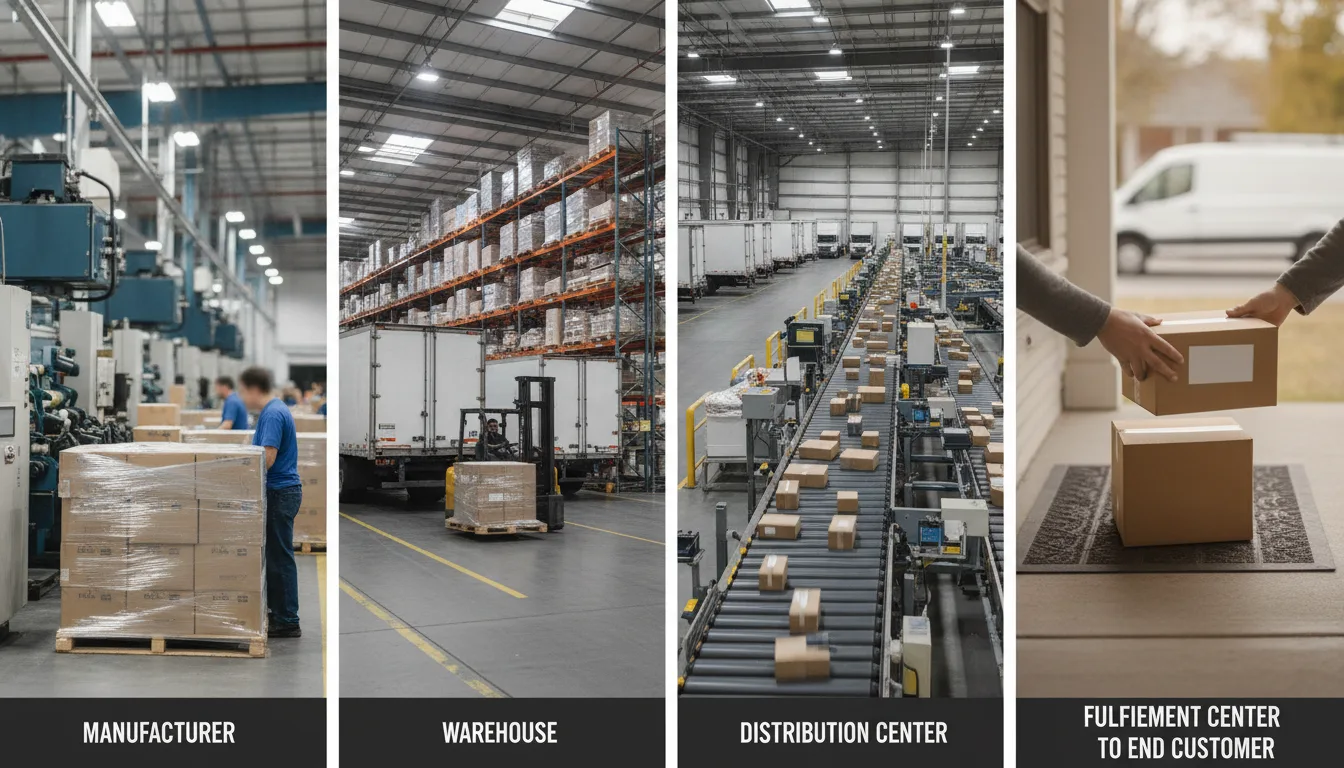
What Is a Warehouse? Warehousing Meaning in Logistics
A warehouse, in its most basic form, is a facility that stores goods. In supply chain terms, warehousing refers to the custody, management and eventual movement of physical inventory. The word covers everything from a climate-controlled pharmaceutical vault to an open-bay storage building holding flat-pack furniture.
What separates a pure warehouse from the other two models is low throughput. Goods arrive on pallets, they are assigned a bin or bay location, and they stay there until they are needed elsewhere. The warehouse management system (WMS) tracks quantities and locations, but the facility does not routinely break cases, pick individual units or generate shipping labels for end consumers.
When a warehouse makes sense
Manufacturers and importers use warehousing to buffer inventory between production runs and peak demand periods. If you bring in a large ocean freight shipment (full container load, or FCL) every 60 to 90 days and release it in batches to your 3PL fulfillment center, you need short- or medium-term warehousing for the overflow. Brands importing goods through East Coast ports often use New Jersey warehousing for this reason: proximity to the Port of New York and New Jersey reduces drayage costs and transit time before the goods move inland or into a fulfillment operation.
YouParcel's warehousing and storage services support this use case with flexible storage terms, real-time inventory visibility and the ability to transition inventory directly into the fulfillment workflow when orders begin.
Warehousing costs: what drives the bill
Warehouse pricing typically combines three elements: a receiving charge (per pallet or per hour of labor), a storage charge (per pallet position or per cubic foot, billed weekly or monthly) and an outbound handling charge when goods leave. Some providers also charge for cycle counts, special inspections or repackaging. Understanding these line items before you sign a contract prevents surprises at month end.
What Is a Distribution Center?
A distribution center (DC) is a high-throughput facility designed to receive large inbound shipments and quickly redistribute them to retailers, wholesalers, Amazon fulfillment centers or other destinations. The defining characteristic is rapid cross-docking or case picking: goods do not sit in a DC for months. They move in days.
Distribution centers are the backbone of retail replenishment. A brand selling into a major retailer ships cases or pallets to that retailer's DC, which then sorts and redistributes product to individual stores. For the brand, this means the DC must comply with the retailer's routing guide: specific labeling requirements, EDI transaction sets (EDI 850 for purchase orders, EDI 856 for advance ship notices, EDI 810 for invoices) and strict delivery windows to avoid chargebacks.
Distribution center services and order profiles
A B2B or wholesale brand using a distribution center expects the following services from its 3PL partner:
- Inbound receiving: unloading truckloads or containers, checking against the purchase order, scanning and putaway.
- EDI integration: receiving purchase orders electronically from retail buyers and generating compliant ASNs (advance ship notices) automatically.
- Retail-compliant labeling: GS1-128 carton labels, store-specific ticket labeling and packing-list formats per each retailer's routing guide.
- Case picking and palletizing: building store-ready pallets in the mix and quantities specified by the buyer.
- Kitting and pre-packing: assembling multi-SKU displays or promotional packs before shipment.
- LTL or truckload dispatch: booking freight on the retailer's or brand's preferred carrier account with the right freight terms.
Brands that sell through both retail channels and direct-to-consumer often need a 3PL that can handle both a DC workflow and a fulfillment center workflow from the same inventory pool. This omnichannel model is more complex but reduces total inventory holding and prevents the need to split stock between two separate facilities.
What Is a Fulfillment Center?
A fulfillment center is a facility purpose-built for high-velocity, individual-order processing. When a consumer places an order on your Shopify store at 2 p.m., a fulfillment center should pick, pack and hand that parcel to a carrier the same day or the next business morning. Speed and accuracy are the operating model.
The workflow inside a fulfillment center is more granular than a warehouse or DC. Individual SKUs are slotted at the unit level. Pick paths are optimized to minimize walking time. Packing stations verify order contents against the pick list. Carriers such as USPS, FedEx, DHL, Aramex and EasyPost collect parcels at scheduled intervals, and tracking numbers upload to the order management system automatically.
Standard fulfillment center operations step by step
- Inbound receiving: inventory arrives from your supplier or freight forwarder; the 3PL counts, inspects, scans barcodes and books items into the WMS.
- Putaway and slotting: units are assigned bin locations based on velocity (fast movers near the packing stations, slow movers in deep storage).
- Order download: orders sync from your Shopify store, Amazon seller account or other marketplace via the 3PL's integration layer.
- Pick: a picker follows a system-generated pick list, pulling the correct SKU and quantity from its bin location.
- Pack: the item is verified, packed with any branded inserts or marketing materials and weighed for dimensional weight calculation.
- Label generation and manifesting: the carrier label prints, the parcel is scanned onto the carrier manifest, and the tracking number is pushed back to the order.
- Carrier pickup and sortation: carriers collect parcels; end-of-day manifests close out the shipping batch.
- Returns processing: returned parcels are received, graded (resalable, refurbishable or unsalable), restocked or disposed of according to your instructions.
Dimensional weight and fulfillment center pricing
Dimensional weight (also called DIM weight) is a pricing method used by parcel carriers that charges for the space a package occupies, not just its actual weight. The formula is: length x width x height (in inches) divided by a DIM divisor. FedEx and UPS apply a divisor of 139 for domestic US parcels billed in imperial units. If the DIM weight exceeds the actual weight, the carrier bills on DIM weight. Fulfillment centers that negotiate carrier contracts on your behalf can reduce per-label costs significantly, which is one of the core financial reasons to outsource fulfillment rather than ship from a warehouse.
Fulfillment center integrations
A modern fulfillment center connects to your sales channels in real time. YouParcel integrates with Shopify, Amazon, Salesforce, Tableau and 70+ other platforms, so inventory levels, order status and shipment tracking flow between systems without manual data entry. That connectivity is what makes it possible to handle 10,000+ orders a day across multiple marketplaces without errors accumulating at scale.
Learn more about how YouParcel approaches this end-to-end model on the ecommerce fulfillment services page.
Distribution Center vs Fulfillment Center: The Core Difference
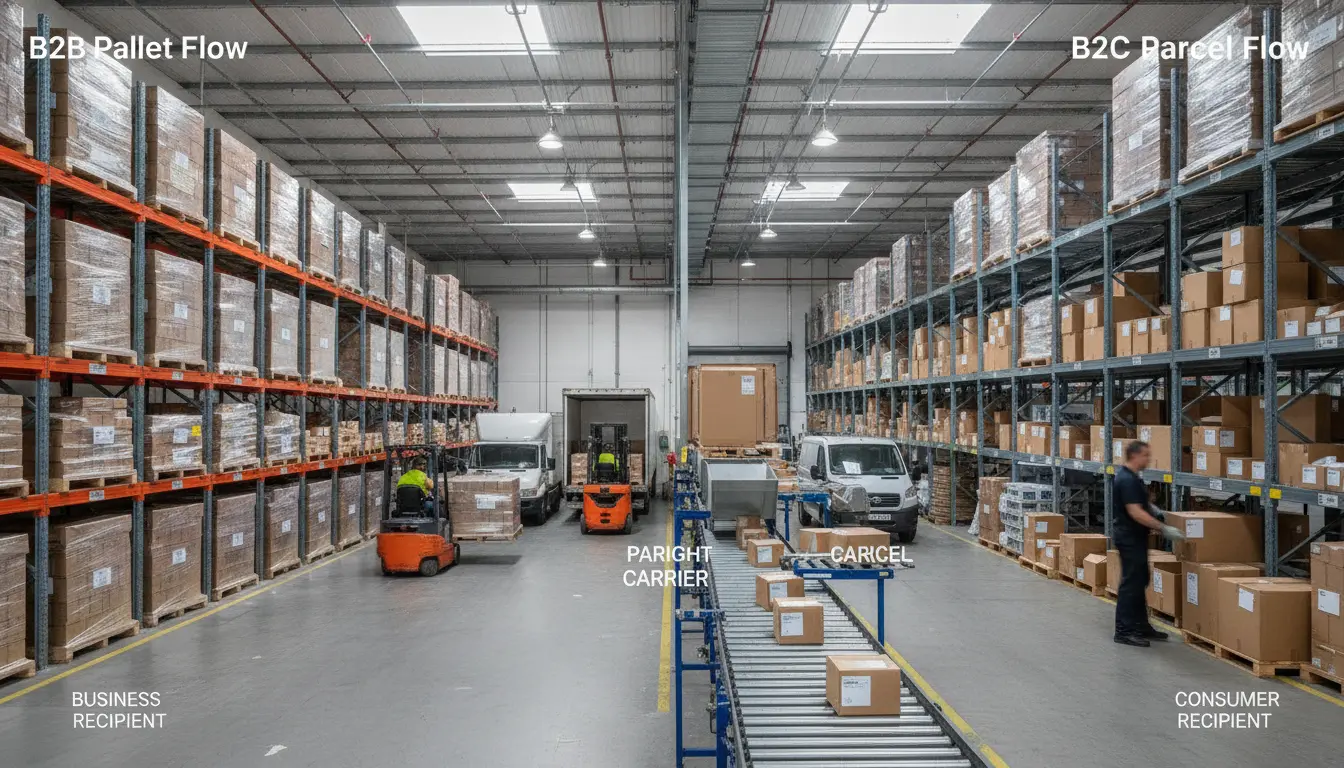
The clearest way to separate a distribution center from a fulfillment center is to look at the customer receiving the shipment. A distribution center ships to businesses: retail stores, Amazon warehouses, wholesale buyers. A fulfillment center ships to individual consumers or business addresses one parcel at a time. The order profile, the carrier mix, the technology stack and the compliance requirements all follow from that single distinction.
That said, the boundary is not always clean. Many brands run both workflows simultaneously. A health and beauty brand might ship cases to a retail DC on Monday and ship hundreds of DTC orders to individual customers the same day from the same inventory. A 3PL with omnichannel capability manages both without splitting the brand's stock into two separate pools.
When Do You Need a Warehouse, a Distribution Center or a Fulfillment Center?
Use warehousing when...
You are importing large volumes ahead of a selling season and need to hold inventory before releasing it into a fulfillment or distribution workflow. Warehousing is also the right choice for safety stock, slow-moving SKUs, raw materials and goods awaiting customs clearance or quality inspection. If your inventory turns are fewer than four times per year, storage costs rather than labor costs will dominate your 3PL bill.
Use a distribution center when...
Your primary channel is wholesale, B2B or brick-and-mortar retail. If you are receiving purchase orders from retail buyers, complying with routing guides, generating EDI documents and shipping pallets or cases to store distribution centers, you need a DC-capable 3PL. Brands expanding from DTC into retail often discover that their existing fulfillment setup cannot handle EDI compliance, retailer-specific labeling or pallet-level shipping, and they need a partner that offers both workflows.
Use a fulfillment center when...
You are selling directly to consumers through Shopify, Amazon, TikTok Shop or any other marketplace and you need individual orders shipped fast. The larger your daily order volume, the more a fulfillment center's carrier rate negotiation, automated workflows and pick accuracy matter to your unit economics. YouParcel's fulfillment centers in New Jersey (20 Farinella Dr, East Hanover, NJ 07936) and Southern California (3700 S. Riverside Ave, Rialto, CA 92324) cover East Coast and West Coast delivery zones, reducing average transit days and ground shipping costs for US-based customers.
The Omnichannel Reality: Operating All Three at Once
Most established brands do not fit neatly into one category. A brand at several hundred DTC orders a day that is also launching into retail needs a 3PL that can:
- Store overflow inventory in bulk (warehousing function).
- Generate EDI-compliant retail shipments with routing-guide labels (DC function).
- Pick and pack individual consumer orders and hand them to parcel carriers (fulfillment function).
Running these three workflows from a single inventory pool is called omnichannel fulfillment. It requires a WMS that can track unit-level inventory while also managing pallet locations, a carrier mix that spans both LTL freight and small-parcel services, and staff trained in both retail compliance and consumer-parcel SLAs. This is exactly the complexity that a 3PL with broad capability is built to absorb, so the brand can focus on product and marketing rather than logistics operations.
YouParcel's leadership team brings 50+ combined years of experience across these three facility types, which matters when you are navigating a retailer's routing guide for the first time or trying to reduce carrier costs on a high-volume day. For a deeper look at how third-party warehousing fits into this picture, visit the YouParcel warehousing and storage overview.
Key Operational Differences That Affect Your Costs
Labor intensity and billing
Warehousing billing is storage-dominant: you pay for space and time. Distribution center billing is labor-dominant at the outbound side: case picking, palletizing and compliance labeling add labor hours that pure storage does not. Fulfillment center billing is pick-and-pack-dominant: each individual order generates a pick fee, a pack fee, a materials fee and an outbound postage charge. At low order volumes, fulfillment center costs per unit can look high; at scale, the negotiated carrier rates and labor efficiency lower the per-unit cost below what an in-house operation can achieve.
Returns processing
Warehouses rarely process returns in any structured way. Distribution centers handle retailer returns, which typically arrive as cases or pallets and are either restocked or disposed of in bulk. Fulfillment centers process high volumes of individual consumer returns: each return is received, inspected, graded (condition A resalable, condition B refurbishable, condition C unsalable), restocked or liquidated, and the customer's refund or exchange is triggered. For brands with return rates above 15%, the returns processing capability of a fulfillment center is as important as its outbound speed.
Technology stack
A basic WMS suffices for warehousing. A DC adds EDI transaction handling, carrier compliance and routing-guide logic. A fulfillment center layered on top of that needs marketplace integrations (Shopify, Amazon, 70+ others), real-time tracking, consumer-facing alerts and BI dashboards so the brand can monitor SLA performance. YouParcel's platform provides real-time tracking and alerts, business intelligence and analytics, and custom solutions for brands with complex requirements, including those operating across multiple channels and geographies simultaneously.
Frequently Asked Questions
What is the main difference between a distribution center and a fulfillment center?
A distribution center ships bulk orders (pallets or cases) to retailers, stores or other facilities, while a fulfillment center picks and ships individual consumer orders directly to end customers. The order profile, carrier mix and compliance requirements are different for each, even though both facilities receive and store inventory.
What does warehousing mean in logistics?
Warehousing in logistics means the physical storage and management of goods at a facility until they are needed for distribution or sale. It includes receiving, putaway, inventory tracking, cycle counting and eventual outbound transfer. Warehousing does not typically involve individual order picking or parcel carrier shipments.
Can one 3PL handle warehousing, distribution and fulfillment together?
Yes. A 3PL with omnichannel capability can run all three functions from the same inventory pool, which prevents stock splitting and reduces total inventory holding. The 3PL's WMS must support both unit-level picking for DTC orders and pallet-level case picking with EDI compliance for retail buyers.
Do I need a distribution center if I sell on Amazon?
It depends on your Amazon model. If you use Fulfilled by Amazon (FBA), you ship cases to Amazon fulfillment centers, which is a DC-style outbound flow that requires specific prep and labeling compliance per Amazon's FBA shipment requirements. If you use Fulfilled by Merchant (FBM) or Amazon Multi-Channel Fulfillment (MCF), your 3PL fulfillment center ships individual orders directly. Many brands use both models simultaneously.
What is warehousing for a Shopify brand just starting out?
For an early-stage Shopify brand, warehousing usually means the storage portion of a 3PL fulfillment contract: your inventory lives in the fulfillment center's storage bays until an order arrives. As volume and SKU count grow, some brands move bulk overstock to a separate, lower-cost storage facility and replenish the fulfillment center in batches to manage storage fees efficiently.
Ready to find the right setup for your brand's order profile? Talk to an Expert at YouParcel to get a clear recommendation on whether you need warehousing, a distribution center, a fulfillment center or a combination of all three.