

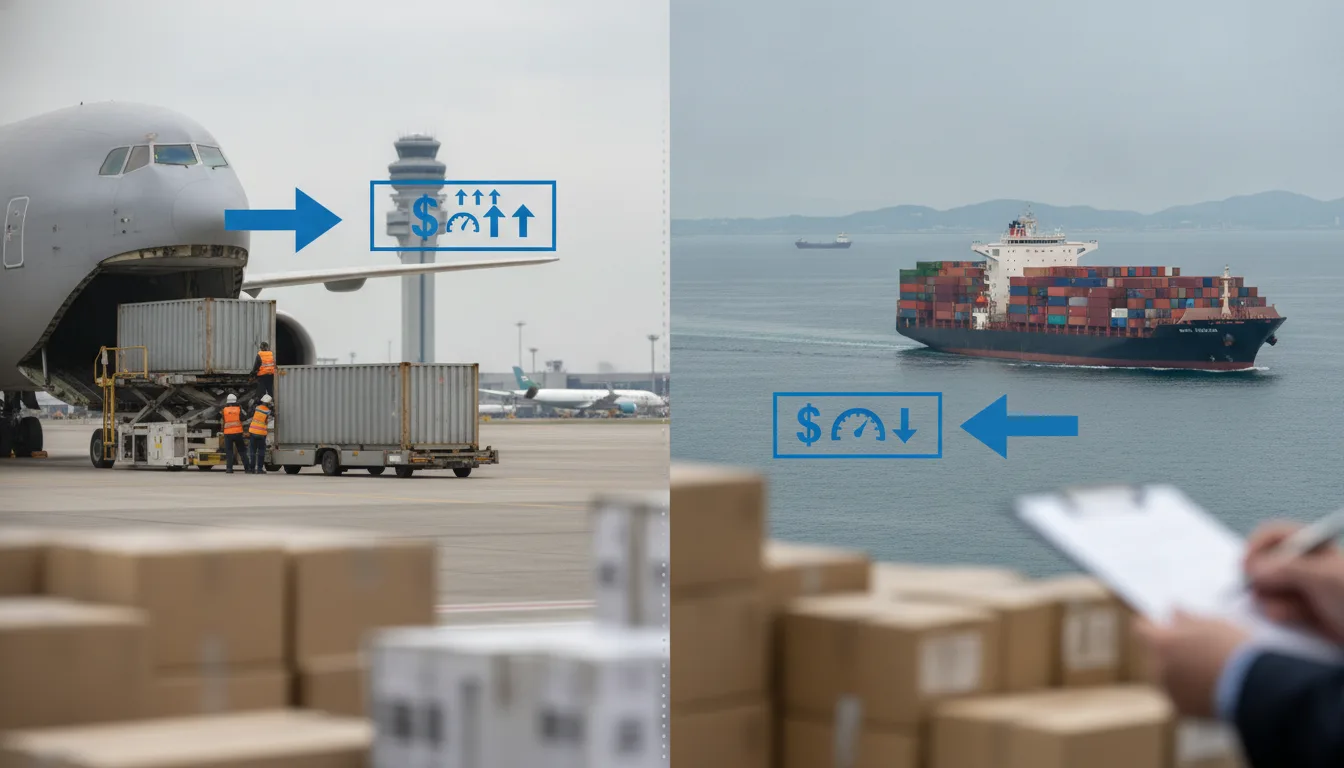
For ecommerce brands moving inventory internationally, the choice between air freight and ocean freight comes down to three variables: how fast you need the stock, how much it weighs or occupies, and what landed cost your margins can absorb. Air freight is faster but significantly more expensive per kilogram; ocean freight is slower but far cheaper per cubic meter for large volumes. YouParcel's freight forwarding team works with both modes and helps brands select the right one shipment by shipment.
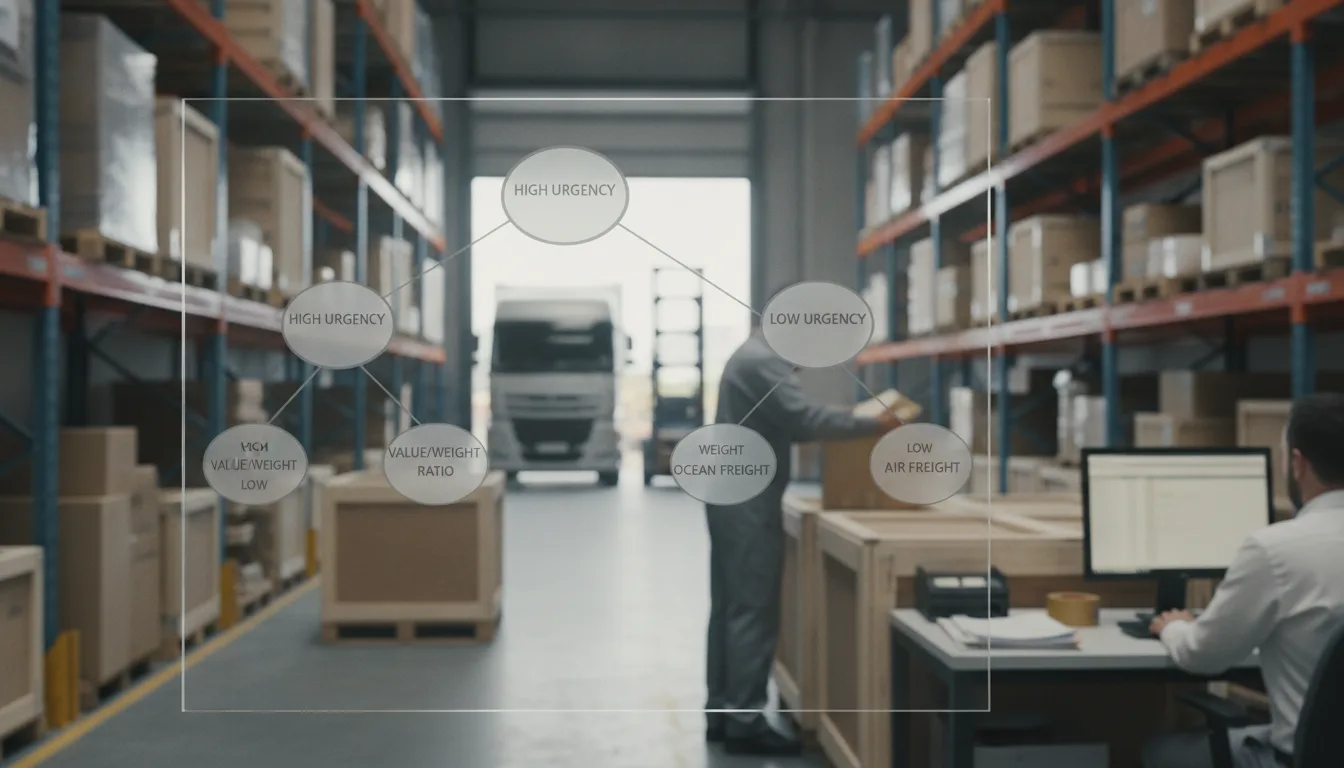
- Air freight suits urgent restocks, high-value or lightweight goods, and new product launches where speed outweighs cost.
- Ocean freight (FCL or LCL) suits large, heavy or low-margin inventory where cost per unit is the primary lever.
- The break-even point between the two modes typically falls between 100 kg and 300 kg depending on the lane, cargo type and current market rates.
- Your Incoterms, customs duties and 3PL receiving costs all affect the final landed cost calculation regardless of which mode you choose.
What is air freight and how does it work for ecommerce?
Air freight (also called airfreight or air cargo) moves goods by commercial or dedicated cargo aircraft. For ecommerce, the most common form is airport-to-airport service using an air waybill (AWB) as the transport document, with a freight forwarder handling booking, documentation and customs clearance on both ends.
Cargo travels either as belly freight on passenger planes or on dedicated freighter aircraft. Belly capacity is cheaper but subject to displacement when passenger baggage volumes are high. Freighter capacity offers more predictability on lanes like Asia-to-US or Europe-to-US.
Transit times on major ecommerce lanes are typically 3 to 7 days city-to-city before customs clearance. Add 1 to 3 business days for customs clearance and inland delivery to your US fulfillment center, and total door-to-door times commonly land between 5 and 10 business days on well-serviced lanes. These are typical industry ranges; actual times vary by carrier, origin airport, customs workload and service level selected.
How air freight pricing works: chargeable weight
Air carriers bill on chargeable weight, which is the higher of actual gross weight (in kg) and volumetric weight (also called dimensional weight). The standard IATA volumetric divisor for air freight is 6,000 cm³ per kg (or 166 in³ per lb in imperial units).
Formula: Volumetric weight (kg) = (Length cm × Width cm × Height cm) / 6,000
Example: A carton measuring 60 cm × 50 cm × 40 cm has a volumetric weight of (60 × 50 × 40) / 6,000 = 20 kg. If the actual weight is 12 kg, you pay for 20 kg. If the actual weight is 25 kg, you pay for 25 kg. Light, bulky goods such as pillows, foam products and certain apparel are almost always billed on volumetric weight by air, which makes ocean a much better fit for those categories.
For more on how dimensional weight is calculated across modes, see the guide on how to calculate dimensional weight.
What is ocean freight and how does it work for ecommerce?
Ocean freight moves goods in standardized intermodal containers aboard container ships. The two main booking types relevant to ecommerce brands are:
- FCL (Full Container Load): you book and fill an entire container, most commonly a 20-foot (20GP, approximately 25–28 CBM usable) or 40-foot (40GP, approximately 55–58 CBM usable) unit. You pay a fixed container rate regardless of how full it is, so FCL becomes efficient when your cargo fills at least 60–70% of the container.
- LCL (Less than Container Load): your cargo shares a container with other shippers' goods. You pay per cubic meter (CBM) or per freight ton (the higher of 1 CBM or 1,000 kg). LCL suits shipments under roughly 10–15 CBM where the per-container FCL rate is not justified.
The transport document for ocean freight is a bill of lading (B/L). Your freight forwarder handles booking, the Importer Security Filing (ISF, also called 10+2), commercial invoice, packing list and any certificates of origin or compliance documentation.
For a detailed breakdown of FCL versus LCL, the cluster article on FCL vs LCL ocean freight covers volumes, costs and consolidation timelines in depth.
Ocean freight transit times
Transit times are longer and vary significantly by origin port. Typical vessel transit times (port-to-port, not door-to-door) on common ecommerce lanes are as follows. These are illustrative industry ranges, not guaranteed times.
| Origin Region | Destination (US) | Typical Vessel Transit (port-to-port) |
|---|---|---|
| China (Shanghai/Shenzhen) | Los Angeles / Long Beach | 14–18 days |
| China (Shanghai/Shenzhen) | New York / New Jersey | 25–32 days (all-water) or 18–24 days (Suez) |
| India (JNPT / Mundra) | New York / New Jersey | 18–28 days |
| UK / Northern Europe | New York / New Jersey | 10–16 days |
| Southeast Asia (Vietnam/Thailand) | Los Angeles | 16–22 days |
Add 2 to 5 business days for customs clearance, drayage (the short-haul trucking move from port to warehouse or rail ramp) and inland delivery. Total door-to-door timelines for ocean freight commonly run 4 to 8 weeks depending on origin and inland routing.
Air freight vs ocean freight: a direct comparison
| Factor | Air Freight | Ocean Freight (FCL/LCL) |
|---|---|---|
| Speed (door-to-door) | 5–10 business days (typical) | 4–8 weeks (typical) |
| Cost per kg (high-volume lanes) | Higher, often 4–6x ocean on weight basis | Lower, especially for dense cargo |
| Minimum viable shipment size | Any size; optimal under 100–200 kg | LCL from 1 CBM; FCL most efficient at 10+ CBM |
| Weight/volume billing | Chargeable weight: higher of actual or dim (÷6,000) | Freight ton: higher of CBM or 1,000 kg per unit |
| CO2 per tonne-km | Significantly higher (roughly 20–50x ocean) | Lower per unit of cargo moved |
| Cargo restrictions | Strict limits on lithium batteries, aerosols, hazmat | More permissive, though IMDG rules apply |
| Documentation | Air waybill (AWB), commercial invoice, packing list | Bill of lading, ISF/10+2, commercial invoice, packing list, any special certs |
| Predictability | High on direct flights; belly cargo can be displaced | Moderate; vessel schedules shift; port congestion a factor |
| Best fit | Urgent restocks, high-value goods, small batches | Bulk orders, low-margin SKUs, planned replenishment |
How to calculate your break-even point between air and ocean
The break-even calculation compares total air freight cost to total ocean freight cost for the same shipment. The steps below show a practical approach.
- Get quotes for both modes on the same shipment. Provide total gross weight (kg), total volume (CBM or carton dimensions), origin and destination zip code, and commodity type. Your freight forwarder can quote both simultaneously.
- Calculate chargeable weight for air. Use the formula above. If your cartons are dense, actual weight wins; if bulky, volumetric weight wins. This directly determines your air freight charge.
- Calculate ocean freight charge. For LCL, multiply your CBM by the per-CBM rate and add origin and destination charges. For FCL, use the flat container rate plus port and inland fees.
- Add all accessorial charges. Both modes carry origin charges, destination charges, customs brokerage fees, ISF filing fees (ocean, typically USD 25–75 per shipment), fuel surcharges and inland delivery. These can add 20–40% on top of the base freight rate.
- Add the cost of time. Ocean freight takes 4–8 weeks longer than air. Translate that into carrying cost (the interest on inventory in transit), stockout risk and any expedite fees you would pay if stock runs out before the vessel arrives. This is often the step brands skip, and it understates the true cost of ocean for fast-turning SKUs.
- Compare total landed cost per unit. Divide total freight and customs cost by number of units. The mode with the lower landed cost per unit, adjusted for time, is the better choice for that shipment.
A worked example
Assume you are shipping 500 units of a skincare serum from the UK to your YouParcel fulfillment center in East Hanover, NJ. Each carton: 40 cm × 30 cm × 25 cm, 8 kg actual weight. Total: 20 cartons, 160 kg actual, 2 CBM volume.
Air volumetric weight: (40 × 30 × 25) / 6,000 = 5 kg per carton, so actual weight of 8 kg wins. Chargeable weight = 160 kg actual. At a hypothetical market rate of USD 6.50/kg (all-in), air total = USD 1,040.
LCL ocean: 2 CBM at a hypothetical all-in rate of USD 180/CBM = USD 360. Add ISF filing (~USD 50), customs brokerage (~USD 150), and drayage to warehouse (~USD 200). Ocean total roughly USD 760.
Difference: USD 280 in favor of ocean. But ocean adds approximately 5 extra weeks of transit. If those 500 units sell at USD 45 gross margin each and you would stock out in week 3, the revenue at risk dwarfs the USD 280 saving. For this shipment, air is the better business decision even though ocean is cheaper on the freight invoice.
This is a simplified illustration using hypothetical rates. Actual rates vary by lane, season, carrier and cargo specifics. Always get current quotes.
When to use air freight for ecommerce
Air freight makes sense for ecommerce brands in these situations:
- You are launching a new product and need stock in the US before a campaign goes live.
- You have an unexpected stockout and cannot wait 6 weeks for the ocean vessel.
- Your product has a high value-to-weight ratio, such as electronics, fine jewelry or premium skincare, where the freight cost as a percentage of product value is low even at air rates.
- Your order volume is small, typically under 100–200 kg or 1 CBM, where LCL consolidation fees make ocean uncompetitive.
- Your product has a short shelf life or is time-sensitive to a retail season (back-to-school, Q4 peak).
- You need reliable, predictable transit to meet a purchase order deadline from a wholesale retail buyer.
When to use ocean freight for ecommerce
Ocean freight is the right call in these scenarios:
- You are doing a large planned replenishment, typically 2 CBM or more for LCL, or a full container for 10+ CBM.
- Your products are heavy relative to their value: home goods, furniture components, fitness equipment, raw materials.
- Your inventory turnover is predictable and you can plan 8–10 weeks ahead, leaving buffer for port delays.
- You need to minimize landed cost on low-margin SKUs where every dollar per unit of freight matters.
- You are importing goods that face air freight restrictions, such as certain lithium battery products or oversized items that exceed aircraft payload limits.
- You are moving a large initial stocking order to seed your US warehouse before switching to smaller air replenishments.
Incoterms and who pays for freight
Incoterms (International Commercial Terms, published by the International Chamber of Commerce) define where the seller's responsibility ends and the buyer's begins. For ecommerce brands importing into the US, the most common terms are:
- EXW (Ex Works): you, the buyer, arrange and pay for everything from the supplier's factory door. Maximum control, maximum responsibility.
- FOB (Free On Board): the supplier loads the goods onto the vessel (or aircraft) at the origin port, and risk and cost transfer to you at that point. FOB is the most common term for ocean freight from Asia.
- CIF (Cost, Insurance and Freight): the supplier pays freight and minimum insurance to the destination port, but risk transfers to you when cargo is loaded. Avoid CIF if you want to control your freight forwarder choice and costs.
- DDP (Delivered Duty Paid): the supplier delivers to your named location, paying duties and taxes. This simplifies your process but typically hides freight and duty costs in the product price, making it harder to benchmark.
For a full discussion of landed cost implications across Incoterms, the article on DDP vs DDU shipping for ecommerce covers the trade-offs in detail. Incoterms apply equally to air and ocean shipments, but FOB is ocean-specific in its strict sense; for air, the equivalent is FOB airport or FCA (Free Carrier), which is the more technically correct term under Incoterms 2020.
US customs duties: what changes after the de minimis suspension
As of August 29, 2025, the US no longer provides duty-free treatment for low-value parcels under the former de minimis threshold. Every commercial import, regardless of value, is now subject to formal or informal entry procedures and applicable duties. This change affects both air and ocean shipments, but it hits air-freight-dependent cross-border parcel models particularly hard since those models were built around duty-free entry for sub-USD-800 shipments.
For ecommerce brands using bulk inbound freight to a US fulfillment center, the duty is paid once at the port of entry on the full commercial invoice value, spread across all units. This is typically more efficient than per-parcel duty collection under a parcel model. Work with a licensed customs broker to classify your products correctly using the Harmonized Tariff Schedule (HTS code) before your first shipment, as duty rates vary widely by product category and origin country.
YouParcel does not act as importer of record (IOR). The IOR is the legal entity responsible for ensuring goods comply with US import laws and paying duties owed. As an overseas brand, you will need to either establish a US legal entity to serve as IOR, work with a third-party IOR service provider, or find a US-based business partner willing to serve in that role. Your freight forwarder or customs broker can explain IOR options specific to your situation. For more on how customs brokers support bulk imports in the current environment, see the post on what a customs broker does for bulk imports after de minimis.
The official US Harmonized Tariff Schedule is maintained by the US International Trade Commission at hts.usitc.gov, where you can look up duty rates by HTS code and country of origin.
How a 3PL and freight forwarder work together on inbound shipments
Many ecommerce brands think of their 3PL and their freight forwarder as separate relationships. YouParcel bridges both: the freight forwarding team handles the origin, ocean or air booking, customs clearance and drayage, while the fulfillment operation receives, checks and stores the inventory in one of its US fulfillment centers.
This matters for a practical reason. When your freight forwarder and your 3PL are the same partner, the inbound receiving appointment, the pallet configuration, the carton labeling requirements and the system update that makes inventory available for order picking all happen in a coordinated workflow rather than across two separate sets of tickets and contacts.
YouParcel handles 10,000-plus orders per day across multiple marketplaces and integrates with Shopify, Amazon, Salesforce, Tableau and 70-plus other platforms, so inventory received from an air or ocean shipment flows directly into the same system driving outbound orders. The team works with carriers including DHL, FedEx, Aramex and EasyPost on the domestic side, and coordinates with freight partners on the international inbound side.
Special considerations by cargo type
Lithium batteries and hazmat
Lithium ion and lithium metal batteries face strict air transport regulations under IATA Dangerous Goods Regulations (DGR). State-of-charge limits, packaging requirements and quantity restrictions per package apply. Some configurations are prohibited in passenger aircraft belly cargo entirely. Ocean freight under IMDG (International Maritime Dangerous Goods) code is often a better fit for large volumes of lithium battery products, though it comes with its own compliance requirements. Always declare battery shipments accurately; misdeclaration is a serious liability.
The IATA Dangerous Goods Regulations are the authoritative reference: iata.org/en/programs/cargo/dgr.
Perishables and temperature-sensitive goods
Food, certain supplements and temperature-sensitive health products almost always move by air when imported in finished consumer-ready form, because ocean transit times and temperature variability create spoilage and shelf-life risk. If you are in the supplement or wellness category, see the related post on fulfillment for supplement and wellness brands for how lot tracking and FEFO (First Expired, First Out) management applies once your goods are in the warehouse.
Oversized and heavy goods
Furniture components, fitness equipment and large home goods are almost always better suited to ocean FCL because their weight and cubic volume make air freight prohibitively expensive. For these categories, the question is usually not air versus ocean but FCL versus LCL and how to optimize container fill rate.
The hybrid strategy: ocean for base stock, air for replenishment
Many brands that have optimized their supply chain use both modes deliberately. The initial stocking shipment, or a large seasonal order placed 10 to 12 weeks before peak demand, moves by ocean FCL to minimize landed cost. Then, as the season accelerates and demand exceeds the forecast, smaller air shipments cover the gap.
This hybrid approach works best when you have reliable inventory data to trigger the air reorder at the right time, not when you have already stocked out. Real-time inventory visibility across your US fulfillment center, integrated with your Shopify or Amazon sales data, is what makes this strategy executable rather than theoretical.
Frequently asked questions
How much cheaper is ocean freight than air freight for ecommerce?
On weight-equivalent terms, ocean freight typically costs 4 to 8 times less than air freight on major ecommerce lanes such as Asia to the US. The gap narrows for dense, heavy cargo and widens for lightweight, bulky goods where air's volumetric weight penalty is severe. The only accurate comparison is a side-by-side quote for your specific shipment dimensions, weight and lane.
What is the minimum shipment size that makes ocean freight worthwhile?
For LCL ocean freight, most freight forwarders accept shipments from 1 CBM or 300 kg, though the per-CBM rates at very small volumes can erode the cost advantage over air. As a rough guide, ocean LCL starts to show a clear cost advantage over air at shipments above roughly 2 to 3 CBM and 200 to 300 kg, depending on the lane and current market rates. Below that, air or even express courier may be more cost-effective once LCL handling fees are included.
How does air freight affect my landed cost calculation?
Landed cost includes the product cost, international freight, customs duties and taxes, insurance, and any inland delivery costs to your fulfillment center. Air freight raises the freight line significantly, but its faster transit reduces inventory carrying costs and the risk of stockouts. For high-velocity SKUs with strong margins, the net landed cost advantage of ocean can be smaller than the freight invoice alone suggests when you factor in the cost of a stockout.
Can I mix air and ocean freight for the same SKUs?
Yes, and this is a common strategy. Brands frequently send their base replenishment order by ocean weeks in advance and then cover unexpected demand spikes or launch quantities with smaller air shipments. The key is having inventory visibility and reorder point logic in place so the air shipment is planned, not reactive and panicked.
Does YouParcel handle both air and ocean inbound freight?
YouParcel offers freight forwarding services covering both air and ocean modes, coordinated with receiving at its US fulfillment centers in New Jersey and California. The team can help you evaluate the right mode for a specific shipment and manage the documentation, customs coordination and inbound receiving in one workflow. To discuss your inbound freight requirements, speak with a freight specialist at Talk to an Expert.
Ready to get a freight assessment and connect your inbound shipments to US fulfillment? Create your YouParcel account and a specialist will help you map out the right inbound strategy for your volume, product type and growth timeline.