


Shipping EU inventory to a US fulfilment centre means choosing between air freight and ocean freight, preparing a commercial invoice and packing list, registering as a US importer, clearing customs under the current duty environment (including the Section 122 10% surcharge active from 24 February 2026 through 24 July 2026), and delivering a palletised, labelled shipment that a 3PL warehouse like YouParcel can receive and process without delays. Getting each step right on the first inbound avoids costly holds, re-palletising fees and lost selling days.
- Every commercial shipment from the EU into the US is a formal customs entry, subject to HTS duties plus the active Section 122 10% surcharge; there is no duty-free threshold for low-value parcels entering the US.
- Air freight suits small, high-value or time-sensitive first shipments; ocean LCL or FCL is the cost-effective route once volume justifies the longer transit and minimum cargo commitments.
- You need an EORI number to export from the EU and a US Employer Identification Number (EIN) or Individual Taxpayer Identification Number (ITIN) to act as US importer of record, or you must appoint a licensed customs broker who can arrange IOR services on your behalf.
- YouParcel operates US fulfilment centres in New Jersey and California and handles 10,000+ orders a day across multiple marketplaces, making it a practical US warehouse partner for EU brands at any volume.
Why EU brands are moving inventory into a US warehouse right now
Before 29 August 2025, many EU sellers shipped individual orders from Europe to US customers and relied on the de minimis threshold to avoid formal customs entries. That threshold no longer applies: every parcel is now a duty event, confirmed by Executive Order 14324 and CBP CSMS #66065494. Shipping costs per order have risen, delivery times have lengthened due to customs processing, and refused or abandoned parcels have increased.
The straightforward response is to import inventory in bulk into a US warehouse in a single formal entry, pay duty once on that shipment, and then fulfil US orders domestically. That changes the economics: one customs entry covers thousands of units, domestic last-mile rates apply, and delivery times drop to two to five days for most US zip codes served from the East Coast or West Coast.
The Section 122 surcharge: what EU brands must account for in 2026
On 24 February 2026 the US imposed a temporary 10% import surcharge under Section 122 of the Trade Act of 1974, applicable to most goods entering the US. The surcharge is scheduled to run through 24 July 2026. It applies on top of existing Most Favored Nation (MFN) rates and any applicable Section 301 duties. For EU goods, which are generally subject to MFN rates capped at roughly 10% plus any product-specific Section 301 rate, the Section 122 surcharge adds a meaningful landed-cost line that must be modelled before your shipment departs.
Source: GHY International, US 10% Section 122 Tariff Overview, published 24 February 2026. Duty calculations are information only; consult a licensed customs broker for binding classification and duty advice.
The practical implication: calculate your landed cost using total duty rate = MFN rate + Section 301 rate (if any) + 10% Section 122 surcharge, applied to the customs value (transaction value, generally FOB or CIF depending on valuation method). A licensed broker can produce a duty estimate for your specific HTS codes before you book the freight.
Step 1: Classify your goods and confirm HTS codes
The Harmonized Tariff Schedule (HTS) code determines your duty rate. EU exporters will already have a CN (Combined Nomenclature) or HS code for their goods; the US HTS code shares the same first six digits as the international HS code but adds two to four country-specific digits. You can search the US HTS at USITC HTS Online (usitc.gov), though binding classification must come from CBP or a licensed broker.
Common EU export categories and indicative MFN ranges (verify before shipping):
| Product category | HS chapter | Typical US MFN rate range | Section 122 addition |
|---|---|---|---|
| Apparel (woven) | 61-62 | 12% to 32% | +10% |
| Consumer electronics | 85 | 0% to 4% | +10% |
| Cosmetics and skincare | 33 | 0% to 6.5% | +10% |
| Furniture and home goods | 94 | 0% to 8% | +10% |
| Nutritional supplements | 21 | 0% to 6.4% | +10% |
| Footwear | 64 | 8.5% to 37.5% | +10% |
These are indicative only. Section 301 duties may apply to specific subheadings. Have a broker confirm the exact rate for every SKU before you book freight.
Step 2: Set up your EU export credentials (EORI)
To export goods commercially from any EU member state you need an Economic Operators Registration and Identification (EORI) number. If your business is registered in Germany, France or another EU country and you have not already obtained an EORI, apply through your national customs authority. In Germany that is the Bundeszollverwaltung (German Customs); in the Netherlands, the Douane. The EORI appears on your export declaration (EX-A form, filed electronically through ATLAS in Germany or AES in other member states) and on your invoice.
An EORI is a prerequisite for any commercial export. Without it, the freight forwarder cannot file the export declaration and the shipment will not be released at the port of departure.
Step 3: Establish your US import identity
Every formal US customs entry requires an importer of record (IOR). The IOR is legally responsible for accurate classification, duty payment and regulatory compliance. EU-based companies have three options:
- Act as your own IOR using a US Employer Identification Number (EIN) issued by the IRS, or an ITIN if you are a sole trader. CBP requires the IOR to have a US address of record.
- Appoint a US entity (a subsidiary, distributor or agent with a US EIN) to act as IOR on your behalf.
- Use a third-party IOR service provider. Specialist IOR companies take legal responsibility for the entry; they charge a service fee that adds to your landed cost. YouParcel does not act as importer of record, but can refer you to established IOR providers as part of its freight forwarding support.
If you plan to import regularly, obtaining your own EIN and a US customs bond is the most cost-effective long-term approach. A continuous bond (covering all entries in a calendar year) is typically more economical than a single-entry bond once you are importing monthly. Your licensed customs broker will advise on bond type and value.
Step 4: Air freight vs ocean freight to a US fulfilment centre
Mode selection is one of the most consequential decisions in your first inbound. The right answer depends on shipment weight, cubic volume, unit value, cash-flow tolerance and how urgently you need stock on the shelf.
| Factor | Air freight | Ocean LCL (Less than Container Load) | Ocean FCL (Full Container Load) |
|---|---|---|---|
| Typical transit (EU to US East Coast) | 3 to 7 days | 18 to 30 days | 14 to 22 days |
| Minimum viable volume | Any; priced per kg | 0.5 to 15 CBM practical range | 20 to 40 CBM (full container) |
| Rate basis | Chargeable weight (actual or volumetric at 1:6 ratio) | Per CBM or weight tonne, whichever is greater | Flat rate per container (20ft or 40ft) |
| Best for | High-value goods, replenishment, first small test shipment | First pallet-scale shipments, seasonal restocks | Established volume, low-unit-value goods |
| Customs entry type | Informal (under $2,500 CBP value) or formal entry | Formal entry (ISF required) | Formal entry (ISF required) |
| ISF filing required? | No (air; ISF is ocean-only) | Yes, 24 hours before vessel loading | Yes, 24 hours before vessel loading |
Air freight to the USA: volumetric weight explained
Air carriers price on chargeable weight, which is the greater of actual gross weight and volumetric (dimensional) weight. The standard IATA volumetric divisor is 6,000 cm³ per kg (or 166 in³ per lb). A box measuring 60 cm x 40 cm x 30 cm has a volume of 72,000 cm³, giving a volumetric weight of 12 kg. If the actual weight is 8 kg, you pay freight on 12 kg. Compact, dense goods (skincare, hardware) are more economical to air-freight than bulky, lightweight goods (apparel, home textiles).
For a first test shipment, air freight lets you reach stock in a US fulfilment centre within a week and begin selling domestically while you plan your larger ocean shipments. Many EU brands air-freight 200 to 500 units for a launch, then pivot to ocean once velocity is proven.
Ocean freight: ISF filing and the 24-hour rule
For any ocean shipment into the US, CBP requires an Importer Security Filing (ISF, also called the 10+2 filing) submitted at least 24 hours before the cargo is loaded at the origin port. The ISF includes the seller, buyer, ship-to party, consolidator, container stuffing location, HTS codes and other data elements. Your freight forwarder or customs broker files the ISF electronically through the Automated Broker Interface (ABI). A late or missing ISF can result in a CBP liquidated damages claim of up to $5,000 per violation.
For LCL shipments, your forwarder consolidates your cargo with other shippers in a single container. The ISF still applies, and your cargo will be deconsolidated at a Container Freight Station (CFS) near the destination port before being delivered to the fulfilment centre.
Step 5: Prepare your shipping documents
Incomplete or inconsistent documents are the leading cause of customs holds. Prepare all of the following before the freight departs:
- Commercial invoice: seller name and address (with EORI), buyer/consignee name and US address, detailed goods description (not generic terms like "merchandise"), HTS or HS codes, quantity per SKU, unit price, total value, currency, Incoterms (see below), country of origin, and payment terms.
- Packing list: mirrors the commercial invoice line by line but adds carton count, carton dimensions (L x W x H in cm or inches), gross weight per carton, net weight per carton, and pallet count. Each carton number on the packing list must match the physical label on the box.
- Bill of lading (ocean) or Air waybill (air): issued by the carrier or freight forwarder. The consignee on the B/L or AWB must be the IOR or the licensed customs broker (for a "to order" B/L).
- Certificate of origin: may be required for preferential tariff treatment or to satisfy specific CBP requirements. For EU goods entering under MFN rates, a formal EUR.1 movement certificate or a statement on origin on the invoice may not be obligatory but can support tariff classification disputes.
- ISF data (ocean only): provide your forwarder with all 10+2 data elements at booking, not at loading.
- FDA prior notice: required for any food, dietary supplement, cosmetic or medical device shipment before it arrives at a US port. Filed through the FDA Prior Notice System Interface (PNSI).
- FCC, CPSC or other product-specific permits: electronics require FCC compliance documentation; children's products require CPSC testing certificates. Have these ready before the freight arrives at port.
Incoterms: which term to use on your first inbound
Incoterms (International Commercial Terms, ICC 2020 edition) define who pays for freight, insurance and customs clearance at each transfer point. For an EU brand shipping to its own US fulfilment centre, the most common terms are:
- DAP (Delivered at Place): seller is responsible for freight and export customs; buyer (the EU brand as US IOR) is responsible for US import duties and final delivery. Practical for brands managing their own US customs entry.
- DDP (Delivered Duty Paid): seller is responsible for everything including US import duties. Useful when a freight forwarder or IOR service provider is managing the US entry on the brand's behalf, but it concentrates all cost and risk with the shipper.
- FCA (Free Carrier): seller hands over goods to the carrier at a named point in the EU (typically the freight forwarder's warehouse or the port). Buyer arranges main carriage and import. Popular for LCL and FCL ocean shipments where the brand controls the ocean leg.
The Incoterm on the commercial invoice must match the Incoterm agreed with the freight forwarder and must be consistent with the customs entry valuation. Mismatches trigger CBP queries and can delay release. For a detailed explanation of Incoterms in ecommerce contexts, see the YouParcel freight forwarding services page.
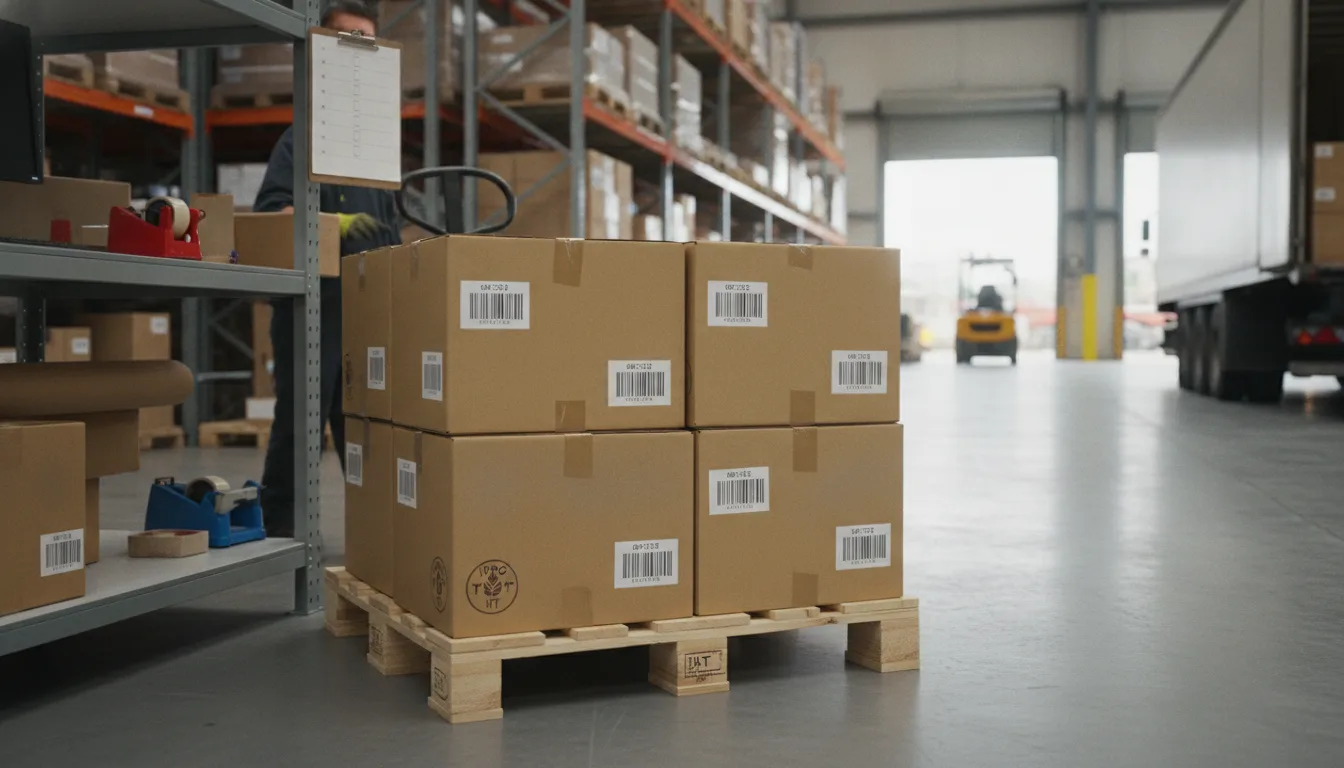
Step 6: Pack and label for 3PL receiving
A US fulfilment centre processes inbound shipments at high throughput. Cargo that arrives unlabelled, mixed-SKU without segregation, or on non-standard pallets will be quarantined, manually sorted and charged a non-compliance fee. Follow these standards before the shipment leaves your EU facility.
Carton requirements
- Use new, double-walled corrugated cartons rated for the gross weight of contents. Reused cartons often fail compression tests in ocean containers.
- Maximum carton weight: 25 kg (55 lb) gross. Heavier cartons require special handling and may be refused or charged at an oversized rate.
- Place a SKU label (barcode, product name, quantity) on at least two faces of each inner carton. Use GS1-128 or Code 128 barcodes at a minimum 300 dpi print resolution.
- If a carton contains multiple SKUs, label each inner pack separately and include a mixed-SKU manifest inside the carton lid.
- For Amazon FBA prep requirements, carton and labelling rules differ; YouParcel's fulfilment services include FBA prep to ensure your inventory meets Amazon's standards before transfer.
Pallet requirements
- Use GMA standard 48 in x 40 in (1,219 mm x 1,016 mm) wood pallets or ISPM 15-certified heat-treated pallets for international shipments. CBP and USDA APHIS require heat-treated wood packaging marked with the IPPC stamp for all wood entering the US.
- Stack height: 1.5 m (60 in) including pallet height is a practical maximum for standard racking; confirm with your 3PL before loading.
- Wrap pallets with stretch film and apply a pallet label on all four sides showing: shipper name, consignee name, PO or ASN number, carton count, gross weight and destination fulfilment centre address.
- Send an Advance Shipping Notice (ASN) to YouParcel at least 48 hours before the freight departs the EU. The ASN should include the PO number, SKU list, quantities per SKU, carton count, pallet count, carrier name, tracking or container number, and estimated arrival date.
Step 7: Route your freight to the right US fulfilment centre
YouParcel operates fulfilment centres in New Jersey, California and Illinois. For EU brands, the two primary receiving locations are:
- NY/NJ facility (East Coast): 20 Farinella Dr, East Hanover, NJ 07936. Well-positioned for the Northeast and Mid-Atlantic US consumer base, and close to the Port of New York/New Jersey (one of the top two US container ports by volume) and Newark Liberty International Airport for air freight deliveries.
- Southern California facility (West Coast): 3700 S. Riverside Ave, Rialto, CA 92324. Positioned for West Coast customers and served by the Ports of Los Angeles and Long Beach, the largest container port complex in the US.
For a first inbound from the EU, most brands route to the East Coast facility because transatlantic air and ocean services from major EU ports (Hamburg, Rotterdam, Antwerp, Frankfurt) land naturally at New York/Newark. If your US customer geography is weighted toward California, or if your ocean carrier's best rates land at Los Angeles/Long Beach, the West Coast facility is the right primary destination.
If you are splitting inventory across both coasts, plan your inbound quantities based on historical or projected order geography. YouParcel's BI and analytics tools (integrating with Salesforce, Tableau and 70+ platforms) can help you model the right split once you have initial US sales data.
Drayage from port to warehouse
Drayage is the short-haul trucking move from the ocean port or CFS to the fulfilment centre. For LCL shipments, your forwarder arranges drayage from the CFS after deconsolidation. For FCL shipments, drayage is arranged from the port terminal directly. Drayage transit times vary from one to five business days depending on port congestion, rail intermodal options and trucking availability. Port congestion at Los Angeles/Long Beach can extend drayage timelines; build two to three additional days into your receiving schedule when shipping to the West Coast.
Step 8: US customs entry and duty payment
For shipments with a CBP-assessed value above $2,500, a formal entry is required. Your licensed customs broker files the entry through the Automated Commercial Environment (ACE) system. CBP may release the goods immediately ("green lane"), request a document review, or examine the physical cargo. Average formal entry release times range from same-day to five business days, though examinations add time and cost.
Duties are paid to CBP at entry. For the duration of the Section 122 surcharge (through 24 July 2026), your duty calculation is:
Total duty = (Customs value) x (MFN rate + Section 301 rate, if any) + (Customs value x 10% Section 122 surcharge)
Model this number before the goods ship. If your product carries a 12% MFN rate, the effective rate through July 2026 is 22% (plus any Section 301 addition). On a $50,000 customs value shipment, that is $11,000 in duties. Plan your cash flow accordingly, as duties are typically due within ten working days of entry liquidation.
After 24 July 2026, the Section 122 surcharge is scheduled to expire. The underlying MFN and any Section 301 rates remain. Verify the current duty environment with your broker before each shipment, as tariff conditions have changed frequently in 2025 and 2026.
Step 9: Receiving at the YouParcel fulfilment centre
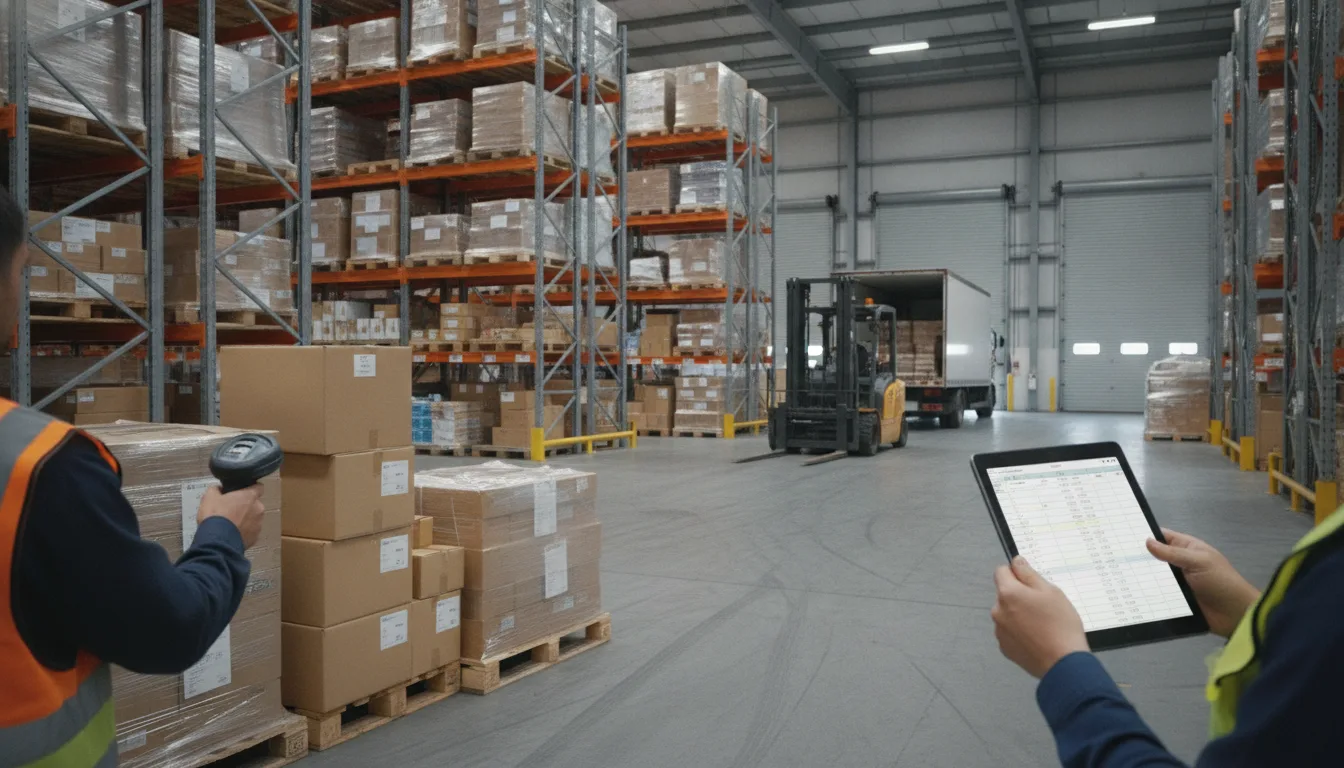
Once your freight arrives at the fulfilment centre dock, the receiving process follows these steps:
- Appointment scheduling: the carrier or drayage provider books a receiving appointment. Walk-in deliveries without an appointment may wait for the next available dock slot.
- ASN matching: the warehouse management system (WMS) matches the incoming shipment against your ASN. Discrepancies (wrong SKU, quantity overage or shortage) are flagged immediately and communicated to your account team.
- Carton and pallet inspection: warehouse staff check for damage, verify carton counts and scan barcodes against the ASN.
- Putaway: units are scanned into inventory locations. Real-time inventory visibility is available through your integration (Shopify, Amazon, or 70+ other platforms).
- Discrepancy resolution: any damaged units are photographed and quarantined; your account team receives a receiving exception report for claims or disposition decisions.
The quality and speed of this process depends almost entirely on how well your ASN and carton labels match what physically arrives. An accurate ASN with correct SKU counts typically results in same-day putaway. A shipment with no ASN or unlabelled cartons may take two to five additional business days to receive.
Common first-inbound mistakes EU brands make
- Undervaluing the commercial invoice: CBP compares declared values against market data. Undervaluation is fraud and can result in penalties, seizure and loss of import privileges. Always declare transaction value accurately.
- Missing ISPM 15 certification on wood pallets: USDA APHIS requires all wood packaging to carry the IPPC heat-treatment mark. Non-compliant pallets are fumigated or destroyed at the importer's expense. Use certified pallets or switch to plastic or pressed-board alternatives.
- Inconsistent product descriptions across documents: the description on the invoice must match the packing list and the bill of lading. CBP uses consistency as a red flag; mismatches trigger exams.
- No FDA prior notice for regulated products: food, supplements and cosmetics require prior notice before arrival. Filing it after the vessel departs is still valid, but filing after arrival at port is not.
- Assuming the 3PL will handle customs: the fulfilment centre receives bonded or released cargo. It does not clear customs on your behalf. You need a licensed broker.
- Sending mixed-SKU cartons without inner-pack labels: receiving staff cannot count or locate individual SKUs without labelling at the unit or inner-pack level.
Connecting freight forwarding and fulfilment under one partner
One of the practical complications for EU brands is managing two separate vendor relationships: a freight forwarder who moves the goods from the EU to the US port, and a 3PL who receives and fulfils from the US warehouse. Handoffs between them create information gaps, particularly around arrival dates, container numbers and ASN data.
YouParcel's freight forwarding services and US fulfilment operations sit under the same platform, which means the freight team and the warehouse team share the same shipment data. Your ASN is generated from the freight booking, arrival notifications feed directly into the WMS, and you have a single account team managing the entire inbound chain from EU origin to US doorstep. For a first inbound, that continuity reduces the risk of data errors that would otherwise cause receiving delays.
YouParcel's leadership team brings 50+ years of combined experience across freight forwarding, customs compliance and ecommerce fulfilment, which is relevant when your first inbound hits an unexpected customs exam or a port congestion delay and you need a team that has managed those situations before.
Frequently asked questions
Do I need a customs broker to ship EU inventory to a US warehouse?
For formal entries (shipments valued above $2,500 CBP) you are not legally required to use a broker, but CBP strongly recommends one. A licensed customs broker navigates ACE filing, ISF deadlines, HTS classification and duty payment. For a first inbound, using a broker almost always saves more in avoided delays and penalties than the broker's fee costs.
What is the Section 122 surcharge and when does it end?
The Section 122 surcharge is a temporary 10% import tariff applied to most goods entering the US under Section 122 of the Trade Act of 1974, active from 24 February 2026 through 24 July 2026. It adds 10 percentage points to your existing duty rate and must be factored into landed cost calculations for any shipment arriving in the US before that date.
Can I ship directly from the EU to an Amazon FBA warehouse instead?
Amazon's FBA programme has strict inbound requirements, labelling rules and shipment plan constraints that make direct international shipping complex and risky. Most EU brands ship to a 3PL first for inspection, FBA prep (labelling, bundling, poly-bagging) and then transfer to Amazon. YouParcel offers FBA prep services at its US facilities.
How long does the entire first inbound process take, from EU warehouse to US inventory ready to ship?
For air freight, the typical range is 7 to 14 days from EU pick-up to US inventory available, covering transit, customs clearance and receiving. For ocean LCL from Northwest Europe to the US East Coast, plan 28 to 45 days. These ranges depend on document accuracy, CBP processing and port congestion; they are estimates, not guarantees.
What happens if CBP examines my shipment?
CBP may request a document examination (CET) or a physical examination at the port or an intensive exam at a CES (Container Examination Station). Physical exams can add three to ten business days and examination fees (typically charged by the terminal or CES). Your customs broker will coordinate with CBP, but you should notify your 3PL to adjust the expected receiving date and avoid booking labour or launching promotions until release is confirmed.
Ready to plan your first inbound to a US fulfilment centre? Talk to an Expert at YouParcel and get a practical inbound plan built around your SKUs, volume and EU origin port.