


Ecommerce order fulfillment during the holiday peak depends on one discipline above all others: working backward from carrier send-by dates to store-facing order cutoffs, then publishing those cutoffs in customer messaging before demand spikes. With USPS filing a price increase effective October 4, 2026, and UPS publishing its 2026 peak demand surcharge schedule in late August, brands that align their 3PL processing windows to these dates now will protect margins and delivery promises through January.
- USPS filed a peak price increase covering Priority Mail Express, Priority Mail, Ground Advantage and Parcel Select from October 4, 2026 through January 17, 2027, raising per-parcel costs mid-peak.
- UPS 2026 peak demand surcharges begin September 27 for large and additional handling packages, and October 25 for residential and air shipments, running through January 16, 2027.
- Your store cutoff must sit at least two to three business days before the carrier send-by date to give your 3PL time to pick, pack, label and hand off.
- YouParcel processes 10,000-plus orders per day across multiple marketplaces, and coordinating cutoff windows with your fulfillment partner ahead of peak avoids capacity surprises in November and December.
Why the 2026 Surcharge Calendar Changes Your Planning Timeline
Carrier surcharges are not just a cost item. They are a planning signal. When a carrier announces that large-package and additional-handling surcharges start September 27, as UPS has done for 2026, it signals that the carrier's network is already accepting peak-rated volume on that date. For a brand still planning cutoffs in October, the surcharge window has already opened.
Two events published in the last week of August 2026 set the parameters for this season:
- USPS peak price increase (filed 2026-08-25): A rate increase applies to Priority Mail Express (PME), Priority Mail, Ground Advantage and Parcel Select from October 4, 2026 through January 17, 2027. The filing was reported by Supply Chain Dive on August 25, 2026. The exact per-piece increases are stated in the USPS Postal Regulatory Commission (PRC) filing; brands should pull the current rate card from the Postal Regulatory Commission and update their shipping cost models now.
- UPS peak demand surcharges (published 2026-08-26): Large package and additional handling surcharges activate September 27, 2026. Residential delivery and air service surcharges activate October 25, 2026. All categories run through January 16, 2027, with higher rates than the prior peak season, per Supply Chain Dive reporting dated August 26, 2026.
Sources: Supply Chain Dive, USPS 2026 peak rate increase, 2026-08-25 and Supply Chain Dive, UPS 2026 peak demand surcharges, 2026-08-26.
FedEx typically publishes its own peak surcharge schedule on a similar cadence. Check the FedEx rate and surcharge pages directly, as figures may differ from prior years; do not rely on last year's numbers for budget planning.
How to Build Store Cutoffs From Carrier Send-By Dates
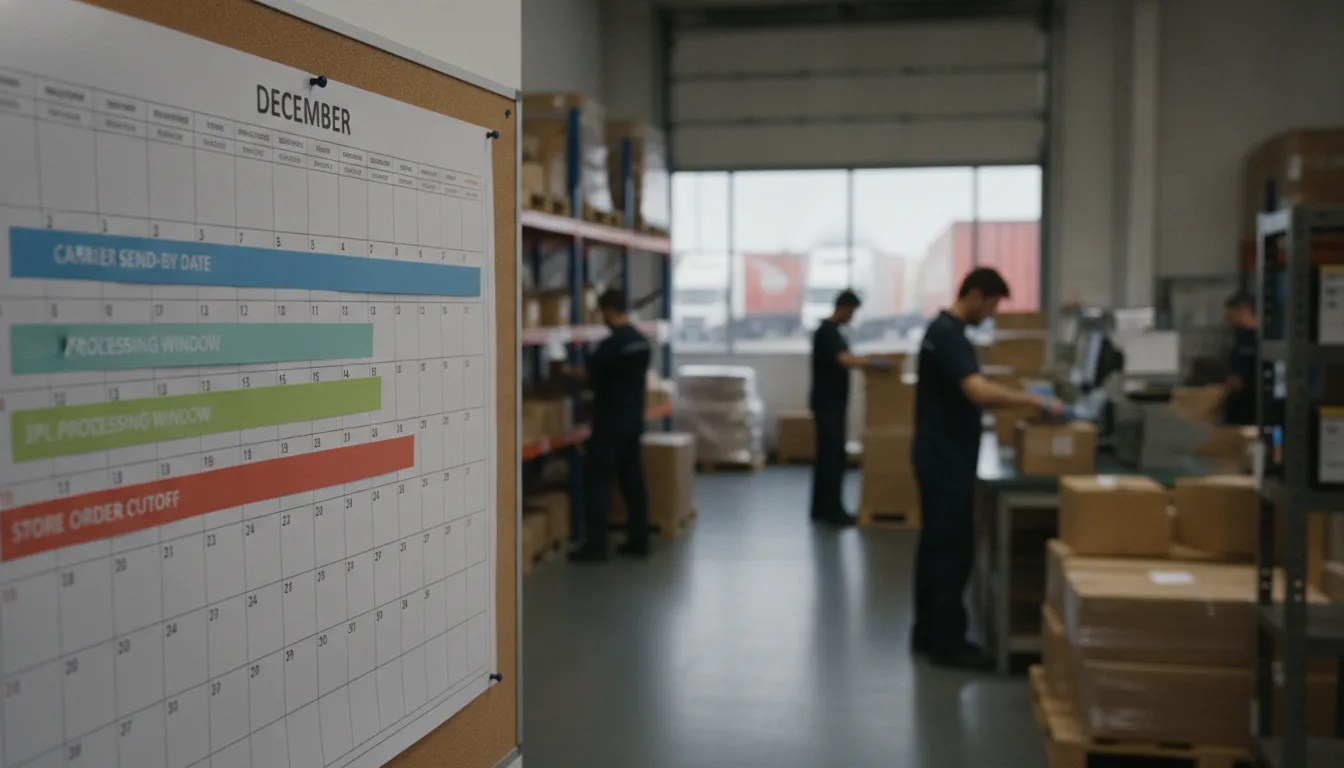
A carrier send-by date is the last date a parcel can enter the carrier network and still reach a residential address by a stated delivery date (for example, December 24). Carriers publish these dates on their holiday shipping pages, usually in late October or November; check carrier sites weekly from mid-October onward. Your store order cutoff is the date you stop accepting orders that carry a guaranteed or implied delivery promise for that holiday.
The gap between those two dates is your 3PL processing window. Here is how to calculate it:
- Identify each carrier service you use and its send-by date. Typical hierarchy for domestic US: Priority Mail Express is the latest (often December 23 for Christmas), then Priority Mail, then Ground Advantage and other ground services (often December 17 to 20 depending on origin zone). Zone-based transit times mean a parcel shipped from your New Jersey or California fulfillment center has different send-by dates to the same zip code.
- Map your 3PL processing time. Confirm with your fulfillment partner the realistic same-day or next-day cutoff time for orders that arrive in the warehouse management system. During peak, order volume may extend pick-and-pack lead times by one business day. Build in at least one additional buffer day for Q4.
- Add inbound buffer for any custom kitting or assembly work. If holiday bundles require kitting, those SKUs need to arrive at the fulfillment center and be kitted before the order can ship. Kitting lead times of two to five business days are common at peak; confirm the schedule with your 3PL in writing, not verbally.
- Count backward from the carrier send-by date. If the USPS Ground Advantage send-by date for Christmas is December 18 and your 3PL needs two business days to process an order, your store cutoff for standard shipping is December 16. If the same order requires kitting that takes three days, the store cutoff is December 11.
- Set a separate cutoff for expedited and express services. Priority Mail and Priority Mail Express have later send-by dates and carry the USPS peak price increase in effect from October 4. Publish the expedited cutoff clearly so customers self-select the right service and accept the associated cost.
- Confirm inventory position before publishing cutoffs. A cutoff is a promise. If stock runs out December 10, the December 16 cutoff becomes misleading. Set inventory triggers with your 3PL so that the store cutoff updates automatically or you receive an alert when a threshold is crossed.
- Document every cutoff and share it with your 3PL, customer service team and marketing team simultaneously. Cutoffs that live only in someone's inbox will not make it into the December 1 email campaign banner.
Translating Surcharge Windows Into Fulfillment Cost Planning
Surcharge windows affect your landed fulfillment cost per order, not just your carrier rate. The table below maps the published 2026 surcharge activation dates to the planning actions that should happen before each date.
| Surcharge category | Carrier | Activation date | End date | Planning action before activation |
|---|---|---|---|---|
| Large package and additional handling | UPS | September 27, 2026 | January 16, 2027 | Audit SKU dimensions; apply dim weight formula (UPS divisor: 139 for domestic); split large orders where economically justified |
| Residential delivery | UPS | October 25, 2026 | January 16, 2027 | Evaluate carrier mix; compare USPS Ground Advantage for lightweight residential parcels; lock carrier allocation with your 3PL |
| Air services (UPS Next Day Air, 2nd Day Air) | UPS | October 25, 2026 | January 16, 2027 | Price expedited shipping to customers above the surcharge floor; set store-facing surcharge disclosure language |
| Priority Mail Express, Priority Mail, Ground Advantage, Parcel Select | USPS | October 4, 2026 | January 17, 2027 | Update postage cost models; review shipping threshold for free shipping offers; confirm rate card with carrier or 3PL account team |
Dimensional weight (dim weight) is the formula carriers use to charge whichever is greater: actual weight or the weight implied by the package volume. The formula is length x width x height (in inches) divided by the carrier's divisor. UPS uses a divisor of 139 for domestic ground and air. USPS Ground Advantage applies dim weight to parcels over one cubic foot. During peak, large-package surcharges compound the dim weight penalty: a parcel billed at a higher dim weight also pays the large-package surcharge if it exceeds the carrier's dimensional threshold. This is a frequent source of cost overruns in Q4 that brands only discover in January when invoices arrive.
What to Confirm With Your 3PL Before October 4
October 4 is the date the USPS peak price increase takes effect. It is also a useful forcing function: any fulfillment planning conversation that has not happened by that date is running behind. The following checklist covers the conversations to complete before the surcharge window opens.
- Processing capacity agreement: Confirm the daily order volume your 3PL has allocated for your account during peak weeks (the week of Thanksgiving, Cyber Week, the two weeks before Christmas). Get this in writing, not in a Slack message.
- Inbound receiving deadlines: Inventory must arrive at the fulfillment center with enough lead time to be received, inspected, slotted and made available for picking before you open holiday promotions. A standard receiving window is three to seven business days after a truck arrives; during peak it can be longer. Ask specifically.
- Kitting and assembly schedule: If you sell gift sets or holiday bundles that require kitting at the fulfillment center, confirm that the kitting is completed and the assembled SKUs are in pick locations before your first holiday promotion goes live. YouParcel's ecommerce fulfillment services include kitting and assembly, and the schedule for peak kitting should be agreed upon by early October at the latest.
- Returns handling during peak: Volume goes up in November and December; returns volume peaks in January. Confirm your 3PL has capacity to receive and process returns without slowing outbound fulfillment.
- Carrier allocation and label generation: Confirm which carriers your 3PL will route your parcels through during peak. Carrier capacity constraints can shift allocation mid-season. Know the rules in advance.
- Tracking and alerts: Real-time tracking and exception alerts matter more in December than at any other time of year. Confirm that your 3PL integration surfaces delays or exceptions to your customer service team with enough lead time to communicate proactively, not reactively.
Writing Customer-Facing Cutoff Messaging That Actually Works
A cutoff date that customers do not see is a cutoff that does not function. The messaging needs to appear in multiple places, early enough to change behavior, and specific enough to be actionable.
The following principles apply regardless of the platform you use:
- Lead with the shipping method, not the date. Customers process "Order by December 16 with Standard Shipping" faster than "Holiday shipping cutoff: 12/16." The method anchors their expectation.
- Use specific dates, not relative language. "Ships within 5-7 days" is not a holiday promise. "Order by December 16 to receive by December 24" is.
- Display cutoffs at the point of decision. Product pages, the cart, the checkout page and the order confirmation email are the highest-value placements. A homepage banner is useful but not sufficient on its own.
- Update messaging in real time as cutoffs pass or inventory depletes. A cart that still shows a December 24 delivery promise on December 19 for a standard shipping option is a customer service ticket waiting to happen.
- Be transparent about the cost of late orders. If a customer misses the standard cutoff and can still order with Priority Mail at a higher shipping cost, show that option explicitly. Do not make them call to find out.

Multi-Warehouse Fulfillment and Zone-Based Cutoff Differences
Brands fulfilling from multiple locations face a more complex cutoff picture: the send-by date for a parcel leaving a New Jersey warehouse to a California address is different from the send-by date for the same parcel leaving YouParcel's Southern California facility at 3700 S. Riverside Ave, Rialto, CA 92324. Zone 1 and Zone 2 shipments (short-distance) carry later send-by dates than Zone 7 or Zone 8 cross-country shipments.
If your inventory is split across YouParcel's East Coast (20 Farinella Dr, East Hanover, NJ 07936) and West Coast fulfillment centers, work with your operations team to understand which origin your 3PL will use for each order. For brands where inventory is not split, the origin zone matters even more: a brand fulfilling entirely from New Jersey has a shorter window to reach California customers than a brand with West Coast inventory. The cutoff for standard ground to California from New Jersey may be five to six days earlier than from Rialto.
This zone math is not theoretical. It is one of the most common sources of missed holiday delivery promises, and it is entirely preventable with a zone-cutoff matrix built in September, not December. Ask your shipping operations team to produce a zone-by-service cutoff table using your actual ship origins and 2026 carrier send-by dates once those are published.
The Cost of Getting This Wrong
Late deliveries in December do not just generate refund requests. They generate social posts, negative reviews and customer churn at the moment of highest lifetime value. The cost of a missed holiday delivery is not limited to the shipping refund. It includes the customer who does not reorder in January, the review that suppresses conversion through Q1 and the customer service hours spent on delivery exceptions that were foreseeable.
Brands that set cutoffs too late, or fail to publish them clearly, are also the ones most likely to pressure their 3PL to ship on an expedited service at the last minute, paying the UPS air surcharge (active from October 25) plus the USPS PME rate increase on top of an already expensive order. The planning work done in September and early October is the cheapest form of peak-season cost control available.
Frequently Asked Questions
When should I start planning holiday order cutoffs with my 3PL?
Begin the conversation in September. Carrier surcharge windows for 2026 are already open or opening within weeks, and your 3PL needs time to confirm capacity, kitting schedules and inbound receiving deadlines before you lock store-facing messaging. Waiting until October means some decisions are already made for you.
How does the USPS 2026 peak price increase affect my shipping strategy?
The increase applies to Priority Mail Express, Priority Mail, Ground Advantage and Parcel Select from October 4, 2026 through January 17, 2027. Update your per-order shipping cost model before October 4, revisit any free-shipping threshold that was set using pre-peak rates, and confirm current figures with the USPS PRC filing or your carrier account team, as the exact per-piece amounts are specified there.
What is the difference between a carrier send-by date and a store order cutoff?
A carrier send-by date is the last date to inject a parcel into the carrier network for a given delivery date. A store order cutoff is the date you stop accepting orders that carry that delivery promise. The gap between the two dates is your 3PL processing window, which should be at least two business days for standard orders and longer if kitting or assembly is involved.
Do peak surcharges apply to all parcel sizes?
No. Surcharge categories differ. UPS large-package and additional-handling surcharges apply based on package dimensions and handling characteristics. Residential delivery surcharges apply per qualifying residential shipment regardless of size. The USPS increase applies at the service level. Review your SKU mix against each carrier's surcharge definitions to identify which of your products are most exposed.
How does a multi-warehouse setup affect holiday order cutoffs?
Shipping zone determines transit time. A parcel from New Jersey to California takes more transit days than a parcel from California to California. If your inventory is split between fulfillment centers, you will have different send-by dates and therefore different store cutoffs by origin. Build a zone-by-service cutoff matrix with your 3PL using your actual ship-from locations and the 2026 carrier send-by dates once published.
Aligning your ecommerce order fulfillment calendar with carrier surcharge windows and realistic 3PL processing times is one of the highest-return planning actions you can take before peak season. YouParcel's team works with brands across Shopify, Amazon and 70-plus other platforms to coordinate cutoffs, inbound schedules and carrier allocation before volume spikes. Talk to an Expert to build your 2026 holiday fulfillment plan now.