

US HTS codes (Harmonized Tariff Schedule codes) are the ten-digit product classification numbers that US Customs and Border Protection uses to determine the duty rate, admissibility requirements, and applicable trade-remedy tariffs for every commercial import. YouParcel works alongside licensed customs brokers to help freight customers understand classification as part of its freight forwarding and customs support services, but final classification decisions must be made by or confirmed with a licensed customs broker or attorney.
- An HTS code is a ten-digit number built on the international six-digit Harmonized System (HS) base; the last four digits are specific to the United States.
- Your HTS code now determines not just the base MFN duty rate but also whether Section 301 (trade-remedy) surcharges, Section 232 (national-security) duties, and the 2026 Section 301 forced-labor tariffs apply to your goods.
- Since August 29, 2025, the US de minimis threshold that previously allowed low-value parcels to enter duty-free has been suspended; every commercial shipment is subject to formal entry and duty assessment regardless of value.
- Misclassification is not a minor administrative error: it can trigger penalty proceedings under 19 U.S.C. § 1592 and result in back-duties, interest, and cargo holds. Always confirm classification with a licensed customs broker.
What is the Harmonized Tariff Schedule of the United States?
The Harmonized Tariff Schedule of the United States (HTSUS) is the official schedule of import duty rates published by the US International Trade Commission (USITC). It is the US implementation of the World Customs Organization (WCO) Harmonized System, which provides a common six-digit product nomenclature used by more than 200 countries. The USITC publishes the HTSUS and updates it regularly; the official schedule is available at hts.usitc.gov.
Every commercial import into the United States must be classified under a valid HTSUS heading. CBP enforces this requirement at the port of entry, and the importer of record bears legal responsibility for the accuracy of the declared classification.
How is an HTS code structured?
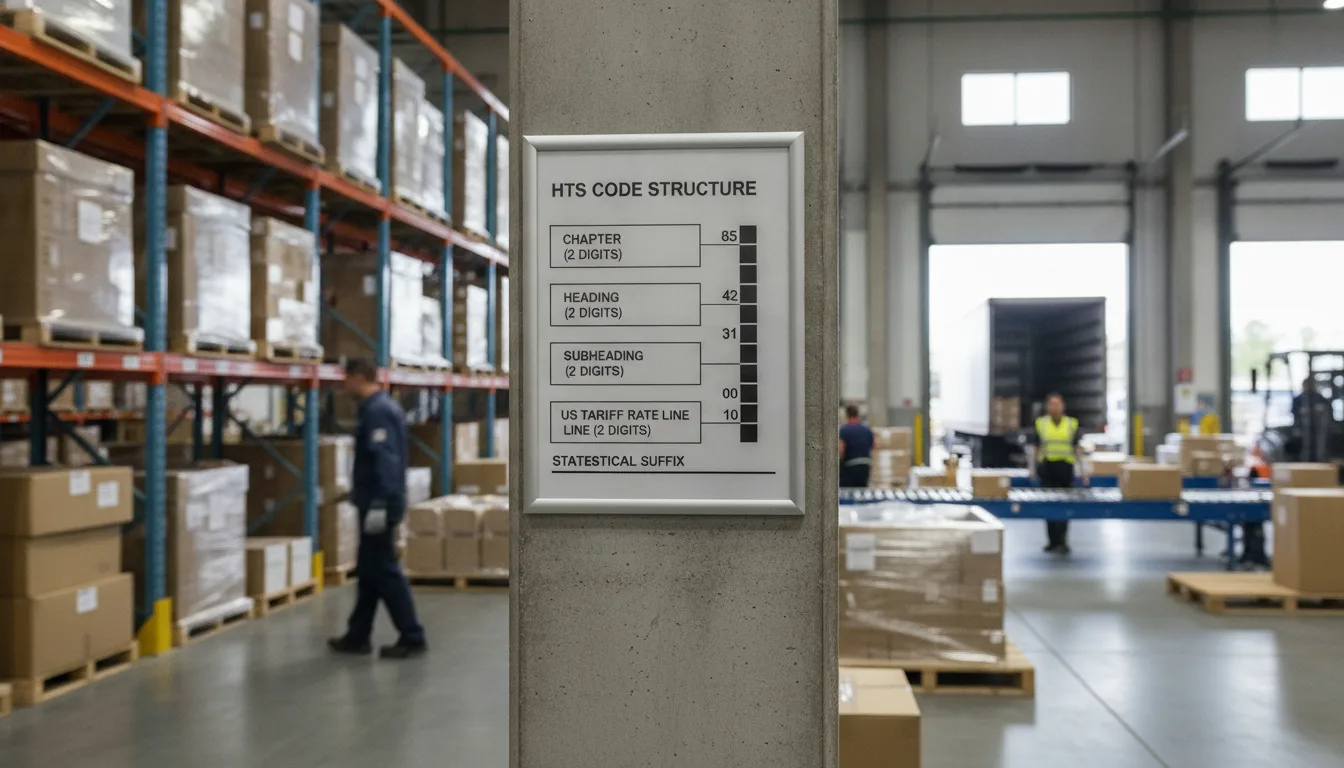
Understanding the structure of an HTS code makes classification far less intimidating. The ten digits break into four logical layers.
| Digits | Layer | What it identifies | Example (cotton T-shirt) |
|---|---|---|---|
| 1-2 | Chapter | Broad product category (99 chapters) | 61 (knitted apparel) |
| 3-4 | Heading | Specific product group within the chapter | 6109 (T-shirts, singlets, other vests, knitted) |
| 5-6 | Subheading | International HS subheading (WCO level) | 610910 (of cotton) |
| 7-8 | US tariff rate line | US-specific breakdown for duty rate | 61091010 (men's or boys') |
| 9-10 | Statistical suffix | US Census Bureau reporting unit | 6109101060 |
The first six digits (chapter, heading, subheading) are identical across all WCO member countries. This is the HS code. When someone says they need an HS code for a product, they typically need at least these six digits. The full ten-digit HTSUS number is required for any US import declaration.
What is the difference between an HTS code, an HS code, and a Schedule B code?
These three terms often cause confusion. Here is a plain comparison.
| Code type | Digits | Used for | Administered by |
|---|---|---|---|
| HS code | 6 | International trade, supplier invoices, country-of-origin rules | World Customs Organization |
| HTS code (HTSUS) | 10 | US import entry, duty rate determination | USITC / CBP |
| Schedule B | 10 | US export declarations (Electronic Export Information) | US Census Bureau |
In practice, the first six digits of an HTS code and the corresponding Schedule B code are usually identical, but the remaining four digits can differ. Always use the HTSUS for import declarations and Schedule B for export filings.
Why HTS classification matters more than ever in 2026
The HTS code on a commercial import entry does not just determine the base Most Favored Nation (MFN) duty rate. It is the trigger for a stack of additional trade-remedy duties that have expanded significantly since 2018 and again in mid-2026.
Section 301 trade-remedy tariffs
Section 301 of the Trade Act of 1974 authorizes additional duties on products from countries the USTR finds engaged in unfair trade practices. The original Section 301 action against China (Lists 1 through 4B, 2018 to 2019) imposed 7.5% to 25% additional duties on a wide range of product categories identified by HTS subheading. USTR has also modified exclusions and re-imposed duties on specific subheadings on multiple occasions since.
Section 232 national-security tariffs
Section 232 of the Trade Expansion Act of 1962 authorizes duties where imports threaten national security. As of September 2026, Section 232 tariffs remain in effect on steel (25%) and aluminum (10% base, with derivative-product extensions) for most trading partners. These duties apply at the HTS subheading level for covered steel and aluminum products and their derivatives.
Section 301 forced-labor tariffs effective July 24, 2026
The most significant recent development for importers is the USTR's finalization of Section 301 forced-labor tariffs on 60 economies. These tariffs of 10% or 12.5% took effect on July 24, 2026, following the expiration of Section 122 authority. For the EU and Taiwan, the combined MFN plus Section 301 rate is generally capped at 10%. For other covered economies, the additional rate is 12.5%. Which rate applies to any specific shipment depends on the HTS subheading of the goods and the country of origin. EY Tax News summarizes the finalized USTR Section 301 forced-labor tariff structure as published July 24, 2026. Always confirm current applicability with a licensed customs broker, as exclusion requests and product-specific carve-outs can change the effective rate.
The duty stack in practice
An importer bringing in a steel-derivative consumer product from a covered economy could face MFN duty, Section 232 duty, and Section 301 forced-labor duty simultaneously. A one-digit classification error can mean tens of thousands of dollars in additional duties on a container load. The HTS code is the single key that opens or closes each layer of that stack.
How to classify a product: a step-by-step approach
The General Rules of Interpretation (GRIs) are the legal framework for HTSUS classification. There are six rules, applied in order. What follows is the practical workflow a licensed customs broker uses. Use it to prepare for that conversation, not to replace it.
- Describe the product precisely. Write down the product's material composition (by percentage if mixed), its function, its condition at import (finished goods, components, sets), its principal use, and any relevant processing it has undergone. Vague descriptions produce wrong codes.
- Identify the chapter using Section and Chapter notes. Open the HTSUS at hts.usitc.gov. The schedule is organized into 22 Sections and 99 Chapters. Chapter and Section notes are legally binding and define what is or is not included in a chapter. Read them before moving to headings.
- Find the correct four-digit heading under GRI 1. GRI 1 says goods are classified first according to the terms of the headings and any relative section or chapter notes. Match the product description to the heading that most specifically describes it. If a single heading clearly covers the article, stop here and move to the subheading level.
- Apply GRI 2 if the product is unfinished or a mixture. GRI 2(a) covers unfinished or incomplete articles that have the essential character of the finished article. GRI 2(b) covers mixtures and combinations of materials.
- Apply GRI 3 for goods classifiable under two or more headings. GRI 3(a) prefers the most specific heading. GRI 3(b) classifies composite goods or sets by the component that gives essential character. GRI 3(c) chooses the heading that occurs last in numerical order if no other rule resolves it.
- Drill down to the six-digit subheading. Once the heading is confirmed, apply the same GRI logic (GRIs 1 through 5 as modified for the subheading level) to identify the correct subheading. Subheading comparisons must be made only within the same heading.
- Select the US tariff rate line (digits 7 and 8) and statistical suffix (digits 9 and 10). These are US-specific and may subdivide by end-use, quota status, or other criteria. The duty rate shown at the tariff-rate-line level is what CBP applies. The statistical suffix is for Census reporting and does not affect the duty rate, but it must still be correct on the entry.
- Check for additional duties. Once you have the ten-digit code, search the USTR's Section 301 list annexes and any active Section 232 Federal Register proclamations to determine whether additional duties apply to that subheading and the country of origin.
- Confirm with a licensed customs broker. Classification is a legal determination. Use this process to build a defensible working hypothesis, then have a licensed broker review it before the first shipment.
How to do an HTS code lookup
There are three primary tools for HTS code lookup. Each has a different strength.
| Tool | Source | Best for | Limitation |
|---|---|---|---|
| USITC HTS Online | hts.usitc.gov | Authoritative, always current; searchable by keyword or browse by chapter | Requires familiarity with the schedule structure |
| CBP Binding Ruling Database (CROSS) | rulings.cbp.gov | Precedent rulings on specific products; useful for contested classifications | Past rulings are not binding on new importers; product details must match |
| Schedule B Search Engine | US Census Bureau / AES | Export classifications; often cross-referenced by brokers as a starting point | Export and import codes diverge at digits 7 through 10; do not use Schedule B numbers on import entries |
A keyword search on the USITC portal will return candidate headings, but the search is not a substitute for reading the section notes, chapter notes, and GRIs. Many misclassifications happen when importers accept a search result without checking whether the chapter notes exclude their specific product.
Requesting a binding ruling from CBP
An importer can request a binding ruling from CBP through the CROSS system before importing a product for the first time. A binding ruling gives legal certainty: CBP must accept the classification on future shipments of the same product as long as the facts remain unchanged. The process takes time (typically several months), so plan ahead for new product lines. Details are at cbp.gov/trade/rulings.
Common HTS classification mistakes and how they affect landed cost
The following errors appear frequently in import entries and can carry significant cost consequences.
Classifying by material when function governs
Machinery and equipment chapters often classify by function (what the product does) rather than material composition. An importer who classifies a plastic-bodied electric pump under plastics (Chapter 39) instead of pumps (Chapter 84) will get the wrong duty rate and may miss or attract Section 232 coverage. Chapter and section notes define which chapter governs when a product could fit in more than one place.
Using a supplier's HS code without verification
Overseas suppliers provide HS codes based on their country's tariff schedule. The first six digits should match, but the chapter notes, exclusions, and administrative rulings in the HTSUS may put the product in a different US heading. The importer of record is legally responsible for the classification on the US entry, not the supplier.
Ignoring end-use provisions
Some HTSUS tariff rate lines apply only when goods are imported for a specific end use, documented at entry. If the goods are diverted after import, the preferential rate is lost and duties become due. End-use provisions appear frequently in textiles, chemicals, and certain machinery parts.
Overlooking quota categories
Absolute quotas (which cut off entry once a quantity is reached) and tariff-rate quotas (which apply a higher out-of-quota rate above a threshold quantity) are tied to specific HTS subheadings. Missing a quota provision on a textile or agricultural product can result in entry refusal or dramatically higher duties.
HTS classification and country of origin: why both matter together
The duty rate for any import is determined by two variables in combination: the HTS code and the country of origin. The same product imported from two different countries can carry completely different effective duty rates because additional Section 301 or Section 232 duties may apply to one country but not the other.
Country of origin for US customs purposes follows the substantial transformation test: a product's origin is the country where it last underwent a process that transformed it into a new and distinct article of commerce with a name, character, and use different from the input materials. This is not the same as the country from which the goods were shipped, and it is not simply where the final assembly step occurred. Preferential origin rules under free-trade agreements use different, agreement-specific rules of origin. A licensed customs broker can advise on origin determination for complex supply chains.
The de minimis suspension since August 29, 2025, means that the combination of HTS code plus origin now applies to virtually every inbound commercial shipment regardless of value. For importers who previously relied on informal entry for low-value parcels, this change requires that origin documentation and accurate classification be established for every product line. The practical implications for ecommerce brands are covered in more detail in the YouParcel article on the US customs de minimis rule change.
What role does a freight forwarder play in HTS classification?
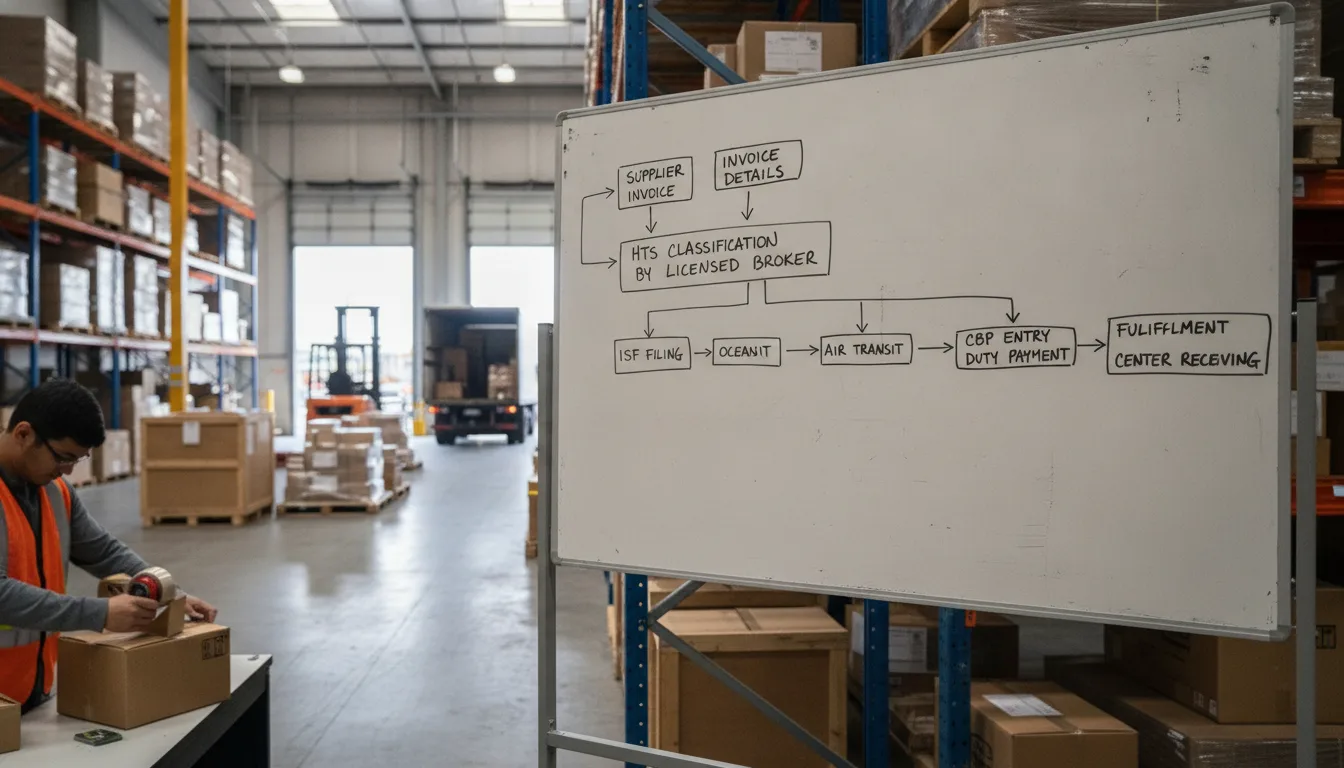
A licensed customs broker handles the legal classification determination and files the entry with CBP. A freight forwarder arranges the physical movement of goods: ocean or air booking, ISF (Importer Security Filing, also called 10+2) submission, inland drayage, and delivery to the warehouse or fulfillment center. Many freight forwarders work alongside or partner with licensed customs brokers, and some firms hold both licenses.
YouParcel's freight forwarding service coordinates the logistics side of inbound shipments and connects customers with the customs expertise needed for compliant entry. Because classification affects every downstream cost from duties to storage to fulfillment economics, getting it right before the first shipment is far cheaper than correcting it after a CBP examination. If you are preparing to bring goods into the US and want to understand the full picture of freight and customs coordination, the YouParcel freight forwarding team can walk through your specific situation.
Practical classification example: a Bluetooth speaker imported from Vietnam
This example illustrates how the classification process works in practice. It is for educational purposes only and does not constitute a legal ruling.
- Product description: A portable, battery-powered Bluetooth speaker with a built-in microphone. Housing is 80% plastic, 20% metal. No radio-reception function beyond Bluetooth.
- Section and chapter search: Section XVI covers machinery and mechanical appliances; Chapter 85 covers electrical machinery and equipment. Chapter 85 Note 3 defines "sound recording or reproducing apparatus." Chapter 90 is excluded because the product is not a measuring instrument.
- Heading: Heading 8518 covers microphones, loudspeakers, headphones, and audio-frequency electric amplifiers. Heading 8518.22 covers single loudspeakers mounted in their enclosures. A portable Bluetooth speaker with an integrated amplifier and microphone is more specifically described by 8518.22 or 8518.29. A customs broker would review recent CBP rulings in the CROSS database for similar products.
- US tariff rate line: The applicable rate line under Chapter 85 for this subheading carries a column 1 (MFN) duty rate. CBP's current rate schedule should be checked at hts.usitc.gov for the precise rate applicable at time of entry.
- Section 301 check: Vietnam is not on the original China Section 301 lists. However, Vietnam is covered by the 2026 Section 301 forced-labor tariff structure. The importer would need to confirm whether this specific HTS subheading is covered and at which rate (10% or 12.5%) as of the date of entry.
- Conclusion: The effective duty is the MFN rate plus any applicable Section 301 forced-labor surcharge. A binding ruling from CBP would give legal certainty before scaling import volumes.
Recordkeeping and audit exposure
CBP's right to examine import records extends five years from the date of entry under 19 C.F.R. Part 163. Importers must maintain commercial invoices, packing lists, entry documents, and any classification support documentation for the full five-year period. If CBP conducts a focused assessment (a formal audit of a specific importer), misclassifications found during the audit period can result in penalties, back-duties, and interest on the full five-year lookback.
Maintaining a product classification database, an internal log that maps each product SKU to its confirmed HTS code, country of origin determination, and any supporting broker opinions or binding rulings, is a standard practice for importers with more than a handful of product lines. This database becomes the first line of defense in any CBP inquiry.
Frequently asked questions
What is an HTS code and why does it matter for importing into the US?
An HTS code is the ten-digit Harmonized Tariff Schedule number that CBP uses to determine the duty rate and admissibility requirements for every commercial import. It matters because the code now triggers not just the base MFN duty rate but also any Section 301, Section 232, or forced-labor tariff surcharges that apply to the product and its country of origin.
How do I find the right HTS code for my product?
Start with the official USITC HTS lookup tool at hts.usitc.gov, read the relevant chapter and section notes, and apply the General Rules of Interpretation in order. Because classification is a legal determination with real duty and penalty consequences, the final code should be reviewed and confirmed by a licensed customs broker before you file your first entry.
Is an HTS code the same as an HS code?
Not exactly. An HS code is the six-digit international code defined by the World Customs Organization. The US HTS code uses those same first six digits and adds four more US-specific digits for a total of ten. When you are filing a US import entry, you need all ten digits of the HTS code, not just the six-digit HS base.
What happens if I use the wrong HTS code on a US import entry?
CBP can reclassify the goods and issue a bill for unpaid duties plus interest. For repeated or deliberate misclassification, CBP can pursue civil penalties under 19 U.S.C. § 1592, which can reach four times the unpaid duties in cases of fraud. The importer of record, not the supplier or freight forwarder, bears legal responsibility for the classification.
Do the new 2026 Section 301 forced-labor tariffs apply to all products?
No. The July 24, 2026 forced-labor tariffs of 10% or 12.5% apply to specific HTS subheadings imported from the 60 covered economies identified by USTR. Whether a given product and country combination is covered depends on the specific tariff annexes published by USTR. A licensed customs broker can confirm applicability for your product categories and countries of supply.
To discuss how inbound freight, customs coordination, and accurate product classification connect to your fulfillment and cost structure, talk to a YouParcel freight expert and get a plan built around your supply chain.