

Incoterms (International Commercial Terms) are standardized trade rules published by the International Chamber of Commerce that define exactly who pays for freight, insurance and customs at each point in a cross-border shipment. For ecommerce importers buying from overseas factories, the four terms that come up most are EXW, FOB, FCA and DDP. YouParcel works with brands importing goods into the US daily and helps them choose the term that keeps costs predictable and risk manageable from factory floor to fulfillment center.
- EXW puts nearly all cost and risk on the buyer from the moment goods leave the factory; it gives the buyer maximum control but maximum responsibility.
- FOB is the most common factory-to-brand term for ocean freight: the seller loads the goods onto the vessel, and risk transfers to the buyer at that point.
- FCA is the preferred modern alternative to FOB, especially for containerized cargo, because risk transfers when the carrier takes custody, not when goods cross the ship rail.
- DDP means the seller delivers goods cleared through customs and duties paid, which protects the buyer from surprise costs but can limit control and inflate landed cost.
What Are Incoterms and Why Do They Matter?
Incoterms are a set of eleven three-letter trade terms first published by the International Chamber of Commerce (ICC) in 1936 and updated most recently in the Incoterms 2020 edition, which is the current operative version. Each term answers three questions for every international shipment:
- Who pays for transportation at each stage (inland origin freight, export clearance, ocean or air freight, insurance, destination customs, final delivery)?
- At what point does risk of loss or damage transfer from seller to buyer?
- Who is responsible for arranging each leg of the journey?
When a purchase order says "FOB Shanghai," both parties know exactly who books the ship, who insures the cargo, and who bears the cost if the container is damaged at sea. Without that shared definition, disputes over invoices and insurance claims become expensive and slow.
Incoterms are not automatically law. They become binding when a contract or purchase order incorporates them by reference, together with the named place (for example, "FOB Port of Los Angeles, Incoterms 2020"). Always specify the version year and the named place to avoid ambiguity.
The Incoterms 2020 Framework at a Glance
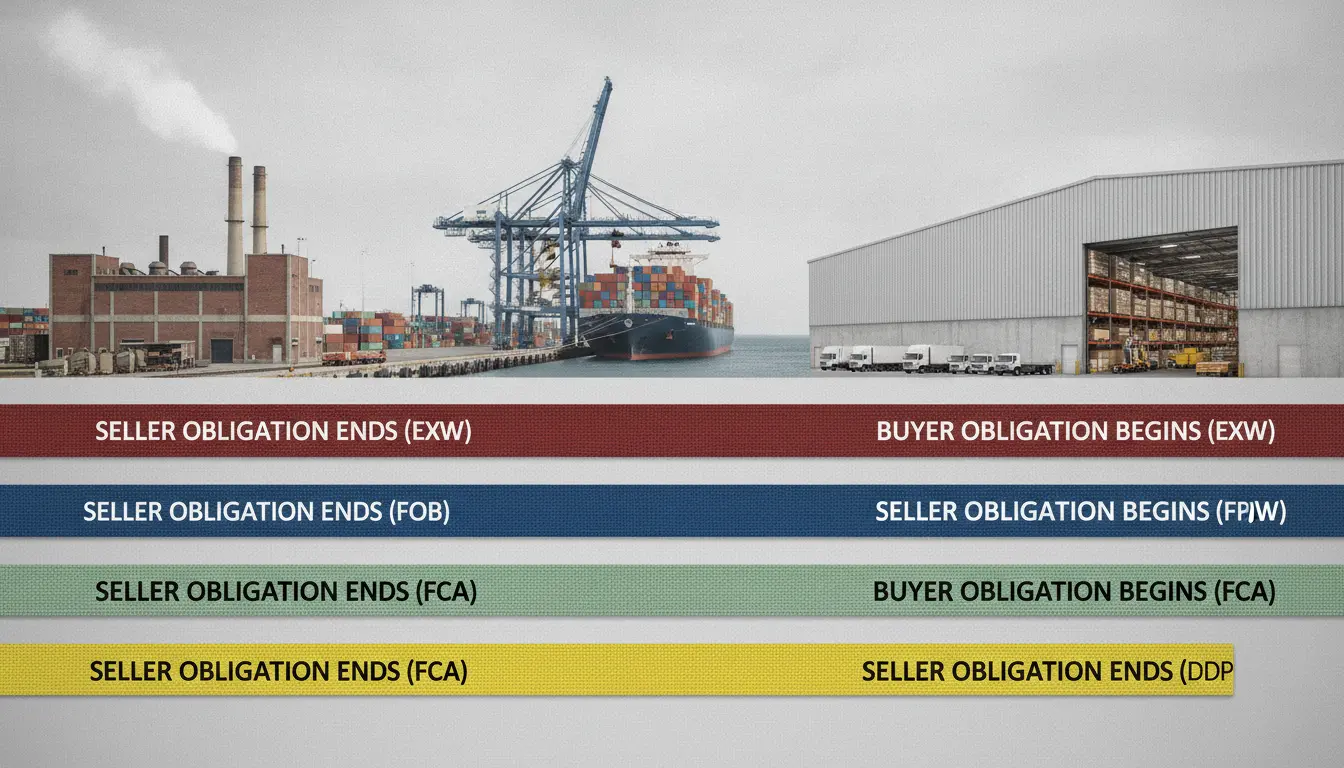
The ICC divides the eleven Incoterms 2020 rules into two groups: rules for any mode of transport (EXW, FCA, CPT, CIP, DAP, DPU, DDP) and rules for sea and inland waterway transport only (FAS, FOB, CFR, CIF). Ecommerce importers shipping by ocean or air regularly encounter four of these eleven terms.
| Term | Full name | Mode | Risk transfers to buyer when... | Who arranges main freight | Who pays import duty |
|---|---|---|---|---|---|
| EXW | Ex Works | Any | Goods are made available at the seller's premises | Buyer | Buyer |
| FCA | Free Carrier | Any | Carrier takes custody at the named place | Buyer | Buyer |
| FOB | Free On Board | Sea/inland waterway | Goods are on board the vessel at origin port | Buyer | Buyer |
| DDP | Delivered Duty Paid | Any | Goods are delivered at destination, cleared and duties paid | Seller | Seller |
The ICC publishes the full Incoterms 2020 rules at iccwbo.org. The official text is the authoritative reference for contract drafting; this article is an educational summary and not legal or customs advice. Always confirm the implications of a specific term with a licensed freight forwarder or customs broker before signing a purchase order.
EXW (Ex Works): Maximum Buyer Control, Maximum Buyer Risk
How EXW works in practice
Under EXW, the seller's only obligation is to make the goods available at their named premises, usually the factory or warehouse. From that moment, the buyer arranges and pays for everything: local trucking to the export port, export customs clearance, the ocean or air freight leg, import customs clearance, duties and taxes, and final delivery to the fulfillment center.
Who actually uses EXW?
EXW is common when a large buyer has its own freight forwarder or customs broker relationship and wants to control every cost and carrier choice from origin to destination. It is less practical for small or mid-sized ecommerce brands because export clearance in the country of origin often requires the buyer to have a legal presence or power of attorney in that country. A US brand buying EXW from a Chinese factory, for example, must arrange a licensed Chinese export agent to file the export declaration on their behalf.
EXW risks to watch for
Risk transfers extremely early: the moment the seller makes goods available. If a forklift at the factory damages the pallet after that point, the loss falls on the buyer. Cargo insurance from the factory gate forward is the buyer's responsibility to arrange. For brands without an experienced freight forwarder in place, EXW is a term that is easy to get wrong.
FOB (Free On Board): The Default for Ocean Freight
How FOB works in practice
Under FOB, the seller pays for and arranges inland trucking to the origin port and loads the goods on board the named vessel. Risk transfers to the buyer the moment the goods cross the ship's rail and are on board. From that point, the buyer's freight forwarder takes over: ocean or air freight, marine insurance, destination port handling, customs clearance, import duties and delivery to the fulfillment center.
A typical purchase order might read: "FOB Yantian Port, Incoterms 2020." The seller delivers to Yantian. The buyer's forwarder books the vessel and handles everything from that port onward.
Why FOB is the most common ecommerce import term
FOB gives the buyer control over the most expensive leg (the ocean freight) while keeping the seller responsible for getting goods to the port. This balance suits most brands importing from Asia because:
- The buyer can negotiate ocean freight rates directly or through a freight forwarder.
- The buyer chooses the carrier and service level (FCL, full container load, or LCL, less than container load).
- The seller handles origin-side complexity, including local trucking and export filing, which they are better placed to manage in their own country.
The practical limitation of FOB
FOB is technically a sea-and-inland-waterway-only rule under Incoterms 2020. It is not intended for containerized cargo where the seller hands off the container to a terminal operator before the container is loaded onto the vessel. In that common scenario, the ICC and logistics professionals recommend FCA instead, because risk under FCA transfers when the carrier (or terminal) takes custody, which is the actual moment the seller loses control.
Many importers continue using FOB by commercial convention even for containerized shipments, but the gap between where risk technically transfers (on board the vessel) and where the seller actually loses control (the container yard) can create disputes if cargo is damaged at the terminal. This is worth raising with your freight forwarder or legal counsel.
FCA (Free Carrier): The Modern Alternative to FOB
How FCA works in practice
Under FCA, the seller delivers the goods to a named carrier or another nominated party at a named place. If that named place is the seller's premises (the factory), the seller is responsible for loading the goods onto the buyer's collecting transport. If the named place is anywhere else, such as a container freight station (CFS) or port terminal, the seller is not responsible for unloading.
Incoterms 2020 added a specific provision for FCA: the buyer and seller may agree that the buyer will instruct its carrier to issue an on-board bill of lading to the seller after loading. This addresses the common letter-of-credit (LC) situation where a bank requires an on-board bill of lading but risk has already transferred to the buyer before loading.
When FCA suits a 3PL-bound shipment
FCA is the preferred term for containerized ocean freight because it aligns the risk transfer with operational reality. The seller delivers the container to the terminal or CFS; from that point, the buyer's freight forwarder manages ocean freight, insurance, US customs clearance and delivery to a fulfillment center such as a YouParcel warehouse in New Jersey or California.
For brands shipping to YouParcel's fulfillment centers (20 Farinella Dr, East Hanover, NJ 07936 for the NY/NJ region, or 3700 S. Riverside Ave, Rialto, CA 92324 for Southern California), FCA at the origin port or container yard keeps the buyer in control of the main freight cost and aligns with the standard workflow a freight forwarder uses for US imports.
DDP (Delivered Duty Paid): Seller Handles Everything
How DDP works in practice
DDP is the term where the seller carries the most obligation. The seller arranges and pays for all freight, export clearance, main carriage, import customs clearance, import duties and taxes, and delivery to the named destination. Risk stays with the seller until goods are delivered at the named place.
From the buyer's perspective, DDP looks simple: one price, no customs surprises. From the seller's perspective, DDP requires the ability to clear customs in the destination country and to act as the importer of record (IOR) or to appoint one.
DDP and the importer of record question
US Customs and Border Protection (CBP) requires that every commercial import have a named importer of record who is responsible for the accuracy of entry documents and payment of duties. Under DDP, the seller (or their appointed customs broker) typically acts as IOR for US imports. Many overseas factories are not set up to do this and will either refuse DDP or embed a substantial mark-up to cover the cost and risk of acting as or appointing a US IOR.
YouParcel does not act as importer of record. If your supplier quotes DDP, confirm in writing who will serve as the US IOR, and ask your customs broker to verify that the arrangement complies with CBP requirements. For more context on the DDP versus DDU (Delivered Duty Unpaid, now called DAP in Incoterms 2020) distinction and what it means for the end customer's checkout experience, see our guide on DDP vs DDU shipping and its practical implications for ecommerce.
DDP risks ecommerce importers underestimate
- US import duties are the buyer's economic cost even under DDP; the seller simply collects and remits them, usually at a mark-up.
- If the seller undervalues the goods for customs and CBP audits the shipment, the buyer may face penalties even though the seller handled the entry.
- DDP gives the seller control over the carrier, which means the buyer cannot specify routing, transit time or the final delivery address in a way that suits their fulfillment operation.
- The US de minimis exemption (Section 321, which allowed duty-free entry for shipments valued at or below $800) has been suspended since August 29, 2025. DDP shipments now carry full duty liability regardless of value. Confirm current CBP rules with a licensed customs broker before quoting DDP or placing orders.
Which Incoterm Works Best for a 3PL-Bound Shipment?
The practical choice for most ecommerce importers
For a brand importing finished goods from an overseas factory and delivering them to a US 3PL fulfillment center, FOB or FCA at the origin port is generally the most practical starting point. Here is why:
| Scenario | Recommended term | Reason |
|---|---|---|
| Containerized ocean freight, experienced freight forwarder in place | FCA (named port or CFS) | Risk transfer aligns with container handoff; buyer controls main freight |
| LCL ocean freight or air freight, no origin-side agent | FOB (named origin port) | Seller handles export; buyer's forwarder takes over at port |
| Buyer has strong origin-country logistics relationships | EXW | Maximum cost control; only viable if buyer can manage export clearance |
| Supplier insists on controlling freight; buyer wants zero customs complexity | DDP | Confirm IOR arrangement and understand embedded cost; lose carrier control |
How the named place affects delivery to a fulfillment center
The named place in an Incoterm is not optional fine print. It determines where the seller's obligation ends and where the buyer's begins. If your Incoterm is FCA and the named place is the factory (not the port), you are responsible for trucking the container from the factory to the port terminal, which may add cost and complexity. If the named place is the origin port's container yard, the seller handles inland trucking to that point.
For shipments destined for a US 3PL, a common and clean workflow is:
- Agree FOB or FCA at the origin port with the factory.
- Engage a licensed US-side freight forwarder to book the ocean or air freight leg.
- File an Importer Security Filing (ISF, also called 10+2) with CBP at least 24 hours before vessel loading for ocean shipments.
- Arrange marine cargo insurance from the named place onward.
- File a formal entry (or informal entry for lower-value commercial shipments) with CBP on arrival, with a licensed customs broker handling classification under the Harmonized Tariff Schedule (HTS) and duty calculation.
- Coordinate drayage (port-to-warehouse trucking) from the US port to the fulfillment center.
- Confirm the 3PL's inbound freight receiving requirements before the shipment departs, including pallet specifications, labeling and advance shipping notice (ASN) formats.
YouParcel's freight forwarding services cover the full import chain, including customs brokerage, compliance, and coordination with its New Jersey and California fulfillment centers, so brands can manage freight-in and fulfillment-out with one partner.
Customs Duties, HTS Codes and the Current US Import Climate
Incoterms define who pays duties, but they do not determine what those duties are. US import duties are set by the Harmonized Tariff Schedule of the United States (HTSUS), administered by the US International Trade Commission (USITC). Additional duties (Section 301 tariffs on goods of Chinese origin, Section 232 tariffs on steel and aluminum, and other trade measures) layer on top of the standard Most Favored Nation (MFN) rate.
The US de minimis threshold, which previously allowed shipments valued at $800 or below to enter duty-free under Section 321 of the Tariff Act, has been suspended for shipments from certain origins following executive action in 2025. Importers should not assume low-value parcels will enter duty-free. Confirm the current status of applicable tariffs and exemptions with a licensed customs broker before committing to a pricing or sourcing strategy. The Federal Register (federalregister.gov) publishes official proclamations and rule notices and is the primary source for verifying current trade measures.
Common Mistakes Ecommerce Importers Make with Incoterms
- Not specifying the named place: "FOB" without a named port is incomplete and unenforceable. Always write the full term: "FOB Port of Ningbo, Incoterms 2020."
- Assuming FOB covers all cargo types: FOB is technically a sea-only term. For air freight, use FCA with the named airport as the named place.
- Skipping cargo insurance under FOB or FCA: Neither term requires the seller to arrange insurance. Once risk transfers to the buyer, uninsured cargo loss is the buyer's problem. Marine cargo insurance is strongly advisable from the named transfer point to the destination warehouse.
- Not coordinating Incoterms with the 3PL's receiving process: Even if the Incoterm is DDP and the seller delivers to the fulfillment center door, the 3PL will have specific requirements for labeling, appointment scheduling and ASN data. The Incoterm does not substitute for a receiving SOP.
- Ignoring the IOR issue in DDP: As noted above, the US IOR must be identified and must be legally capable of serving in that role. This is a compliance issue, not just a paperwork formality.
Frequently Asked Questions
What is the difference between FOB and FCA?
Both terms have the buyer pay for and arrange the main freight, but they differ in when risk transfers. FOB transfers risk when goods are on board the named vessel, a standard that works well for bulk cargo but creates a gap for containerized shipments that are handed to a terminal operator before loading. FCA transfers risk when the carrier (or terminal) takes custody, which better reflects how modern container shipping actually works. The ICC recommends FCA for containerized cargo.
Who pays customs duties under FOB shipping?
Under FOB, the buyer is responsible for all costs and risks from the named origin port onward, including import customs clearance, duties, taxes and final delivery. The seller's only remaining obligation after loading is to provide the commercial invoice, packing list, bill of lading and any required certificates of origin.
What does EXW mean for a small ecommerce brand?
EXW means the buyer handles everything from the factory gate: inland trucking, export clearance, ocean or air freight, import customs and final delivery. It gives the buyer full cost control but requires a licensed export agent in the country of origin and a freight forwarder with strong origin-side capabilities. For small brands without those relationships, FOB or FCA is usually more practical.
Is DDP the safest Incoterm for the buyer?
DDP offers the buyer the clearest landed cost upfront, since the seller covers duties and delivery, but it is not necessarily the cheapest or most controllable option. The seller embeds their cost of acting as or appointing a US importer of record, often at a mark-up. The buyer also loses control over carrier selection, transit routing and delivery timing, which matters when coordinating inbound freight to a fulfillment center on a schedule.
Do Incoterms apply to air freight as well as ocean freight?
Yes. EXW, FCA, CPT, CIP, DAP, DPU and DDP all apply to any mode of transport, including air. FOB, CFR and CIF are restricted to sea and inland waterway transport. For air freight shipments, use FCA with the named airport (or the carrier's premises at the airport) as the named place, not FOB.
To discuss the right Incoterm for your import strategy and how to coordinate ocean or air freight directly into a US fulfillment operation, talk to a YouParcel freight forwarding expert and get practical guidance for your specific sourcing lanes.