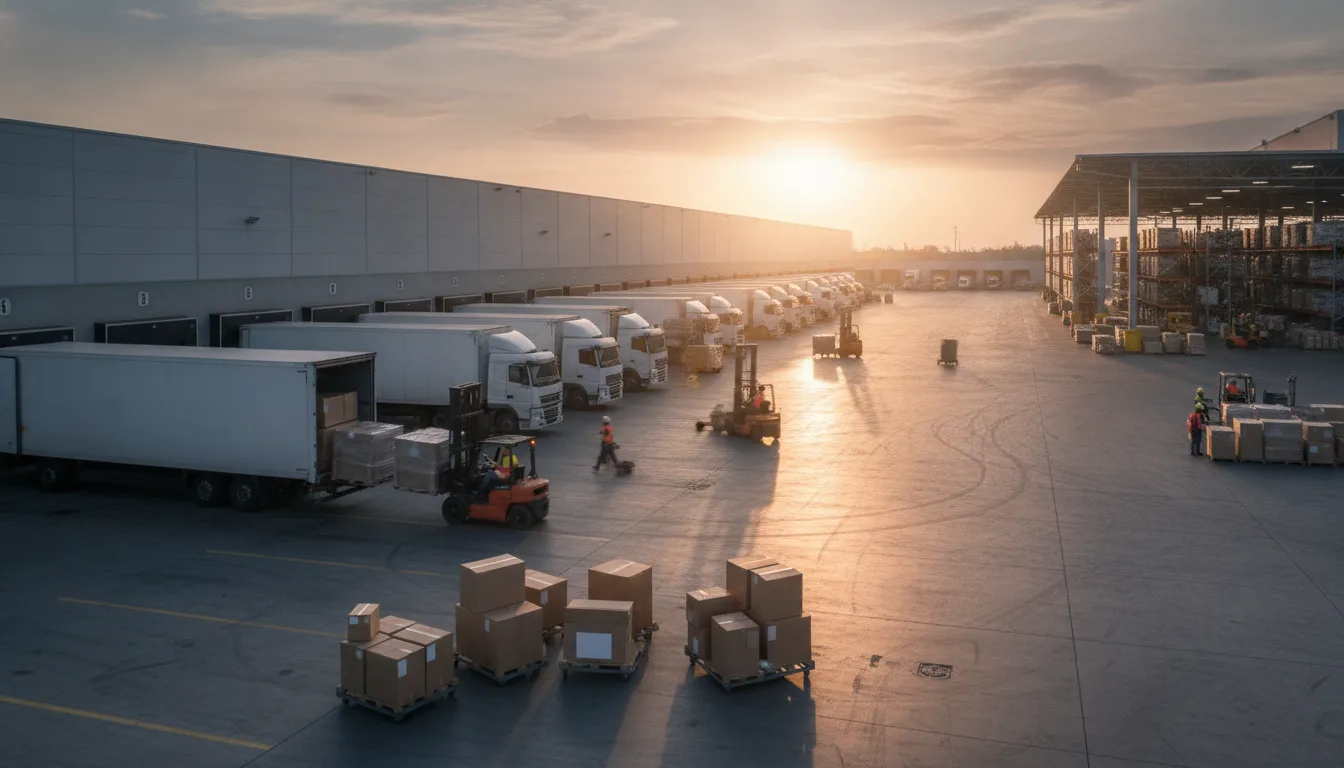


A warehouse in the USA is now a serious operational option for Indian exporters and D2C brands, not just a convenience. Since August 2025, every parcel shipped from India to a US consumer carries a formal customs duty obligation, and a cumulative additional duty of 50% on Indian-origin goods applies on top of the standard tariff rate. YouParcel works with growing Indian brands to evaluate whether per-order international courier shipping or bulk shipment into a US fulfillment center produces a better landed cost, faster delivery, and a more reliable customer experience.
- US de minimis duty-free treatment was suspended for all countries on 2025-08-29 (EO 14324), meaning every parcel from India now goes through a formal customs entry regardless of value.
- An additional 25% US duty on Indian-origin goods (EO 14329) brought the cumulative additional tariff rate to 50%, effective 2025-08-27, on top of any standard Most Favored Nation (MFN) or Section 301 rate.
- Bulk importing inventory into a US warehouse consolidates duty into one formal entry per inbound shipment, which can reduce per-unit duty administration costs and eliminate the per-parcel duty burden on your US customers.
- YouParcel operates fulfillment centers in New Jersey and California and processes 10,000-plus orders a day across multiple marketplaces, giving Indian brands an established US logistics base to ship from.
What changed in August 2025: the two regulatory events Indian exporters need to understand
Two executive orders took effect within days of each other and together reshaped the economics of direct-to-consumer shipping from India to the United States.
The end of de minimis for all countries
De minimis is the threshold below which imported goods enter a country without a formal customs entry or duty assessment. In the United States, that threshold had been $800 per shipment per person per day under 19 U.S.C. § 1321. Executive Order 14324 and the corresponding CBP message (CSMS #66065494) suspended duty-free de minimis treatment for all countries, with the suspension taking effect on 2025-08-29. Every parcel arriving from India, regardless of value, now requires a formal customs entry and is subject to applicable duties and fees. CBP CSMS #66065494 is the authoritative source for the operational implementation of this change.
The additional 25% duty on Indian goods
Separately, Executive Order 14329 imposed an additional 25% duty on goods originating in India, bringing the cumulative additional tariff rate to 50%, effective 2025-08-27. This is layered on top of the standard MFN rate and any pre-existing Section 301 duties that apply to the specific Harmonized Tariff Schedule (HTS) subheading for your product. EY Tax News: 2025-1663 provides a clear summary of the cumulative rate structure. The practical effect: a cotton garment (HTS 6109.10, standard MFN rate 16.5%) now carries a total additional duty of 50% before the MFN rate is added, making the all-in tariff burden substantially higher than it was before August 2025.
These two changes together mean that the low per-parcel, no-duty model that allowed many Indian D2C brands and Amazon sellers to ship directly from India to US customers at low apparent cost no longer exists. Every shipment is now a duty event.
Two fulfillment models: how they work and how they compare
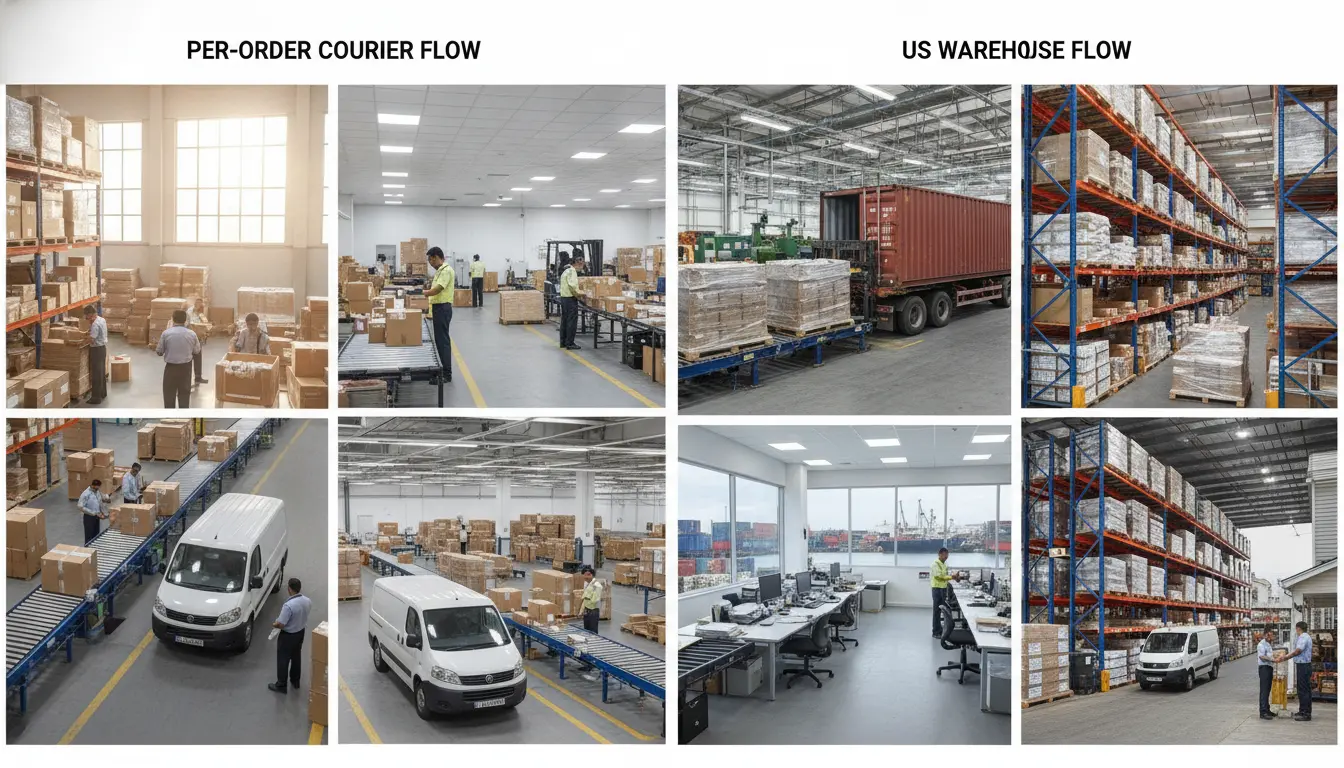
Indian brands selling to US customers generally have two structural options. The first is per-order international courier shipping: you fulfill each order from India, hand it to a courier such as DHL, FedEx or Aramex, and that parcel clears US customs individually. The second is the US warehouse model: you ship inventory in bulk to a US fulfillment center, clear customs once on the inbound shipment, and then fulfill US orders domestically from that warehouse.
Per-order international courier shipping: how it works in practice
Under this model, each customer order generates an individual international parcel. The courier company (DHL Express, FedEx International Priority, Aramex or similar) collects the parcel, files the customs entry on your behalf, pays any duties and taxes, and either recovers them from the consignee (Delivered Duty Unpaid, or DDU) or includes them in a prepaid Delivered Duty Paid (DDP) service where the shipper pre-funds the duty.
Before August 2025, many Indian brands shipped Delivered at Place (DAP) and relied on the $800 de minimis threshold to avoid duty on most consumer orders. That approach no longer works. Every parcel now triggers a formal customs entry, and the consignee either pays duty at the door or you absorb it through a DDP arrangement with the courier.
US warehouse model: how it works in practice
Under this model, you ship a consolidated pallet or container of inventory from India to a US fulfillment center. That inbound shipment clears US customs as one formal entry. Your licensed customs broker files the entry, duty is assessed on the commercial invoice value of the whole shipment, and the goods enter the US as domestic inventory. From that point, every customer order ships within the United States, using domestic carriers such as USPS, FedEx Ground or UPS, at domestic rates and with domestic transit times.
YouParcel's freight forwarding service can manage the inbound leg from India, coordinating ocean or air freight and customs clearance before goods arrive at the fulfillment center. Once inventory is received and checked in, YouParcel's ecommerce fulfillment service handles pick, pack and ship for each US order, with integration into Shopify, Amazon and 70-plus other platforms.
Side-by-side comparison: per-order courier vs US warehouse
| Factor | Per-order international courier | US warehouse (bulk import + domestic fulfillment) |
|---|---|---|
| Customs entry | One formal entry per parcel; high administrative volume | One formal entry per inbound shipment; duty settled on wholesale value |
| Duty basis | Retail or D2C price per parcel (generally higher value per unit than wholesale cost) | Commercial invoice value of bulk shipment (typically cost price) |
| Who pays duty | Consignee (DDU) or shipper via DDP surcharge; friction at delivery if DDU | Importer of record at US entry; transparent, built into landed cost |
| Delivery speed to US customer | Typically 5 to 14 days depending on service level and customs clearance | 2 to 5 days domestic ground or express once inventory is in the US |
| Customer experience | International tracking, potential customs delays, duty surprise at door | Domestic tracking, predictable transit, no duty surprise for customer |
| Minimum volume to consider | Any volume; low commitment | Typically one pallet or more; requires demand visibility to avoid overstock |
| Cash-flow profile | Pay per shipment; no inventory capital in US | Capital tied up in US inventory; duty paid on arrival, not at sale |
| Amazon FBA compatibility | Not compatible; FBA requires domestic US inbound shipments | Compatible; 3PL receives and preps inventory, then ships to FBA |
| Returns handling | Returns ship back to India or are abandoned; high cost | Returns processed domestically; graded, restocked or disposed locally |
| Carrier options | DHL, FedEx International, Aramex, EasyPost network | USPS, FedEx Ground, FedEx Home Delivery, UPS, regional carriers |
| Branding and packaging | Limited custom packaging options with couriers | Full custom unboxing, inserts, kitting and assembly at the warehouse |
| Complexity | Lower operational complexity; courier manages customs filing | Higher setup complexity; requires freight, customs broker, 3PL relationship |
The duty math: why the basis of assessment matters
One of the most consequential differences between the two models is the value on which customs duty is assessed. Understanding this requires knowing how US Customs and Border Protection (CBP) determines dutiable value.
For per-order courier shipments, CBP assesses duty on the transaction value declared on the parcel, which is typically the retail or D2C selling price. For a product you sell at $80, the 50% cumulative additional duty alone is $40, before adding the standard MFN tariff rate specific to your HTS subheading.
For a bulk inbound shipment to a US warehouse, CBP assesses duty on the commercial invoice value, which is the cost at which you transfer goods to the US entity, typically closer to your cost of goods or transfer price. If that same product has a cost of $25, the same 50% cumulative additional duty is $12.50 per unit. The absolute duty per unit is lower, and the total duty is paid once rather than on every individual sale.
This is not a way to avoid duty. You are paying duty on every unit of inventory that enters the United States. The difference is timing, basis and administrative load. A licensed customs broker is essential for structuring the entry correctly and ensuring the declared value complies with CBP valuation rules under 19 CFR Part 152. Always work with a qualified broker; nothing in this article constitutes customs or legal advice.
Who is the importer of record, and why it matters for Indian brands
The importer of record (IOR) is the entity legally responsible for the accuracy of the customs entry, payment of duties and compliance with all US import regulations. CBP holds the IOR liable for any underpayments, penalties or compliance failures.
YouParcel does not act as importer of record. Indian brands entering the US warehouse model need to establish their own IOR arrangement, which typically means one of three structures: a US-incorporated subsidiary of the Indian company acts as IOR; a third-party IOR service provider assumes liability on a contractual basis; or, in some cases, the US fulfillment partner's entity can serve this role under specific arrangements that go beyond standard 3PL services.
Setting up a US legal entity is often the cleanest path for Indian brands with consistent US sales volume, and it also enables direct Amazon Seller Central accounts, domestic banking and simplified tax registration. An experienced customs broker and a US trade attorney can advise on the structure that suits your volume and risk profile.
Amazon FBA and the US warehouse model for Indian sellers
Amazon FBA (Fulfillment by Amazon) requires that inbound shipments to Amazon fulfillment centers originate from within the United States. Indian sellers who shipped directly from India to Amazon FBA before August 2025 may have relied on de minimis treatment for small test shipments or direct-to-consumer orders. That pathway is closed.
The established route is: ship from India in bulk to a US 3PL, clear customs on arrival, complete any required FBA prep (FNSKU labeling, poly-bagging, bubble wrapping, carton labeling per Amazon's routing guide), and then ship to the designated Amazon fulfillment center as a domestic US shipment. YouParcel handles FBA prep at its fulfillment centers and can coordinate the inbound freight from India through its freight forwarding service, giving Indian Amazon sellers a single point of contact from the Indian factory gate to the Amazon warehouse.
When per-order courier shipping still makes sense
The US warehouse model is not always the right answer. Per-order international courier shipping remains the practical choice in specific situations.
If your US sales volume is low and unpredictable, holding inventory in a US warehouse creates overstock risk and ongoing storage costs before you have demonstrated consistent demand. Testing a new US market with a limited SKU range through per-order courier shipping lets you validate price points and customer acquisition before committing to bulk inventory.
If your products are made-to-order, highly customized or perishable, a US warehouse holding standard finished goods inventory may not fit your production model. Luxury, handcrafted or bespoke categories sometimes justify the higher per-unit shipping cost and slower delivery because the product itself commands the lead time.
If you are in an early-stage test with fewer than a few hundred US orders per month, the fixed and semi-fixed costs of freight forwarding, customs brokerage, receiving and monthly warehousing may outweigh the per-parcel duty savings from the warehouse model. The break-even point depends on your product value, duty rate and order volume, so modeling the numbers for your specific HTS code and selling price is essential before committing.
When the US warehouse model wins
For Indian brands with established US demand, the warehouse model typically produces a better unit economics profile and a materially better customer experience once the inbound logistics are set up correctly.
The domestic delivery speed advantage is significant. US customers who order from a domestic warehouse receive their parcels in two to five business days via standard ground services. The same order shipped from India arrives in five to fourteen days depending on service level and customs clearance. For categories where competitor products ship Prime two-day, the international courier route is a structural disadvantage.
The customer experience around duty is equally important. Under per-order DDU shipping, US customers may receive a surprise duty bill at their door, which generates refused deliveries, chargebacks and negative reviews. Under DDP courier shipping, the shipper absorbs or pre-pays the duty, which protects the customer experience but reduces margin. The US warehouse model removes duty from the consumer delivery entirely, because duty is paid on the inbound wholesale shipment, not at the point of sale.
Returns are dramatically simpler. When a customer returns an order that shipped from a US warehouse, the return stays in the United States. YouParcel's reverse logistics operation can receive, grade and restock returned units domestically, or dispose of them according to your policy. Returned parcels that originated in India and need to go back to India face a complex and expensive international return process that most D2C brands cannot sustainably operate.
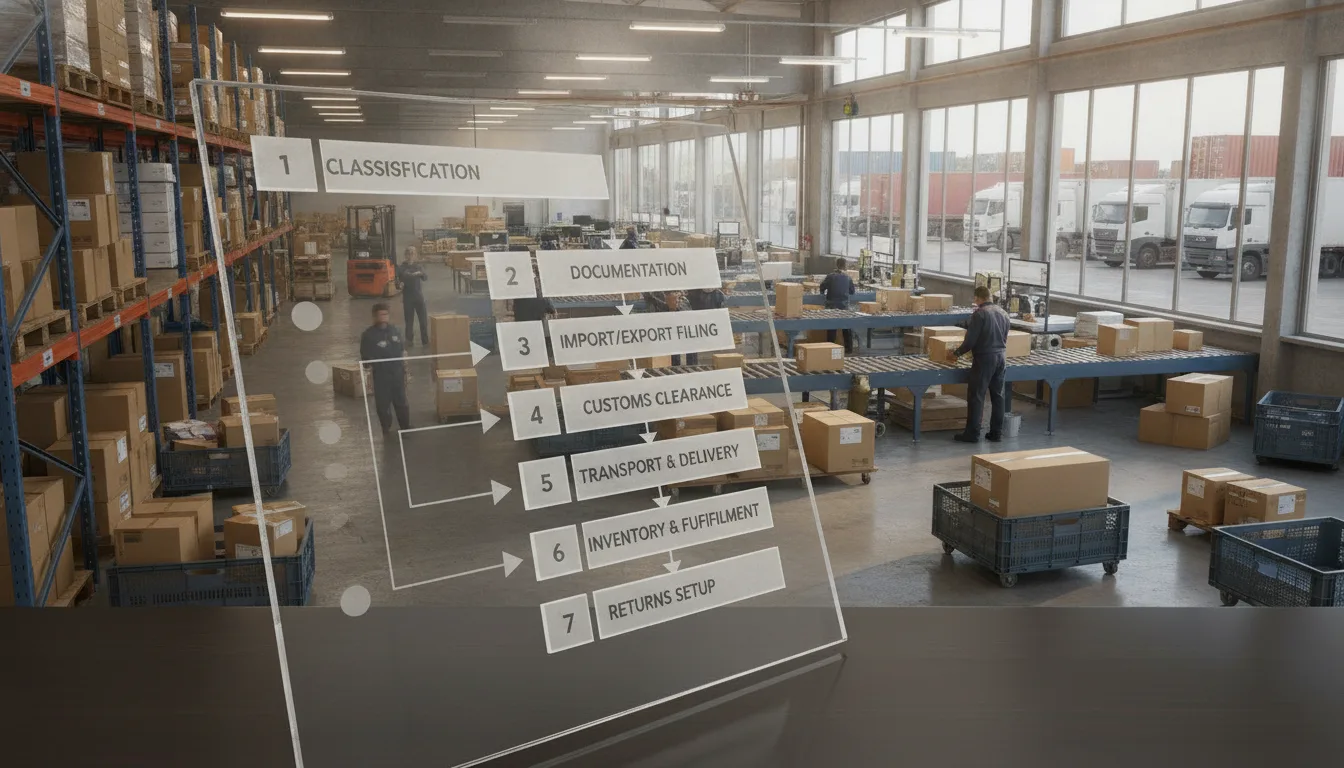
How to get started: a practical sequence for Indian brands
- Identify your HTS subheadings. Work with a licensed customs broker to confirm the correct 10-digit HTS code for each product. The applicable MFN rate plus the 50% cumulative additional duty on Indian-origin goods determines your total duty rate. Some product categories have materially different rates, and misclassification carries penalties.
- Model landed cost under both scenarios. For your top-selling SKUs, calculate the total cost per unit delivered to a US customer under per-order DDP courier shipping versus bulk import at cost price into a US warehouse including freight, customs brokerage, duties and 3PL fulfillment costs. The comparison number that matters is cost per delivered unit at your target order volume.
- Establish or confirm your US importer of record arrangement. If you do not have a US entity, consult with a trade attorney on whether a US LLC or corporation makes sense for your volume. Engage a licensed customs broker before the first inbound shipment.
- Plan your first bulk shipment. A single LCL (Less than Container Load) ocean shipment or air freight consolidation can move your first pallet of inventory to the US without committing to a full container. Your freight forwarder will coordinate the ISF (Importer Security Filing, also called 10+2), which is required at least 24 hours before vessel departure for ocean shipments.
- Select and onboard your US 3PL. Provide the 3PL with your product dimensions, weights, SKU list, packaging specifications and any Amazon FBA prep requirements before the first shipment arrives. Dimensional weight (the volumetric weight calculated by dividing length times width times height in inches by 139 for most domestic carriers) affects your domestic shipping cost, so packaging optimization at this stage pays dividends on every order thereafter.
- Integrate your sales channels. Connect your Shopify store, Amazon Seller Central account or other marketplace accounts to your 3PL's warehouse management system. YouParcel integrates with Shopify, Amazon and 70-plus other platforms, so orders flow directly from the marketplace to the fulfillment center without manual intervention.
- Set up a returns process. Define your returns policy, including the return window (typically 30 days for US consumer expectations), grading criteria (sellable, damaged, needs repackaging) and disposition instructions before launch.
YouParcel's US fulfillment infrastructure for Indian brands
YouParcel operates fulfillment centers in New Jersey and California, with its first facility established in Saddle Brook, NJ. The East Hanover, NJ facility (20 Farinella Dr, East Hanover, NJ 07936) serves the high-density Northeast and Mid-Atlantic consumer market. The Rialto, CA facility (3700 S. Riverside Ave, Rialto, CA 92324) serves the West Coast and provides a second inventory node for brands that want to reduce average shipping distance and transit time to US customers.
Splitting inventory across both coasts reduces the average distance to the end customer, which lowers domestic carrier costs and shortens transit times. For Indian brands launching in the US, starting with a single node (typically the East Coast for its proximity to the largest US consumer population centers) and expanding to a second node once volume justifies it is a practical sequence.
YouParcel's ecommerce fulfillment service covers receiving, putaway, pick and pack, carrier selection, label generation, real-time tracking and BI reporting via integrations with Tableau and Salesforce. The leadership team brings 50-plus years of combined experience in US logistics, and the operation handles 10,000-plus orders per day across multiple marketplaces.
For the inbound freight leg from India, YouParcel's freight forwarding service can coordinate ocean freight (FCL or LCL) or air freight, customs brokerage introductions and drayage from the port to the fulfillment center, giving Indian brands a single point of contact across the full supply chain.
Frequently asked questions
Can I still ship individual orders from India to US customers without paying US duty?
No. As of 2025-08-29, US de minimis duty-free treatment is suspended for all countries under EO 14324 and CBP CSMS #66065494. Every parcel entering the United States, regardless of value, is subject to a formal customs entry and applicable duties. There is no minimum value threshold that exempts Indian-origin goods from duty.
Does moving inventory into a US warehouse eliminate the US tariff on Indian goods?
No. Moving inventory into a US warehouse does not eliminate the duty; it consolidates the duty payment into one inbound customs entry rather than one per consumer order. The duty is assessed on the commercial invoice value of the bulk shipment, which is typically the cost price rather than the retail price, and that difference in basis can reduce the total duty amount compared with per-order retail-value assessment.
What is the additional US duty on Indian goods and what is the cumulative rate?
EO 14329 imposed an additional 25% duty on Indian-origin goods, bringing the cumulative additional tariff rate to 50% effective 2025-08-27. This cumulative rate is applied on top of the standard MFN tariff rate for the applicable HTS subheading, so total duty rates vary by product category. A licensed customs broker can confirm the all-in rate for your specific products.
Can an Indian brand use Amazon FBA in the US without a US legal entity?
Amazon requires a valid importer of record for inbound FBA shipments entering the United States, and the IOR must be a legally recognized entity capable of holding CBP liability. Many Indian brands use a third-party IOR service or establish a US LLC to meet this requirement. YouParcel does not act as importer of record, but its freight forwarding service can connect you with licensed brokers who can advise on IOR arrangements.
How much inventory should I send to a US warehouse when starting out?
There is no universal minimum, but most growing brands start with one to three pallets of their best-selling SKUs to test sell-through rates before committing to a full container load. Starting with a narrow SKU range reduces the risk of slow-moving stock generating ongoing storage costs, and you can replenish via ocean LCL or air freight as you build US sales history and demand visibility.
Ready to model the numbers for your specific products and build a US fulfillment plan? Talk to an Expert at YouParcel to discuss inbound freight from India, warehouse placement and domestic fulfillment for your brand.