


Just-in-time inventory management, the practice of ordering stock only as it is needed to reduce holding costs, breaks down during Chinese New Year because Chinese factories close for two to four weeks of national holiday and then operate at reduced capacity for another one to two weeks after reopening. Chinese New Year 2026 falls on February 17, and brands that do not build safety stock before that date risk empty shelves and missed orders through March and into April. YouParcel recommends locking in replenishment orders and adjusting reorder points no later than mid-January 2026.
- Chinese New Year 2026 is February 17; effective factory shutdowns typically run from late January through mid-March when you account for pre-holiday slowdowns and post-holiday restart ramp-ups.
- Just-in-time inventory models must be temporarily suspended or padded with a larger safety-stock buffer during this window to avoid stockouts at your fulfillment center.
- Reorder points for CNY should be recalculated using an extended lead time of 45 to 60 days rather than your normal baseline.
- YouParcel handles 10,000-plus orders a day and can receive and store your CNY buffer stock across warehouses in New Jersey, California and Illinois.
Why Chinese New Year disrupts just-in-time inventory management
Just-in-time (JIT) inventory management is a lean supply chain strategy in which a brand orders replenishment stock close to the moment it is needed, keeping warehouse holding costs low and reducing the risk of obsolete inventory. JIT works well when lead times are short and predictable. Chinese New Year destroys both of those conditions at once.
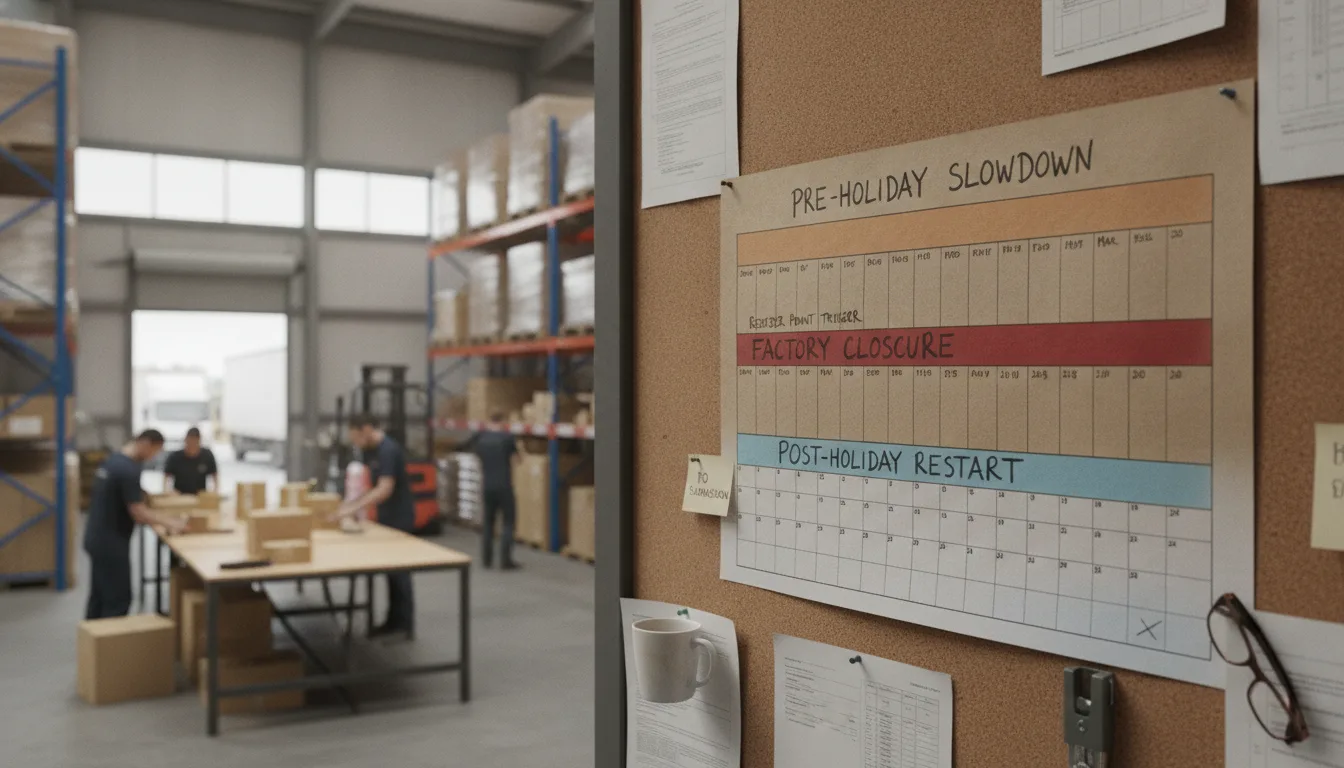
The disruption has three distinct phases:
- Pre-holiday slowdown (roughly January 20 to February 17, 2026): Many factory workers return to their home provinces a week or two before the official holiday begins. Production capacity drops and order queues lengthen. Factories prioritize existing purchase orders, so new orders placed after early January risk not being fulfilled until after the holiday.
- Factory closure (approximately February 17 to March 2, 2026): Most Chinese manufacturing facilities are closed for the Golden Week and the days surrounding it. Ocean freight bookings made during this window either sit in a queue or are rolled to the next available vessel sailing, which can add ten to fourteen days to your effective lead time.
- Post-holiday restart (roughly March 2 to March 20, 2026): Workers return gradually. Quality control teams, machine operators and logistics staff come back at different times. Most factories reach full capacity three to four weeks after reopening. During this phase, production errors are statistically higher and lead times remain extended.
According to STG USA, a licensed customs broker and freight forwarder, preparation for Chinese New Year 2026 is especially critical for shippers because ocean freight vessels fill up quickly as factories rush to clear backlogs before the shutdown begins. Early purchase order placement and booking are essential to avoid rate spikes and vessel rollovers during that period.
Source: STG USA: Preparing for Chinese New Year 2026
Key inventory terms defined
Before running the numbers, a quick definition of each term used in this guide:
| Term | Definition | Formula |
|---|---|---|
| Safety stock | Buffer inventory held above the expected demand level to absorb demand spikes or supply delays | Z x (demand standard deviation) x square root of lead time |
| Reorder point (ROP) | The inventory level at which a new purchase order should be triggered so stock arrives before existing inventory runs out | (Average daily demand x lead time in days) + safety stock |
| Lead time | The total elapsed time from placing a purchase order with a supplier to the moment inventory is available to ship in your fulfillment center | Supplier production time + transit time + receiving and put-away time |
| Average daily demand (ADD) | The mean number of units sold or shipped per day over a representative historical period | Total units sold in period divided by number of days in period |
| Service level (Z) | The statistical confidence that you will not stock out; a Z score of 1.65 represents a 95% service level, 2.05 represents a 98% service level | Lookup from standard normal distribution table |
The Council of Supply Chain Management Professionals (CSCMP) maintains an authoritative supply chain glossary that defines these and related terms: CSCMP Supply Chain and Logistics Terms and Glossary.
How to calculate your CNY 2026 reorder point
The standard reorder point formula uses your normal supplier lead time. For Chinese New Year, you must substitute an extended lead time that accounts for all three disruption phases described above. Use 45 days as a conservative baseline and 60 days if your supplier is in a province that historically restarts slowly or if you sell a category with high demand variance.
Step 1: Establish your average daily demand
Pull your unit sales data for the equivalent period last year (February through April 2025) and divide by the number of days. If you have known demand changes (a new sales channel, a promotion scheduled for Q1 2026, or a category trending upward), apply a demand uplift percentage to that historical figure. It is cheaper to hold slightly more stock than to expedite via air freight in March.
Example: A brand sold 2,100 units of a top SKU between February 1 and April 30, 2025 (89 days). Average daily demand = 2,100 / 89 = approximately 23.6 units per day. Apply a 10% uplift for expected channel growth: adjusted ADD = 26 units per day.
Step 2: Determine your extended CNY lead time
Typical lead time components for a product manufactured in China and shipped to a YouParcel fulfillment center in New Jersey or California:
| Component | Normal (days) | CNY extended (days) |
|---|---|---|
| Factory production | 14 | 21 to 28 |
| Export customs and port loading | 3 | 5 to 7 |
| Ocean transit (China to US West Coast, LCL or FCL) | 18 to 22 | 18 to 22 |
| US customs clearance | 2 to 3 | 3 to 5 |
| Drayage to warehouse | 2 | 2 to 4 |
| Receiving and put-away at 3PL | 2 | 2 to 3 |
| Total | 41 to 46 | 51 to 69 |
For planning purposes, use 55 days as your CNY extended lead time unless you have supplier-specific data that supports a tighter estimate. For East Coast warehouses (YouParcel operates in East Hanover, NJ at 20 Farinella Dr), add three to five days for the extra ocean transit from Shanghai or Shenzhen to a US East Coast port compared to Los Angeles or Long Beach.
Step 3: Calculate your CNY reorder point
Using the formula: ROP = (ADD x extended lead time) + safety stock
Safety stock at a 95% service level (Z = 1.65):
If your daily demand standard deviation is 8 units and your extended lead time is 55 days:
Safety stock = 1.65 x 8 x square root of 55 = 1.65 x 8 x 7.42 = approximately 98 units
Reorder point = (26 x 55) + 98 = 1,430 + 98 = 1,528 units
That means when your on-hand inventory drops to 1,528 units, you need to trigger a purchase order to your Chinese supplier. Given that most purchase orders placed after the first week of January 2026 will not be fulfilled until after the holiday restart, the practical action is to have your replenishment order confirmed and in production no later than January 9, 2026, with goods leaving China by February 5 to 10, 2026.
Step 4: Set a secondary order point for contingency
For high-velocity or high-margin SKUs, set a second trigger at 70% of your primary ROP. If you reach this level before the planned replenishment arrives, escalate to air freight or a domestic backup supplier rather than waiting. Air freight from China to the US typically runs 5 to 10 transit days but at a cost premium that may be 6 to 10 times the per-kilogram ocean rate. The math still favors air freight when the alternative is a stockout on a high-margin product.
When JIT is the wrong model for CNY and what to use instead
Just-in-time inventory management assumes that supplier lead times are stable and short enough that ordering close to the point of need does not create a gap. During CNY, neither condition holds. The right approach is a temporary shift to a min-max or reorder-point model with CNY-adjusted parameters for the January through April cycle.
| Inventory model | How it works | Suitable during CNY? | Why |
|---|---|---|---|
| Just-in-time (JIT) | Order only when demand signal arrives; minimal buffer stock | No | Lead times are too long and unpredictable to cover demand without a buffer |
| Reorder point (ROP) | Trigger a fixed order quantity when inventory hits a pre-calculated threshold | Yes, with CNY-adjusted lead time | Systematically absorbs the extended lead time when inputs are correct |
| Min-max | Hold between a minimum and maximum inventory level; order up to the max when hitting the min | Yes | Simple to implement; set the min at CNY ROP and the max at CNY ROP plus four to six weeks of demand |
| Periodic review | Review stock levels on a fixed schedule (weekly) and order to a target level | Partial | Works if the review cycle is weekly and the target level uses CNY lead time; risky if review is monthly |
CNY 2026 planning timeline for ecommerce brands
- By December 15, 2025: Audit all China-sourced SKUs. Identify which are single-sourced from Chinese manufacturers versus those with a domestic or alternative regional supplier. Flag any product with a lead time exceeding 30 days as high-risk.
- By December 22, 2025: Pull demand data for February through April 2025. Calculate CNY-adjusted ROP and safety stock for each high-risk SKU using the formulas above.
- By January 5, 2026: Submit purchase orders to Chinese suppliers. Most factories start their pre-holiday wind-down by January 20, so a January 5 order confirmation gives you two weeks of normal production capacity. Share confirmed order dates with your 3PL so inbound receiving can be planned.
- By January 15, 2026: Book ocean freight for all CNY buffer shipments. Vessel space fills quickly in January. If your freight forwarder has not confirmed sailing dates by this point, get a rate and space confirmation in writing.
- By February 1, 2026: Verify that all CNY buffer stock is either in transit or already received at the warehouse. If any orders are still in production, assess whether air freight is cost-justified for your margin profile.
- February 17, 2026 (Chinese New Year): Do not submit new production orders expecting delivery before late March. Focus on monitoring in-transit shipments and reviewing sell-through rates against your safety stock buffer.
- March 1 to 20, 2026: Track factory restart status with your supplier. Most factories issue a return-to-work notice; ask for one in writing and use it to reset your next replenishment order timeline.
How your 3PL can support CNY inventory planning
A fulfillment partner is not just a place to store boxes. The right 3PL helps you plan inbound volumes, coordinate receiving schedules and give you inventory visibility so you can act before a stockout rather than after. YouParcel supports brands across this cycle in several practical ways.
Inbound receiving and pre-receiving coordination
When a large CNY buffer shipment arrives, a fulfillment center that is not prepared for the inbound volume can create receiving delays that effectively extend your lead time by another five to ten days. YouParcel processes 10,000-plus orders a day across multiple marketplaces, which requires disciplined inbound scheduling. Sharing your purchase order details and expected container arrival dates in advance allows the warehouse team to slot receiving labor accordingly.
Multi-node inventory distribution
If your sales come from both coasts, holding all of your CNY buffer stock in a single warehouse concentrates both your inventory risk and your shipping costs. YouParcel operates warehouses in New Jersey, California and Illinois, which means you can split a buffer replenishment between the East Hanover, NJ facility (serving the Northeast and Mid-Atlantic) and the Rialto, CA facility at 3700 S. Riverside Ave (serving the Western US and the Port of Los Angeles inbound flow) without managing two separate 3PL relationships.
Real-time inventory visibility and alerts
YouParcel provides real-time inventory tracking and integrates with Shopify, Amazon, Salesforce and 70-plus other platforms. During a CNY window, that visibility is the difference between catching a low-stock condition at 1,600 units (when you can still act) and discovering it at 200 units (when your only option is air freight or a backorder notice to customers). Setting automated reorder alerts inside your warehouse management system at your CNY ROP threshold is a practical way to operationalize the calculations in this guide.
If your current inventory management strategy is producing recurring stockouts, overstock situations, or both, that is a signal your reorder point parameters need an audit. Our post on 3 signs your inventory management strategy has room for improvement walks through the diagnostic steps.
For a broader view of how fulfillment operations connect to inventory planning, see the YouParcel ecommerce fulfillment services page, which covers inbound freight, receiving, storage, pick-and-pack and same-day dispatch in one integrated workflow.
Safety stock sizing: worked example for a mid-size brand
The following example is illustrative. Actual inputs should come from your own sales data and confirmed supplier lead times.
Scenario: A US DTC brand sells a home goods product on Shopify and Amazon. The product is manufactured in Guangdong province. Normal lead time is 42 days. CNY extended lead time: 60 days.
| Input | Value | Source |
|---|---|---|
| Average daily demand (ADD) | 40 units/day | Historical sales Feb through Apr 2025 |
| Demand standard deviation (daily) | 12 units | Statistical calculation from same period |
| Extended CNY lead time | 60 days | Supplier confirmed + freight estimate |
| Target service level | 95% (Z = 1.65) | Brand decision |
| Safety stock | 1.65 x 12 x sqrt(60) = 1.65 x 12 x 7.75 = 153 units | Formula |
| Reorder point | (40 x 60) + 153 = 2,553 units | Formula |
| Normal reorder point (non-CNY) | (40 x 42) + 79 = 1,759 units | Formula with normal lead time and standard safety stock |
| Additional buffer units required for CNY | 2,553 minus 1,759 = 794 units above normal ROP | Delta calculation |
This brand needs approximately 794 extra units of buffer stock in the warehouse before the CNY window opens, above and beyond what its normal reorder point would trigger. At a product weight of 0.8 kg per unit, that is approximately 635 kg of additional inbound freight to plan for. At the standard dimensional weight divisor of 5,000 for international air freight (cubic centimetres divided by 5,000 to get chargeable kilograms), the brand can assess whether ocean or air is the right mode for the buffer replenishment based on its timeline.
What happens if you miss the CNY window
If your purchase order is not confirmed by January 5 to 10, 2026, you have a narrowing set of options:
- Air freight from China: 5 to 10 transit days, but rates per kilogram are typically 6 to 10 times higher than ocean LCL. Use this for high-margin, lightweight SKUs only.
- Domestic sourcing: If a US-based supplier or a North American alternative can produce or fulfill the product, this avoids the CNY disruption entirely. Landed cost will be higher but predictability is better.
- Demand management: Pausing paid media on low-margin SKUs that are likely to stock out extends the runway of your remaining inventory and protects margin.
- Backorder with transparency: Some brands take pre-orders with clearly communicated ship dates in March or April. This works for loyal customer bases but requires accurate shipping date commitments.
- Inventory reallocation: If you hold stock across multiple channels (for example, Amazon FBA and a Shopify storefront), pulling inventory from one channel to another may extend your available sell-through window on the channel with the best margin.
Frequently asked questions
When does the Chinese New Year 2026 factory shutdown actually start?
The official Chinese New Year holiday begins on February 17, 2026, but factory production slows meaningfully from around January 20 as workers begin returning home. For supply chain planning purposes, treat the effective production disruption window as January 20 to March 10, 2026, and plan purchase orders accordingly.
What is a safe safety stock level to carry through the CNY window?
Safety stock depends on your daily demand variability and your target service level. As a practical starting point, use a Z score of 1.65 (95% service level) applied to your daily demand standard deviation and a square root of 55 to 60 days for the CNY-extended lead time. The worked example in this guide shows a full calculation.
Should I use just-in-time inventory management during Chinese New Year?
No. JIT inventory management relies on stable, short lead times, and Chinese New Year disrupts both. For the January through April period, switch to a reorder-point or min-max model with CNY-adjusted parameters, then return to your normal JIT parameters once your post-holiday replenishment shipment is confirmed in transit.
How far in advance should I place purchase orders with Chinese suppliers before CNY 2026?
Place and confirm purchase orders with Chinese suppliers by January 5 to 10, 2026 at the latest. Orders confirmed after that date risk falling into the pre-holiday production backlog and may not ship until mid to late March, leaving a four to six week gap in your inventory coverage.
Can a 3PL help me manage inventory through the CNY window?
Yes. A 3PL provides the warehouse capacity to hold your buffer stock, real-time inventory visibility to monitor sell-through rates, and multi-location distribution that reduces stockout risk by spreading inventory across geographic nodes. YouParcel operates fulfillment centers in New Jersey, California and Illinois and integrates with Shopify, Amazon and 70-plus other platforms to give you live inventory data throughout the CNY period.
If you want help modeling your CNY 2026 buffer requirements or scheduling inbound freight to a YouParcel warehouse, talk to a fulfillment expert and we will work through the numbers with you.
Create a YouParcel account to get started with inventory-aware fulfillment before the Chinese New Year 2026 window closes.