


Multi channel fulfillment is the practice of shipping orders from a single physical inventory pool to customers who bought on different sales channels, such as Shopify, Amazon and Walmart, through one warehouse or 3PL network. YouParcel operates this model daily, processing 10,000-plus orders across multiple marketplaces, and the operational complexity lives almost entirely in how that shared stock is allocated, buffered and synced rather than in the picking and packing itself.
- A single 3PL stock pool eliminates split-inventory capital costs and reduces the risk of one channel going out of stock while another sits on surplus units.
- Effective multichannel fulfillment depends on three layers working together: inventory allocation rules, per-channel safety buffers and near-real-time WMS-to-channel sync.
- Warehouse-side operations, such as how inbound freight is received, how pick paths are structured and how returns feed back into available stock, determine whether allocation rules hold under peak load.
- YouParcel integrates with Shopify, Amazon, Walmart and 70-plus other platforms, giving operations teams a single source of truth for on-hand, reserved and in-transit quantities.
Why a Shared Inventory Pool Makes Financial Sense
The alternative to a shared pool is channel-partitioned inventory: a fixed quantity ring-fenced for Shopify, a separate lot for Amazon FBA, and perhaps a third batch for Walmart Fulfillment Services or drop-ship. Partitioning is simple to understand but expensive to run. Each partition carries its own safety stock, and because demand is uneven across channels, you end up holding excess units in one silo while another goes out of stock and loses the sale.
A shared pool collapses those silos into one on-hand figure. All channels draw from the same physical shelves. The tradeoff is that you now need rules to govern allocation priority, per-channel visibility limits and how quickly inventory positions are updated when any channel places a demand signal. Get those rules wrong and two channels sell the same unit simultaneously, which is an oversell event that damages your seller metrics on every marketplace involved.
How large is the efficiency gain?
The gain depends on how uncorrelated your channel demand patterns are. If Shopify spikes on weekends and Amazon spikes on Prime promotional days, those peaks do not overlap, and a shared pool needs far less total safety stock than two separate pools would. Supply chain practitioners refer to this as the risk-pooling effect: aggregating demand across channels reduces the coefficient of variation of total demand, which in turn reduces the safety stock required to hit a given service level. The Council of Supply Chain Management Professionals documents this principle in its supply chain glossary as a core justification for centralized inventory strategies.
The Three Operational Layers of Multi Channel Fulfillment
Layer 1: Inventory allocation rules
Allocation rules define which orders get fulfilled first when available units are constrained. At the warehouse level, allocation is not a software setting alone; it is a physical commitment. Once a pick ticket is generated and a unit is pulled from the shelf, that unit is consumed from on-hand stock. The allocation decision is therefore made the moment a pick wave is released, not when the order is placed.
Common allocation strategies in multi channel ecommerce fulfillment include:
- First-in, first-out by order timestamp: Orders are picked in the sequence they arrive, regardless of channel. Simple and fair, but it can allow a low-margin channel to consume stock ahead of a high-margin one during a demand spike.
- Channel priority tiers: You assign a fulfillment priority rank to each channel. Amazon orders with same-day SLAs, for example, may be released to pick before Shopify orders with standard 2-to-5 day windows. Priority tiers require the WMS (warehouse management system) to hold lower-priority orders in a queue while higher-priority pick waves clear.
- Revenue-weighted allocation: Available units are proportionally reserved across channels based on their share of trailing revenue. This is more sophisticated and typically requires custom logic built into the order management layer sitting above the WMS.
- Promised-date allocation: Orders closest to their customer-facing delivery promise are released first. This is common in omnichannel retail where ship-by dates are contractually tied to routing guides and retailer compliance requirements.
YouParcel's integration with Shopify, Amazon and 70-plus platforms means order demand signals flow into a central order management layer, where allocation rules can be configured before pick waves hit the warehouse floor.
Layer 2: Per-channel safety buffers
A safety buffer (also called a channel buffer or reserved quantity) is a quantity of on-hand stock withheld from a channel's available-to-sell figure. It exists for one reason: to prevent marketplace visibility from advertising units that could be consumed by a competing order before the marketplace's feed refreshes.
Buffer sizing is both a business decision and a technical one. Consider the following inputs:
- Feed refresh latency: How often does your integration push updated inventory levels to each channel? A refresh cycle of 15 minutes means that in a worst-case spike, a channel could sell 15 minutes' worth of orders against an inventory position that is already depleted. Buffer size should cover at least one full refresh cycle of expected demand.
- Channel SLA sensitivity: Amazon's seller metrics are penalized by cancellations due to inventory discrepancy. Walmart Marketplace similarly tracks order defect rates. Set tighter (larger) buffers on channels where a stockout-driven cancellation carries a metric penalty.
- Inbound freight pipeline: If a replenishment shipment is in transit from your freight forwarder and due to arrive within 48 hours, you may choose to reduce buffers temporarily to maximize sell-through on fast-moving SKUs.
- Return re-integration lag: Returned units that have been inspected, graded and returned to sellable stock should re-enter the available quantity only after they clear quality inspection at the fulfillment center. Counting returns-in-transit as available-to-sell before they physically pass inspection is a common source of phantom inventory.
A practical starting point for most brands is a buffer of 2 to 5 percent of on-hand units per channel, with a floor of 2 units regardless of percentage. That floor prevents a buffer of zero on low-velocity SKUs where a 2 percent calculation rounds down to nothing.
Layer 3: WMS-to-channel sync logic
The sync layer is where warehouse-side reality becomes marketplace-side availability. When a unit is picked, packed and shipped, the WMS decrements on-hand count. That decrement must propagate to every connected channel before the next order can be accepted against those units.
Key sync concepts to get right:
| Sync event | What triggers it | Risk if delayed |
|---|---|---|
| Pick confirmation | Picker scans unit at pick location | Another channel sells the same unit |
| Receiving confirmation | Inbound freight counted and putaway | Sellable units invisible to channels, missing revenue |
| Return-to-stock | Return graded as sellable and scanned into location | Phantom stockout, suppressed listings |
| Damage quarantine | Unit flagged as unsellable after inspection | Oversell of units that cannot ship |
| Cycle count adjustment | Scheduled or triggered inventory count | Stale inventory figures across all channels simultaneously |
Near-real-time sync, meaning updates propagated within seconds to a few minutes of a warehouse event, is the standard for high-volume multi channel ecommerce operations. Batch-overnight sync is adequate only for very low-velocity SKUs where the probability of two channels selling the same unit within a 24-hour window is negligible.
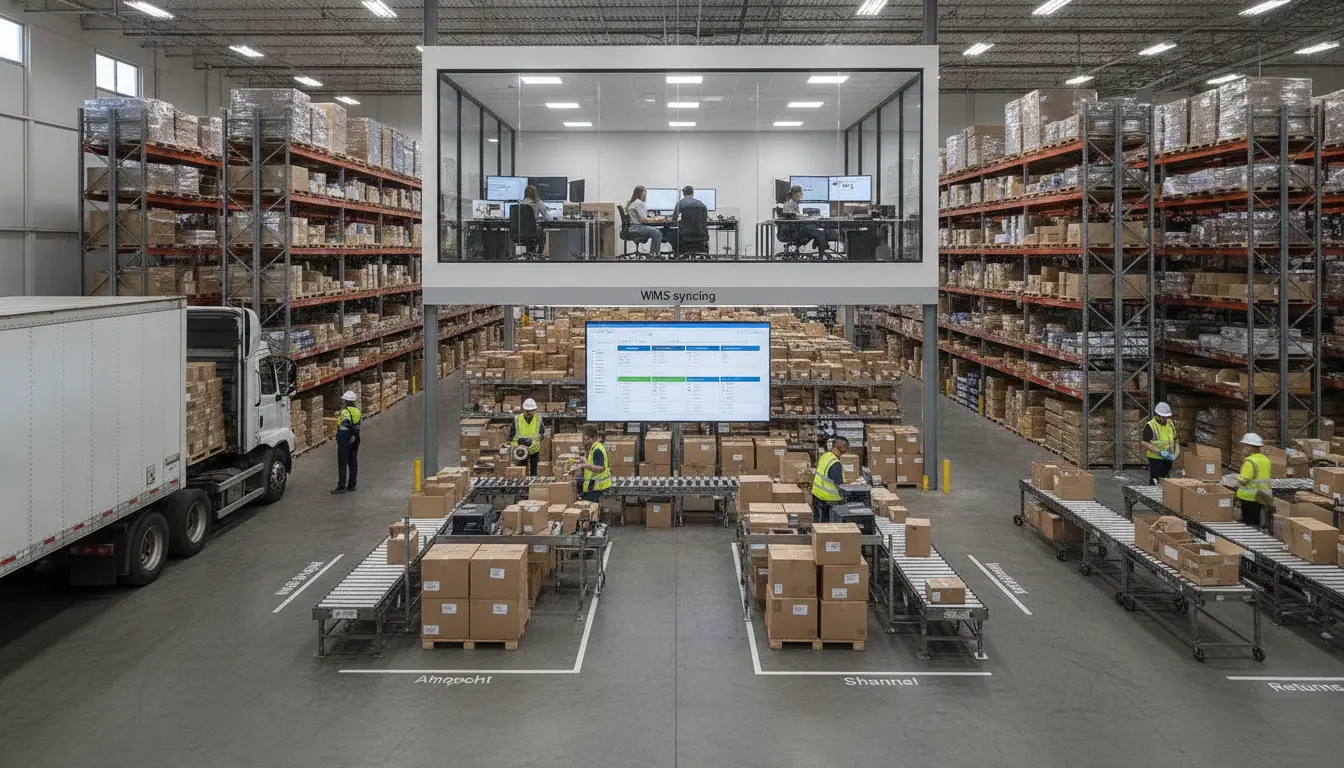
Warehouse-Side Operations That Make or Break the Shared Pool
Allocation rules and sync logic are only as good as the physical warehouse processes feeding them. This section focuses on the warehouse-side operations that determine whether a shared inventory model performs at scale.
Receiving and putaway accuracy
Every unit that enters the fulfillment center must be scanned, counted and assigned to a bin location before it can appear as available-to-sell. Receiving errors, such as a case counted as 24 units when the actual count is 20, create a discrepancy that propagates to every channel simultaneously. At YouParcel's facilities in East Hanover, NJ and Rialto, CA, inbound freight goes through a structured receiving workflow: trailer check-in, pallet breakdown, unit-level count verification against the advance shipping notice (ASN), and barcode scan into the WMS before putaway.
For brands shipping inbound freight from overseas, accurate ASN data submitted before the shipment arrives is critical. If the WMS cannot match received units to an expected ASN line, units go into a discrepancy hold and are unavailable to any channel until the exception is resolved. That resolution can take hours or days depending on how well the inbound freight documentation was prepared.
Slotting strategy for multichannel velocity
Slotting is the deliberate assignment of SKUs to warehouse locations based on pick frequency, unit size and pick-path efficiency. In a multichannel environment, the same SKU may generate a Shopify single-unit pick, an Amazon multi-unit pick and a Walmart pallet-layer pick within the same pick wave. Slotting your fastest-moving SKUs close to the packing stations reduces travel time per unit and directly increases the throughput available to service all channels simultaneously.
Poor slotting does not cause oversells, but it causes pick waves to run long, which delays shipments across all channels at once. When a delay pushes an Amazon order past its ship-by window, the late-shipment metric applies regardless of whether the inventory was available. The warehouse bottleneck, not the inventory rule, caused the SLA miss.
Kitting and assembly for channel-specific SKUs
Many brands sell a base product on Shopify as a single unit but list a bundle or kit on Amazon with different packaging or inserts. If those are managed as separate SKUs with separate on-hand quantities, the shared-pool benefit is lost. A better practice is to hold the component units in the shared pool and perform light kitting at the time of pick, assembling the channel-specific configuration on demand. YouParcel offers kitting and assembly as part of its fulfillment service, which allows brands to maintain one physical inventory of components while presenting channel-specific product configurations to buyers.
How returns re-enter the shared pool
Returned units from any channel arrive at the same returns processing station. Each unit goes through a grading workflow:
- Scan the return against the original order and the RMA (return merchandise authorization) if one was issued.
- Inspect the unit for damage, missing components and original packaging integrity.
- Assign a disposition code: sellable (return to stock), refurbish (secondary processing), unsellable (liquidate or discard), or vendor return.
- Scan sellable units into their bin location, triggering a WMS on-hand increment.
- The WMS pushes the updated available quantity to all connected channels.
The critical rule is that units must not be reflected as available-to-sell until step 4 is complete. Any process that counts a return as available at the point of receipt, before inspection, risks selling a damaged unit that then generates another return. That loop compounds both return costs and marketplace metrics damage.
Channel-Specific Compliance Requirements That Affect the Shared Pool
Running omni-channel fulfillment services from one warehouse does not mean you can treat all orders identically at the packing station. Each channel has its own compliance requirements that must be enforced at the point of fulfillment.
Amazon packaging and labeling
Amazon Multi-Channel Fulfillment orders shipped by a 3PL must meet Amazon's packaging standards if the brand wants to maintain Buy Box eligibility and avoid customer-facing complaints. For seller-fulfilled orders, that means no Amazon-branded boxes, carrier-compliant labeling and poly-bag or bubble-wrap requirements for specific product categories. The WMS must flag Amazon orders for the correct packing material profile at the packing station.
Walmart routing guide compliance
For brands selling on Walmart through a wholesale or drop-ship arrangement rather than a marketplace model, Walmart's routing guides dictate carrier selection, label format, packing requirements and EDI transaction sets (typically 850 purchase order, 856 advance ship notice, 810 invoice). Non-compliant shipments attract chargebacks from the retailer. YouParcel supports EDI and retailer compliance including routing guides and labeling requirements, which means the fulfillment workflow can be configured to enforce Walmart-specific rules on orders sourced from the shared inventory pool without manual intervention.
Shopify merchant-defined packaging
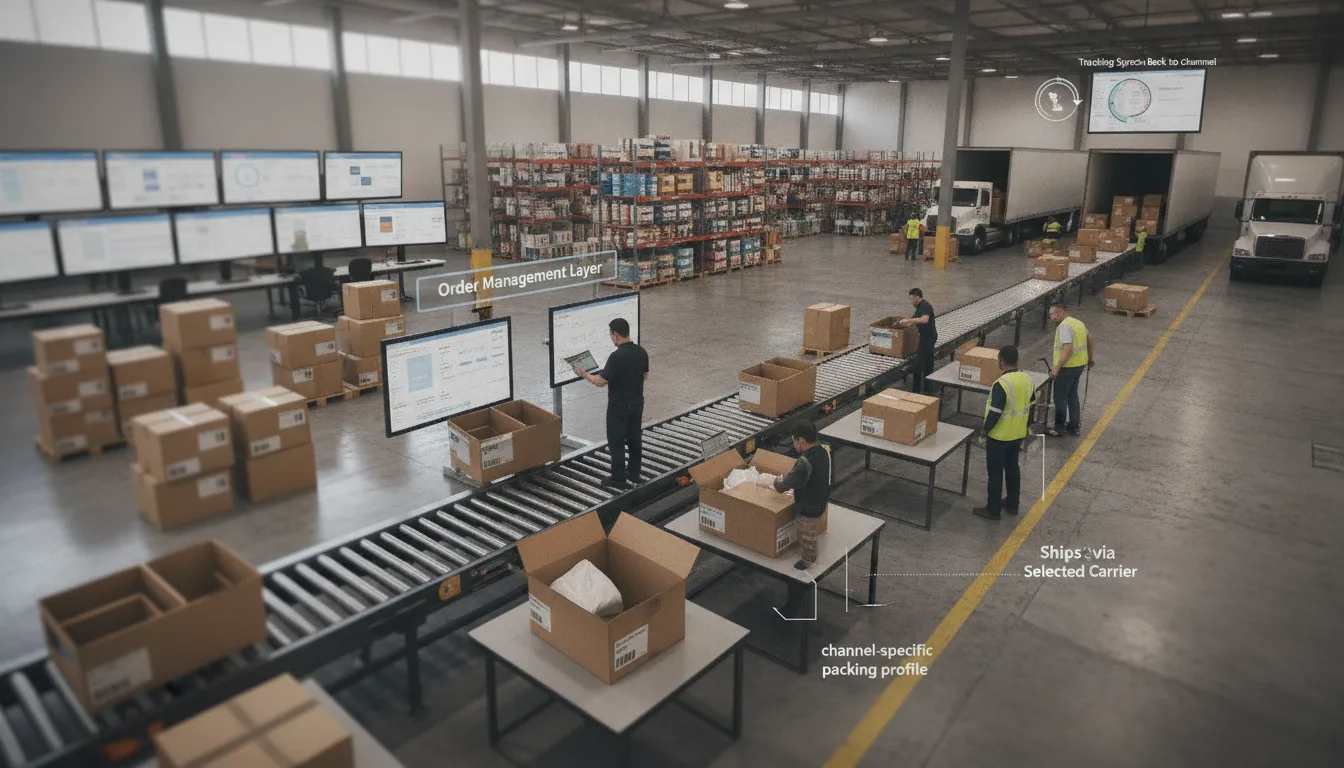
Shopify DTC orders typically give the brand the most packaging flexibility: custom boxes, branded tissue, inserts and unboxing experiences. Because these configurations are brand-driven rather than retailer-mandated, they need to be encoded in the packing instructions attached to the Shopify channel in the WMS. When a Shopify order triggers a pick, the packing station sees the brand's insert and box specification automatically.
Running all three channel configurations from one fulfillment center is achievable when the WMS is set up with per-channel packing profiles. The alternative, using separate fulfillment partners per channel, eliminates this complexity but reintroduces the inventory partitioning cost discussed earlier in this article.
Metrics That Signal Your Shared Pool Is (or Is Not) Working
Operations teams need a small set of leading indicators to know whether their multichannel inventory model is healthy. The following are the most actionable:
| Metric | Definition | Threshold to investigate |
|---|---|---|
| Oversell rate by channel | Orders accepted that could not be fulfilled due to zero available units | Any rate above 0.1% of orders per channel per week |
| Inventory discrepancy rate | Variance between WMS on-hand and physical count at cycle count | More than 0.5% unit discrepancy at SKU level |
| Receiving lag | Time from freight delivery to units appearing as available-to-sell | More than 24 hours for standard palletized freight |
| Return-to-stock cycle time | Time from return arrival at dock to unit appearing as sellable in WMS | More than 48 hours for standard consumer goods |
| Channel stockout frequency | How often a channel shows zero available on an active SKU | More than 2% of active SKUs out of stock on any channel at any time |
YouParcel provides real-time tracking and BI analytics, allowing operations teams to monitor these metrics at the order and SKU level across all connected channels. Access to that data layer is what distinguishes a well-run shared pool from one that is technically correct in its rules but operationally blind to drift.
Scaling the Shared Pool Across Multiple Fulfillment Locations
A single warehouse shared pool works well until your US order volume and geographic spread create a situation where a single DC (distribution center) cannot serve all customers within your target delivery window without excessive shipping costs. At that point, the inventory model shifts from a single shared pool to a distributed shared pool: the same allocation and sync logic, but now the available quantity is split across two or more physical locations.
YouParcel operates fulfillment centers on both coasts, with its NY/NJ facility at 20 Farinella Dr, East Hanover, NJ 07936 serving the northeastern US, and its Southern California facility at 3700 S. Riverside Ave, Rialto, CA 92324 covering the western US. For brands processing high order volumes to both coasts, splitting inbound inventory between the two locations and routing channel orders to the nearest DC reduces transit time and carrier zone charges without requiring separate channel accounts or separate inventory pools.
The routing logic in a distributed model works as follows: when an order arrives, the order management layer checks the ship-to zip code, identifies the nearest DC with available units, and routes the pick task to that facility. The channel-side available quantity is the sum of units across both locations, minus their respective buffers. The sum is what the customer sees as in stock; the routing decision is invisible to the buyer.
For more on how this model fits within a broader ecommerce fulfillment strategy, see YouParcel's omnichannel fulfillment capabilities and the multi-channel selling tools and platforms guide.
Common Setup Mistakes and How to Avoid Them
Mistake 1: Going live on all channels simultaneously without buffer tuning
Brands often connect all their channels to the 3PL integration on the same day and set buffers to zero because they want maximum sell-through. Without buffers, the first demand spike across two channels simultaneously produces an oversell. The correct approach is to go live with conservative buffers, observe channel-level velocity for two to four weeks, and then reduce buffers incrementally as actual demand patterns confirm the refresh cycle is fast enough to protect against simultaneous sales.
Mistake 2: Counting inbound units before they clear receiving
Some brands manually adjust inventory in their Shopify admin or Amazon Seller Central ahead of a freight delivery to prevent stockouts before the shipment arrives. That adjustment creates available-to-sell inventory that does not physically exist. If the freight is delayed at the port, subject to customs examination or arrives with a unit shortfall, the brand has already sold units it cannot ship. Inbound units should appear as available only after the WMS confirms physical receipt and bin location assignment.
Mistake 3: Ignoring channel-specific hold periods for marketplace orders
Some marketplaces hold payment for a window after an order is placed, and during that window a cancellation is possible. Releasing a pick task immediately on order receipt for those marketplace types means labor is consumed on orders that may cancel. Configuring a short hold period, typically 15 to 60 minutes, before the pick task is released allows cancellations to be absorbed without warehouse labor cost. This needs to be set per channel because Shopify DTC orders typically have no payment-hold period worth waiting for.
Mistake 4: Not testing sync behavior during a promotion
Running a simultaneous promotion across Shopify and Amazon, such as a site-wide sale aligned with a Prime promotional window, is the highest-risk scenario for a shared pool. Order velocity can spike 10x to 20x within minutes. The sync layer, which performs adequately at normal velocity, may lag under that load if the integration is processing a backlog of update calls. Test your integration at simulated peak throughput before the promotion goes live, not during it.
The Material Handling Institute (MHI) publishes operational benchmarks for warehouse throughput and picking accuracy that are useful reference points when stress-testing a fulfillment operation ahead of peak periods. Their warehouse fundamentals resources cover the physical operations side of throughput planning in detail.
Frequently asked questions
What is the difference between multi channel fulfillment and omnichannel fulfillment?
Multi channel fulfillment means shipping orders from multiple sales channels, such as Shopify, Amazon and Walmart, from one inventory source. Omni-channel fulfillment extends this to include physical retail, wholesale and B2B channels, with the same unified inventory logic. In practice the terms are often used interchangeably, but omnichannel typically implies a more complex channel mix that includes EDI-based retail partners alongside direct-to-consumer channels.
How do I prevent overselling when running Shopify and Amazon from the same warehouse?
Set a per-channel safety buffer in your order management layer, ensure your WMS pushes inventory updates to both channels within a few minutes of any pick confirmation or receiving event, and test your sync latency under simulated peak order volumes before running simultaneous promotions on both channels.
Should I split my inventory between my East Coast and West Coast fulfillment centers by channel or by geography?
Split by geography, not by channel. All channels should draw from both locations, with the order management layer routing each order to the nearest DC that has available units. Splitting by channel reintroduces the partitioned-inventory problem and negates the risk-pooling benefit of a shared pool.
How quickly should returns be re-integrated into the shared inventory pool?
Returns should not appear as available-to-sell until they pass physical inspection at the fulfillment center. For standard consumer goods, a return-to-stock cycle time of under 48 hours from dock receipt to WMS availability is a reasonable operational target, though high return volumes during peak periods may extend this.
Can a 3PL enforce different packing and labeling rules for each channel from the same warehouse?
Yes, provided the WMS is configured with per-channel packing profiles. When a pick task is released, the packing station sees the channel-specific instructions: retailer routing guide compliance for Walmart, branded inserts for Shopify DTC, or plain packaging for Amazon-routed orders. YouParcel supports this configuration across all connected channel integrations.
Ready to consolidate your Shopify, Amazon and Walmart inventory into a single managed pool? Talk to a YouParcel fulfillment expert about allocation rules, channel buffers and WMS integration for your specific SKU mix and order volume.