

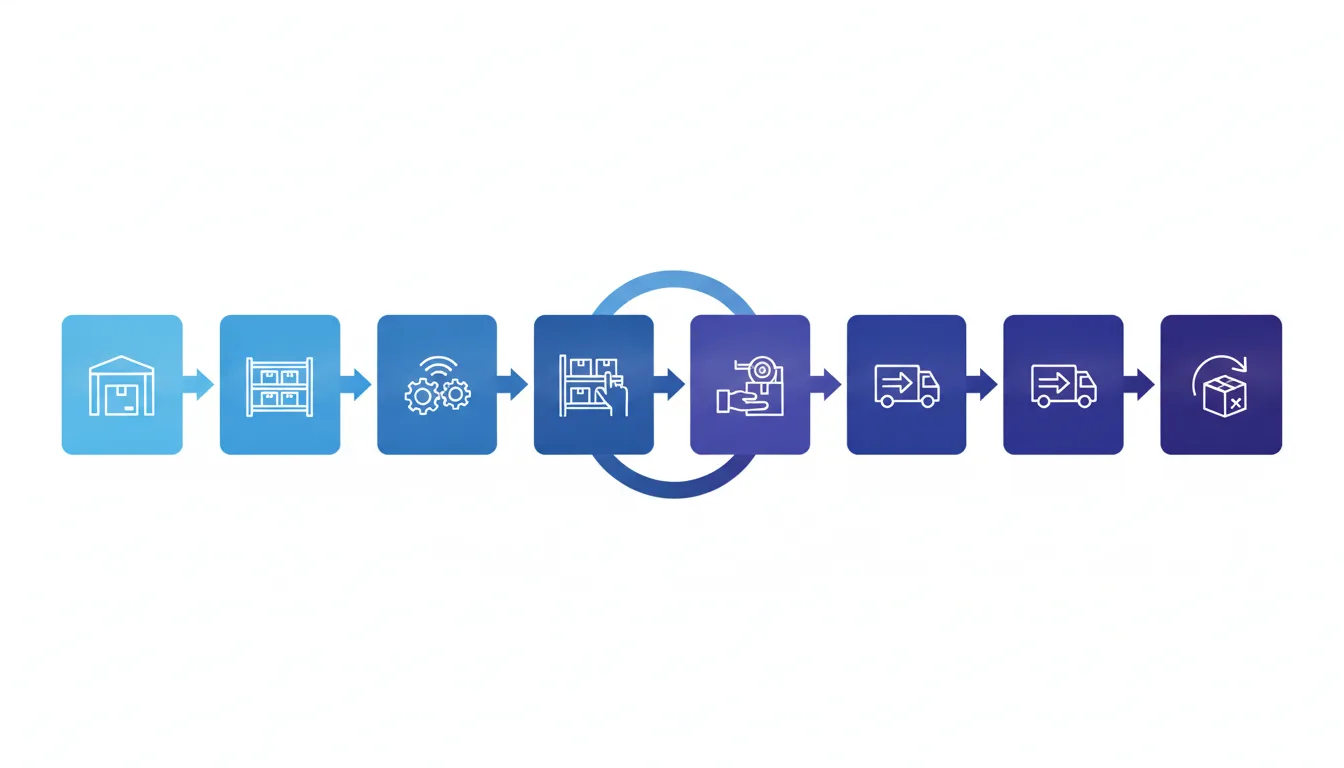
Order fulfillment is the end-to-end process of receiving inventory, storing it, syncing orders from sales channels, picking and packing individual orders, shipping them to customers, and managing returns. For ecommerce and DTC brands, it is the operational backbone that determines whether a customer gets the right product, on time, in good condition. YouParcel handles 10,000-plus orders a day across multiple marketplaces, so the steps below reflect what actually happens in a working fulfillment operation.
- Order fulfillment spans seven distinct stages, and each one has its own failure modes that compound downstream.
- Errors caught at receiving and storage prevent the most expensive problems: mis-ships, stockouts and chargebacks.
- Technology integration between your sales channels and your fulfillment system is the single biggest lever for speed and accuracy.
- Returns are part of the fulfillment cycle, not an afterthought, and handling them well directly affects repeat-purchase rates.
What Is Order Fulfillment? A Working Definition
Order fulfillment, sometimes called order processing or pick-pack-ship, covers every physical and digital step between a customer placing an order and that customer receiving the correct product. The Council of Supply Chain Management Professionals (CSCMP) defines fulfillment broadly as the complete process of satisfying a customer order, from order receipt through delivery and post-sale service, including returns management. For ecommerce brands, that definition is exactly right: fulfillment does not end at the carrier handoff.
The term is used interchangeably with ecommerce order fulfillment when the demand signal comes from an online storefront or marketplace, and with order fulfillment system when the conversation is about the software and warehouse infrastructure that execute those steps. This article covers all three angles.
Why Each Step Matters: The Compounding Cost of Errors
A mistake at receiving can corrupt inventory counts. A corrupted count causes a picking error. A picking error triggers a mis-ship. A mis-ship generates a return, a replacement shipment and often a customer service escalation, turning one upstream error into four separate costs. Understanding each step in sequence is the fastest way to locate where your operation is losing money.
Step 1: Receiving Inventory
Receiving is the process by which a fulfillment center accepts, inspects and records inbound goods from a supplier or manufacturer. It is the foundation of inventory accuracy. If a unit is not correctly received, it effectively does not exist inside the warehouse management system (WMS) until someone catches the discrepancy.
What happens during receiving
- A purchase order (PO) or advance ship notice (ASN) is sent to the warehouse before the shipment arrives.
- Warehouse staff unload the shipment and count units against the PO, noting any discrepancies such as shorts, overages or damages.
- Each SKU is scanned or entered into the WMS, creating a digital record of on-hand quantity.
- Products that require prep, including poly bagging, labeling or bundling, are processed before putaway.
- A receiving discrepancy report is filed if counts do not match, and the brand is notified.
What goes wrong at receiving
The most common problems are supplier shipments that arrive without an ASN, forcing manual keying and slowing throughput; unit counts that differ from the PO because suppliers ship partial or substitute quantities; and damage that was not noted at unloading, which leads to customer complaints weeks later when that damaged unit ships. Requiring suppliers to send ASNs at least 24 hours before delivery and photographing damaged cartons at receipt eliminates most disputes.
Step 2: Storage and Inventory Management
Once received, inventory is assigned a location inside the warehouse. Storage strategy directly affects pick speed and carrying costs. A fulfillment center uses several storage methods depending on product velocity and size.
| Storage Method | Best For | Trade-off |
|---|---|---|
| Fixed location (dedicated bin) | High-velocity SKUs, predictable demand | Wastes space when stock is low |
| Floating or chaotic storage | Large SKU catalogs, variable demand | Requires reliable WMS scanning; harder to audit |
| Zone-based storage | Product families with similar handling needs | Picker must travel between zones for multi-SKU orders |
| Bulk or pallet storage | High-volume replenishment stock | Requires forklift access; slower unit picking |
YouParcel operates fulfillment warehouses in New Jersey, California and Illinois. The East Hanover, NJ facility (20 Farinella Dr, East Hanover, NJ 07936) serves the NY/NJ metro and the broader East Coast. The Rialto, CA facility (3700 S. Riverside Ave, Rialto, CA 92324) covers Southern California and western markets. Positioning inventory close to your highest-density customer zip codes reduces the ground-transit zones your parcels travel, which cuts both cost and delivery time without changing carriers.
What goes wrong at storage
Commingling, where units from different lots or condition codes are stored together, is the most costly storage error in ecommerce. It is particularly damaging for sellers on Amazon, where commingling can result in a customer receiving a used or counterfeit unit that was not yours. Cycle counting, meaning regular partial physical counts rather than one annual wall-to-wall count, catches discrepancies before they cause mis-ships. A monthly cycle count on your top 20 percent of SKUs by order volume typically surfaces 80 percent of inventory inaccuracies.
Step 3: Order Sync and Channel Integration
An order fulfillment system connects your sales channels to the warehouse so that when a customer checks out, the order lands in the WMS automatically, with the correct shipping method, address and any special instructions. Without this integration, staff must manually re-enter orders, which is slow, error-prone and unscalable past a few dozen orders a day.
YouParcel integrates with Shopify, Amazon, Salesforce and 70-plus other platforms. When an order is placed on any connected channel, it flows into the fulfillment system in near real time, inventory is reserved, and a pick ticket is generated. Bi-directional sync also pushes tracking numbers back to the channel so the customer receives an automated shipping notification.
What goes wrong at order sync
Split inventory that exists in multiple warehouses without a shared inventory pool causes overselling: the system shows 50 units available, but they are spread across two locations and neither has enough to fulfill a large order. Mapping errors between channel SKUs and warehouse SKUs, for example a bundle on Shopify that maps to three separate WMS units, cause the wrong items to be picked. Testing every SKU mapping before go-live and setting safety-stock buffers on high-velocity items prevents most of these problems.
Step 4: Picking
Picking is the act of locating and retrieving the specific units needed to fill an order. It is the most labor-intensive step in the fulfillment process and the primary driver of per-order accuracy rates. Even a 99 percent pick accuracy rate means 100 wrong orders out of every 10,000 shipped.
Common picking methods
| Method | How It Works | Best Volume Range |
|---|---|---|
| Single-order picking | One picker fulfills one order at a time | Low volume, fragile or high-value goods |
| Batch picking | One picker collects units for several orders in one warehouse pass | Medium volume, many single-SKU orders |
| Zone picking | Each picker owns one zone; totes travel between zones | Large warehouses, wide SKU range |
| Wave picking | Orders are released in scheduled waves aligned to carrier cutoffs | High volume, time-sensitive shipping windows |
What goes wrong at picking
Wrong location, wrong SKU and wrong quantity are the three picking failure modes. Scan-to-pick, where a packer scans both the bin barcode and the product barcode before placing the unit in the tote, eliminates most wrong-SKU errors. Quantity errors are common when units are stored loose without inner packs counted, so requiring units to be stored in scan-confirmed quantities at putaway reduces this significantly. Inadequate lighting and aisle congestion during peak periods slow pickers and raise error rates, which is why carrier cutoff windows are important to build around from day one.
Step 5: Packing
Packing is where picked units are placed into the final shipping container with appropriate protective materials, and where the shipping label is generated and applied. Packing decisions affect three things simultaneously: dimensional weight charges, damage rates and the customer unboxing experience.
Dimensional weight: how it works
Dimensional weight (DIM weight) is a pricing technique used by carriers including FedEx, UPS and USPS. It calculates a theoretical weight based on package volume and bills the higher of actual weight versus DIM weight. The standard domestic DIM divisor for most major carriers is 139 (length x width x height in inches, divided by 139). A box measuring 12 x 10 x 8 inches has a DIM weight of 6.9 pounds. If the actual product weighs 2 pounds, the carrier charges for 6.9 pounds. Choosing the smallest box that safely fits the product is the single highest-return packing optimization for most ecommerce brands.
Packing materials and protection
Void fill options include air pillows, kraft paper and biodegradable peanuts, each serving different fragility profiles. Glass and ceramics need a minimum of two inches of cushion on all six sides. Apparel and soft goods rarely need rigid boxes and often ship safely in poly mailers at a fraction of the dimensional weight. Custom-fit boxes reduce void fill costs and DIM weight simultaneously.
What goes wrong at packing
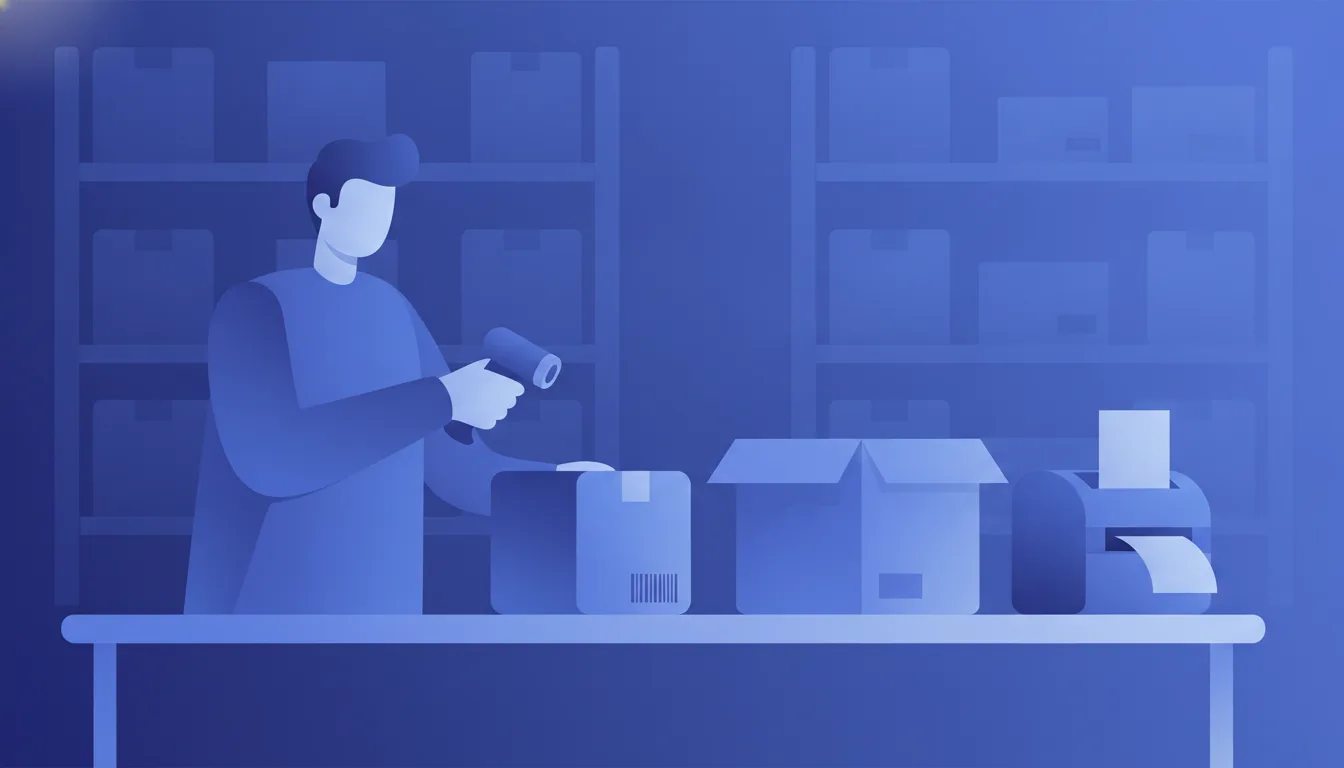
The most frequent packing errors are using oversized boxes (which inflates DIM weight and void-fill cost), under-filling fragile items (which leads to damage claims), applying the wrong label to the right box (a mis-ship that is very hard to intercept after label scan), and missing special instructions such as gift messaging or inserts. A packing quality-check scan, where a packer scans both the order barcode and each unit barcode before sealing the box, catches wrong-label and wrong-item errors before they leave the building.
Step 6: Shipping and Carrier Handoff
Shipping is the stage where the sealed, labeled parcel is handed to a carrier and begins its journey to the customer. Carrier selection, service level and the physical handoff process all affect final-mile cost and delivery speed.
Carrier selection in practice
YouParcel works with USPS, FedEx, DHL, Aramex and EasyPost, among others. No single carrier is cheapest or fastest for every zone, weight and delivery-speed combination. A hybrid model, where lightweight parcels under one pound go USPS, heavier domestic parcels go FedEx or UPS Ground, and international parcels route through DHL or Aramex, typically produces the best blend of cost and transit time. The right carrier mix depends on your average order weight, customer zip-code distribution and the service-level agreements you have promised buyers.
Tracking and visibility
YouParcel provides real-time tracking and proactive alerts from the moment a label is scanned at pickup through delivery confirmation. For international shipments to any of the 100-plus countries YouParcel ships to, tracking handoffs between origin carrier and destination postal authority are a known visibility gap: packages that enter a destination country postal network often go dark for 24 to 72 hours. Pre-advising customers of this gap reduces inbound "where is my order" contacts significantly.
What goes wrong at shipping
Address errors that were not caught at order entry cause failed deliveries and expensive carrier address-correction fees. Missing or incorrect customs documentation causes international parcels to be held at customs or returned. For shipments entering the United States, duty and tax obligations now apply to all commercial shipments regardless of value; the de minimis duty-free threshold for commercial goods has been suspended. Exporters should work with a licensed customs broker recognized by U.S. Customs and Border Protection to confirm correct HS codes and declared values before shipping internationally. YouParcel does not act as importer of record (IOR); brands should arrange IOR services through a licensed customs broker or freight forwarder when required.
Step 7: Returns Management (Reverse Logistics)
Returns management, also called reverse logistics, is the process of receiving, inspecting, restocking or disposing of products that customers send back. Return rates in ecommerce vary widely by category: apparel returns often run 20 to 30 percent, while electronics and home goods tend to run lower. How efficiently a brand handles returns directly affects net margin, inventory health and customer lifetime value.
The returns process step by step
- Customer initiates a return through the brand portal or using a carrier label provided at checkout.
- The parcel is shipped back to the fulfillment center or a designated returns facility.
- Warehouse staff receive and inspect the returned unit: is it sellable, refurbishable or unsellable?
- Sellable units are restocked to available inventory after a quality check and repackaging if needed.
- Refurbishable units are flagged for kitting, repackaging or remanufacturing depending on brand policy.
- Unsellable units are quarantined for brand decision: donate, liquidate or destroy.
- The WMS updates inventory counts and the customer receives their refund or exchange confirmation.
What goes wrong at returns
Slow grading, meaning units sit uninspected for days or weeks, ties up capital and creates phantom out-of-stocks. Units that are graded sellable but have cosmetic damage that was not noted cause secondary customer complaints when those units ship again. Return fraud, where customers return items other than what was purchased, is rising in ecommerce; photographing returns at receiving and recording the condition before issuing a refund authorization to the brand helps document and reduce this exposure.
Setting a clear returns window, with 30 days being standard for most categories and 60 to 90 days for premium goods, and communicating it at checkout reduces ambiguity and disputes. For brands on Amazon, Shopify and other marketplaces, return policy must match platform requirements or the brand risks policy violations and account suspension.
How an Order Fulfillment System Ties All Seven Steps Together
An order fulfillment system is the software layer, typically a warehouse management system combined with an order management system (OMS), that connects all seven steps into a single auditable workflow. Without it, each step operates in a silo: receiving data lives in a spreadsheet, orders are manually keyed from channel emails, and tracking numbers are emailed to customers one by one.
With an integrated system, a receiving scan at step one feeds inventory that automatically appears as available for sale at step three, pick tickets generated at step four reference the exact bin location assigned at step two, and tracking data captured at step six flows back to the customer and the channel automatically.
YouParcel integrates with Shopify, Amazon, Salesforce, Tableau and 70-plus other platforms, so brands do not need to rebuild their existing tech stack. Business intelligence and analytics built into the platform surface order accuracy rates, receiving lead times, return rates by SKU and carrier performance by zone, giving operations teams the data to make decisions at the right level of specificity.
For a deeper look at the strategic principles that sit behind these operational steps, see the guide on building a bulletproof fulfillment strategy. For a full overview of what a third-party fulfillment service covers end to end, visit the YouParcel ecommerce fulfillment services page.
Common Fulfillment Metrics to Track Across All Seven Steps
| Metric | What It Measures | Target Range (general industry) |
|---|---|---|
| Receiving accuracy rate | Units correctly received vs. PO quantity | 98% or higher |
| Inventory accuracy rate | Physical count vs. WMS count | 98% or higher |
| Order accuracy rate (pick-and-pack) | Orders shipped without error | 99.5% or higher |
| On-time ship rate | Orders shipped by promised carrier cutoff | 99% or higher |
| Return processing time | Days from return receipt to unit disposition | 1 to 3 business days |
| Cost per order | Total fulfillment cost divided by orders shipped | Varies by product and volume; benchmark quarterly |
Frequently Asked Questions
What is the order fulfillment process in simple terms?
Order fulfillment is the sequence of steps a business takes to deliver a product to a customer after an order is placed. It includes receiving inventory at a warehouse, storing it, syncing orders from sales channels, picking the right products, packing them securely, shipping them to the customer, and processing any returns. Each step must be completed accurately for the next one to work correctly.
What is the difference between order fulfillment and order management?
Order management covers the commercial and financial lifecycle of an order: payment capture, fraud checks, order routing and customer communication. Order fulfillment is the physical execution, covering warehouse operations, packing and shipping. The two systems share data constantly but serve different functions; most growing brands need both integrated into a single platform to operate efficiently.
How long does the order fulfillment process take?
In a well-run fulfillment center, an order placed before the carrier cutoff time, typically noon to 2 pm local warehouse time, can ship the same day. Receiving new inventory typically takes one to two business days to process and make available for orders. Returns grading and restocking generally take one to three business days depending on inspection requirements and return volume.
When should a brand outsource order fulfillment to a 3PL?
Most brands find that outsourcing to a third-party logistics provider (3PL) makes financial and operational sense when they are shipping more than 100 to 200 orders per month, when storage costs at their current location exceed 3PL warehousing rates, or when they need to reach customers in multiple geographic regions without operating multiple warehouse leases themselves. A 3PL also provides carrier rate access and technology that would cost significantly more to build in-house.
What are the most common causes of order fulfillment errors?
The most common causes are inaccurate inventory counts from poor receiving practices, channel-to-WMS SKU mapping errors, picking without barcode scanning verification, address errors imported from order channels without validation, and customs documentation mistakes on international shipments. Eliminating each one requires a combination of process discipline and the right technology integrations.
Ready to improve accuracy, speed and visibility across all seven steps of your order fulfillment process? Talk to a YouParcel fulfillment expert to review your current operation and identify where your biggest gains are.