


Order fulfillment software is a category of tools, from standalone warehouse management systems to order management systems, that automate pick, pack and ship workflows. When a brand partners with a 3PL like YouParcel, the 3PL's own tech stack, including 70+ platform integrations, real-time tracking and built-in BI, often replaces the need to license, configure and maintain separate fulfillment software entirely.
- Standalone fulfillment software requires your team to own integrations, data pipelines and ongoing maintenance; a 3PL's native tech stack bundles all of that into the service.
- The integrations that matter most are store and marketplace connections, ERP and inventory sync, returns management, business intelligence and carrier rate shopping.
- YouParcel connects to Shopify, Amazon, Salesforce, Tableau and 70+ other platforms out of the box, handling 10,000+ orders a day across multiple marketplaces.
- Brands that outsource fulfillment to a capable 3PL rarely need to buy separate order fulfillment software at all.
What Is Order Fulfillment Software, Exactly?
The term covers several overlapping system types. A warehouse management system (WMS) controls physical warehouse operations: receiving, putaway, pick paths, packing stations and shipping label generation. An order management system (OMS) sits upstream and orchestrates where orders are routed, how inventory is allocated and how split shipments are handled. A fulfillment platform often bundles both, adding carrier rate shopping, returns portals and reporting dashboards.
The Council of Supply Chain Management Professionals (CSCMP) defines order management as the process of capturing, validating, promising and fulfilling customer orders across channels. In practice, every tool in this space competes on how cleanly it connects to the places orders originate and the carriers that deliver them. That connection layer, the integration fabric, is where most operational pain lives.
The Case for Buying Your Own Fulfillment Software
Brands that operate their own warehouse, or that have deeply custom workflows no standard 3PL supports, have legitimate reasons to invest in a dedicated WMS or OMS. A self-operated fulfillment center needs software to direct staff, manage bin locations, enforce FIFO (first-in, first-out) rotation and generate compliance labels for retailers. In that environment, owning the software means owning the configuration and the data.
The tradeoffs are real:
- Implementation timelines for enterprise WMS platforms commonly run three to twelve months.
- Each new sales channel or marketplace requires a custom integration build or a middleware connector subscription.
- Carrier rate updates, marketplace API version changes and ERP upgrades all require ongoing IT resources to maintain.
- The software license or SaaS fee is a fixed cost that scales poorly during slow seasons.
For brands under roughly 500 daily orders that are self-fulfilling, a mid-market OMS can be the right call. Beyond that volume, or the moment a brand opens a second geographic node, the complexity argument shifts sharply toward outsourcing.
What a 3PL's Tech Stack Actually Includes
A mature 3PL does not just rent you shelf space. It operates a full technology layer on top of its physical network. YouParcel's platform illustrates what that looks like in practice: a connected system that spans order ingestion, warehouse execution, carrier selection, tracking, returns and analytics, all accessible through a merchant portal and a set of APIs.
When you send orders into a 3PL's system, the sequence looks like this:
- Order ingestion: Your storefront or marketplace pushes orders via API or EDI. The 3PL's OMS layer captures the order, validates the address and assigns it to the correct fulfillment node based on inventory position and destination zone.
- Inventory allocation: Available units are reserved in real time so your storefront reflects accurate on-hand quantities. Oversell protection runs automatically.
- Warehouse execution: Pick lists are generated and directed to warehouse staff or automated picking systems. Kitting and assembly instructions are embedded for SKUs that require it.
- Carrier selection and labeling: The system rate-shops across carriers such as USPS, FedEx, DHL, Aramex and EasyPost, selects the service level that meets the delivery window, and prints a compliant shipping label.
- Tracking and alerts: A tracking number is pushed back to your storefront and, optionally, to your customer via automated notification. Real-time status updates flow through the entire chain.
- Returns processing: Inbound returns are received, inspected and either restocked or quarantined. Return status feeds back into your OMS record.
- Reporting and BI: Order velocity, fill rates, carrier performance and storage utilization data surface in dashboards that connect to tools like Tableau and Salesforce.
A brand that relies on a 3PL for all of the above does not need a separate WMS, a separate OMS, a separate returns portal or a separate reporting tool. The 3PL's tech stack is the fulfillment software.
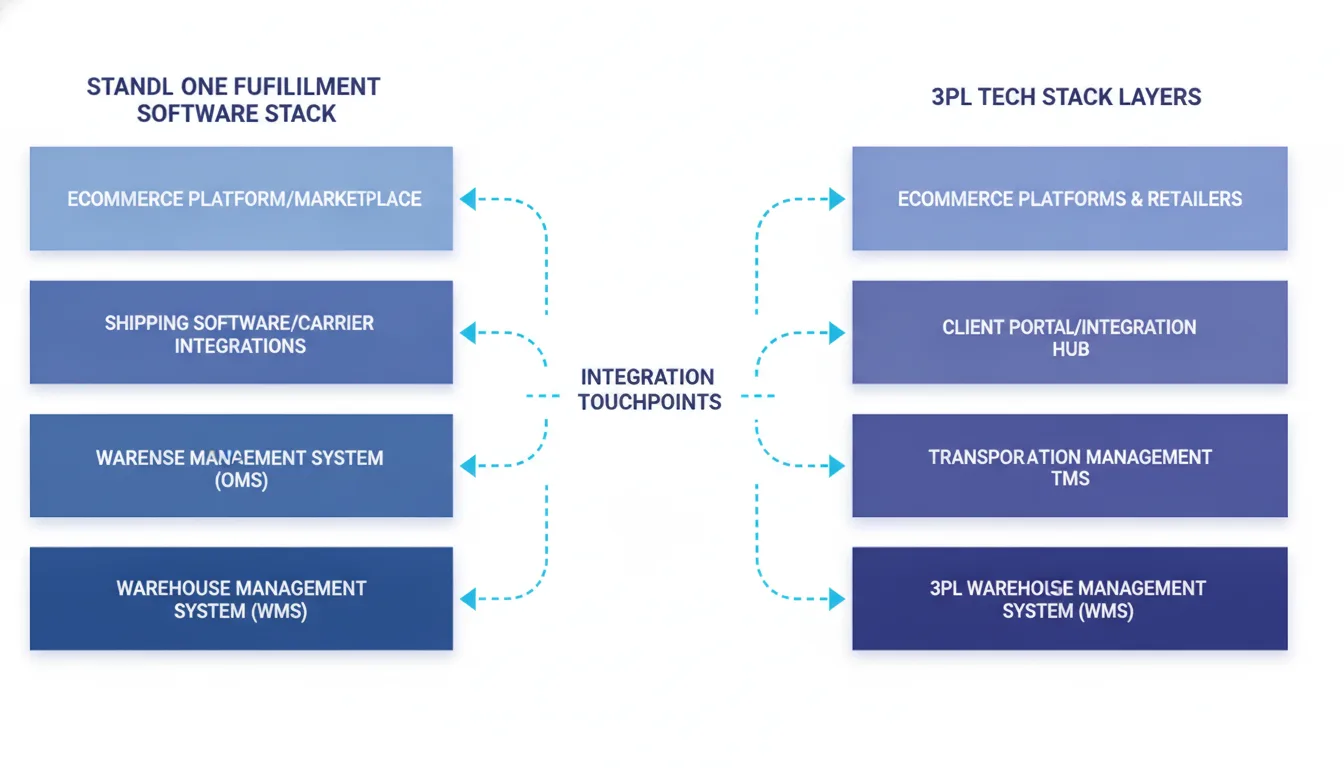
Which Integrations Actually Matter? A Layer-by-Layer Breakdown
Store and Marketplace Connectivity
The first integration layer connects your sales channels to the fulfillment system. For direct-to-consumer brands, this is the Shopify fulfillment API (sometimes called the Fulfillment Service API or the Order Webhooks layer, depending on implementation). Shopify sends new orders to a registered fulfillment service endpoint; the 3PL acknowledges receipt and later pushes a tracking number back, which Shopify marks the order as fulfilled and surfaces to the customer.
Amazon FBM (Fulfilled by Merchant) sellers need a different connection: orders pulled via the Amazon Selling Partner API (SP-API), with tracking confirmation uploaded within Amazon's required window to protect seller performance metrics. Amazon's SP-API documentation specifies the confirmation requirements that affect your account health score, so the integration must be reliable, not just functional.
YouParcel supports Shopify, Amazon and 70+ additional platforms and marketplaces, which means brands selling across multiple channels push all orders into one fulfillment queue without managing separate middleware for each channel. That consolidation alone eliminates a category of software many brands pay for independently. You can review the full scope of connections at YouParcel's integrations overview.
ERP and Inventory Sync
Growing brands running Salesforce, NetSuite, SAP or similar ERP systems need bidirectional inventory data: the ERP holds the book of record for product costs, purchase orders and financials, while the 3PL holds the physical inventory. Without a reliable sync, the two systems drift apart and cause overselling, mis-shipments and inaccurate cost accounting.
A native ERP integration pushes inbound receipts from the 3PL into the ERP as they happen, updates available-to-sell quantities in real time, and ties order costs back to the correct line items. Brands that rely on manual CSV exports between their ERP and a standalone fulfillment tool introduce lag and error that compounds at volume. YouParcel's integration with Salesforce is a direct example of closing that loop without custom middleware.
Returns and Reverse Logistics
Returns management is a frequent gap in standalone fulfillment software packages. An order management system may track an outbound shipment perfectly but have no structured process for what happens when a customer sends a product back. A 3PL that handles reverse logistics as a native service, not a bolt-on, connects the return event directly to inventory availability: a restocked unit is immediately reflected in the sellable inventory feed.
For apparel and consumer electronics brands where return rates regularly exceed 20 percent of shipped volume, the speed of that feedback loop directly affects revenue. A standalone returns portal that does not share a data model with the fulfillment system requires reconciliation work that grows with order volume.
Business Intelligence and Analytics
Fulfillment data is operations data and financial data at the same time. Carrier cost per order, average transit time by zone, fill rate by SKU, return reason codes and storage turn all feed strategic decisions about assortment, pricing and carrier mix. Brands that pull this data manually from a 3PL portal into spreadsheets are one step behind brands whose 3PL connects directly to Tableau, Salesforce or a data warehouse.
YouParcel's built-in BI and analytics layer, and its native Tableau integration, mean that operations teams can monitor performance in the same environment where commercial and finance teams are already working. That is a meaningful advantage over licensing a standalone fulfillment platform and then paying separately for a BI connector. For a closer look at the full technology layer, see how YouParcel's technology platform is built.
Carrier and Rate-Shopping Integrations
Carrier integrations are the integrations most brands think about first, but they are also the ones a good 3PL handles invisibly. Rate shopping across USPS, FedEx, DHL and regional carriers requires negotiated rate access, API connectivity with each carrier and logic to apply the correct service level based on package dimensions, weight, destination zone and delivery commitment. Dimensional weight (DIM weight), calculated by multiplying length times width times height and dividing by a carrier-specific divisor (typically 139 for domestic ground carriers in the US), often determines the billable weight for lightweight but bulky packages.
Brands that build their own carrier integrations through a tool like EasyPost still need to negotiate their own rates, manage carrier API changes and build the rate-selection logic themselves. A 3PL with high order volume, such as YouParcel processing 10,000+ orders a day, has negotiated carrier pricing that individual brands at lower volumes cannot match independently.
EDI and Retail Compliance
Brands distributing through wholesale or omnichannel retail partners face a distinct integration requirement: EDI (Electronic Data Interchange). EDI transaction sets such as the 850 (purchase order), 856 (advance ship notice) and 810 (invoice) are mandatory for major retailers and carry chargeback penalties for non-compliance. YouParcel supports EDI and retailer compliance requirements including routing guides, packing lists and labeling standards, which is an integration category that most standalone consumer fulfillment software does not address at all.
Direct Comparison: Standalone Fulfillment Software vs 3PL Tech Stack
| Capability | Standalone Fulfillment Software | 3PL Tech Stack (YouParcel) |
|---|---|---|
| Shopify and marketplace order ingestion | Requires integration setup per channel; ongoing API maintenance | Native; 70+ channels connected out of the box |
| Warehouse execution (pick, pack, ship) | Directs your own warehouse staff | Executed by 3PL across NJ, CA and IL facilities |
| Carrier rate shopping | Requires carrier API accounts and negotiation | Built in; USPS, FedEx, DHL, Aramex, EasyPost and others |
| ERP sync (Salesforce, NetSuite, SAP) | Middleware or custom build often required | Native Salesforce integration; additional ERPs via API |
| Returns and reverse logistics | Frequently a separate module or tool | Native reverse logistics with real-time restock feed |
| BI and analytics | Separate BI tool or data export required | Built-in BI; native Tableau integration |
| EDI and retail compliance | Rarely included; specialist add-on needed | Supported natively for wholesale and omnichannel |
| Real-time tracking and alerts | Depends on carrier integrations built | Real-time tracking and alerts across all carriers |
| Kitting and assembly | WMS feature; requires configuration | Supported at fulfillment centers |
| IT maintenance burden | Owned by your team | Owned by YouParcel's team |
| Cost structure | License or SaaS fee plus integration costs | Per-order or usage-based; bundled with fulfillment service |
When Does a Brand Still Need Separate Fulfillment Software?
There are three scenarios where a standalone order fulfillment system remains the right answer even for brands working with a 3PL.
First, brands that operate their own warehouse alongside a 3PL arrangement need a WMS for their self-operated facility. The 3PL handles one node; the in-house WMS handles another. An OMS sitting above both systems routes orders to the correct node.
Second, brands with highly custom manufacturing or assembly workflows, common in made-to-order or configure-to-order businesses, may need a system that models their specific work-in-process steps before handing off to a 3PL for outbound shipping only.
Third, enterprise brands that require a single system of record for global inventory across dozens of fulfillment partners in multiple countries may invest in a global OMS that sits above all partners and feeds orders down to each 3PL's system via API.
Outside of these scenarios, most growing ecommerce and DTC brands find that the 3PL's native platform covers everything they need without the software overhead.
The Hidden Cost of Integration Sprawl
One pattern that consistently creates operational problems is what practitioners call integration sprawl: a stack where orders move through five or six loosely connected tools, each with its own login, its own data model and its own failure mode. A storefront pushes to an OMS, which pushes to a WMS via a middleware connector, which writes to a shipping platform, which updates a tracking dashboard, which exports to a BI tool. Each handoff is a potential point of latency, data loss or error.
When a carrier API change breaks the shipping platform integration, the downstream effects cascade: orders stall, tracking does not update, customer service tickets spike, and the finance team cannot reconcile costs. The brand's internal team owns the fix, not the software vendor.
A 3PL with a unified tech stack reduces the number of handoffs. When YouParcel's platform receives an order from Shopify, executes it at a fulfillment center and pushes tracking back to Shopify and Tableau, the brand's team is not managing any of those integrations. The accountability sits with one partner.
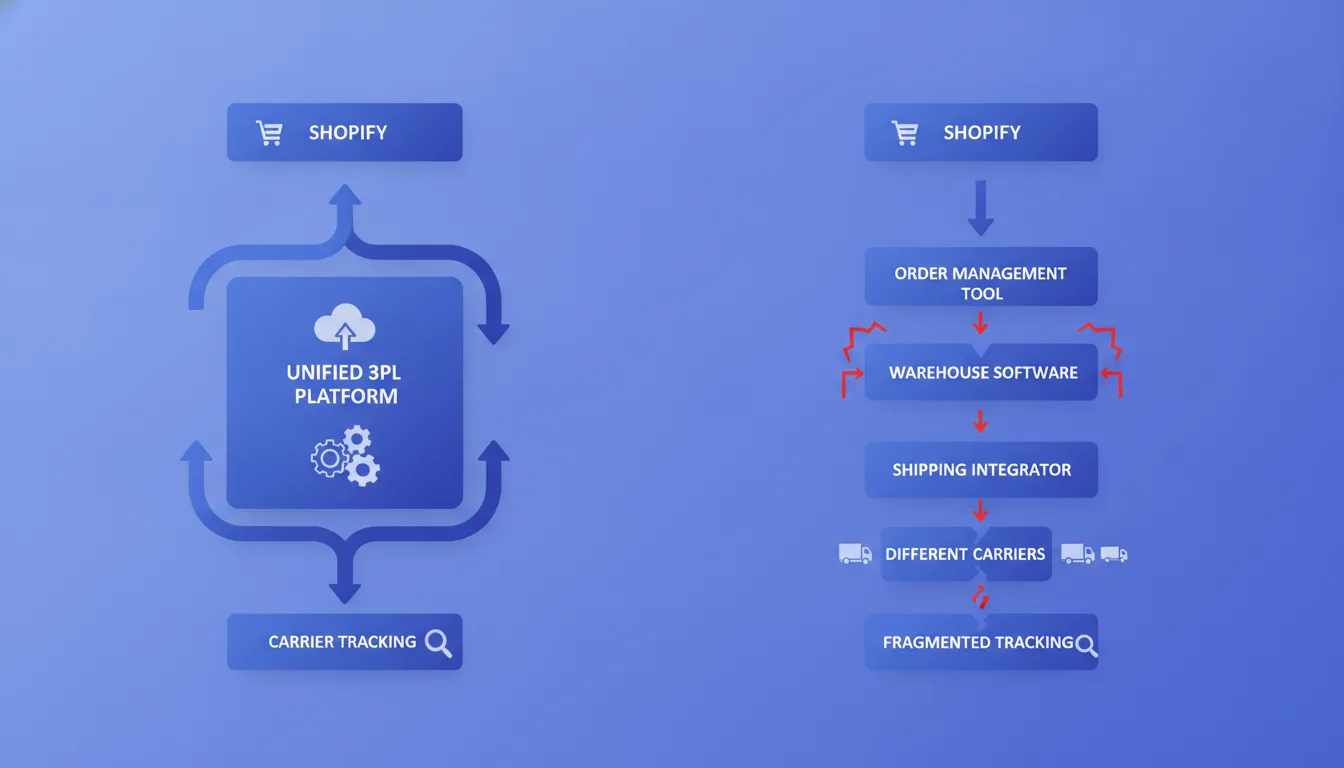
How to Evaluate a 3PL's Tech Stack Before You Commit
Not all 3PLs offer the same integration depth. When evaluating a 3PL as an ecommerce fulfillment platform, ask these questions:
- Which marketplaces and storefronts does the platform connect to natively, and which require a third-party middleware subscription?
- How does inventory sync work during peak periods when order volume spikes, and what is the refresh interval for on-hand quantities?
- Does the platform support EDI for retail and wholesale distribution, or is that a separate service?
- What does the returns workflow look like end to end, and how quickly does a returned unit become available-to-sell?
- What BI and reporting tools connect natively, and can you access raw order and shipment data via API for your own data warehouse?
- What happens when a carrier API changes or a marketplace updates its order schema? Who owns the fix and how quickly is it deployed?
YouParcel's leadership team brings over 50 years of combined experience in logistics and supply chain operations. That depth shows in the specificity of the integrations the platform supports and in the hands-on customer service approach when edge cases arise. The CSCMP Supply Chain Management Definitions and Glossary provides a useful reference for the standard terminology around order management and fulfillment that any tech stack evaluation should map to.
Frequently Asked Questions
What is the difference between an OMS and a WMS in order fulfillment?
An order management system (OMS) handles order routing, inventory allocation and channel orchestration at the business logic level. A warehouse management system (WMS) controls physical warehouse operations: where inventory is stored, how it is picked and how shipments are packed and labeled. Many 3PLs run both internally and expose a unified merchant portal so brands do not need to interact with either system separately.
Does my brand need to buy order fulfillment software if I use a 3PL?
In most cases, no. A 3PL with a mature tech stack, like YouParcel with 70+ native integrations, replaces the need for standalone fulfillment software by handling order ingestion, warehouse execution, carrier selection, tracking, returns and analytics as part of the service. Brands that also operate their own warehouse are the main exception.
How does the Shopify fulfillment API work with a 3PL?
Shopify's fulfillment service API allows a registered third-party fulfillment partner to receive new order notifications, acknowledge receipt and push tracking numbers back to Shopify automatically. When the tracking number is confirmed, Shopify marks the order fulfilled and triggers any customer notification flows you have configured. The brand does not need to manually export or import orders.
What integrations should I prioritize when choosing an ecommerce fulfillment platform?
Prioritize native connections to your primary sales channels (Shopify, Amazon or whichever marketplaces you sell on), real-time inventory sync with your ERP or accounting system, a structured returns workflow, and a BI or analytics connection that fits how your team reviews performance data. Carrier rate shopping is also critical if you want to optimize shipping costs rather than pay a single flat carrier rate.
Can a 3PL handle EDI for my wholesale or retail distribution orders?
Yes, provided the 3PL supports EDI natively. YouParcel supports EDI and retailer compliance requirements including routing guides and labeling standards, which is necessary for brands selling through major retail chains that require 850, 856 and 810 transaction sets. Not all 3PLs offer this, so confirm during evaluation if wholesale distribution is part of your channel mix.
Ready to see how YouParcel's tech stack maps to your current integration needs? Talk to an Expert and get a concrete assessment of which connections you can consolidate and what that means for your operations.