


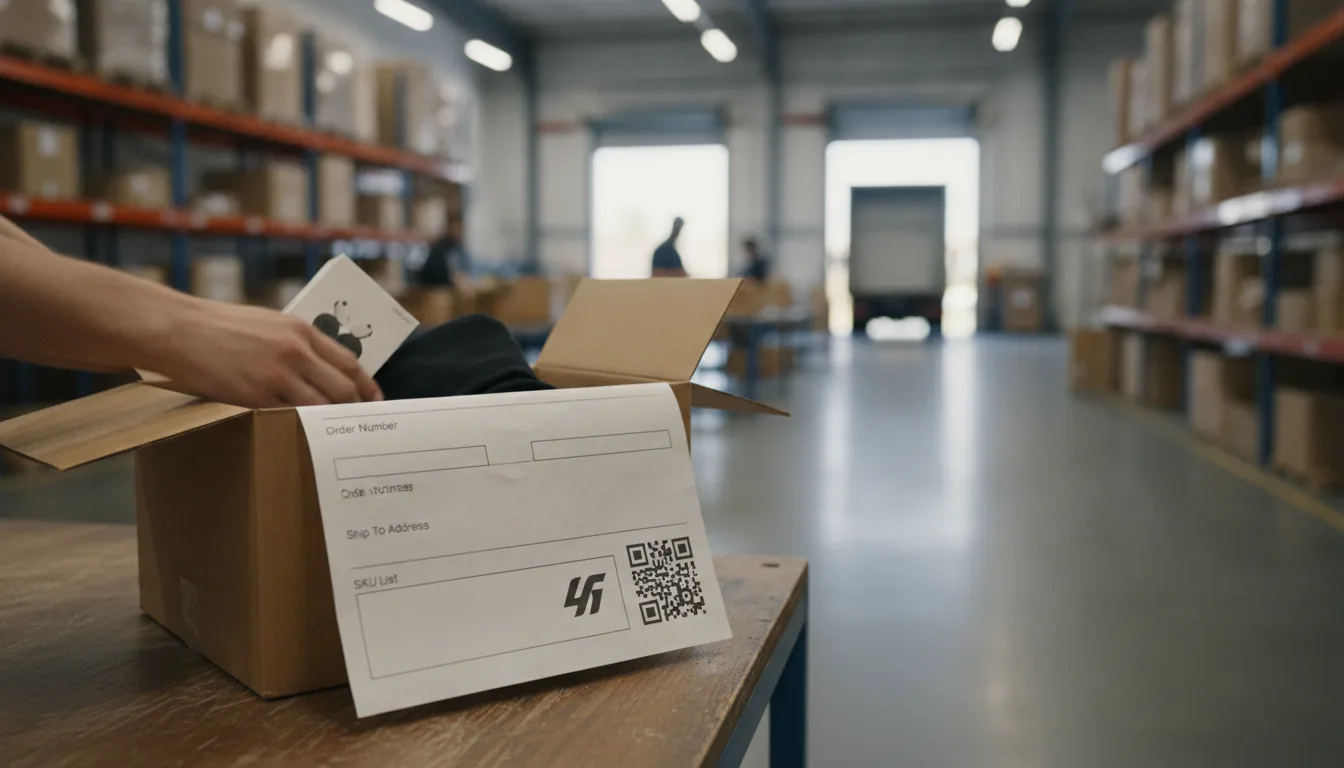
A packing slip is a printed or digital document placed inside a shipment that itemizes every product packed in that box: SKU, description, quantity ordered, quantity shipped, and any substitutions or backordered lines. YouParcel generates and verifies packing slips as a standard step in every pick and pack workflow, whether the order is a single DTC parcel or a full pallet destined for a retail distribution center.
- A packing slip is not an invoice: it lists what is in the box, not what the customer owes.
- DTC packing slips focus on the end customer experience; B2B packing slips must satisfy retailer routing guides and EDI compliance requirements.
- Gift orders require a price-suppressed or price-masked variant of the standard packing slip.
- 3PLs use packing slips as a scan-and-verify checkpoint that reduces mis-ships before the carton is sealed.
What is a packing slip, and how does it differ from an invoice?
An invoice is a financial document that states the amount owed and payment terms. A packing slip is an operational document that describes physical contents. The two may travel together on a B2B shipment but serve completely different purposes. Customs authorities may also require a commercial invoice separately from any packing documentation, particularly on international shipments where declared value and HS codes must appear on the invoice, not the packing slip.
For domestic DTC orders, many brands fold a simplified packing slip into a single insert. That insert can include a returns initiation URL, a QR code, or a personalized message, all of which are absent from a commercial invoice. Keeping the two documents distinct prevents price exposure to end consumers and simplifies returns processing downstream.
Core fields every packing slip should include
Regardless of channel, a complete packing slip covers the following fields. Missing even one can cause a retailer to reject an inbound delivery or a consumer to contact support about a wrong item.
| Field | Why it matters | DTC required | B2B/wholesale required |
|---|---|---|---|
| Order number | Links physical box to the order management system record | Yes | Yes |
| Ship-to address | Confirms delivery destination; used for carrier label cross-check | Yes | Yes |
| Bill-to address | Often the same for DTC; different for B2B accounts payable | Optional | Yes |
| SKU and product description | Allows recipient to verify contents without scanning | Yes | Yes |
| Quantity ordered vs. quantity shipped | Flags partial shipments and backorders immediately | Yes | Yes |
| Unit of measure (each, case, pallet) | Critical for wholesale where a unit may be a case of 12 | Rarely needed | Yes |
| Purchase order (PO) number | Retail buyers require this for accounts payable matching | No | Yes |
| Shipment date | Useful for SLA tracking and return window calculations | Yes | Yes |
| Carrier and tracking number | Lets recipient proactively track without calling support | Yes | Yes |
| Backorder or substitution notes | Prevents disputes when shipped quantity differs from ordered | Yes | Yes |
| Returns address and policy URL | Reduces inbound support contacts; supports automated returns | Recommended | Situational |
| Unit prices and totals | Must be suppressed for gift orders; needed for B2B audits | Suppress for gifts | Yes |
| Brand logo and messaging | Reinforces brand identity; white-label for 3PL environments | Recommended | Optional |
DTC packing slips: brand experience and returns in one insert
Direct-to-consumer brands treat the packing slip as the first physical brand touchpoint after unboxing. The document is usually compact, one half-sheet or A5, and printed on branded paper. Pricing is almost always hidden because many DTC purchases are gifts or at least gift-eligible. A clean, friendly insert reduces the perception that a parcel is a commercial transaction and reinforces the product story.
Practical DTC packing slip elements that go beyond the core fields include:
- A personalized message, such as a first-name greeting pulled from order metadata.
- A QR code linking to returns initiation, reducing inbound email volume significantly for high-volume brands.
- A discount code for the next purchase, printed only on first-time buyer orders when the OMS can flag that attribute.
- Care or usage instructions for products that require them, such as supplements, candles, or apparel with wash symbology.
None of these elements belong on a B2B packing slip. Keep the templates separate in your warehouse management system (WMS) and map them to order types at the channel level.
B2B and wholesale packing slips: compliance comes first
When shipping to a retailer, distributor, or wholesale account, the packing slip is not primarily a customer experience tool. It is a compliance document that must match the buyer's routing guide exactly. Retailers across mass-market and specialty channels publish routing guides that specify label placement, carton marking, and what must appear on a packing slip or ASN (advance ship notice). Errors can trigger chargebacks from the retailer against the brand, not from the carrier.
Key differences in a B2B packing slip:
- PO number prominence: The buyer's purchase order number is typically the primary sort key; some retailers require it in a specific position on the slip.
- Department or distribution center codes: Retail DCs route cartons by department; that code must appear on the packing slip and the carton label.
- GS1-128 barcodes: Many retailers require a GS1-128 barcode (formerly called UCC-128) encoding the PO, item, and quantity. The barcode standard is maintained by GS1.
- EDI 856 ASN alignment: The packing slip contents must mirror the Electronic Data Interchange (EDI) 856 advance ship notice sent before the goods arrive. Discrepancies between the physical slip and the EDI transmission trigger compliance penalties.
- Case and inner-pack counts: Wholesale shipments often move in master cases containing multiple inner packs. The packing slip must reflect the hierarchy: case count, inner-pack count per case, and unit count per inner pack.
YouParcel supports EDI and retailer compliance workflows, including routing guide adherence and GS1-128 labeling, as part of its ecommerce and B2B fulfillment services.
Gift orders: price suppression and special inserts
Gift orders require a modified packing slip that omits unit prices and order totals entirely. This is not just a courtesy; it is a standard expectation across DTC, marketplace, and B2B gift programs. The correct approach is to configure a separate packing slip template in your OMS or WMS that is triggered when an order is flagged as a gift at checkout.
A gift packing slip typically includes:
- The recipient's name and ship-to address, not the billing name.
- A gift message field, populated from the order if the customer entered one.
- Product descriptions and quantities with no prices.
- A returns or exchange note that directs the recipient to a gift returns portal rather than the standard returns flow, which may require the order number and email of the original purchaser.
Some brands go further and replace the standard packing slip with a branded gift card insert entirely. That is a valid choice for luxury or premium DTC brands, but the operational data (order number, SKU, tracking) should still be accessible to the 3PL team, either on a hidden internal label or in the WMS record, so returns can be processed without the recipient needing the original invoice.
How 3PLs use packing slips in the pick and pack process
Pick and pack is the fulfillment workflow where a warehouse associate or automated system selects (picks) the correct SKUs from storage locations and places them into a shipping container along with any required inserts, then seals (packs) the carton. Order picking accuracy depends heavily on how the packing slip is generated and verified.

At YouParcel, the pick and pack sequence for a standard DTC order follows these steps:
- Order import: The order arrives from Shopify, Amazon, or another connected platform via one of YouParcel's 70+ integrations and enters the WMS.
- Pick list generation: The WMS batches compatible orders and generates optimized pick lists, grouping picks by warehouse zone to reduce travel time.
- Picking: The associate picks each item and scans the barcode against the pick list. A mismatch triggers an alert before the item reaches the packing station.
- Packing slip print and place: At the packing station, the correct packing slip template (DTC, gift, or B2B) is printed or retrieved from a pre-generated queue and placed in the carton before sealing.
- Verification scan: The sealed carton is scanned to confirm the packing slip order number matches the carrier label before the carton moves to the outbound dock.
- Label application and carrier handoff: The carton receives its shipping label and enters the carrier sortation stream with USPS, FedEx, DHL, or another carrier partner.
The packing slip is therefore a checkpoint document as much as it is a customer-facing insert. Skipping or delaying packing slip generation to speed up throughput is one of the most common causes of mis-ship errors in high-volume fulfillment environments, particularly during peak periods.
What is order picking, and why does it affect packing slip accuracy?
Order picking (sometimes written as pick and pack or pack and pick, the terms are interchangeable in practice) is the process of retrieving specific SKUs from their storage locations to fill a customer order. The Council of Supply Chain Management Professionals (CSCMP) identifies order picking as a core warehouse activity that directly determines order accuracy and fulfillment cycle time. Accuracy at the picking stage determines whether the right items reach the packing station at all. Even a perfect packing slip cannot fix a mis-pick that happened three aisles back.
Common picking methods and how they interact with packing slips:
| Picking method | How it works | Packing slip timing |
|---|---|---|
| Discrete (single-order) picking | One picker, one order at a time from start to finish | Slip printed before or at packing station; order is already assembled |
| Batch picking | Picker collects items for multiple orders in one warehouse pass | Slip must be matched to the correct batch container at the sort and pack station |
| Zone picking | Each picker handles one warehouse zone; totes are consolidated downstream | Slip generated only after all zones confirm their quantities; partial totes held until complete |
| Wave picking | Orders are released in coordinated waves aligned with carrier pickup windows | Slips released at wave start; packing station queue must match wave manifest |
For brands scaling past a few hundred orders per day, the choice of picking method has a direct downstream effect on how packing slips are generated and verified. A 3PL that runs zone or wave picking without a tightly integrated WMS can produce packing slip mismatches at the consolidation step. That is worth asking about specifically when evaluating fulfillment partners, alongside broader questions about ecommerce fulfillment capabilities.
Packing slips for international shipments
On cross-border orders, the packing slip travels inside the parcel while the commercial invoice and customs declaration travel outside, either in a pouch on the carton or transmitted electronically to the carrier. The two documents must agree on product descriptions and quantities. Discrepancies between the packing slip and the commercial invoice can cause customs delays or secondary inspection, even when the declared value and HS codes on the invoice are correct.
A few specific considerations for international packing slips:
- Avoid marketing language in product descriptions. Customs officers read the commercial invoice, not the packing slip, but internal consistency matters if a shipment is examined.
- Include country of origin at the line-item level for shipments to markets that require it, such as European Union imports subject to rules of origin under trade agreements.
- For shipments into the United States, importers should be aware that all commercial shipments, regardless of value, are subject to applicable duties and taxes. YouParcel does not act as importer of record (IOR); brands should work with a licensed customs broker for IOR services on US-bound freight.
YouParcel ships to 100+ countries and handles international order documentation as part of its standard outbound workflow from fulfillment centers in New Jersey and Southern California.
Kitting, bundles, and multi-SKU packing slips
Kitting refers to assembling multiple individual SKUs into a single sellable unit before or at the time of fulfillment. A packing slip for a kitted order must reflect the kit SKU as the line item if kitting was done upstream (pre-kitting), or list each component SKU if the kit is assembled at packing time (on-demand kitting). The choice has real implications for inventory visibility: a pre-kitted SKU appears as a single inventory unit in the WMS, while an on-demand kit shows as multiple component units until assembled.
Brands that run subscription boxes, gift sets, or bundle promotions frequently encounter packing slip confusion when their OMS sends a kit parent SKU but the WMS picks and verifies components. Aligning the packing slip output format with the actual inventory and picking method is an operational detail worth resolving before go-live with a 3PL, not after. YouParcel handles kitting and assembly as part of its standard fulfillment service offering and can configure packing slip output accordingly.
DTC fulfillment packing slip checklist
Use this checklist before approving a packing slip template for a new DTC brand or SKU assortment.
- Order number present and scannable (barcode or QR code preferred for high-volume operations).
- Ship-to name and address match the carrier label exactly.
- Each line item shows SKU, product name, and quantity shipped.
- Backorder or partial-ship lines noted with expected ship date if available.
- Pricing suppressed for gift orders; pricing omitted entirely from DTC slips if brand policy.
- Returns URL or QR code included with stated return window, for example 30 days from ship date.
- Brand logo and color scheme match current brand guidelines.
- No pricing, promotional, or upsell content that would look out of place if the recipient is not the buyer.
- Template is mapped correctly in the WMS to the order type (DTC standard, gift, subscription, or B2B).
For a broader look at how packing slips fit into the full order lifecycle, including receiving, storage, and returns, see YouParcel's DTC fulfillment operations overview.
Frequently asked questions
Is a packing slip the same as a shipping label?
No. A shipping label is affixed to the outside of the carton and contains the carrier's routing data, tracking barcode, and destination address in a machine-readable format. A packing slip is placed inside the carton and lists the order contents for the recipient. Both documents may share some fields, such as the ship-to address and order number, but they serve different functions and are generated by different systems.
Do I need a packing slip for every order?
For DTC shipments there is no legal requirement to include a packing slip in most US domestic orders, but it is strongly recommended because it reduces customer service contacts and supports returns processing. For B2B and wholesale orders shipped to retail distribution centers, a compliant packing slip is almost always a mandatory requirement under the buyer's routing guide, and omitting it typically results in a retailer chargeback.
What is the difference between a packing slip and a pick list?
A pick list is an internal warehouse document used by the fulfillment team to locate and collect items from storage. A packing slip is an outbound document placed in the carton for the recipient. The pick list is usually destroyed or archived internally; the packing slip ships with the order. Both are generated from the same order data but are formatted for entirely different audiences.
How should a 3PL handle packing slips for marketplace orders like Amazon?
Marketplace programs such as Amazon Multi-Channel Fulfillment have specific packing slip and packaging requirements, including restrictions on inserting competitor promotional materials or pricing information. A capable 3PL maintains separate packing slip templates per sales channel in the WMS and applies the correct template automatically based on order source, so marketplace compliance rules are enforced without manual intervention.
Can a packing slip be digital rather than printed?
Yes. Some brands are moving toward digital packing confirmations delivered by email or SMS rather than a physical insert, partly to reduce paper use as part of broader sustainability efforts. However, most B2B buyers and many DTC customers still expect a physical packing slip inside the carton, particularly for returns and dispute resolution. If a brand moves to digital-only, the returns and customer service process must be redesigned to work without the physical document.
Ready to standardize your packing slip workflow and hand off pick and pack to an experienced 3PL? Talk to an Expert at YouParcel to discuss your order volume, channel mix, and documentation requirements.