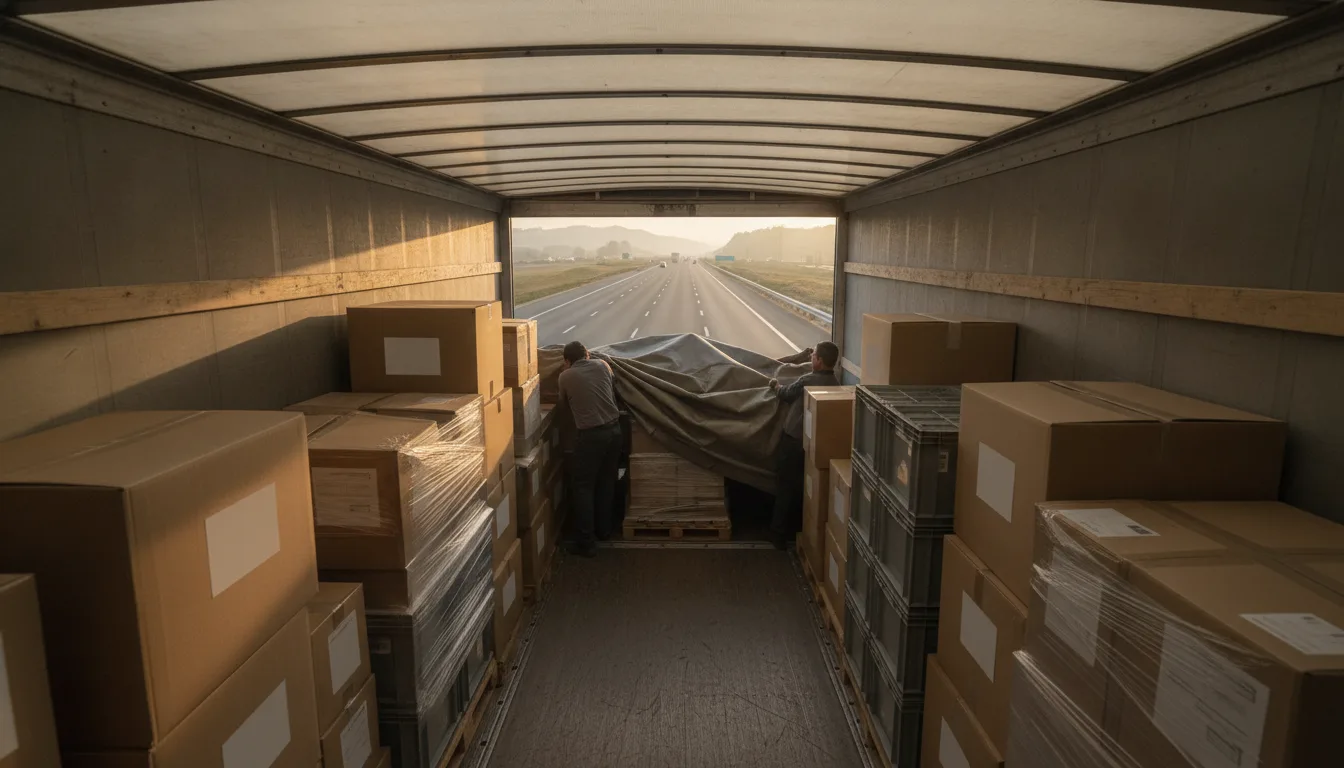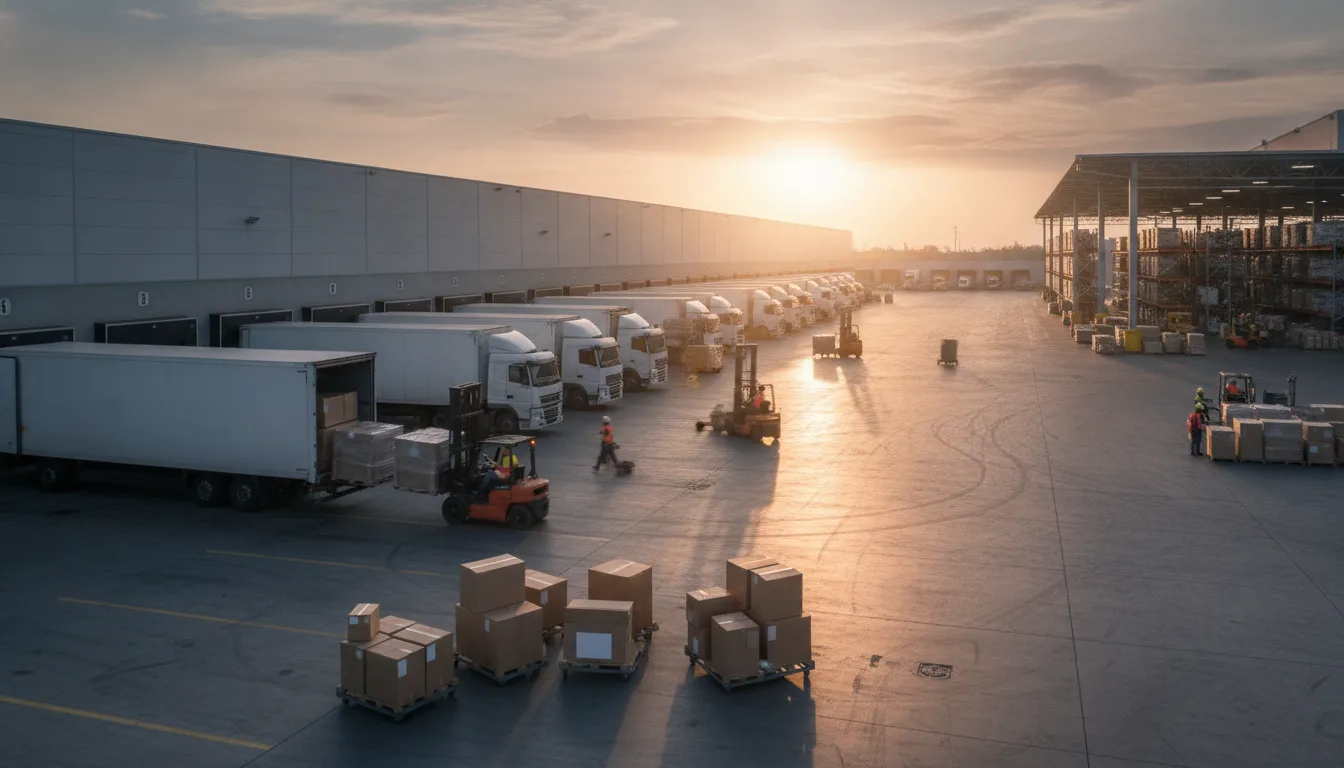


Warehouse pick and pack is the process by which a fulfillment center retrieves specific products from storage locations and packages them into a shipment-ready parcel for each customer order. It sits at the center of every ecommerce fulfillment operation, and the picking method a 3PL like YouParcel uses directly determines order accuracy, labor cost and how fast your orders ship.
- Pick and pack covers two distinct stages: picking (locating and retrieving items) and packing (verifying, protecting and labeling the parcel).
- Four main picking methods exist: discrete, batch, zone and wave. Each fits a different order volume and SKU profile.
- Packing checks, including barcode scanning and weight verification, are the last line of defense against mis-ships before a parcel leaves the warehouse.
- Choosing a 3PL with the right picking method for your order mix can reduce labor cost and lower your error rate at the same time.
What Is Order Picking?
Order picking (also called "order selection" in warehouse management literature) is the act of a warehouse associate or automated system traveling to a storage location, confirming the correct SKU and quantity, and physically retrieving those units for a specific customer order. It is widely cited as the most labor-intensive activity in a warehouse, accounting for a substantial share of total warehouse operating costs, according to research published by the Material Handling Institute (MHI).
The packing stage follows immediately: the picked items are verified, placed into an appropriate carton or poly mailer, protected with void fill or dunnage, sealed, labeled and sorted to a carrier staging area. Together, these two stages form the pick and pack workflow that powers direct-to-consumer shipments.
The Four Warehouse Picking Methods
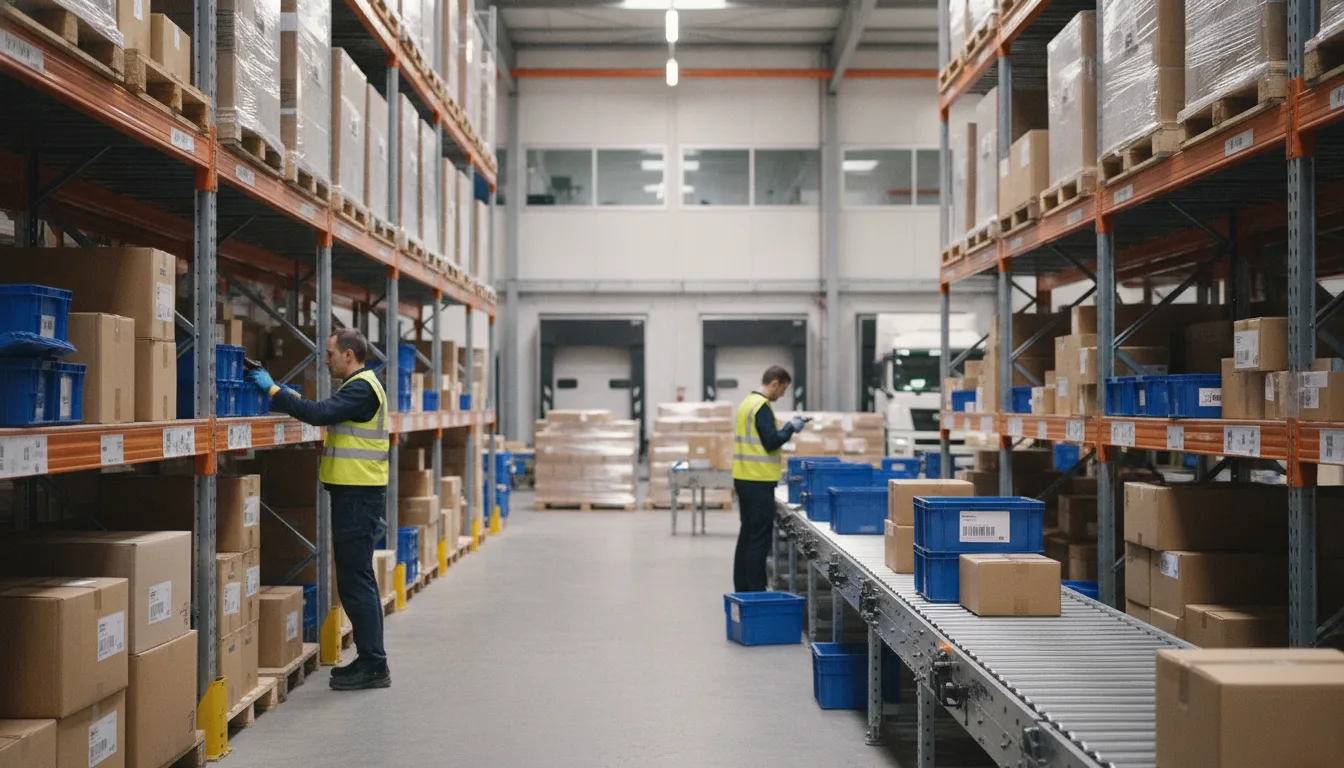
Not every warehouse picks orders the same way. The method a fulfillment center chooses depends on order volume per day, the number of SKUs, order size in units per order, and the physical layout of the facility. Here are the four methods used in practice, with the tradeoffs of each.
Discrete Picking (Single-Order Picking)
Discrete picking means one picker fulfills one order from start to finish before starting the next. The picker receives a pick list (printed or digital), walks the warehouse collecting every item on that order, and delivers the tote to the packing station.
Discrete picking is the simplest method to manage and train for. Each order is self-contained, so errors are easy to trace. The downside is travel time: a picker walking the warehouse for a 3-item order and a picker walking it for a 12-item order both cover similar distances. At lower volumes that is acceptable. At 500 or more orders per day, travel time becomes a meaningful cost driver.
Best fit: low to mid order volumes, high-value or complex orders requiring individual attention, or operations where SKU counts are small enough that the picker rarely leaves one zone.
Batch Picking (Multi-Order Picking)
In batch picking, one picker collects items for multiple orders simultaneously in a single warehouse pass. The warehouse management system (WMS) groups orders that share common SKUs into a batch, the picker pulls all units at once into separate compartments or totes, and a sorter or the picker themselves separates them by order at the packing station.
Batch picking cuts travel time significantly because the picker visits each location fewer times total. The tradeoff is a slightly more complex sort step and a higher risk of mis-sorting items between orders if the process is not well-controlled. Barcode scanning at the sort step catches most errors.
Best fit: mid-to-high order volumes, orders with one to three items each, SKU catalogs with moderate repetition across orders (common in apparel, supplements and beauty).
Zone Picking
Zone picking divides the warehouse into physical zones: for example, Zone A for small accessories, Zone B for bulky items, Zone C for refrigerated or controlled goods. Each picker is assigned to a zone and only retrieves items within it. Orders travel from zone to zone on a conveyor or via a tote-passing system, with each zone picker adding their items until the order is complete.
Zone picking reduces travel time per picker because nobody crosses the entire warehouse. It also allows the facility to place fast-moving SKUs in high-traffic zones close to packing stations, a concept called slotting. The complexity lies in coordinating order completion: if one zone is a bottleneck, all orders waiting on items from that zone are delayed. For a deeper look at how slotting interacts with pick efficiency, see our guide to warehouse slotting and why it matters for ecommerce.
Best fit: large warehouses with many SKU categories, high daily order volumes, multi-item orders, or operations that mix ambient and specialty storage conditions.
Wave Picking
Wave picking is a scheduling method layered on top of discrete, batch or zone picking. Orders are released to the floor in coordinated waves timed to match carrier pickup windows, packing capacity and shipping deadlines. For example, a warehouse might release wave 1 at 8 a.m. for all orders with a same-day cutoff, wave 2 at 11 a.m. for standard ground, and wave 3 at 2 p.m. for a later carrier pickup.
Releasing orders in waves prevents the packing stations from being overwhelmed all at once and allows the WMS to optimize pick paths across the entire wave before anyone leaves the picking floor. The practical result is steadier throughput and fewer bottlenecks. Wave picking requires a capable WMS and reliable carrier pickup schedules, so it is most common in higher-volume 3PL environments.
Best fit: operations processing hundreds to thousands of orders per day, facilities with multiple carrier pickups at different times, or businesses with strict same-day cutoff requirements.
Picking Method Comparison
| Method | How it works | Best order volume | Main advantage | Main risk |
|---|---|---|---|---|
| Discrete | One picker, one order, one pass | Low to mid | Simple, easy to audit | High travel time per order |
| Batch | One picker, multiple orders per pass | Mid to high | Fewer warehouse traversals | Sort-step mis-assignment |
| Zone | Pickers assigned to fixed areas; order travels zone to zone | High | Minimal cross-warehouse travel | Zone bottlenecks delay whole order |
| Wave | Orders released in scheduled batches aligned to carrier windows | High to very high | Smooth throughput, carrier alignment | Requires capable WMS and reliable schedules |
What Happens at the Packing Station?
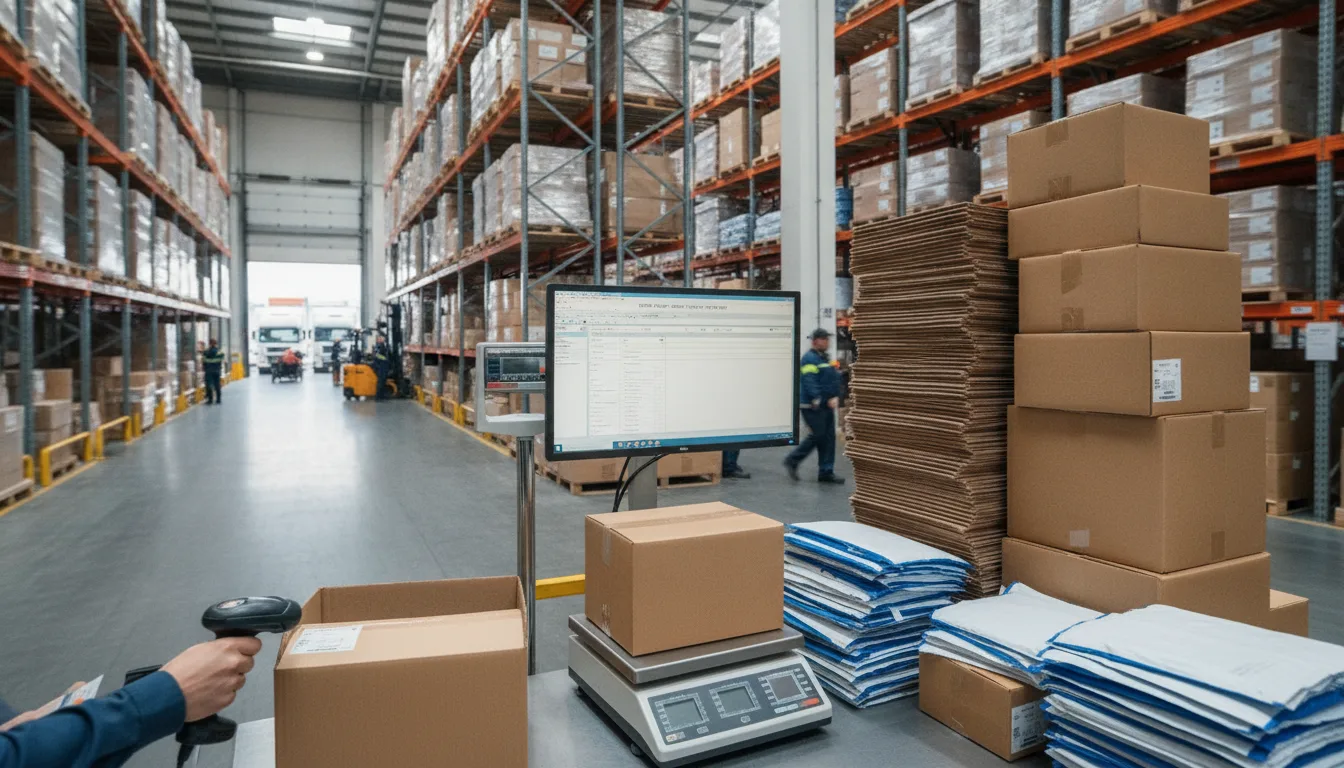
Packing is where accuracy is confirmed and the customer experience is shaped. A well-run packing station performs several checks in sequence before a parcel is sealed.
- Item scan and order verification. The packer scans each picked unit's barcode against the open order in the WMS. If the scan does not match, the system flags the exception before anything is packed. This step catches the majority of picking errors.
- Quantity confirmation. The packer confirms that the number of units scanned matches the order line. For multi-unit orders, every unit is scanned individually rather than simply counted by eye.
- Carton selection and dimensional optimization. The packer selects the smallest appropriate carton or poly mailer for the items. This matters commercially: carriers like FedEx and UPS apply dimensional weight (dim weight) pricing, calculated by dividing the package's cubic volume by a divisor (typically 139 for FedEx and UPS domestic, in cubic inches per pound). Oversized cartons inflate dim weight and therefore shipping cost. Choosing the right box size for each order is a direct cost lever.
- Protective packaging and dunnage. Items are protected with void fill (air pillows, kraft paper, foam), bubble wrap for fragile goods, or tissue paper and branded inserts per the merchant's requirements.
- Kitting and assembly (where applicable). If an order includes a pre-assembled kit or promotional bundle, the packing station is where kit components are confirmed together. YouParcel offers kitting and assembly services that can be integrated directly into the pick and pack workflow.
- Shipping label application. The WMS prints or assigns a carrier label. The packer applies it flat, unobstructed and scannable. Carrier routing (USPS, FedEx, DHL, Aramex or others) is determined by the rate-shopping rules configured for the merchant.
- Weight check. Many operations weigh the sealed parcel and compare it against an expected weight range derived from the order contents. A parcel that is too light almost certainly has a missing item; too heavy may indicate a picking error or an extra unit.
- Sort to carrier lane. The verified, labeled parcel moves to the correct carrier staging lane or onto a sortation conveyor for end-of-day manifesting and pickup.
How Pick and Pack Accuracy Is Measured
Order accuracy rate is the standard metric: the percentage of orders shipped complete, with the correct items, to the correct address, in undamaged condition. Industry benchmarks vary by operation type and volume, but most professional 3PLs target high accuracy rates. The specific rate a given operation achieves depends on the picking method, WMS quality, barcode labeling rigor and staff training.
Pick and pack services at YouParcel are supported by real-time tracking and barcode-verified packing, integrated across Shopify, Amazon and 70-plus other platforms so that order data flows from the merchant's storefront directly into warehouse operations without manual re-entry, which itself is a common source of error.
Two operational inputs matter most for accuracy:
- Slotting discipline. Items stored in the wrong bin location generate mis-picks even when the picker and the WMS are both functioning correctly. Regular slotting audits keep bin locations aligned with actual inventory. The warehouse slotting guide covers how to structure those audits.
- Barcode labeling quality. Every SKU and every storage bin should carry a scannable barcode. Faded, poorly placed or missing barcodes force manual overrides that bypass the system's error-checking logic.
How Pick and Pack Affects Your Fulfillment Cost
Pick and pack fees are typically structured as a per-order base pick fee plus a per-unit fee for each additional item in the order. The exact amounts vary by 3PL (YouParcel does not publish standard rates; for a quote, see the expert consultation link below). What drives those fees up or down is worth understanding before you sign a contract.
Order Complexity
An order for one T-shirt in one size is fast to pick and pack. An order for five items across four different SKU categories, each requiring fragile wrap and a custom insert, is significantly more labor-intensive. If your average order size is growing, check whether your 3PL pricing scales reasonably with that complexity.
SKU Count and Catalog Spread
A catalog with 5,000 active SKUs stored across a large footprint means longer average pick paths under discrete picking. A well-slotted warehouse or a zone picking configuration can mitigate this, but the underlying SKU breadth affects the floor plan and therefore the labor model.
Carton Usage and Dim Weight
As noted above, oversized cartons inflate dimensional weight and shipping cost. A 3PL that runs carton optimization logic, selecting the smallest viable box for each order, saves real money on carrier invoices at scale. The Council of Supply Chain Management Professionals (CSCMP) defines dimensional weight as a pricing technique that accounts for package density rather than actual mass alone, and all major US parcel carriers apply it to domestic and international shipments.
Returns and Re-Stocking
Pick and pack is not complete without a plan for returns. Items that come back need to be received, inspected, graded and either restocked or quarantined. This is a separate billable activity from outbound pick and pack, and it has a material effect on net inventory accuracy.
Pick and Pack vs. Pick, Pack and Ship: What Is the Difference?
Pick, pack and ship (sometimes written as pick-pack-ship) simply adds the carrier handoff step to the base pick and pack definition. In practice, most 3PL contracts bundle all three: the fulfillment center picks, packs and tenders the parcel to the carrier as a single service. The distinction matters mostly in pricing discussions, where some operators quote pick and pack separately from postage and carrier charges. When evaluating a 3PL contract, confirm which activities are included in the base pick and pack fee and which are billed as line items (carrier postage, packaging materials, inserts, weight checks, labeling).
What to Ask a 3PL About Their Pick and Pack Operation
When evaluating ecommerce fulfillment services, pick and pack capabilities are among the most important operational details to verify. Here are the specific questions worth asking.
- Which picking methods do you use, and how do you determine which applies to my account?
- What WMS do you operate, and how does it integrate with Shopify, Amazon or my current platform?
- How is barcode scanning enforced at the pick and packing stations?
- Do you perform weight checks on packed parcels before they leave the facility?
- How is a picking error identified and corrected after a parcel has shipped?
- What is your carton optimization process, and how is dim weight managed?
- Can I provide branded packaging, custom inserts or specific dunnage requirements?
- How do you handle multi-line orders that require kitting or assembly at the packing station?
- What is your reported order accuracy rate, and how is it measured?
YouParcel handles 10,000-plus orders per day across multiple marketplaces from fulfillment centers in New Jersey, California and Illinois, with leadership carrying 50-plus years of combined logistics experience. The operation supports real-time order tracking, BI and analytics reporting, and direct integrations with Shopify, Amazon, Salesforce, Tableau and 70-plus additional platforms, so your pick and pack data connects directly to the reporting tools your operations team already uses.
Frequently Asked Questions
What does pick and pack mean in a warehouse?
Pick and pack describes the two-step process of retrieving specific products from their warehouse storage locations (picking) and then verifying, protecting and packaging them into a shipment-ready parcel (packing). Most 3PL fulfillment contracts include both steps as a single bundled service, often extended to include carrier handoff as pick, pack and ship.
Which picking method is most accurate?
Discrete picking is the simplest to audit because each order is handled by one person from start to finish, making errors easy to trace. Batch and zone picking achieve comparable accuracy when barcode scanning is enforced at every hand-off point, but they require stronger WMS discipline to prevent mis-sorting between orders.
How does pick and pack affect shipping costs?
Pick and pack choices affect shipping costs primarily through carton selection. Oversized cartons increase dimensional weight, and carriers calculate freight charges based on whichever is greater: actual weight or dim weight. A 3PL that optimizes carton size per order reduces your carrier spend directly, often more than any rate negotiation would achieve on its own.
What is the difference between batch picking and wave picking?
Batch picking groups orders by shared SKUs so one picker collects multiple orders per warehouse pass. Wave picking is a scheduling layer that releases groups of orders to the floor at timed intervals aligned to carrier pickup windows. The two methods can be combined: a warehouse might run batch picking within each wave.
Can a 3PL handle custom packaging and inserts during pick and pack?
Yes. Most professional 3PLs, including YouParcel, can incorporate merchant-supplied branded boxes, custom poly mailers, tissue paper, thank-you cards and promotional inserts into the packing workflow. These requirements are configured in the WMS and applied at the packing station according to order rules you define, such as applying a specific insert only to first-time customers or orders above a certain value.
To discuss your order volume, SKU profile and pick and pack requirements with a fulfillment specialist, talk to an expert at YouParcel and get a configuration tailored to your operation.