

FBA prep for Prime Day 2026 means getting inventory into Amazon fulfillment centers before the June 23 cutoff, while keeping reserve stock at a 3PL such as YouParcel for mid-event replenishment and to service the DTC demand spike that typically follows a major Amazon sale. With Prime Day confirmed for June 23-26, brands have a narrower runway than a typical July event.
- Amazon officially announced Prime Day 2026 dates as June 23-26, earlier than the July window brands planned around in prior years.
- FBA inbound shipments must arrive and be checked in at an Amazon fulfillment center before the event; late freight almost certainly misses the sale window.
- Holding reserve stock at a 3PL warehouse lets you replenish FBA mid-event and fulfill DTC orders without competing for the same units.
- YouParcel operates fulfillment centers on the East Coast (East Hanover, NJ) and West Coast (Rialto, CA), which puts inventory close to both coasts for fast ground replenishment to Amazon nodes.
Why June Changes the Math
Amazon announced on June 2, 2026 that Prime Day 2026 would run June 23-26, shifting the event roughly three to four weeks earlier than the mid-July slot it occupied in recent years. 9to5Mac reported the confirmed dates on June 2. That shorter lead time compresses every step: supplier production, ocean or air freight, customs clearance, inbound receiving at a 3PL, and finally the Amazon FBA prep and shipment creation process itself.
Brands that planned their replenishment cycle around a July event are now working with roughly half the buffer they expected. The practical consequence is that any inventory not already in a US warehouse by approximately June 10 is at real risk of missing Amazon's receiving cutoff. Amazon has not published a formal inbound cutoff date for Prime Day 2026 as of this writing, but historical patterns suggest units need to be checked in at an FC at least seven to ten days before the event starts. Check Amazon Seller Central for any official send-in deadline specific to your storage type and fulfillment center assignment.
The Two-Track Fulfillment Model for Prime Day
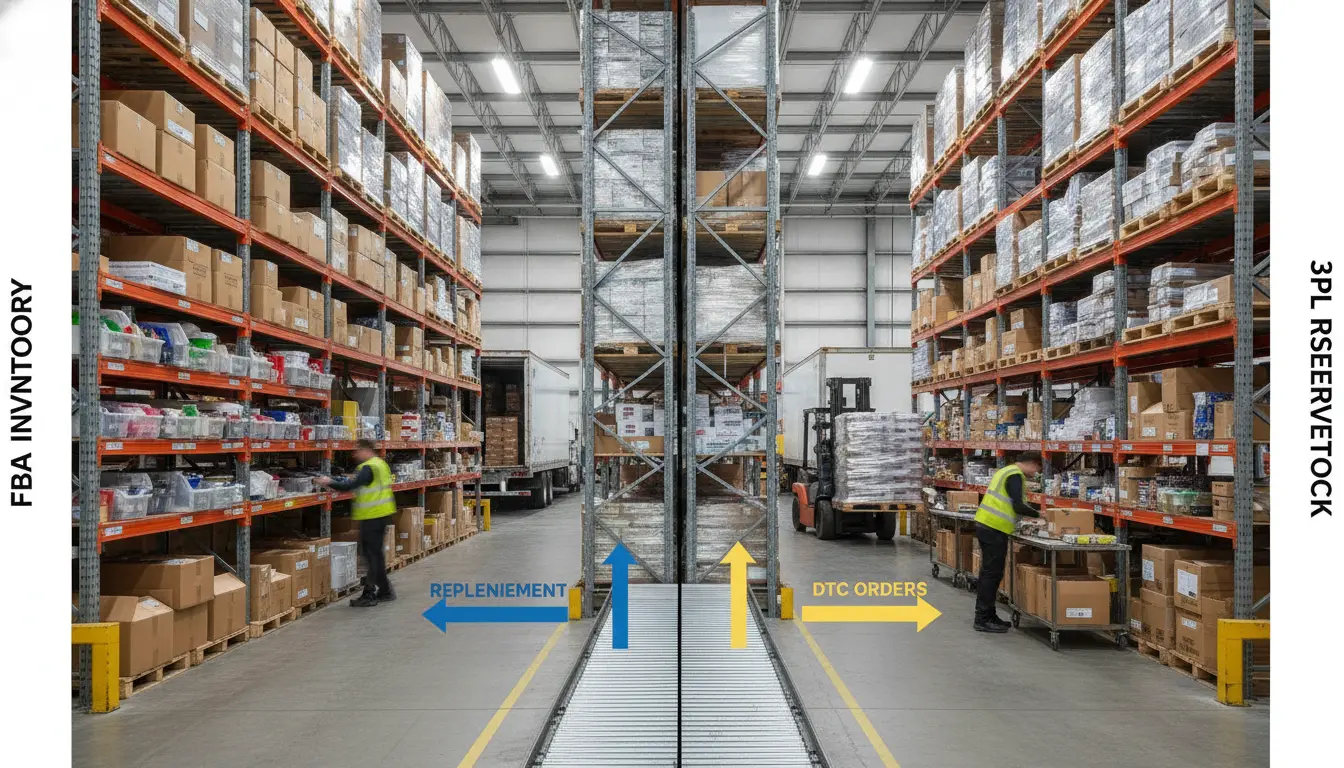
Experienced Amazon sellers use a two-track approach during peak events: one pool of inventory lives at Amazon FBA to serve Prime-eligible listings, and a second pool of reserve stock sits at a 3PL to handle mid-event FBA replenishment and direct-to-consumer orders. Running both tracks from a single 3PL partner simplifies the coordination significantly.
Track 1: FBA inventory for Prime Day listings
Units destined for FBA must be prepped to Amazon's requirements before they arrive at a fulfillment center. FBA prep (short for Fulfillment by Amazon preparation) covers the physical work Amazon requires sellers to perform before inbound shipment: labeling each unit with an FNSKU barcode, poly-bagging or bubble-wrapping fragile or loose items, bundling multi-packs, applying suffocation warning labels to poly bags over a certain opening size, and building cartons to Amazon's box-weight and dimension limits. Errors at this stage generate Amazon defect notices and can delay receiving by days or weeks.
YouParcel's ecommerce fulfillment service includes FBA prep work: FNSKU labeling, carton labeling, poly-bagging, bundling and box-content uploads. Units arrive at the YouParcel facility, the team completes prep to Amazon's current standards, and shipments go out to the Amazon fulfillment center addresses generated inside Seller Central. The detailed receiving and labeling requirements are covered in the guide to shipping to Amazon FBA.
Track 2: Reserve stock for replenishment and DTC
Even with a healthy FBA send-in, two things can drain your Prime Day position: unexpected velocity on a top seller, and the DTC surge that tends to run alongside or immediately after a major Amazon event as customers who discover your brand on Amazon search for it directly. Reserve stock held at a 3PL warehouse provides the buffer for both situations.
Mid-event FBA replenishment is possible but time-constrained. Amazon's inbound processing times do not pause for the event, and new shipments created on June 23 will not be Prime-eligible for active listings until they clear receiving, which can take several business days depending on the FC. Replenishment units sent before the event that arrive during the event window have a better chance of being available. This is why having pre-staged reserve stock at a nearby 3PL, ready to ship to Amazon the moment velocity signals appear, is worth the storage cost.
FBA Prep Checklist: Steps Before June 23
- Audit current FBA inventory levels. Pull an inventory health report from Seller Central. For each ASIN, calculate days of cover at your Prime Day projected sell rate. A conservative estimate is two to three times your normal daily velocity for the four-day event window.
- Identify the replenishment gap. Subtract current FBA units (minus any reserved or unfulfillable) from your target Prime Day quantity. The difference is what you need to send in.
- Confirm inbound shipment plan in Seller Central. Amazon's shipment creation workflow assigns fulfillment center addresses and generates the FBA box labels. Create shipments now; do not wait for inventory to arrive at your 3PL.
- Complete FBA prep at the 3PL. Brief your fulfillment partner on FNSKU assignments, poly-bag requirements, master carton configuration and any product-type-specific rules (e.g., expiration date labels for consumables, additional bubble wrap for glass). Confirm prep completion timelines against your target ship date.
- Ship to Amazon FCs. Use the carrier and service level that gives you confidence of delivery at least seven to ten days before June 23. For shipments from the East Coast, ground service to East Coast FCs is typically reliable within two to three business days. West Coast shipments to West Coast FCs follow a similar pattern. Confirm current transit-time estimates with your carrier at time of booking.
- Stage reserve stock separately. Designate a portion of your on-hand inventory as reserve, clearly separated from the FBA send-in pool. This stock remains at the 3PL and is available for DTC orders and mid-event replenishment shipments.
- Set up DTC order routing. If your Shopify or other DTC storefront is connected to your 3PL, verify that routing rules point DTC orders to the reserve pool, not to FBA inventory. YouParcel integrates with Shopify, Amazon and 70+ other platforms, so order routing between channels can be managed from a single dashboard.
- Monitor and trigger replenishment. Define a reorder point for each ASIN during the event. When FBA units on hand drop to that level, release a portion of reserve stock into a new inbound shipment. Have the shipment plan pre-built in Seller Central so you are only clicking confirm, not starting from scratch.
Amazon Multi-Channel Fulfillment as a Backup Path
Amazon Multi-Channel Fulfillment (MCF) lets sellers use their FBA inventory to fulfill orders placed on non-Amazon channels: a Shopify store, a direct website or even a wholesale order. During Prime Day, using MCF to serve DTC demand from your FBA pool competes directly with Prime-eligible stock. If a spike in DTC orders draws down FBA units, your Prime Day listing availability suffers.
The cleaner approach is to serve DTC orders from 3PL reserve stock, reserving FBA inventory for Prime-eligible sales. MCF remains useful as an overflow safety valve if 3PL stock runs out, but it should not be the primary DTC fulfillment path during a peak event. For a full analysis of when MCF makes sense versus a dedicated 3PL channel, the existing coverage of Amazon multi-channel fulfillment goes deeper on the tradeoffs.
Inbound Freight Timing: What Still Has a Chance
| Freight mode | Origin | Realistic US arrival window | Assessment for June 23 FBA cutoff |
|---|---|---|---|
| Air freight | Asia / Europe | 3-7 business days port-to-port | Possible if booked by June 10; expensive per unit |
| Ocean FCL/LCL (already at sea) | Asia | Depends on vessel position and customs clearance | Only if vessel arrives US port by approximately June 12-13 |
| Domestic truck (US warehouse to FC) | US 3PL warehouse | 1-5 business days depending on distance | Viable for inventory already in a US facility |
| Parcel carrier (small shipments) | US 3PL warehouse | 1-3 business days ground, East-to-East or West-to-West | Best option for top-ups from reserve stock |
The table above uses general industry transit-time ranges. Confirm specific timelines with your freight forwarder and carrier at time of booking. For brands whose inventory is already sitting in a US warehouse, domestic ground moves are the most reliable path to meeting the FBA receiving window.
DTC Surge: What to Expect After the Event
Prime Day creates a halo effect for brand discovery. Shoppers who buy or browse your products on Amazon during the event frequently search for the brand directly in the days that follow, driving a DTC order spike that can run three to seven days after the event closes. This is an opportunity, not a problem, as long as you have stock and fulfillment capacity to serve it.
Key preparation steps for the DTC surge include:
- Confirm your 3PL pick-and-pack capacity for the week of June 23-30. Communicate expected order volume increases to your fulfillment partner in advance.
- Pre-position packaging materials (mailers, boxes, void fill) so the facility does not run short mid-surge.
- Verify that your carrier accounts have no volume restrictions that could delay pickups during the spike.
- Check that real-time tracking and order confirmation emails are functioning on your DTC storefront. Customer service contacts spike alongside orders, and proactive tracking communication reduces inquiry volume.
Returns After Prime Day
A four-day sale window generates a returns tail. FBA returns are handled by Amazon according to its standard returns policy. Units are either returned to FBA inventory (if they pass Amazon's condition grading) or marked as unfulfillable. For DTC orders, your 3PL processes returns according to your configured return window and grading rules. Build a returns processing brief now so your fulfillment partner knows whether returned units should be restocked, refurbished or dispositioned, and at what condition thresholds.
Frequently Asked Questions
When is Prime Day 2026?
Amazon officially announced Prime Day 2026 for June 23-26, 2026. This is earlier than the July window used in recent years. The announcement was made on June 2, 2026.
What is FBA prep and do I need a 3PL to do it?
FBA prep is the physical preparation work Amazon requires before units enter its fulfillment network: FNSKU labeling, poly-bagging, bundling, carton labeling and box-content uploads. You can do it yourself, but many sellers use a 3PL such as YouParcel to handle prep at scale, especially ahead of a peak event when speed and accuracy matter most.
Can I replenish FBA inventory during Prime Day?
Yes, you can create new inbound shipments during the event, but units will not appear as Prime-eligible stock until Amazon receives and processes them, which typically takes several business days. Pre-staging reserve stock at a 3PL and triggering shipments the moment reorder points are hit gives you the best chance of mid-event replenishment landing before the event ends.
Should I use Amazon MCF to fulfill DTC orders during Prime Day?
It is technically possible, but using MCF during a peak event draws down the same FBA units that drive your Prime Day listing availability. The recommended approach is to serve DTC orders from 3PL reserve stock and keep FBA inventory dedicated to Prime-eligible sales.
How far in advance should I send inventory to Amazon FBA for Prime Day?
Based on historical patterns, units should be checked in at an Amazon fulfillment center at least seven to ten days before the event starts. For June 23, that points to a receiving target of approximately June 13-16. Confirm any official send-in deadline published by Amazon in your Seller Central account, as Amazon may issue specific guidance for the 2026 event.
If your inventory is not yet positioned for Prime Day or you need a fulfillment partner to handle FBA prep and DTC reserve stock, talk to a YouParcel fulfillment expert about what is still achievable before June 23.