


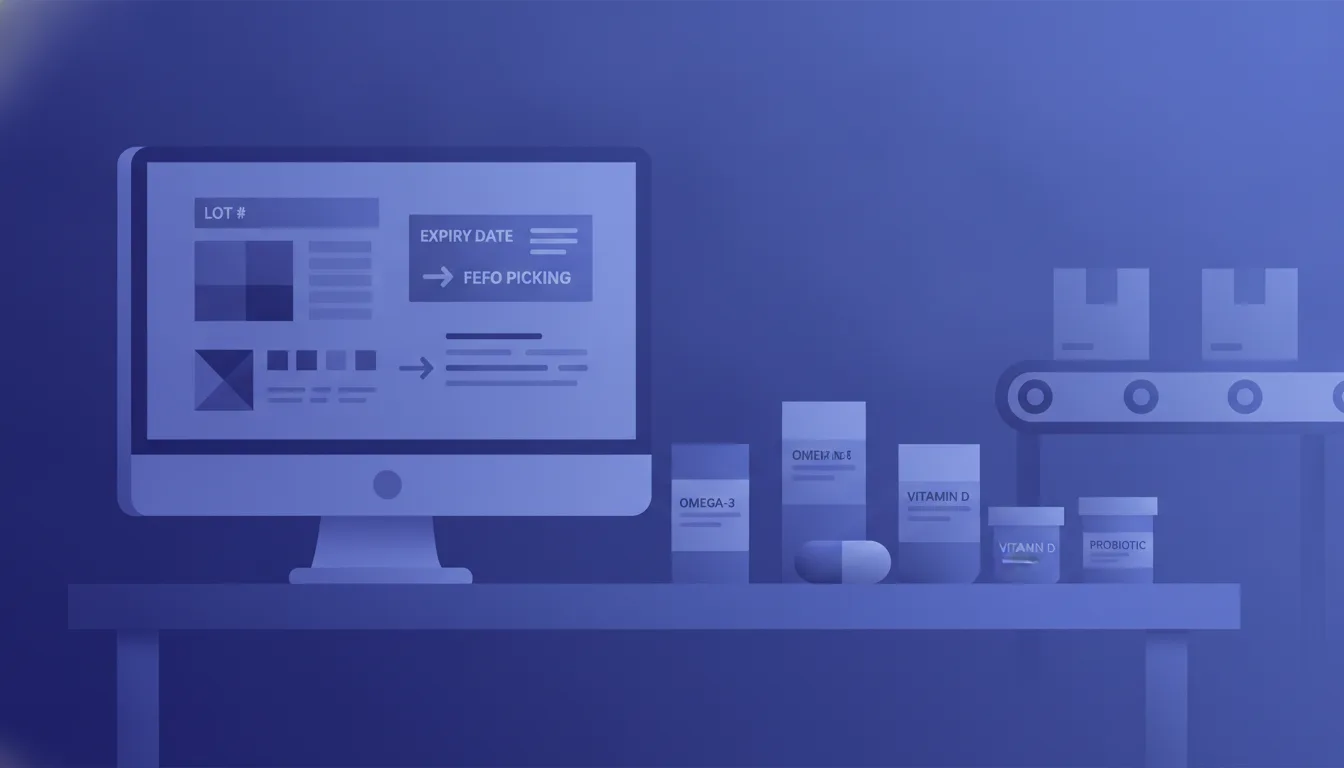
Ecommerce fulfillment services for supplement and wellness brands require more than a pick-pack-ship workflow. Because these products carry lot numbers, expiration dates and regulatory labeling obligations, YouParcel and any serious 3PL partner must operate purpose-built inventory controls, specifically lot tracking, expiry date visibility and first-expired-first-out (FEFO) picking, to keep perishable health products compliant and customers safe.
- Lot tracking links every unit shipped to the exact production batch it came from, enabling fast, targeted recalls without pulling all stock.
- Expiry date management prevents short-dated or expired product from reaching customers, protecting both brand reputation and regulatory standing.
- FEFO picking (first-expired, first-out) is the industry-standard rule that ensures the unit with the soonest expiration date ships before fresher stock, minimizing waste and liability.
- Knowing what to ask a 3PL about these controls before you sign a contract is as important as the controls themselves.
Why Supplement and Wellness Fulfillment Is Different
Dietary supplements, vitamins, protein powders, topical wellness products and related goods occupy a regulated middle ground between food and pharmaceuticals in the United States. The FDA does not approve most supplements before sale, but it does regulate manufacturing practices under 21 CFR Part 111 (Good Manufacturing Practice for Dietary Supplements). Cosmetic-adjacent wellness products, including many topical serums and skin-care supplements, now also fall under the Modernization of Cosmetics Regulation Act (MoCRA), signed into law in late 2022 and phased into effect through 2024 and 2025. MoCRA introduced mandatory facility registration, serious adverse event reporting and substantiated safety requirements for cosmetic products sold in the United States.
The FTC separately governs claims made on product labels and in advertising. Overstated health claims, misleading before-and-after comparisons or unsubstantiated efficacy language can trigger enforcement action independent of any FDA finding. Brands should work with qualified regulatory counsel to evaluate their specific label copy and advertising before launch.
None of these rules are fulfilled by a warehouse alone, but the warehouse is where compliance gaps become physical. Shipping the wrong lot, sending expired product or failing to pull a recalled batch in hours rather than days turns a regulatory issue into a consumer safety event.
What Is Lot Tracking and Why Does It Matter?
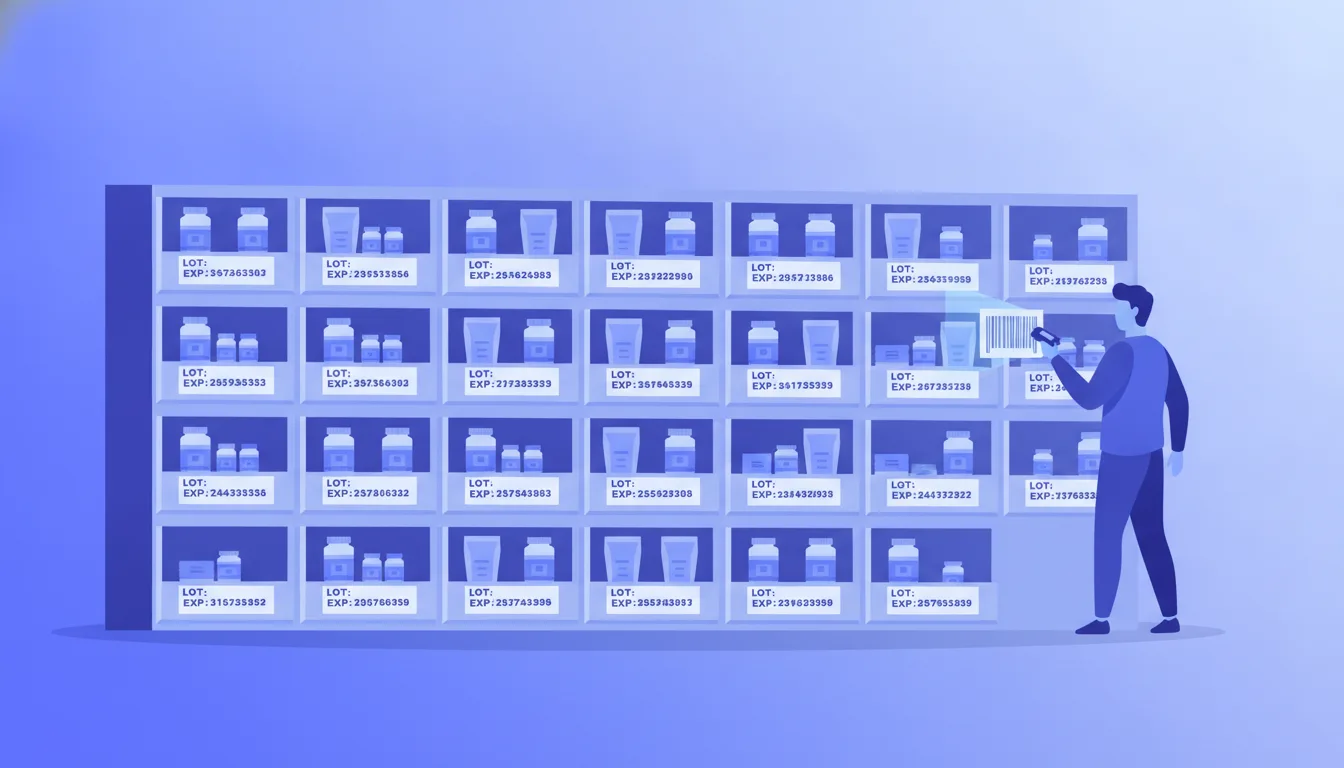
A lot number (also called a batch number or lot code) is a unique identifier assigned by the manufacturer to a specific production run. Every bottle, pouch or canister in that run shares the same lot number. When a 3PL receives a shipment of supplements, it should record the lot number at inbound alongside the expiration date and the quantity received. That data ties every unit in the warehouse to its origin.
If the brand or manufacturer issues a recall or voluntary withdrawal, the 3PL can query its warehouse management system (WMS) for every order shipped from that lot, generate a list of affected customers and halt outbound shipments of remaining units. Without lot-level traceability, a brand must either recall everything or rely on customer complaints to find affected product, both of which are far more costly.
Lot tracking at inbound: what should happen
- The inbound team scans or manually keys the lot number and expiration date from each carton or inner pack label as it is received.
- The WMS creates a lot record and assigns it to a specific bin or pallet location.
- The system flags any lot whose expiration date falls within a configurable quarantine window (for example, 90 days from today) and places those units in a hold status pending brand review.
- The brand receives an inbound receipt report showing quantities, lots and expiry dates so it can verify accuracy against the manufacturer certificate of analysis (COA).
- Any discrepancy between the COA lot data and the physical label triggers a hold and a notification to the brand before units are made available for fulfillment.
Understanding Expiration Dates in a Fulfillment Context
An expiration date (or best-by date) on a supplement tells the consumer the date through which the manufacturer guarantees potency and safety under recommended storage conditions. In a warehouse context, expiration dates drive several decisions that go beyond simply not shipping expired product.
Minimum remaining shelf life
Many carriers, marketplaces and retail buyers require a minimum remaining shelf life (MRSL) at the time of shipment. Amazon, for example, has published policies requiring that certain consumable products arrive at fulfillment centers with a minimum number of days of shelf life remaining, and the threshold varies by category. Retail buyers purchasing through purchase orders for brick-and-mortar placement often require 70 to 80 percent of total shelf life remaining at the time goods are received at their distribution center. A 3PL that does not track expiry dates at the lot level cannot enforce MRSL requirements automatically, meaning short-dated units can slip through and trigger chargebacks, returns or marketplace listing suspensions.
Quarantine thresholds and alerts
A well-configured WMS should allow the brand to set a quarantine horizon, for example, place any lot on hold when its expiration date is fewer than 60 or 90 days away. Units in quarantine status are invisible to the picking queue until a brand decision is made: destroy, liquidate or return to the brand. Automated alerts sent by email or through an integration with the brand's platform mean the team does not have to log into a portal daily to catch approaching expirations.
First-Expired, First-Out (FEFO) Picking: The Standard for Perishable Products
FEFO is an inventory picking discipline in which the unit with the earliest expiration date is always selected for shipment before units with later expiration dates, regardless of when the stock arrived in the warehouse. It is distinct from FIFO (first-in, first-out), which sequences picks by receipt date rather than expiration date. For shelf-stable goods, FIFO is usually adequate. For supplements and wellness products with meaningful shelf-life variation across production lots, FEFO is the correct method.
FEFO versus FIFO: a direct comparison
| Attribute | FIFO | FEFO |
|---|---|---|
| Pick sequence based on | Receipt date (oldest received first) | Expiration date (soonest to expire first) |
| Best for | Non-perishable or undated goods | Supplements, food, cosmetics, biologics |
| Recall containment | Partial (by receipt date range) | Full (by exact lot and expiry) |
| Reduces waste | Moderate | High (prioritizes oldest expiry, not oldest receipt) |
| WMS requirement | Receipt date tracking | Lot-level expiry date tracking |
| Marketplace compliance | Usually insufficient for consumables | Industry-standard for consumables |
In practice, a FEFO-enabled WMS directs the picker to a specific bin location tied to the lot with the earliest expiry date, not simply the nearest bin or the bin where stock was first placed. If two lots have the same expiration date, the WMS typically falls back to FIFO as a tiebreaker. The key is that the system, not the picker, makes this decision, removing human error from the equation.
Storage Conditions: Temperature, Humidity and Segregation
Lot tracking and FEFO are only meaningful if the product is stored correctly in the first place. Most dietary supplements require cool, dry storage away from direct light. The label statement "store in a cool, dry place" is not decoration; it is a manufacturer condition of the expiration date guarantee. Some products, particularly probiotics or certain liquid formulations, require refrigerated storage in the range of 35 to 46 degrees Fahrenheit (2 to 8 degrees Celsius).
Before signing with a 3PL, brands should confirm whether the facility offers climate-controlled zones, what the monitored temperature and humidity ranges are, how that data is logged and whether the logs are available to the brand. Co-mingling supplements with products that off-gas (certain industrial goods, for example) can contaminate stock even without physical contact. Ask specifically about product segregation policies.
Kitting, Bundling and Lot Integrity
Many wellness brands sell bundles: a protein powder paired with a shaker, a multivitamin stack assembled into a subscription box, or a starter kit combining three SKUs. When kitting involves lot-tracked components, the assembled kit must carry traceability for every component lot inside it, not just the outer carton. A WMS that supports component-level lot capture during kitting ensures that a recall affecting one ingredient does not require pulling all kits from inventory blindly.
Kitting and assembly services, including light manufacturing and co-packing coordination, are part of the operations that a capable 3PL can offer. For supplement brands, confirming that the 3PL's kitting workflow preserves per-component lot data is a non-negotiable requirement.
Reverse Logistics and Lot-Level Returns
Customer returns in the supplement category require a decision: can the returned unit be restocked, or must it be quarantined and destroyed? The answer depends on the unit's condition, remaining shelf life and whether the seal is intact. A 3PL with lot tracking can scan a returned unit back to its original lot record, check the expiry date and condition, and route it to the correct disposition bin automatically. Returns that cannot be verified to a lot should default to destruction or quarantine, not restock, to prevent potentially compromised product from re-entering circulation.
What to Ask a 3PL About Lot Tracking and FEFO
The following questions will reveal whether a potential 3PL has genuine capability or is simply using the right vocabulary. These are practical, operational questions, not sales-call questions.
- Does your WMS capture lot numbers and expiration dates at inbound, and are they stored at the unit level or the carton level? Unit-level or each-level tracking is necessary for direct-to-consumer shipments where single bottles are picked.
- How does FEFO picking work in your system? Does the WMS direct the picker to a specific bin, or does the picker decide? System-directed FEFO is the correct answer; picker-decided is a gap.
- Can I set a minimum remaining shelf life threshold that prevents short-dated units from being picked? This is essential for marketplace compliance.
- How quickly can you generate a lot-level recall report showing all orders shipped from a specific batch? The honest answer should be minutes for a report covering a defined date range, not days.
- Do you maintain lot-level traceability through kitting and bundling operations? If the brand sells bundles, every component must retain its lot record inside the kit.
- What is your returns workflow for lot-tracked products, and what disposition options are available? Look for: restock, quarantine, photograph-and-return-to-brand, and destruction with a certificate.
- What are your storage temperature and humidity ranges, and how are they monitored and logged? Ask for a sample temperature log.
- Can I access lot and expiry data through an API or dashboard integration with my own systems? For brands running BI and analytics tools, data portability matters.
Regulatory Labeling: A Brief Overview
This section is informational only. Supplement and wellness brands should work with qualified regulatory counsel and review applicable FDA, FTC and state-level requirements for their specific product categories before making labeling decisions.
For dietary supplements, the FDA requires a Supplement Facts panel, not a Nutrition Facts panel, under 21 CFR Part 101. The panel must list serving size, servings per container, and each dietary ingredient with quantity per serving. Structure-function claims (for example, "supports immune health") require a disclaimer and notification to the FDA within 30 days of first marketing. Health claims and nutrient content claims are separately regulated and require scientific substantiation or specific authorization.
Under MoCRA, cosmetic products including topical wellness items must list all ingredients on the label in descending order of predominance, using INCI (International Nomenclature of Cosmetic Ingredients) names. Facilities manufacturing or processing cosmetics for U.S. sale are required to register with the FDA, and product listings must be submitted. The FDA has published guidance on MoCRA registration timelines and requirements at fda.gov.
The FTC's guidance on endorsements, testimonials and health-related advertising claims is published in its Endorsement Guides. Brands using influencer marketing or before-and-after imagery should review this guidance carefully with counsel.
From a fulfillment standpoint, accurate labeling at the point of manufacture means the 3PL can scan and verify labels at inbound. Any label that does not match the expected SKU, lot or expiry format should be flagged before units enter pick-able inventory.
How YouParcel Approaches Supplement and Wellness Fulfillment
YouParcel operates fulfillment centers on both coasts: its New York and New Jersey facility is located at 20 Farinella Dr, East Hanover, NJ 07936, and its Southern California facility is at 3700 S. Riverside Ave, Rialto, CA 92324. Both locations handle ecommerce fulfillment for direct-to-consumer brands, processing more than 10,000 orders per day across multiple marketplaces. The platform integrates with Shopify, Amazon and more than 70 other platforms, enabling real-time inventory visibility and order routing.
YouParcel's operations team brings more than 50 years of combined logistics experience, and the team offers hands-on customer service rather than a generic ticket queue. For wellness brands that need specific configurations around lot tracking, expiry windows or storage conditions, those requirements are discussed with the brand during onboarding and documented in the operating procedure, not assumed.
The platform supports kitting and assembly, which is relevant for brands building subscription boxes or promotional bundles. For brands shipping internationally, YouParcel ships to more than 100 countries and works with carriers including USPS, FedEx, DHL and Aramex. Real-time tracking and alerts are available through the platform, giving operations teams visibility on every outbound shipment.
For brands evaluating fulfillment options, the YouParcel fulfillment services page outlines capabilities, and the DTC brand fulfillment page covers direct-to-consumer workflows in detail.
Frequently Asked Questions
What is FEFO picking and why do supplement brands need it?
FEFO stands for first-expired, first-out. It is a picking rule that directs warehouse staff to ship the unit with the earliest expiration date before units with later dates. Supplement brands need it because lots from the same SKU can have different expiry dates, and shipping newer stock first leaves older stock at risk of expiring unsold, which creates waste, liability and potential marketplace compliance violations.
Can a standard 3PL handle lot tracking for supplements?
Many general 3PLs track inventory at the SKU level only, which is not sufficient for supplements. Lot-level tracking requires a WMS that captures lot numbers and expiry dates at inbound, links each unit to its lot record and directs picks by FEFO logic. Before signing with any 3PL, ask specifically how lot data is captured, stored and used in the pick workflow.
What happens to my supplement inventory if a lot needs to be recalled?
With lot-level traceability, a 3PL can immediately quarantine all remaining units of the affected lot in the warehouse and generate a shipment report showing every order that included units from that lot, with customer address data. Without lot tracking, the brand must either issue a broader recall or attempt to identify affected shipments from manufacturing records alone, which is slower and less precise.
How does minimum remaining shelf life affect my Amazon listings?
Amazon has category-specific policies requiring consumable products to have a minimum number of days of shelf life remaining when received at its fulfillment centers or when listed on the marketplace. Sending short-dated inventory can result in disposal fees, stranded inventory or listing suppression. A 3PL with configurable MRSL thresholds can prevent short-dated units from being allocated to Amazon shipments automatically.
Do I need FDA registration to sell supplements through a 3PL?
This is a regulatory question that depends on your specific products and business structure, and you should consult qualified regulatory counsel for a definitive answer. Generally, dietary supplement manufacturers and certain distributors are required to register their facilities with the FDA under 21 CFR Part 1, and facilities manufacturing cosmetic products are subject to MoCRA registration requirements. A 3PL that stores and ships your finished goods is typically not the registrant for your products, but your counsel can confirm the applicable obligations for your specific situation.
Ready to discuss lot tracking, FEFO and storage requirements for your supplement or wellness brand? Talk to an Expert and get a direct conversation with YouParcel's fulfillment team.
Related reading: Apparel Fulfillment: Managing Sizes, SKUs and High Return Rates
Related reading: Beauty and Cosmetics Fulfillment: What to Ask a 3PL (Including MoCRA Basics)