


A US fulfilment centre is a third-party warehouse on American soil that receives bulk inbound freight, stores your inventory, picks and packs individual orders, and ships them to US customers through domestic carriers. For EU brands, using a US fulfilment centre like YouParcel means one formal customs entry on the inbound bulk shipment rather than a duty event on every individual parcel, which is exactly what the regulatory environment now demands.
- US de minimis duty-free treatment was suspended on 2025-08-29 for all countries under Executive Order 14324 and CBP CSMS #66065494, so every cross-border parcel into the US is now a duty event regardless of value.
- The EU-US Joint Statement of August 2025 established an approximate 15% all-in ceiling on most EU goods, replacing the volatile tariff environment of early 2025, but it did not restore duty-free entry for parcels.
- Bulk import into a US warehouse shifts when and how duty is paid: one formal entry per inbound shipment, assessed on the commercial invoice value, rather than per-parcel fees that scale with order volume.
- YouParcel operates fulfilment warehouses in New Jersey and California, handles 10,000+ orders per day, and integrates with Shopify, Amazon and 70+ other platforms, giving EU brands a direct path to US-domestic delivery speeds and unit economics.
What changed in August 2025 and why it matters for EU sellers
The end of de minimis for EU shipments
Until mid-2025, low-value parcels sent directly from the EU to US consumers could enter duty-free under the Section 321 de minimis threshold. That is no longer the case. Executive Order 14324, formalized through CBP CSMS #66065494 effective 2025-08-29, suspended duty-free de minimis treatment for all countries. Every commercial parcel now requires formal or informal customs entry and is subject to applicable duties and fees, regardless of the declared value. You can review the official CBP bulletin at CBP CSMS #66065494.
The statutory de minimis exemption is also scheduled for full repeal from 2027-07-01, meaning the structural change is permanent rather than temporary. EU brands that built their US strategy around low-value direct-to-consumer shipping need to recalculate landed cost and reconfigure their supply chain. For precise duty classification and entry requirements, work with a licensed US customs broker. The information here is provided for planning purposes only and does not constitute customs or legal advice.
The EU-US Joint Statement and the 15% ceiling
On 2025-08-21, the United States and European Union issued a Joint Statement establishing a framework that caps the combined tariff rate on most EU goods at approximately 15% all-in. This replaced the unpredictable and escalating tariff schedule that characterized much of 2025. The German Marshall Fund of the United States published a clear trade explainer on the framework: Trade Explainer: August 2025 US-EU Joint Statement on Trade.
The 15% ceiling provides cost predictability that was largely absent earlier in the year, and that predictability matters for financial planning. However, the framework does not restore parcel-level duty exemptions. Duty applies whether goods arrive as a single pallet or a single parcel. What changes with bulk import is the operational structure around that duty obligation, not the obligation itself.
How duty works when you stock inventory in the US
Bulk import versus parcel-by-parcel entry
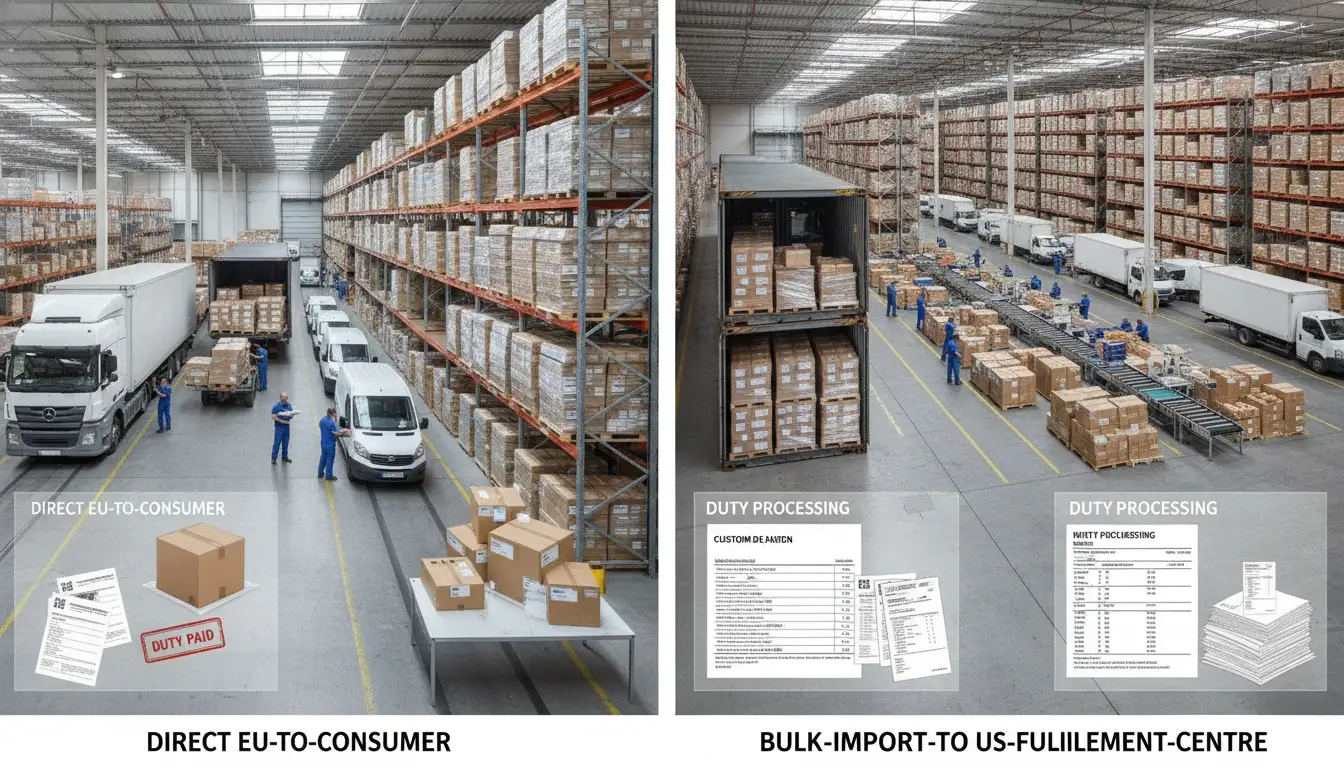
When you ship individual consumer orders directly from Germany or another EU country, each parcel is a separate customs event. Under the current rules, each one incurs duties, broker or processing fees, and potential delays at the border. Volume amplifies cost and friction.
When you ship a consolidated freight load to a US fulfilment centre, you file one formal entry covering the entire shipment. Duty is assessed on the commercial invoice value of the bulk goods at the applicable Harmonized Tariff Schedule (HTS) rate. After that single entry, all subsequent domestic deliveries move as US-origin shipments with no further customs involvement. The table below compares the two models side by side.
| Factor | Direct parcel shipping (EU to US consumer) | Bulk import to US fulfilment centre |
|---|---|---|
| Customs entry | One per parcel, at current informal entry rates | One formal entry per inbound shipment |
| Duty basis | Declared parcel value per shipment | Commercial invoice value of bulk freight |
| Last-mile carrier | International carrier (DHL, FedEx International, etc.) | US domestic carrier (USPS, FedEx, UPS) |
| Delivery speed to US customer | International transit time plus customs clearance | Domestic ground or express from nearest warehouse |
| Returns address | Back to EU or expensive US returns solution | US warehouse address, processed locally |
| Scalability | Duty cost and broker fees scale with order count | Duty cost fixed per inbound shipment volume |
What importer of record means for EU brands
To clear a bulk shipment through US customs, someone must act as the Importer of Record (IOR). The IOR is the legal entity responsible for ensuring goods comply with all US import requirements and for paying applicable duties and fees. YouParcel does not act as IOR. EU brands typically establish a US legal entity to serve as IOR, or they appoint a licensed customs broker or freight forwarder to act in that capacity. Your licensed customs broker can advise on the most appropriate structure for your business and product category. Resolving the IOR question is a foundational step before your first inbound shipment arrives at the fulfilment warehouse.
HTS classification and the 15% rate in practice
The applicable duty rate for your products depends on their Harmonized Tariff Schedule (HTS) code, not just the country of origin. The August 2025 framework places an approximate 15% all-in ceiling on most EU goods, but specific HTS codes may carry different base Most Favored Nation (MFN) rates, Section 301 additional duties, or other charges. A licensed customs broker will classify your products correctly before you ship. Misclassification creates liability for the IOR and can cause costly delays at the port of entry.
Why EU brands choose a US fulfilment centre now
Delivery speed and customer expectations
US consumers expect two-to-five day delivery for most product categories. International transit from Europe, even with expedited services, cannot reliably meet those expectations after factoring in customs clearance. When your inventory is already in a warehouse in New Jersey or California, orders ship domestically and meet the same speed standards as US-headquartered competitors. That is a meaningful commercial advantage, particularly on marketplaces like Amazon where delivery speed directly influences search ranking and Buy Box eligibility.
Landed cost becomes predictable and manageable
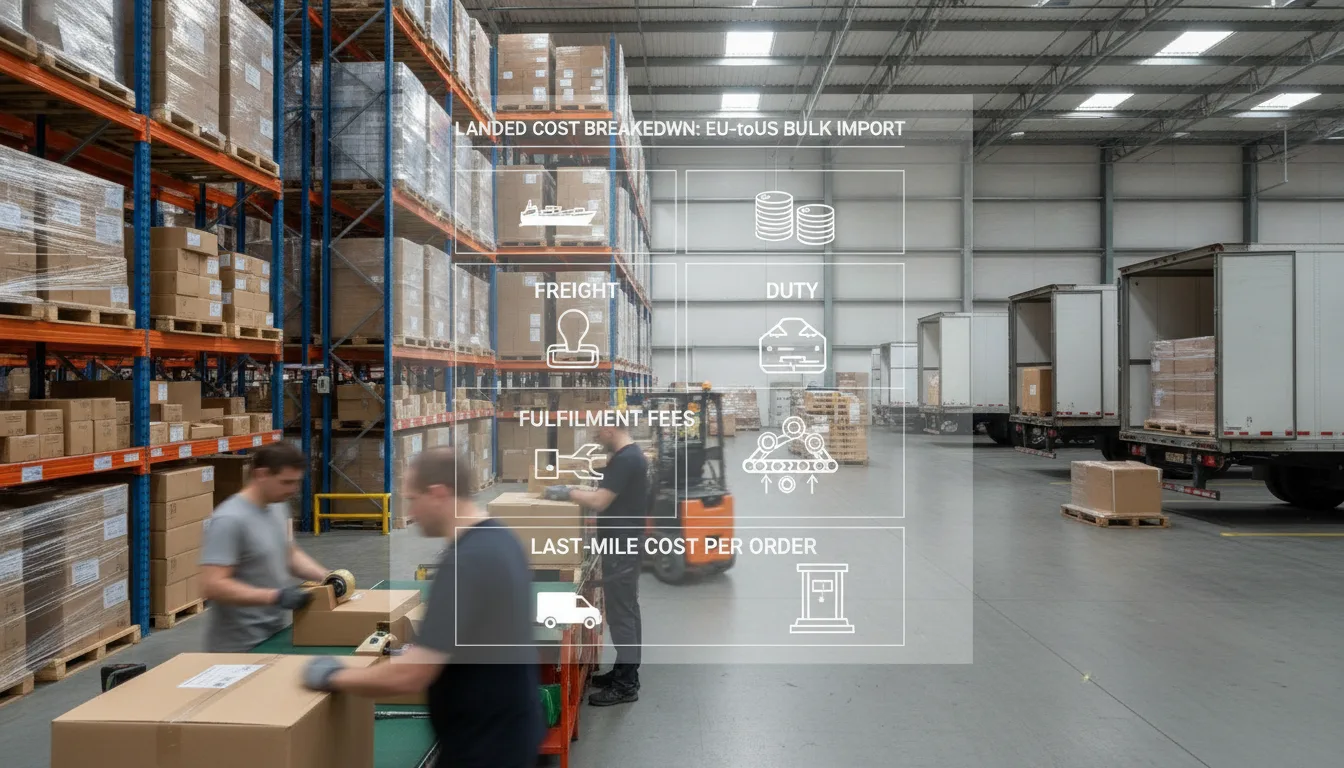
With the 15% ceiling in place for most EU goods and duty assessed once per inbound shipment, you can model your US landed cost accurately. The formula is straightforward in concept: freight cost plus duty on commercial invoice value plus fulfilment fees per order. That structure is far more controllable than per-parcel duty assessments that vary with each shipment, each declared value, and each carrier handling of informal entry requirements.
Returns and reverse logistics in the US
One underappreciated cost of direct cross-border shipping is the returns problem. When a US customer wants to return a product and the only return address is in Germany, the friction is enormous and the shipping cost often exceeds the product value. A US fulfilment centre gives you a US return address. YouParcel processes returns at its warehouse locations, grades returned items, and either restocks sellable units or follows your disposition rules for damaged goods. That loop closes domestically, at domestic carrier rates.
Marketplace and platform compliance
Amazon requires fulfilment from US addresses for Prime eligibility and Multi-Channel Fulfilment. Shopify merchants offering domestic US shipping promises need a US inventory location. YouParcel integrates with Shopify, Amazon and 70+ additional platforms including Salesforce and Tableau, so your existing tech stack connects directly to the warehouse management system. Orders flow in, tracking flows back, and your customers see a US-native experience from purchase to delivery.
How to move EU inventory into a US fulfilment centre
- Classify your products. Obtain the correct 10-digit HTS codes for every SKU before you ship. Your customs broker uses these to calculate applicable duties and verify that no import restrictions or licensing requirements apply to your product category.
- Determine your IOR structure. Decide whether you will establish a US legal entity as IOR or appoint a licensed broker or freight forwarder to act in that role. This must be resolved before the shipment reaches US shores.
- Book freight forwarding. Arrange ocean freight (Full Container Load or Less than Container Load) or air freight from your EU origin to the US port closest to your target warehouse. YouParcel offers freight forwarding services that can coordinate the inbound move from Europe to the US fulfilment centre, including customs clearance coordination.
- File the Importer Security Filing (ISF). For ocean shipments, the ISF (also called 10+2) must be filed with CBP no later than 24 hours before the vessel departs the foreign port. Your freight forwarder or customs broker handles this, but the EU brand or its IOR is responsible for providing accurate data.
- Receive at the US warehouse. YouParcel receives your inbound freight at its New Jersey or California facility, checks unit counts against your advance ship notice, labels or barcodes inventory to your SKU structure, and slots it into the warehouse management system. From that point, inventory is live and available to fulfill orders.
- Integrate your sales channels. Connect your Shopify store, Amazon Seller Central, or other platforms to YouParcel. Orders route automatically to the nearest fulfilment location.
- Monitor with BI and real-time tracking. YouParcel provides real-time inventory visibility, order tracking and analytics so you can manage reorder points from Europe without operational blind spots.
Choosing between New Jersey and California
YouParcel operates fulfilment centres in East Hanover, NJ (20 Farinella Dr, East Hanover, NJ 07936) and Rialto, CA (3700 S. Riverside Ave, Rialto, CA 92324). The right starting point depends on where your US customers are concentrated.
| Factor | New Jersey (East Hanover) | California (Rialto) |
|---|---|---|
| Primary market reach | Northeast US, Mid-Atlantic, major East Coast metros | West Coast, Southwest, Pacific markets |
| Port proximity | Port of New York and New Jersey | Ports of Los Angeles and Long Beach |
| Best for EU brands | Brands shipping from the EU via East Coast ports or with a heavier East Coast customer base | Brands with a West Coast focus or Amazon FBA Western node strategy |
Many EU brands with established US volumes split inventory across both locations to reduce ground transit time nationally. YouParcel's multi-warehouse capability and analytics tools help determine the optimal inventory split based on actual order geography.
Freight forwarding from the EU: practical considerations
Inbound freight from Germany or other EU countries typically moves by ocean (20-foot or 40-foot container for FCL, or consolidated LCL for smaller volumes) or by air for high-value or time-sensitive goods. Ocean freight from Northern Europe to the US East Coast generally runs three to four weeks in transit under normal sailing schedules; the actual timeline depends on the carrier, routing and port congestion at the time of booking. Air freight is faster but carries a significantly higher cost per kilogram, so it is generally reserved for new product launches, urgent restocks, or high-margin SKUs.
For EU brands, the Incoterm on the supplier or internal transfer invoice affects who bears risk and cost at each leg. ICC Incoterms rules define the point at which responsibility transfers between parties. Most EU brands shipping their own inventory to a US warehouse use DAP (Delivered at Place) or DDP (Delivered Duty Paid) internally, but the IOR implications of DDP must be confirmed with your customs broker before applying that term to a US import. YouParcel's US fulfilment service can work alongside your customs broker and freight forwarder to coordinate receiving once the shipment clears US customs.
What EU brands should budget for the US market
Specific pricing varies by product category, volume, packaging, and carrier selection. YouParcel does not publish standard rates here; the right starting point is a conversation with a fulfilment expert who can model your specific SKU mix and order profile. At a category level, plan to budget for the following cost components:
- Import duty: Based on HTS classification and the applicable rate (approximately 15% all-in for most EU goods under the August 2025 framework, though your specific code may vary).
- Freight: Ocean or air freight from EU origin to US port, plus drayage from port to warehouse.
- Customs brokerage and ISF filing fees: Charged per formal entry and per ISF filing by your licensed broker.
- Fulfilment fees: Receiving, storage (typically charged per pallet or cubic foot per month), pick-and-pack per order, and outbound shipping cost to the consumer.
- Returns processing: Per-unit or per-return fees for receiving, grading and restocking or disposing of returned goods.
The comparison that matters is not fulfilment cost in isolation, but total landed cost per order delivered to a US customer, compared against your current direct cross-border model under the new duty regime. For most EU brands shipping more than a few hundred units per month to US customers, the bulk-import model improves both per-unit economics and the customer experience simultaneously.
Frequently asked questions
Can I still ship individual parcels directly from the EU to US customers?
Yes, but every parcel is now a duty event. The US de minimis exemption was suspended on 2025-08-29 and there is no longer a value threshold below which parcels enter duty-free. Direct cross-border parcel shipping remains physically possible, but the cost and complexity at the parcel level has increased significantly compared to the pre-August 2025 environment.
How does the August 2025 EU-US framework affect the duty rate on my products?
The Joint Statement establishes an approximate 15% all-in ceiling on most EU goods, providing more predictability than the tariff rates of early 2025. However, the exact rate for your products depends on their HTS code. A licensed US customs broker can determine the applicable rate for your specific SKUs and advise on any product-level exceptions or additional duties that may apply.
Who acts as importer of record when I ship to a US fulfilment centre?
YouParcel does not act as importer of record. As the EU brand, you will need to establish a US legal entity as IOR or appoint a licensed customs broker or freight forwarder to act in that capacity. The IOR is legally responsible for duty payment and customs compliance, so this is a step to resolve before booking your first inbound shipment.
How long does it take to get set up with a US fulfilment centre?
Onboarding timelines depend on your product complexity, integration requirements, and how quickly your IOR structure is confirmed. The warehousing and platform integration setup can move quickly once your inbound freight is booked and your sales channels are connected. The customs and legal groundwork typically takes longer than the logistics setup, so starting that process first is the practical approach.
Does stocking inventory in the US remove the need to pay duty?
No. Bulk import into a US fulfilment centre consolidates the duty event into one formal customs entry per inbound shipment rather than per parcel, but duty is still assessed on the commercial invoice value of the imported goods. The advantage is operational efficiency and cost predictability, not duty elimination. Always work with a licensed customs broker to ensure correct classification and compliance.
Ready to move your EU inventory into the US market under the new trade framework? Talk to an Expert at YouParcel to get a fulfilment and freight plan built around your product mix, order volumes and US customer base.