

A US fulfillment center is now the most practical route forward for UK brands selling to American shoppers. On 29 August 2025, US Customs and Border Protection suspended duty-free de minimis treatment for low-value parcels under Executive Order 14324 and CBP CSMS #66065494, eliminating the threshold that once let parcels valued under $800 enter the United States without formal customs entry. YouParcel operates warehouses in New Jersey and California that let UK brands import inventory in bulk, pay duty once at the shipment level, and then ship domestically to US customers using US carriers.
- US de minimis duty-free entry is suspended for all countries, including the UK, effective 29 August 2025, meaning every parcel dispatched directly from a UK address to a US consumer now triggers a customs duty event.
- Storing inventory inside the United States before the sale converts your international freight into a domestic last-mile shipment, consolidating duty exposure into a single formal customs entry per inbound bulk shipment rather than thousands of individual parcel entries.
- Royal Mail paused US-bound untracked parcels on 26 August 2025 and launched a Postal DDP (PDDP) service as an interim option, but that service still charges duty on every parcel at the point of export or import, not in bulk.
- YouParcel handles 10,000-plus orders a day across multiple marketplaces and can receive your bulk freight at its New Jersey or California fulfillment centers, pick and pack individual orders, and ship them domestically through USPS, FedEx, DHL and other carriers.
What Changed on 29 August 2025
Section 321 of the Tariff Act of 1930 historically allowed goods valued at $800 or less to enter the US duty-free and without a formal entry filing. Executive Order 14324, implemented by CBP through CSMS message #66065494, suspended that treatment for all countries effective 29 August 2025. The official CBP notice is available at the CBP GovDelivery bulletin dated 29 August 2025.
The practical result: a UK brand shipping 500 orders a week directly from its UK warehouse to US consumers now generates 500 separate customs duty events every week. Each parcel requires duties and fees to be collected, either from the recipient (DDU/DAP terms) or pre-paid by the shipper (DDP terms). Neither approach is free; both add cost and processing friction.
What Royal Mail Did in Response
Royal Mail paused acceptance of US-bound untracked parcels on 26 August 2025, three days before the suspension took effect. It subsequently launched a Postal Delivered Duty Paid (PDDP) service to allow tracked, prepaid-duty shipments to continue flowing to US addresses. Details of that service are documented in the trade press, including Value Added Resource coverage dated 26 August 2025.
PDDP is a viable short-term fix for brands that want to keep shipping parcels from the UK. It is not a duty elimination strategy. The duty is still paid on every individual parcel, calculated on the declared value and the applicable HTS (Harmonized Tariff Schedule) rate. For brands shipping at volume, the cost per parcel adds up quickly, and the operational overhead of classifying goods at the parcel level is significant.
How a US Fulfillment Center Changes the Duty Structure
Moving inventory into a US warehouse before the sale shifts the customs event upstream. Instead of paying duty on each individual parcel, you pay duty once on the bulk inbound shipment. Here is how that works in practice.
The parcel-by-parcel model
Under the old Section 321 model, each $200 order crossed the US border as an individual duty-free parcel. With de minimis suspended, that same order now requires a customs entry. At scale, that means your carrier or postal operator must file, classify and collect on every single shipment. Processing costs, brokerage fees and the risk of recipient refusal all multiply.
The bulk import model
When you ship a pallet or container of inventory to a YouParcel fulfillment center, that inbound shipment clears US customs as a single formal entry. Your licensed customs broker classifies the goods under the correct HTS code, calculates duties owed and files the entry. After that entry is paid and the goods are released, every subsequent sale to a US consumer is a domestic transaction. No further customs events occur at the parcel level.
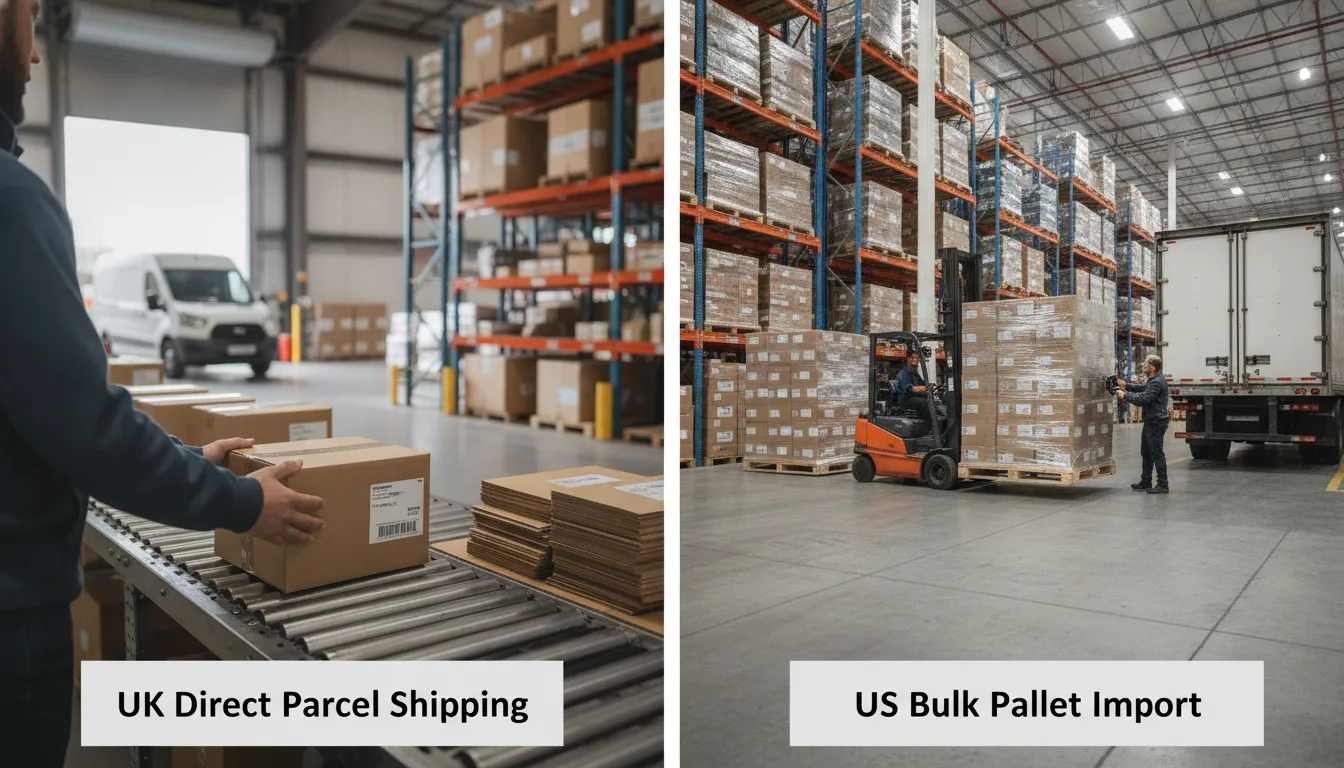
The table below contrasts the two models across the dimensions that matter most to a UK brand at this moment.
| Dimension | Direct parcel shipping from UK (PDDP or DDU) | Bulk import into US fulfillment center |
|---|---|---|
| Customs duty trigger | Every individual parcel, on every sale | Once per inbound shipment (formal entry) |
| HTS classification burden | Per parcel, often automated but error-prone at volume | Per SKU at inbound, reviewed by a licensed broker |
| Duty payment responsibility | Shipper (DDP/PDDP) or recipient (DDU); recipient refusal risk exists under DDU | Importer of record at time of bulk entry (see IOR note below) |
| Last-mile carrier options | International postal networks and express couriers | USPS, FedEx, DHL, Aramex, EasyPost (domestic rates) |
| Customer experience | International tracking; potential customs delays | Domestic tracking and delivery speeds from US stock |
| Returns address | UK address (costly for US customers to return to) | US address (domestic return; YouParcel handles reverse logistics) |
| Inventory visibility | Units en route; no US buffer stock | US stock on hand; real-time inventory tracking through YouParcel integrations |
A Note on Importer of Record
To import goods into the United States, someone must act as the importer of record (IOR): the legal entity responsible for ensuring the goods comply with US import regulations and for paying duties and taxes. YouParcel does not act as importer of record. UK brands entering the US market typically have three options: establish a US legal entity that acts as IOR, work with a third-party IOR service provider, or structure the shipment so that the goods are sold to a US buyer before importation and that buyer acts as IOR. Each approach has different legal and commercial implications. We recommend consulting a licensed customs broker or trade attorney to determine the right structure for your business before shipping your first inbound pallet.
What the Inbound Process Looks Like with YouParcel
Once your IOR arrangement is in place, the inbound flow to a YouParcel fulfillment center is straightforward. Here are the key steps.
- SKU setup and integration. Connect your Shopify store, Amazon seller account or other sales channel to YouParcel. YouParcel integrates with Shopify, Amazon, Salesforce, Tableau and 70-plus other platforms, so inventory and order data sync automatically.
- Freight booking. Arrange ocean or air freight from your UK supplier or warehouse to either the YouParcel fulfillment center in East Hanover, NJ (20 Farinella Dr, East Hanover, NJ 07936) or Rialto, CA (3700 S. Riverside Ave, Rialto, CA 92324). Your freight forwarder handles the ISF (Importer Security Filing, also called the 10+2 filing) and coordinates with your customs broker on the formal entry.
- Customs clearance. Your licensed customs broker files the entry, declares the correct HTS codes and pays duties on the inbound shipment. The goods are released by CBP and delivered to the YouParcel facility.
- Receiving and putaway. YouParcel receives the inbound freight, checks quantities against your advance ship notice (ASN), and puts inventory into storage locations. Any discrepancies are flagged immediately.
- Pick, pack and ship. When a US customer places an order, YouParcel picks the item, packs it in appropriate packaging (including any branded or custom packaging you specify), applies a shipping label and hands it to the domestic carrier. No further customs event occurs.
- Tracking and reporting. Real-time tracking updates go to you and your customer. YouParcel's BI and analytics tools give you visibility into inventory levels, order velocity and fulfillment costs across all channels.
- Returns processing. US customers return to a US address. YouParcel grades, restocks or disposes of returned units according to your instructions.
Which US Fulfillment Location Makes Sense for UK Brands?
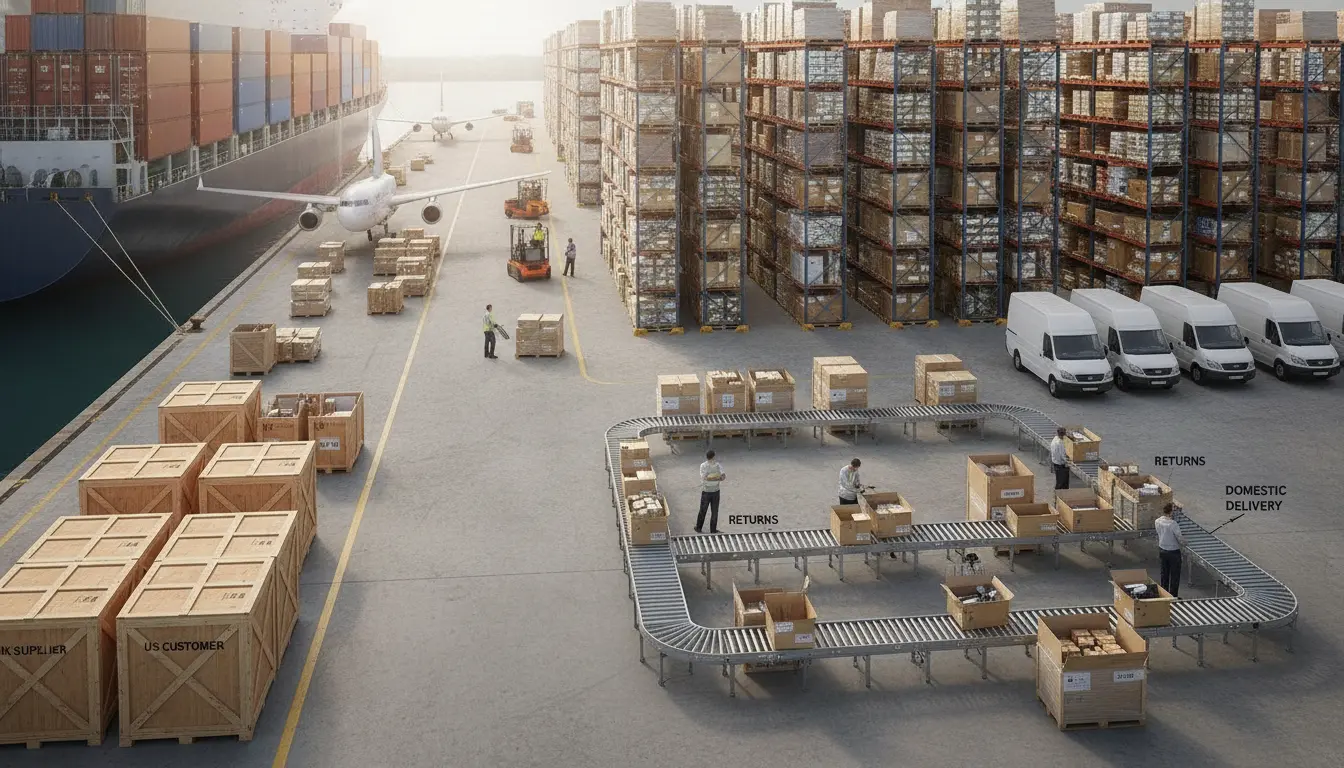
YouParcel operates fulfillment centers in New Jersey and California. For UK brands, the choice of inbound port and warehouse location depends on your customer geography and your freight routing.
New Jersey (East Hanover, NJ)
The East Hanover, NJ facility serves the Northeast and Mid-Atlantic, the most densely populated US consumer markets. Brands whose US customer base skews toward New York, New England or the Eastern Seaboard will typically benefit from NJ-first placement. Ocean freight from the UK arrives most efficiently via the Port of New York and New Jersey, one of the busiest container ports on the East Coast.
Southern California (Rialto, CA)
The Rialto, CA facility in the Inland Empire serves the Western US and is well-positioned for air freight arriving at LAX or ocean freight through the Ports of Los Angeles and Long Beach. If your UK brand ships air freight at speed, LA is often the faster option for West Coast stock.
Split inventory
Brands with US order volumes across both coasts can split inventory between NJ and CA to reduce average domestic shipping zones and therefore per-parcel carrier costs. YouParcel's analytics tools help you model the right split based on actual order geography.
Duty Is Not Eliminated, It Is Restructured
It is worth being direct about this, because some advice circulating in the UK ecommerce community implies that a US warehouse removes the duty burden. It does not. Duty is paid when goods enter the United States. Moving to a warehouse model moves that payment upstream, to your bulk inbound shipment, rather than spreading it across thousands of individual parcels. The total duty paid over a year is roughly the same either way, barring classification differences. The advantages of the warehouse model are operational: fewer customs events, lower per-unit processing costs, domestic shipping speeds, a US returns address and better customer experience.
To understand the full context of the de minimis suspension and what it means for ecommerce brands, see our detailed explainer on the end of the de minimis threshold.
Who Is This Model Right For?
Not every UK brand is ready for a US warehouse. The economics work best when certain conditions are in place.
| Signal | Suggests warehouse model is worth evaluating |
|---|---|
| US order volume | Consistent US orders, enough to justify a minimum inbound shipment (a pallet or more) every few weeks |
| Product margins | Margins that can absorb warehousing and fulfillment fees while remaining competitive on price |
| Customer experience goals | US domestic shipping speeds and a US returns address matter to your target buyer |
| Carrier disruption impact | Royal Mail parcel pauses or PDDP cost increases are creating friction or customer complaints |
| Multichannel ambitions | Plans to sell on Amazon US, Shopify, or wholesale into US retail, all of which benefit from US-held stock |
Smaller UK brands that are still testing the US market with a handful of orders per week may find that PDDP or a DDP express courier service is the right bridge while they validate demand. YouParcel also works with small businesses at earlier stages of their US expansion, so the conversation about the right model is worth having regardless of where you are in the journey.
Integrations That Matter for UK Brands
UK brands typically sell through Shopify or Amazon, and YouParcel integrates natively with both. Orders flow in automatically, inventory levels update in real time, and tracking information is pushed back to the sales channel without manual intervention. For brands also selling wholesale into US retail, YouParcel supports EDI (Electronic Data Interchange) and retailer compliance requirements including routing guides and labeling standards, which are non-negotiable for getting onto the shelves of major US retailers.
Frequently Asked Questions
Does using a US fulfillment center mean I no longer pay customs duty on goods going to US customers?
No. Duty is paid when your bulk inventory enters the United States, at the formal entry stage. After that, individual orders to US customers ship domestically and no further customs duty applies. The total duty obligation does not disappear; it is concentrated into a single inbound event rather than spread across every parcel.
Who acts as importer of record if I store inventory in a YouParcel warehouse?
YouParcel does not act as importer of record. You will need a US legal entity, a third-party IOR service or a qualifying sale-to-US-buyer arrangement. A licensed customs broker can advise on the right structure for your business before you book your first inbound shipment.
Can I still use Royal Mail PDDP while I set up a US warehouse?
Yes. PDDP and a US warehouse are not mutually exclusive. Many brands use a postal DDP service to maintain US order flow while they build inventory levels and onboard a US 3PL. The transition can happen in stages.
How do returns work if my customers are in the US but I am based in the UK?
When your inventory is held in a YouParcel US fulfillment center, returns go to that US address. YouParcel processes inbound returns, grades condition, and either restocks or disposes of units according to your instructions. This eliminates the cost and friction of US customers shipping returns back to the UK.
What is the minimum volume needed to make a US fulfillment center worthwhile?
There is no universal threshold because it depends on your product margins, average order value and fulfillment cost structure. The practical starting point is enough US orders to justify a regular inbound shipment, typically at least a pallet at a time, on a predictable cadence. Talk to a YouParcel expert to model the numbers for your specific situation.
If your UK brand is ready to move from parcels to pallets and establish a proper US fulfillment operation, the first step is a conversation about volumes, SKUs and timelines. Talk to an expert at YouParcel to get a fulfillment assessment built around your US growth plans.