


Walmart Fulfillment Services (WFS) is Walmart's own fulfillment program for Walmart Marketplace sellers: you send inventory to Walmart's ecommerce fulfillment centers, and Walmart picks, packs and ships orders to US customers. YouParcel, a multichannel 3PL, offers an alternative where a single partner handles fulfillment across Walmart, Shopify, Amazon and other channels from warehouses in New Jersey, California and Illinois.
- WFS is purpose-built for Walmart Marketplace and can boost your product's search ranking on Walmart.com, but it locks inventory into Walmart's network.
- A 3PL lets you fulfill Walmart orders alongside Shopify, Amazon and wholesale channels from one inventory pool, reducing split-stock inefficiency.
- The right choice depends on your channel mix, SKU count, inventory volume and how much control you need over packaging and returns.
- YouParcel integrates with 70+ platforms, including Shopify and Amazon, and processes 10,000+ orders per day across multiple marketplaces.
What Is Walmart Fulfillment Services (WFS)?
WFS is Walmart's first-party fulfillment program, launched in 2020 and expanded significantly since. It works similarly to Amazon FBA: sellers ship inventory in bulk to Walmart's ecommerce fulfillment centers, and Walmart handles the customer-facing logistics. Products fulfilled through WFS display a "Fulfilled by Walmart" tag on the listing and are eligible for Walmart's two-day shipping promise to US customers.
WFS is available only to approved Walmart Marketplace sellers operating in the United States. Sellers pay storage fees and fulfillment fees based on item weight and dimensions. For current, authoritative fee schedules, consult the official WFS seller resource page on Walmart's Seller Center.
How WFS Works in Practice
- Enroll: Apply for WFS through your Walmart Seller Center account. Walmart reviews your catalog and account health before approving access.
- Prep and ship inbound inventory: Follow Walmart's inbound shipping requirements, including carton labeling, packing standards and routing to designated fulfillment centers. Non-compliance can result in receiving delays or chargebacks.
- Walmart receives and stores inventory: Items are checked in at a Walmart ecommerce fulfillment center and made available for purchase on Walmart.com.
- Customer places an order: Walmart picks, packs and ships the order using its carrier network, aiming for two-day delivery to most US addresses.
- Returns: Customer returns flow back through Walmart's standard return process, which may include returns to Walmart store locations or direct mail-back.
What Does a 3PL Offer for Walmart Marketplace Orders?
A third-party logistics provider (3PL) is a company that stores your inventory in its own warehouses and fulfills orders on your behalf across any sales channel you designate. When a Walmart Marketplace order comes in, the 3PL picks, packs and ships it using the carrier and packaging you specify. The same inventory pool can simultaneously serve Shopify, Amazon, wholesale buyers and any other channel.
YouParcel's fulfillment service, for example, integrates with Shopify, Amazon, Salesforce and 70+ other platforms so a single SKU update or stock replenishment applies across all your active channels in real time. Orders land in one dashboard, and the fulfillment logic routes each one to the nearest warehouse based on your configuration.
How 3PL Fulfillment for Walmart Works in Practice
- Connect your Walmart Marketplace account: Your 3PL integration pulls orders directly from Walmart's API, usually within minutes of the order being placed.
- Inventory is stored at the 3PL warehouse: The same units serve every connected channel. No separate inbound shipment to Walmart's network is required.
- The 3PL picks, packs and ships: The 3PL uses carriers such as USPS, FedEx or DHL to meet Walmart's seller-fulfilled delivery requirements. Meeting Walmart's on-time delivery rate threshold is critical to maintaining good seller health.
- Tracking is pushed back to Walmart: The integration updates the order with a tracking number, keeping Walmart's system in sync and protecting your seller metrics.
- Returns come back to the 3PL: You control the returns policy, grading criteria and restocking or disposal decisions.
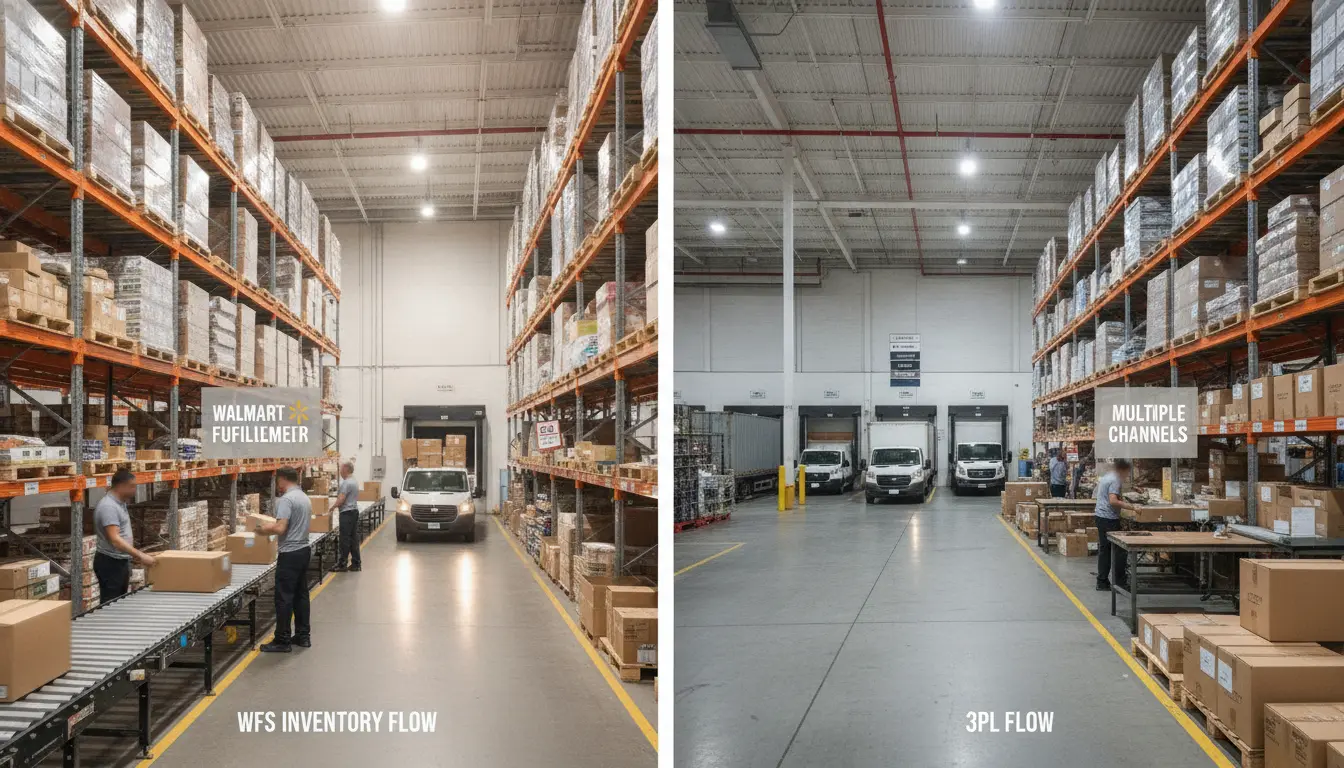
WFS vs 3PL: A Direct Comparison
| Factor | Walmart Fulfillment Services (WFS) | 3PL (e.g., YouParcel) |
|---|---|---|
| Channels supported | Walmart Marketplace only | Walmart, Shopify, Amazon, wholesale, B2B and more from one inventory pool |
| Inventory location | Walmart's ecommerce fulfillment centers | Your 3PL's warehouses (YouParcel: NJ, CA, IL) |
| Listing badge / ranking boost | "Fulfilled by Walmart" tag, two-day badge, potential ranking lift on Walmart.com | No automatic badge; seller-fulfilled listings; ranking depends on your on-time delivery rate |
| Packaging and branding | Walmart-branded or plain poly mailers; no custom packaging | Custom boxes, inserts and branded tape (depending on 3PL); your brand on the parcel |
| Inbound requirements | Must comply with Walmart's specific labeling, carton and routing rules | Must comply with 3PL's receiving checklist; simpler if you already use the 3PL for other channels |
| Returns control | Walmart manages the return experience; items may be returned to Walmart stores | Full control: you set the return window, grading criteria and restocking or disposal rules |
| Inventory visibility | Through Walmart Seller Center | Real-time dashboards across all channels; YouParcel provides BI and analytics |
| Kitting and assembly | Not available | Available (bundles, subscription boxes, promotional sets) |
| B2B / wholesale | Not supported through WFS | Supported, including EDI and retailer compliance (routing guides, labeling) |
| International shipping | US domestic orders only | Ships to 100+ countries from US warehouses |
| Minimum volume | No published minimum, but Walmart requires account health benchmarks | Varies by 3PL; YouParcel works with brands from startup scale to 1,000+ orders per day |
When WFS Makes More Sense
WFS is a strong choice when Walmart Marketplace is your primary or only US sales channel and your goal is to maximize visibility and conversion rate on Walmart.com. The "Fulfilled by Walmart" badge is a meaningful trust signal for shoppers, and Walmart's algorithm tends to favor WFS listings in search results, as noted in Walmart's seller documentation.
WFS also makes sense if your products are straightforward to prep (no kitting, no fragile assembly), your SKUs are relatively stable and you have the inbound logistics bandwidth to send inventory directly to Walmart's network on a regular cadence. If you are already familiar with FBA inbound prep, the operational model will feel familiar.
When a 3PL Makes More Sense
A 3PL becomes the more practical option the moment you sell on more than one channel. Splitting inventory between WFS and a separate fulfillment operation for Shopify or Amazon creates double the inbound work, double the safety stock requirements and two sets of fees and contracts to manage. With a 3PL, one inbound shipment serves all your channels.
A 3PL also gives you significantly more control over the customer experience. Custom packaging, branded inserts and your own returns policy are all within reach. For brands where the unboxing moment matters, or where return fraud checks and grading logic are important, that control has real commercial value.
Brands with complex SKU structures, including bundles, subscription kits or items that require light assembly before shipping, will generally find that a 3PL is better equipped. YouParcel's ecommerce fulfillment service includes kitting and assembly as a standard capability, something WFS does not offer.
Finally, if you sell wholesale to retailers alongside your DTC and marketplace business, a 3PL with EDI capability and retailer compliance experience handles all three channels from a single inventory pool. Routing guides, pallet labeling and retailer-specific carton standards are part of YouParcel's B2B fulfillment scope.
Can You Use WFS and a 3PL at the Same Time?
Yes, and some brands do exactly that. A common split is to send high-velocity, Walmart-exclusive SKUs into WFS for the listing badge and ranking benefit, while routing all other SKUs (or the same SKUs for Shopify and Amazon orders) through a 3PL. This approach carries real trade-offs: you now manage two inbound streams, two inventory pools and two cost structures.
A cleaner alternative for most multichannel brands is to fulfill Walmart orders as seller-fulfilled through the 3PL, then invest in building a strong on-time delivery rate and competitive pricing on the listing itself. Walmart does offer a Delivery Guarantee program for high-performing sellers that provides some of the same visibility benefits as WFS without splitting inventory.
Seller-Fulfilled Walmart Orders: Meeting Walmart's Performance Standards
If you go the 3PL route for Walmart, your seller health metrics become your responsibility. Walmart measures on-time delivery rate, valid tracking rate and cancellation rate. Failing benchmarks can suppress your listings or, in serious cases, lead to suspension. Key considerations include:
- Carrier selection: Use carriers with reliable scan events and tracking that Walmart's system can ingest. Carriers like USPS, FedEx and DHL all provide compatible tracking. YouParcel works with all three.
- Cut-off times: Coordinate your 3PL's same-day cut-off time with the delivery promise you advertise on the listing. Overpromising delivery speed is a common cause of late shipments.
- Tracking upload: Your 3PL's integration must push tracking numbers back to Walmart within Walmart's required window. A delay in tracking upload counts against your valid tracking rate even if the parcel arrived on time.
- Inventory accuracy: Overselling because of a lag between your 3PL's inventory count and your Walmart listing is a leading cause of cancellations. Real-time inventory sync is essential.
For current Walmart seller performance standards, refer to the Walmart Seller Performance Standards resource in Seller Center.
Cost Considerations: What to Compare
Actual fee figures for WFS are published by Walmart and updated periodically. Always check the current WFS fee schedule in Walmart Seller Center before modeling your unit economics, as storage and fulfillment rates change. When comparing WFS to a 3PL, the meaningful cost drivers to put side by side are:
| Cost Component | WFS | 3PL |
|---|---|---|
| Storage fees | Charged per cubic foot; seasonal surcharges apply for peak periods | Charged per pallet, bin or cubic foot depending on the provider and contract |
| Fulfillment fee | Per-unit fee based on weight tier (see Walmart Seller Center for current rates) | Pick-and-pack fee per order plus materials; varies by SKU complexity and packaging |
| Inbound shipping | Seller's cost to ship to Walmart's fulfillment center network | Seller's cost to ship to 3PL warehouse; can often be consolidated across channels |
| Returns processing | Included in Walmart's process; some restocking fees may apply | Charged per return unit; scope depends on grading and restocking instructions |
| Split-stock overhead | High if you also need a separate fulfillment setup for other channels | Low; one pool serves all channels |
| Kitting / assembly | Not available; must be done before inbound | Available as a service from the 3PL |
For brands processing a large share of orders through Walmart, the per-unit WFS fee can be very competitive, especially when the listing badge lifts conversion rate and lowers your effective customer acquisition cost. For brands where Walmart is 20 to 30 percent of volume, the operational simplicity of a single 3PL often outweighs the badge benefit.
Frequently Asked Questions
What is the difference between WFS and seller-fulfilled on Walmart Marketplace?
With WFS, Walmart stores and ships your inventory from its own ecommerce fulfillment centers, displaying a "Fulfilled by Walmart" badge. With seller-fulfilled, you or a 3PL you hire ships orders directly to customers. Seller-fulfilled gives you more packaging control and channel flexibility, but you are responsible for meeting Walmart's on-time delivery and tracking standards.
Can a 3PL integrate directly with Walmart Marketplace?
Yes. Most established 3PLs connect to Walmart Marketplace through Walmart's API or a middleware integration. YouParcel integrates with 70+ platforms, and Walmart Marketplace connectivity allows orders to route automatically from the marketplace to the warehouse and tracking data to flow back in real time.
Does using WFS guarantee faster delivery than a 3PL?
WFS offers Walmart's two-day delivery promise backed by Walmart's carrier network. A 3PL can achieve comparable transit times to most US customers by positioning inventory across multiple warehouses, for example in both New Jersey and California, and selecting the right carrier service level. Transit outcomes depend on origin warehouse location, carrier, service level and destination.
Is WFS available for international sellers?
Walmart Marketplace has opened to international sellers in certain categories, but WFS specifically requires inventory to be shipped to and stored in Walmart's US fulfillment centers. International sellers must manage the import leg themselves or work with a freight forwarder. A 3PL with US warehouse locations can receive international inbound shipments, store inventory and fulfill Walmart orders domestically, simplifying the process for overseas brands.
What happens to WFS inventory if I want to switch to a 3PL?
Walmart allows sellers to request inventory removal from WFS fulfillment centers, subject to removal fees and processing time. Plan the transition carefully to avoid stockouts: arrange inbound inventory at your 3PL warehouse before or simultaneously with pulling stock from Walmart's network, and update your listings to seller-fulfilled once the 3PL stock is live and your integration is tested.
If you sell on Walmart Marketplace alongside Shopify, Amazon or wholesale accounts and want to explore whether a single 3PL can simplify your operations, talk to a YouParcel fulfillment expert to review your channel mix, SKU profile and volume.