


Inventory accuracy at year end means confirming that the physical unit count held by your 3PL matches the quantity on your books, unit for unit, SKU by SKU, before you close your accounting period. When you fulfill through a partner like YouParcel, the reconciliation process spans your warehouse management system (WMS), your own ERP or accounting software, and the carrier network, making cutoff discipline and a clear adjustment workflow essential.
- Set a hard inventory cutoff date and freeze inbound and outbound activity around it so your count and your books reflect the same moment in time.
- Account separately for in-transit stock, damaged or quarantined units, and open returns before you finalize any adjustment.
- Use your 3PL's cycle-count data and adjustment reports as primary evidence, then reconcile line by line against your perpetual inventory system records.
- Resolve discrepancies in writing with your 3PL before signing off on financial statements; unexplained shrinkage carries tax and audit risk.
Why Inventory Accuracy Matters More at Year End
During the year, small count variances are often absorbed by daily receiving and shipping activity. At fiscal year end, every unit discrepancy flows directly into your cost of goods sold (COGS) and balance sheet inventory asset. Auditors, lenders and tax advisors look at ending inventory as a hard number. An overstated count inflates gross profit; an understated count depresses it. Either error creates restatement risk.
For brands using a perpetual inventory system, the expectation is that the ledger balance updates with every transaction, so a year-end physical count should produce a small, explainable variance. If it does not, the reconciliation process described below will surface the root cause.
Key Terms You Need to Know
Before walking through the steps, a brief glossary helps align your team with your 3PL's operations staff.
- Perpetual inventory system: a method in which stock levels are updated in real time after every receipt, shipment, return or adjustment, as opposed to a periodic system that only counts stock at set intervals.
- Cycle counting: the practice of counting a subset of SKUs on a rotating schedule throughout the year rather than stopping all operations for a single full physical count. Many 3PLs, including YouParcel, use cycle counting to keep WMS data current between annual reconciliations.
- Year-end inventory count: a comprehensive physical count of all on-hand units conducted at or near the fiscal year-end date, used to confirm or correct the perpetual ledger.
- WMS (Warehouse Management System): the software your 3PL uses to track unit locations, movements and counts inside the facility.
- Adjustment report: a formal document from your 3PL listing any discrepancy between the WMS count and the expected quantity, along with the reason code (for example: damaged, missing, mislabeled, found).
- Cutoff date: the specific date and time after which transactions are excluded from the current accounting period and carried into the next.
Step-by-Step: How to Reconcile 3PL On-Hand Data With Your Books
- Agree on a cutoff date and time with your 3PL. Notify your fulfillment partner at least two to three weeks before year end. Confirm the exact timestamp, for example 11:59 PM Eastern on December 31, after which no receipts or shipments will be counted in the current period. This single step prevents more reconciliation errors than any other action.
- Request a frozen WMS snapshot. Ask your 3PL to export on-hand quantities by SKU and location as of the cutoff timestamp. This is your reference file. It should include bin locations, lot numbers (if applicable) and any units flagged as damaged, quarantined or on hold.
- Pull your perpetual inventory ledger for the same timestamp. Export your ERP or inventory management platform balance for every SKU you store at the 3PL, dated to match the WMS snapshot exactly.
- Identify and isolate in-transit inventory. Units that have left the fulfillment center but have not yet been delivered, and units that have shipped from a supplier but have not yet been received, will not appear on the WMS snapshot. Gather carrier tracking records, purchase orders and advance shipping notices (ASNs) to account for these separately. In-transit stock owned by your brand is still an asset on your balance sheet even though it is physically between locations.
- Separate damaged, quarantined and held units. Your 3PL's WMS should flag these with a status code. Damaged units that have been written off by the 3PL need a formal adjustment memo. Units in quarantine pending your inspection decision remain on your books at cost until you make that decision. Do not mix sellable and non-sellable units in your final count.
- Run a SKU-level variance report. Subtract the WMS quantity from your ledger quantity for each SKU. A positive variance means your books show more units than the 3PL holds; a negative variance means the 3PL holds more than your books show. Either way, you need a documented explanation before posting an adjustment.
- Investigate variances above your materiality threshold. Set a threshold, for example any SKU with a variance greater than two units or greater than a defined dollar amount, and require a written explanation for each. Common causes include receiving errors, mis-picks that were not captured, return processing delays, mislabeled units and cycle-count timing gaps.
- Request a formal adjustment report from your 3PL. The report should list each SKU, the WMS quantity, your expected quantity, the variance, the reason code and the proposed resolution. Keep this document for your audit file.
- Post adjustments in your accounting system. Once you accept the 3PL's explanation, post the inventory adjustment entry before closing the period. If your 3PL is liable for a loss under the terms of your fulfillment agreement, document the claim separately.
- Confirm the reconciled balance in writing. Both parties should sign off on the final agreed quantities. This protects you in an audit and gives your 3PL a clean baseline for the new year.
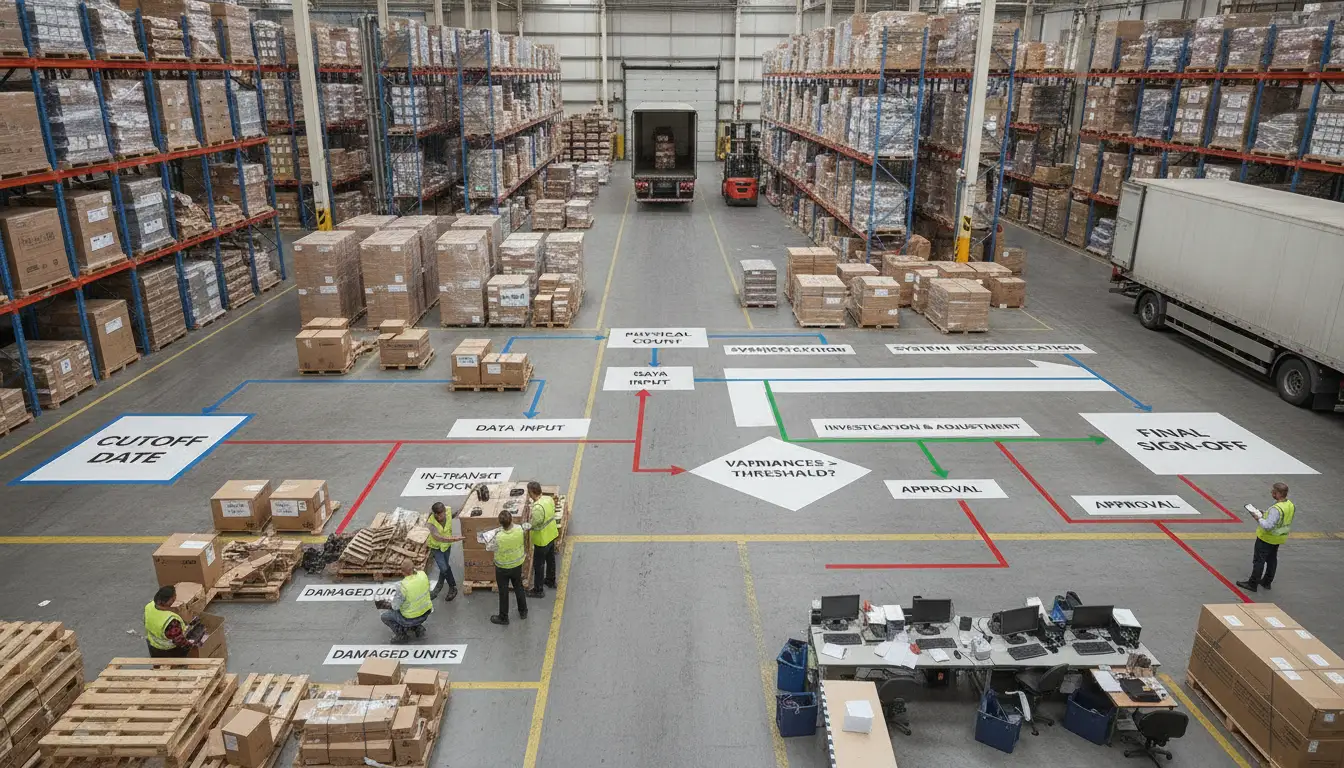
Cutoff Timing: The Most Common Source of Discrepancy
The December holiday shipping surge means that your 3PL is receiving inbound freight and shipping outbound orders at peak velocity right up to the cutoff date. Timing errors in this window are the single most frequent cause of year-end variance.
To minimize cutoff risk, consider these practical measures:
- Ask your 3PL to pause inbound receiving for 24 to 48 hours before the cutoff if your agreement allows it, or at minimum to timestamp every receipt clearly so late arrivals are assigned to the correct period.
- Flag any purchase orders you expect to arrive in the last week of December. If a shipment arrives after your cutoff, it belongs in January inventory regardless of when you placed the order.
- Confirm that your carrier's end-of-day scan matches your 3PL's ship timestamp. Carriers such as FedEx, USPS and DHL record a package as shipped when they scan it at pickup. Your 3PL's WMS should match that event.
- Check for open orders that were picked and packed but not yet manifested as of the cutoff. These units are no longer available inventory but may still appear in the WMS as allocated rather than shipped.
Handling In-Transit Stock at Year End
In-transit inventory falls into two categories at year end, and each is treated differently on your balance sheet.
| Category | Definition | Who Owns It | Where It Appears |
|---|---|---|---|
| Outbound in transit (shipped, not delivered) | Orders dispatched by the 3PL before cutoff, in carrier custody | Customer (title transferred at ship) | Not on your inventory balance; should be in COGS |
| Inbound in transit (ordered, not received) | Stock purchased from a supplier, en route to the fulfillment center | Your brand (depending on Incoterms) | Inventory asset if title has passed; confirm with your accountant |
| Return in transit | Customer return shipped back, not yet checked in by 3PL | Depends on your return policy and when title reverts | May need a separate accrual; confirm with your accountant |
| Transfer in transit (between warehouses) | Stock moving between your 3PL locations (e.g., NJ to CA) | Your brand | Should appear in one WMS location or a transit bin; reconcile both nodes |
The treatment of inbound in-transit inventory depends on the Incoterms agreed with your supplier. Under FOB (Free On Board) origin terms, title passes when goods are loaded at the supplier's port, meaning you own the stock while it is on the water. Under FOB destination, title passes only on delivery to your 3PL. Your accountant should confirm the correct treatment based on your supplier contracts. For a broader explanation of trade terms, the International Chamber of Commerce Incoterms rules are the authoritative reference.
Damaged and Quarantined Units: How to Handle Them
Damaged inventory is one of the more sensitive reconciliation topics because it touches both your asset valuation and any potential claim against your fulfillment partner.
Most 3PL agreements define liability for damage that occurs inside the warehouse separately from damage that occurs in transit (which is a carrier claim). Read your fulfillment agreement carefully before the year-end process begins so you know which party bears the loss for each category.
For the reconciliation itself, use these working rules:
- Damaged but saleable at a discount: Keep on the balance sheet at net realizable value, not at full cost. Flag for a write-down rather than a write-off.
- Damaged and unsaleable: Write off the cost. Obtain a disposal certificate or photo documentation from the 3PL. If the 3PL is liable, record a receivable for the claim amount.
- Quarantined pending inspection: Hold on the balance sheet at cost until you inspect. Do not write off before you see the units.
- Expired (date-coded products): Write off immediately upon confirmed expiry. Request a destruction report from the 3PL.
Using Cycle Counts to Simplify Year-End Reconciliation
Brands that rely on a single annual physical count at year end face the greatest reconciliation burden because twelve months of potential variance must be explained at once. Cycle counting distributes that work across the year.
In a typical cycle-count program, your 3PL counts a rotating subset of SKUs on a weekly or monthly schedule, prioritizing high-velocity or high-value items more frequently. The Council of Supply Chain Management Professionals (CSCMP) defines cycle counting as a subset physical count that does not require a full facility shutdown, making it practical for active fulfillment operations. You can read the CSCMP's supply chain glossary at cscmp.org.
For year-end reconciliation, cycle-count history gives you three practical advantages:
- You can identify recurring problem SKUs before the cutoff date and investigate them while operations are still active.
- Your year-end variance is typically smaller because errors have been caught and corrected throughout the year.
- Your auditors have a documented trail of counts rather than a single snapshot, which supports the reliability of your perpetual inventory records.
Ask your fulfillment partner for a cycle-count summary covering the full fiscal year as part of your year-end package. It should show each SKU counted, the WMS quantity at count time, the physical count result and any adjustment made.
What to Request From Your 3PL: A Year-End Document Checklist
Consolidating the right documents before you begin reconciliation saves significant time. Send this request to your 3PL operations contact at least ten business days before your cutoff date.
- On-hand inventory snapshot by SKU and bin location, frozen at the agreed cutoff timestamp
- Cycle-count summary for the full fiscal year
- Open inbound purchase order and ASN report (units ordered but not yet received)
- Open outbound order report (orders picked but not yet shipped or manifested)
- Damaged, quarantined and disposed-unit report with reason codes and dates
- Return receipt log: all returns checked in during the period, with condition grades
- Transfer log: any units moved between fulfillment locations during the period
- Adjustment report: all WMS adjustments made during the year with reason codes

How Technology Supports Inventory Accuracy Year-Round
Real-time WMS integrations reduce year-end reconciliation effort significantly. When your ecommerce platform, ERP or accounting tool connects directly to your 3PL's WMS, every receipt, shipment and return updates both systems simultaneously, eliminating manual re-entry as a source of error.
YouParcel integrates with Shopify, Amazon, Salesforce, Tableau and more than 70 other platforms, giving brands a single view of on-hand quantities across channels. Real-time tracking and BI analytics mean that inventory discrepancies surface during the year, not only at year-end count time. To learn how this works in a broader fulfillment context, see how YouParcel's ecommerce fulfillment connects inventory data across sales channels.
For brands running multiple fulfillment locations, including YouParcel's warehouses in New Jersey, California and Illinois, each location generates its own WMS snapshot. Your year-end reconciliation must cover all nodes separately, then roll up to a single consolidated balance. A multi-node adjustment report is especially important if you have transferred inventory between facilities during the year.
What Happens If Your Books and the 3PL Do Not Agree
A variance that survives investigation falls into one of three categories, each with a different resolution path.
| Variance Type | Likely Cause | Resolution |
|---|---|---|
| Books show more than WMS | Units shipped but not deducted from your ledger; supplier invoice posted before receipt | Confirm shipment and deduct; or delay invoice posting to match receipt |
| WMS shows more than books | Received units not entered in your system; duplicate SKU or mislabeled product | Post receipt entry; correct SKU mapping; re-label if mislabeled |
| Variance with no clear cause | Shrinkage, theft, fulfillment error or system timing gap | Write off after investigation; file a claim if 3PL liability applies; document for auditors |
Unexplained shrinkage should be documented with a written summary of the investigation steps taken, even if the final entry is simply a write-off. Auditors and tax authorities expect evidence that you exercised reasonable diligence, not merely a journal entry.
Frequently Asked Questions
How far in advance should I notify my 3PL about the year-end inventory count?
Notify your fulfillment partner at least two to three weeks before your cutoff date. This gives them time to schedule a physical or cycle count, prepare the document package and flag any open issues, such as pending inbound shipments or uninspected returns, that could affect the count.
What is the difference between a cycle count and a year-end inventory count?
A cycle count covers a rotating subset of SKUs throughout the year without stopping warehouse operations. A year-end inventory count is a comprehensive check of all on-hand units at a specific point in time, typically at fiscal year end. Brands with strong cycle-count programs typically see smaller and more explainable variances at their annual count.
Who is responsible for inventory shrinkage at a 3PL warehouse?
Responsibility depends on your fulfillment agreement. Most 3PL contracts define liability limits for warehouse-caused loss or damage. Shrinkage from carrier transit is generally a carrier claim, not a 3PL claim. Review your specific agreement and consult your attorney or logistics advisor before filing a claim.
How should I treat in-transit inventory on my year-end balance sheet?
Inbound inventory you own (based on Incoterms with your supplier) is an asset even while in transit. Outbound orders shipped before cutoff have transferred title to the customer and should be in COGS, not inventory. Returns in transit require a judgment call based on your return policy; your accountant should advise on the correct accrual treatment.
Does using a perpetual inventory system eliminate the need for a year-end count?
No. A perpetual inventory system reduces the size and frequency of discrepancies, but it does not eliminate the need for a periodic physical count to validate the ledger. Most auditors and accounting standards require at least an annual verification of physical quantities against the perpetual record, regardless of how current the system data appears.
Ready to simplify year-end reconciliation with real-time WMS data, BI reporting and hands-on support? Talk to an expert about how YouParcel's fulfillment operations can give your brand the inventory accuracy it needs at year end and every day of the year.