


Amazon FBA fees increased on January 15, 2026, adding an estimated average of roughly $0.08 per unit across standard fulfillment size tiers, according to third-party seller summaries of the Amazon Seller Central announcement. For brands using FBA for Amazon orders and Amazon Multi-Channel Fulfillment (MCF) for off-Amazon channels, that incremental cost compounds quickly at scale. YouParcel works with sellers running thousands of daily orders across multiple channels, and the question we hear most right now is straightforward: does it still make financial and operational sense to route every order through Amazon, or is this the moment to split the network?
- Amazon raised FBA fulfillment fees effective January 15, 2026; the average increase across standard tiers is approximately $0.08 per unit (per third-party summary; verify exact tiers on Amazon Seller Central).
- FBA is cost-competitive for lightweight, fast-turning products sold primarily on Amazon, but MCF carries a surcharge for non-Amazon channel orders and restricts carrier and branding choices.
- An independent 3PL lets you consolidate all channels under one roof, control packaging and carrier selection, and avoid Amazon's storage and removal fees, though it requires a separate integration and inbound freight workflow.
- The right answer depends on your channel mix, average unit economics, product dimensions and how much brand control matters to your customers.
What Changed on January 15, 2026
Amazon announced adjustments to its fulfillment fee schedule for US sellers, effective January 15, 2026. The changes affect per-unit fulfillment fees across multiple size tiers. Third-party analyses summarizing the update, such as the breakdown published by Novadata (Novadata, January 15, 2026), put the average increase at approximately $0.08 per unit across standard tiers. Amazon Seller Central remains the authoritative source for the exact fee table by size and weight band; always verify the numbers there before updating your P&L models.
This update follows a period of multiple fee revisions. Sellers who built margin models on 2024 or early-2025 fee schedules and have not revisited them are likely running on understated fulfillment costs. The practical effect differs significantly depending on whether you use FBA for Amazon-only orders, MCF for off-Amazon channels, or a third-party logistics provider for some or all of your volume.
Three Fulfillment Models: How They Actually Work
Fulfillment by Amazon (FBA)
FBA means you ship inventory to Amazon's fulfillment centers, and Amazon picks, packs and ships every Amazon.com order. You pay a per-unit fulfillment fee (which now reflects the January 2026 rates), monthly storage fees, and additional charges for aged inventory, removals, returns processing and inbound placement. The Prime badge and Buy Box weighting are the main advantages. The constraints are that Amazon controls the packaging, the carrier and the customer relationship on its platform.
Amazon Multi-Channel Fulfillment (MCF)
MCF lets you use the same FBA inventory to fulfill orders from your Shopify store, your own website, wholesale accounts or other marketplaces. Amazon picks, packs and ships those orders too, but at a higher per-unit rate than standard FBA, because Amazon charges a premium for fulfilling non-Amazon orders. MCF shipments arrive in Amazon-branded or plain packaging (plain packaging is available but must be selected), and you have no control over which carrier Amazon uses. Delivery speed tiers exist, and faster speeds carry higher fees.
An Independent 3PL
A third-party logistics provider (3PL) holds your inventory in its own warehouses and ships orders across every channel you sell on. You send inbound freight once, or split inventory across warehouse locations for speed, and the 3PL routes each order to the carrier that fits the speed and cost target. You choose the packaging, inserts and carrier mix. You are not subject to Amazon's storage limits, aged inventory surcharges or removal fee schedules. The trade-off is that you pay inbound receiving and storage fees directly, and you need a warehouse management system (WMS) integration for each sales channel.
Direct Cost Comparison by Scenario
Because Amazon's exact fee per unit depends on the size tier, weight and delivery speed, the table below does not use specific dollar figures. Instead it maps the cost and control factors across the three models by fulfillment scenario so you can apply your own numbers.
| Factor | FBA (Amazon orders only) | MCF (off-Amazon channels) | Independent 3PL |
|---|---|---|---|
| Base fulfillment fee | Standard FBA rate (Jan 2026 schedule) | FBA rate plus MCF channel surcharge | 3PL pick-and-pack rate (varies by provider and volume) |
| Storage fees | Amazon monthly plus aged inventory surcharges | Same Amazon storage (shared inventory) | 3PL monthly storage rate; no Amazon aging penalties |
| Inbound freight cost | Paid by seller; Amazon inbound placement fee applies | Same as FBA (inventory shipped to Amazon) | Paid by seller to 3PL warehouse; no Amazon placement fee |
| Carrier choice | Amazon selects | Amazon selects | Seller or 3PL selects (USPS, FedEx, DHL, etc.) |
| Branded packaging | Not available | Limited (plain box available; no custom inserts) | Full control: custom boxes, tissue, inserts |
| Returns processing | Amazon fee per return; limited grading visibility | Amazon fee per return | 3PL processes returns; full condition grading and restocking |
| Multi-channel visibility | Amazon only | All channels, but through Amazon's system | All channels; unified inventory through WMS and integrations |
| Prime eligibility | Yes (standard FBA) | No | No (unless seller uses Seller Fulfilled Prime, subject to Amazon approval) |
Which Model Fits Which Seller Profile?
FBA makes sense when Amazon is your dominant channel
If 80 percent or more of your unit volume moves through Amazon.com, FBA is still the most operationally straightforward option. The Prime badge materially affects conversion, the Buy Box algorithm rewards FBA inventory, and you do not need to build a separate fulfillment workflow. The January 2026 fee increase hurts margins on thin-margin SKUs and heavy or oversized items, but for fast-turning, lightweight products where the Prime conversion premium is real, FBA unit economics typically remain competitive.
Products that perform well inside FBA tend to share these characteristics: they are small and standard-sized (fitting within Amazon's standard or small standard tiers), they turn quickly enough to avoid aged inventory surcharges (generally under 180 days), and they do not require custom packaging or inserts that drive repurchase on a direct channel.
MCF becomes expensive for high-volume off-Amazon orders
MCF is a reasonable bridge when your off-Amazon volume is low, say under 10 to 15 percent of total orders, and you want to avoid running a second inventory pool. As off-Amazon volume grows, the MCF surcharge per unit accumulates, you lose carrier control (which affects both cost and customer experience), and you have no ability to differentiate the unboxing. Brands building a DTC Shopify channel alongside Amazon often find that MCF fees erode the margin advantage of the direct channel, defeating part of the purpose of running a DTC operation.
MCF also carries a meaningful practical constraint: Amazon can restrict MCF shipments during peak periods, and the carrier Amazon selects may not meet the delivery promise you made on your own storefront.
A 3PL fits multi-channel brands, bulky products and brand-focused DTC operations
An independent 3PL makes financial and operational sense when at least one of the following is true:
- You sell across three or more channels (Amazon, Shopify, wholesale, other marketplaces) and want one inventory pool rather than fragmented stock.
- You sell oversized, heavy or bulky items where FBA's size-tier fees and inbound placement costs are disproportionately high relative to the product's selling price.
- Your brand experience, including custom packaging, inserts and carrier selection, is a material part of customer retention and lifetime value.
- You are growing a wholesale or B2B channel that requires EDI compliance, retailer routing guides and pallet-level shipments that FBA is not designed to handle.
- You have slow-moving SKUs or seasonal inventory where Amazon's aged inventory surcharges would apply and where you need flexible storage terms.
For sellers in this profile, the January 2026 FBA fee update is not just a cost event; it is a signal to revisit the total cost of fulfillment across all channels, not just the Amazon fee line.
The Hybrid Model: FBA for Amazon, 3PL for Everything Else
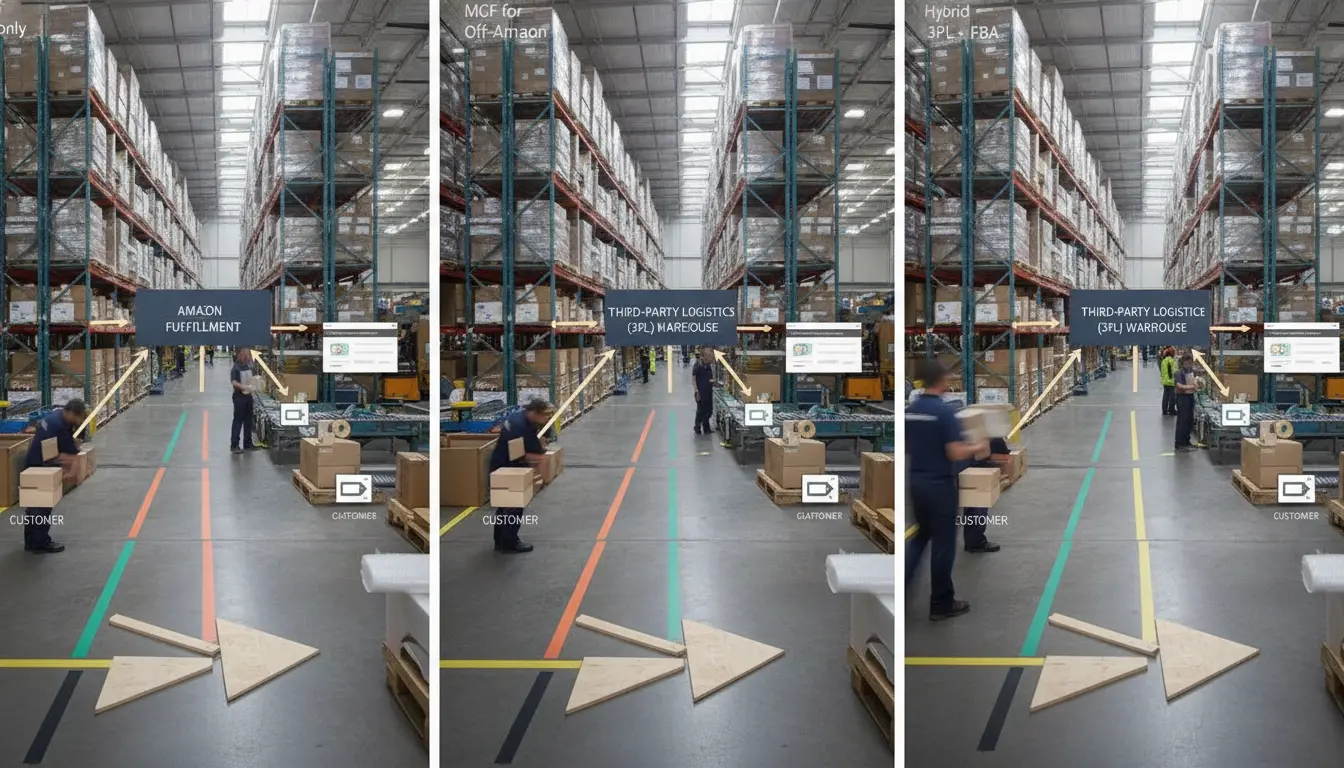
Many brands at scale run a hybrid: FBA handles Amazon.com orders to protect Prime eligibility and Buy Box performance, while an independent 3PL handles Shopify, wholesale and other marketplace orders. This model splits inventory between two locations, which requires coordination, but it eliminates the MCF surcharge on off-Amazon orders, restores full carrier and packaging control on direct channels, and removes those SKUs from Amazon's storage fee schedule.
The operational requirement for a hybrid model is reliable integration between your sales channels, your Amazon Seller Central account and your 3PL's warehouse management system. YouParcel integrates with Amazon, Shopify and 70-plus other platforms, which means a brand can connect all its channels to one fulfillment operation and route orders by channel rules without manual intervention. You can read more about how channel-specific routing works in the context of YouParcel's ecommerce fulfillment services.
FBA Prep: Where the 3PL and Amazon Intersect
Even sellers who keep FBA as their primary channel often route inventory through a 3PL first for FBA prep: labeling, poly-bagging, bundling, kitting and inspection before the goods enter Amazon's network. This avoids Amazon's prep service fees (which Amazon charges per unit) and gives sellers more control over prep quality and inbound compliance.
YouParcel handles FBA prep at its fulfillment centers, including receiving inbound freight, applying FNSKU labels, poly-bagging and bundling, kitting multi-unit sets, and staging inventory for inbound shipments to Amazon. In some cases, prep fees at a 3PL are lower per unit than Amazon's own prep charges, particularly for items that require multiple prep steps. For a detailed look at Amazon MCF compared with independent fulfillment alternatives, that resource covers the trade-offs in full.
Calculating Your Own Break-Even Point
The right way to evaluate FBA versus MCF versus a 3PL is to build a per-unit cost model using your actual numbers. The inputs you need are:
- Current FBA fulfillment fee per SKU at the January 2026 rate (pull from Seller Central's fee preview tool).
- Monthly storage cost per unit based on your average inventory level and turn rate, including any aged inventory charges you currently pay.
- MCF surcharge per unit for each off-Amazon channel you use, multiplied by monthly off-Amazon unit volume.
- Inbound freight cost per unit to Amazon versus to a 3PL warehouse (compare lane by lane, since Amazon's inbound placement fee and your carrier rate both factor in).
- 3PL pick-and-pack quote per unit for your SKU mix and order profile, plus storage cost at the 3PL.
- Return processing cost: Amazon's per-return fee versus a 3PL's returns grading and restocking fee.
When you sum columns one through six for each scenario, the break-even channel split between FBA-plus-MCF and FBA-plus-3PL usually becomes clear. For most brands with meaningful off-Amazon volume, the MCF surcharge is the single largest driver of the gap.
What the 2026 Fee Environment Means for Planning
The January 2026 FBA update is part of a broader pattern: Amazon has adjusted its fee schedule multiple times in recent years, and those adjustments have consistently moved in one direction. Building a fulfillment model that is entirely dependent on Amazon's pricing gives Amazon full leverage over your margin structure. Diversifying into an independent 3PL for at least some channels is a way to introduce competitive tension into that cost structure, even if FBA remains the right answer for your Amazon-specific volume.
Brands that have already moved toward a hybrid or full 3PL model report benefits beyond the per-unit fee line: more visibility into inventory across channels, the ability to run promotions and inserts on direct channels, and faster iteration on packaging without being constrained by Amazon's inbound requirements. Those qualitative factors do not show up in the fee comparison table, but they matter for customer lifetime value and brand equity at scale.
Frequently asked questions
How much did Amazon FBA fees increase in January 2026?
Third-party summaries of the Amazon Seller Central announcement put the average increase at approximately $0.08 per unit across standard fulfillment size tiers, effective January 15, 2026. The exact amount varies by size tier and weight band, so verify your specific SKU fees directly in Amazon Seller Central's fee preview tool.
What is the difference between FBA and Amazon Multi-Channel Fulfillment (MCF)?
FBA fulfills orders placed on Amazon.com and qualifies those orders for Prime. MCF uses the same inventory pool to fulfill orders from non-Amazon channels, such as Shopify or your own website, but at a higher per-unit rate and without Prime badging. With MCF, Amazon selects the carrier and controls the packaging.
When does using a 3PL instead of Amazon MCF make financial sense?
A 3PL typically becomes cost-competitive when off-Amazon orders represent more than 15 to 20 percent of your total volume, when you sell bulky or heavy items that carry high FBA size-tier fees, or when carrier choice and branded packaging are important to your DTC customer experience. The break-even depends on your specific SKU profile and order volume.
Can I use FBA and a 3PL at the same time?
Yes. A hybrid model, where FBA handles Amazon.com orders and an independent 3PL handles all other channels, is common among multi-channel brands. It preserves Prime eligibility on Amazon while removing off-Amazon orders from the MCF surcharge and restoring full control over packaging and carrier selection.
Does a 3PL help with Amazon FBA prep?
Yes. Many sellers route inventory through a 3PL for FNSKU labeling, poly-bagging, kitting and bundling before shipping to Amazon's fulfillment centers. This avoids Amazon's per-unit prep fees and gives sellers more control over prep quality and inbound compliance before inventory enters the FBA network.
If the January 2026 FBA fee changes have prompted you to revisit your fulfillment model, YouParcel can walk through the numbers with you, covering your channel mix, SKU profile and cost per unit across FBA, MCF and a 3PL. Talk to an expert to get a fulfillment cost analysis for your specific operation.