

An ecommerce returns policy is the written contract between a brand and its customers that defines the return window, accepted item conditions, refund or exchange options, and who pays for return shipping. When that policy is backed by a 3PL like YouParcel, the warehouse handles physical intake, grading, restocking, and carrier coordination so the brand never touches a returned parcel. Getting the policy and the 3PL operations aligned is what separates brands that profit from returns from brands that absorb them as pure cost.
- Your policy language directly determines what your 3PL must be configured to do: return windows, condition grades, disposition rules, and exchange workflows all need matching warehouse instructions.
- A 3PL adds value at four operational stages: receiving and RMA matching, inspection and grading, disposition (restock, quarantine, refurbish, liquidate, or destroy), and reporting back to your OMS or platform.
- YouParcel integrates with return management platforms such as Loop Returns and Happy Returns, and with order management systems including Shopify and Amazon, so return data flows without manual re-entry.
- Policy gaps, such as an undefined condition threshold or a missing exchange SOP, become warehouse bottlenecks; aligning both documents before launch prevents costly rework.
Why the Returns Policy and 3PL Operations Must Be Designed Together
Most brands write a returns policy from a marketing perspective and treat the warehouse as an afterthought. The gap creates real problems. If your policy promises a 30-day refund on unworn apparel but your 3PL has no written grading criteria for "unworn," every grey-area item stalls in a holding bin and your refund cycle stretches past the window you promised.
The practical fix is to draft policy language and warehouse standard operating procedures in parallel. Each policy clause should map to a warehouse instruction. The table below shows how that translation works across the most common policy elements.
| Policy clause | What it means for your 3PL | What happens if it is missing |
|---|---|---|
| Return window (e.g., 30 days from delivery) | 3PL checks carrier scan date against RMA creation date before accepting the parcel | Out-of-window returns get processed and restocked, increasing shrink |
| Accepted condition (e.g., unused, original packaging) | 3PL grades each unit against a defined rubric: Grade A (resellable), Grade B (open box), Grade C (damaged/defective) | Damaged units get restocked and shipped to the next customer, triggering a second return |
| Refund vs. exchange vs. store credit | 3PL needs an exchange pick-and-pack workflow and inventory reservation logic | Exchanges are processed manually, creating delay and mis-ships |
| Who pays return shipping | Prepaid label generation (via carrier API) or customer-arranged shipment instructions | Customers use the cheapest carrier, shipments arrive damaged or untracked |
| Non-returnable items (e.g., opened supplements, final sale) | 3PL flags these SKUs in the WMS so they are quarantined on receipt and not restocked | Restricted SKUs re-enter active inventory, creating compliance or safety risk |
| Refund trigger (receipt of return vs. inspection) | Determines whether the OMS issues the refund on scan-in or after grading is complete | Refunds issued before inspection incentivize return fraud |
The Four Operational Stages a 3PL Handles on Your Behalf
Stage 1: RMA Creation and Label Generation
An RMA, or return merchandise authorization, is the unique identifier that connects a customer return request to a specific order and SKU in your warehouse management system. Without a valid RMA, a 3PL cannot process a return accurately because there is no order record to match the physical item against.
When a customer initiates a return through your portal, Shopify returns flow, or a dedicated return management app such as Loop Returns or Happy Returns, an RMA number is generated and either embedded in a prepaid label or emailed to the customer. YouParcel integrates directly with these platforms, so the RMA appears in the warehouse queue before the parcel arrives. This pre-advice step cuts intake processing time considerably: staff already know what to expect, in what quantity, and from which order.
Prepaid label generation typically pulls from the same carrier mix used for outbound: USPS, FedEx, or UPS domestically, with DHL or Aramex for international return lanes. The carrier choice affects both cost and scan density. USPS Ground Advantage is often the lowest-cost option for lightweight returns under 1 lb, while FedEx Ground suits heavier items where dimensional weight (the formula: length x width x height in inches divided by 139 for domestic parcels) would otherwise inflate cost.
Stage 2: Physical Receiving and Inspection
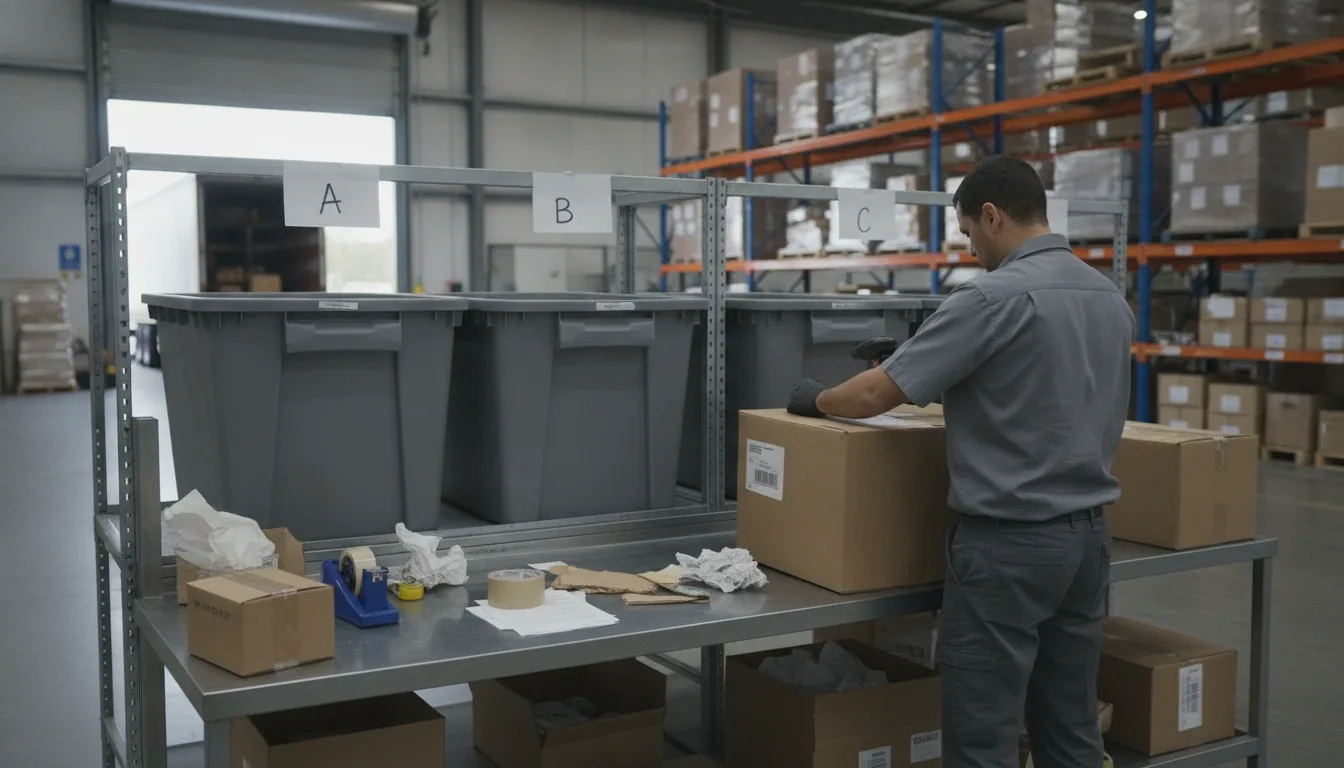
When the parcel arrives at a YouParcel fulfillment center, the receiving team scans the outer label to match it against the open RMA record. The item is then opened, identified by SKU or barcode, and inspected against the grading rubric your brand has defined.
A practical three-tier grading system works as follows:
- Grade A, resellable as new: item is undamaged, in original or intact packaging, and within the accepted condition defined by your policy. It goes back to active bin stock.
- Grade B, open-box resellable: item is functional but packaging is damaged or missing. It is set aside for a secondary channel (open-box listing, outlet store, or B2B liquidation) based on your instructions.
- Grade C, unsellable: item is broken, contaminated, or missing components. It is routed to quarantine for destruction, donation, or vendor claim.
Apparel brands, which typically see return rates between 20 percent and 40 percent for online orders according to the National Retail Federation, often add a fourth grade for items that need minor refurbishment: re-folding, re-tagging, or repackaging. Some brands ask their 3PL to handle this light assembly work, which ties directly to kitting and assembly capabilities.
Stage 3: Disposition and Inventory Update
Disposition is the decision about what happens to each returned unit after grading. This is where most brands leave money on the table because they have not given the 3PL clear instructions for anything other than Grade A. A complete disposition matrix covers at least five outcomes:
| Grade | Disposition option | Inventory impact |
|---|---|---|
| Grade A | Restock to active pick location | Increases available units in WMS immediately |
| Grade B | Move to quarantine bin, await brand instruction | Recorded as on-hand but not available for sale |
| Grade B | Relist on outlet channel (if brand has pre-approved) | Tagged as "open box" SKU variant in OMS |
| Grade C | Destroy per brand's written instruction | Written off; destruction certificate issued |
| Grade C | Return to brand or vendor for warranty claim | Moved to outbound holding; brand arranges pick-up |
The WMS records each disposition in real time, and the inventory count in your connected Shopify store or Amazon seller account updates accordingly through YouParcel's integration layer. This prevents overselling restocked units before they are physically back on the shelf.
Stage 4: Exchange Fulfillment and Reporting
Exchanges are operationally more complex than refunds because they involve both an inbound return and an outbound shipment, often processed as a linked transaction. The two most common models are:
- Instant exchange: the replacement unit ships before the original is received. This requires inventory reservation and a conditional hold on the customer's payment method, coordinated through your returns software. The 3PL needs pre-authorization to pick and pack the replacement on RMA creation, not on physical receipt.
- Standard exchange: the replacement ships after the original return is received and graded as acceptable. This is simpler for the 3PL and carries no inventory risk, but it adds 3 to 7 days to the customer experience depending on carrier transit times.
Reporting is the last step and often the least used. A 3PL that surfaces return reason codes, SKU-level return rates, grading outcomes, and average processing time gives your merchandising and customer service teams data they can act on. YouParcel provides BI and analytics capabilities, including integrations with Tableau and Salesforce, so return metrics can sit alongside broader fulfillment KPIs. If your monthly review does not include a return reason breakdown by SKU, you are missing the clearest signal in your product data.
How to Write a Returns Policy That Your 3PL Can Actually Execute
The following principles apply regardless of your product category or return volume.
Be Specific About Condition Language
Phrases like "like new" or "unused" mean different things to different people. Replace them with observable criteria. For apparel: tags attached, no visible wear, no odor, original poly bag intact. For electronics: all original accessories present, no physical damage, factory reset completed. These criteria become the grading checklist your 3PL works from.
Define the Return Window Clearly and Consistently
Start the return window from the delivery date shown on the carrier's tracking record, not the order date. A 30-day window that starts at order date effectively gives the customer 20 to 23 days after delivery for standard domestic transit. That mismatch generates disputes. Many brands in competitive categories have extended return windows to 60 or 90 days, particularly for apparel and footwear, to reduce purchase hesitation. Your 3PL needs the exact rule and the data source (carrier delivery scan) used to enforce it.
State Who Pays Return Shipping and Under What Conditions
A hybrid model is common: free returns for defective or mis-shipped items (the brand's error), customer-paid returns for change-of-mind. If you use prepaid labels, your 3PL can generate them through its carrier accounts, which is often cheaper than the customer arranging their own shipment. If you require customer-arranged returns, specify accepted carriers to ensure trackable delivery and reduce the risk of items arriving damaged.
Address International Returns Separately
International customers returning to a US warehouse face customs clearance on the inbound shipment. Items shipped back from Canada, the UK, or the EU require the sender to declare the item as a return on the commercial invoice (Incoterm: DDP or DAP depending on who bears duty risk), and the US importer of record for that inbound shipment must be identified. YouParcel handles international returns processing at its US fulfillment centers in New Jersey and California, but the customs and IOR obligations for inbound international returns are the brand's responsibility to arrange. This is information to work through with your customs broker, not a task the 3PL takes on by default.
For more on international customs obligations, the US Customs and Border Protection guidance on returned goods is a useful reference point, though brands should work with a licensed customs broker for their specific circumstances.
Include a Fraud Prevention Layer
Return fraud, including returning items never purchased, substituting a different item, or returning a used item claimed as defective, is a material cost for brands processing high volumes. Practical deterrents your policy and 3PL can support together include: photo documentation on receipt (the 3PL photographs the item in the opened parcel before grading), SKU and serial number verification against the original order record, and a policy clause stating that fraudulent returns will be referred for investigation. The 3PL does not pursue fraud cases, but documentation it captures is the brand's evidence if needed.
Returns Policy Benchmarks by Product Category
Return windows and accepted conditions vary by category. The ranges below reflect common industry practice, not YouParcel-specific requirements.
| Category | Typical return window | Key condition requirement | Common 3PL task |
|---|---|---|---|
| Apparel and footwear | 30 to 90 days | Unworn, tags attached, original packaging | Re-tagging, refolding, poly-bag replacement |
| Consumer electronics | 15 to 30 days | All accessories present, factory reset | Accessory check, serial number verification |
| Beauty and cosmetics | 30 days, unopened only | Sealed, batch code intact for MoCRA traceability | Batch verification, quarantine of opened units |
| Supplements and wellness | Often 30 days, specific lot rules apply | Sealed, lot number present, within expiry | Lot and expiry check, non-resaleable quarantine |
| Home goods and furniture | 30 to 60 days | Unassembled or disassembled, all parts present | Parts count, repackaging, LTL return coordination |
Connecting Your Returns Policy to Your 3PL Tech Stack
The integration between your returns software and your 3PL's WMS is what makes policy execution automatic rather than manual. YouParcel integrates with return management platforms including Loop Returns and Happy Returns, as well as with Returnly and ReturnLogic. When these platforms generate an RMA, it flows directly into the warehouse queue. When the 3PL grades and dispositions the item, the status updates back to the returns platform and to your Shopify or Amazon store.
The key data fields that must pass between systems for clean returns processing are:
- RMA number (unique identifier linking return to original order)
- SKU and quantity expected
- Return reason code (customer-provided at initiation)
- Disposition instruction (from your policy rules, pre-configured in the WMS)
- Grading outcome (populated by warehouse staff on receipt)
- Refund or exchange trigger flag
Brands that have not mapped these fields before going live with a 3PL typically discover the gap at peak season, when return volumes spike and manual reconciliation becomes impossible. The time to configure the integration is during 3PL onboarding, not in November.
For a detailed look at how the broader reverse logistics operation fits together, see the YouParcel reverse logistics service page, which covers the full scope from returns intake to final disposition.
Peak Season and Returns Capacity Planning
Returns volume in January typically runs two to three times the daily average for most DTC brands, driven by holiday gift returns. If your 3PL is not pre-staffed and your policy is not pre-communicated to customers in December, two things happen: processing times stretch, and customers escalate to your support team asking where their refund is.
Practical steps to take before peak:
- Share your expected return volume forecast with your 3PL at least six weeks before the holiday cutoff date.
- Confirm whether your 3PL will extend return intake hours in January and what the agreed processing SLA (the service level agreement defining the maximum time from receipt to grading completion) will be.
- Update your policy page and order confirmation emails with the extended holiday return window, if you are offering one, and the realistic refund timeline.
- Pre-configure disposition rules for any new SKUs launched in Q4 so receiving staff are not waiting for instructions on unfamiliar products.
- Review Grade B and Grade C inventory disposal plans so quarantine bins do not overflow into active pick locations during high-volume intake periods.
YouParcel processes 10,000+ orders per day across multiple marketplaces. That scale means the warehouse infrastructure and carrier relationships are built for volume surges, but advance communication of your specific return mix remains essential for accurate staffing and bin allocation.
For related planning guidance, the article on returns processing operations covers intake, grading, and restocking mechanics in depth.
Frequently asked questions
What should a 3PL returns policy setup include before going live?
Before launching returns with a 3PL, you need a written grading rubric for each product category, disposition rules for every grade, RMA field mapping between your returns software and the WMS, carrier selection for prepaid labels, and a defined refund trigger (scan-in versus post-inspection). Missing any one of these creates processing delays or inventory errors from day one.
How does a 3PL handle exchanges versus refunds differently?
Refunds require only intake, grading, and a status update to the OMS to trigger a payment reversal. Exchanges also require a pick-and-pack outbound shipment for the replacement unit, inventory reservation at RMA creation (for instant exchanges), and a linked order record so the exchange ships on the correct carrier service and from the correct warehouse location.
Can a 3PL help reduce return fraud?
A 3PL can document returns with photos on receipt, verify SKUs and serial numbers against original order records, and flag returns that arrive outside the policy window or in a condition inconsistent with the return reason stated. This documentation is the brand's evidence for any fraud investigation, though pursuing the case remains the brand's responsibility.
What is a reasonable return processing SLA for a 3PL?
Industry practice for a mid-volume brand (100 to 500 returns per day) is typically 2 to 5 business days from receipt to grading completion and inventory update, though this varies by product complexity and grading requirements. The SLA should be written into your 3PL agreement and reviewed for adjustment during peak planning. See the guide on 3PL agreement SLAs and liability terms for what to include in the contract.
How does an ecommerce returns policy affect customer lifetime value?
Research from multiple retail studies consistently shows that customers who have a positive return experience buy again at higher rates than those who experienced friction. A clear policy reduces pre-purchase hesitation, particularly for apparel and electronics, and a fast refund cycle (driven by efficient 3PL processing) is the operational variable brands control most directly after the policy is set.
Ready to align your returns policy with warehouse operations that can actually execute it? Create a YouParcel account or talk to an expert to discuss your return volumes and configuration requirements.
Related reading: How to Compare 3PL Alternatives Fairly: A Framework Beyond Price