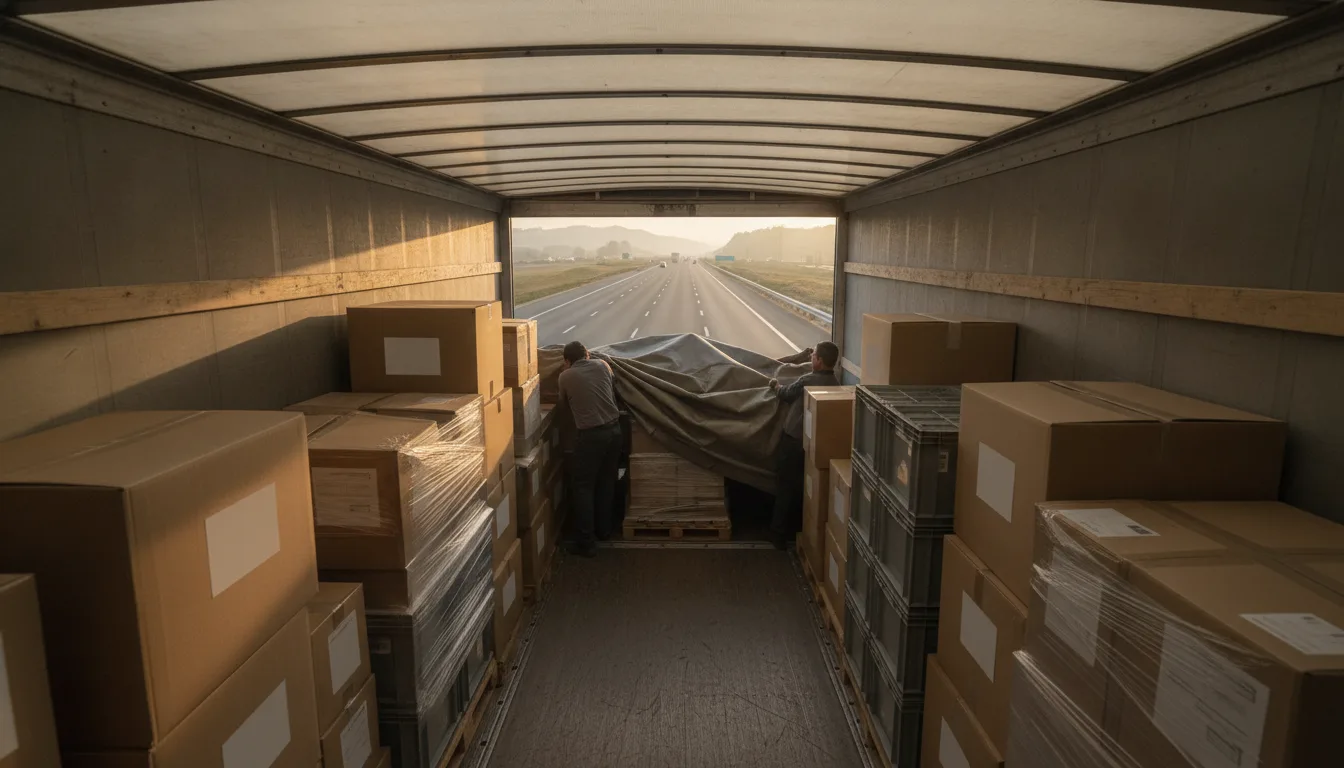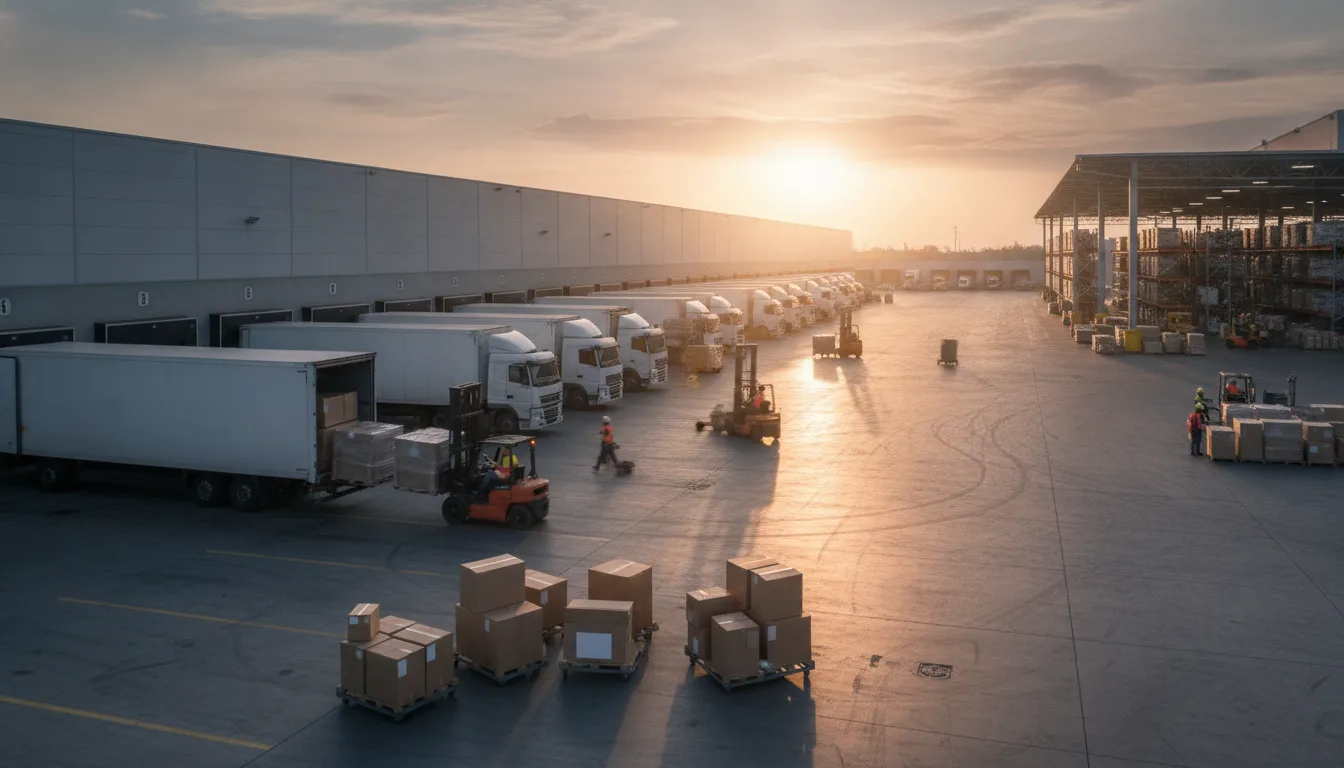


B2b fulfillment is the process of picking, packing, and shipping orders in case or pallet quantities to retailers, distributors, or business buyers, rather than sending individual parcels to consumers. Where DTC fulfillment optimizes for speed and low per-unit cost on small packages, b2b order fulfillment requires precise quantity accuracy, compliance with retailer-specific documentation, and delivery scheduling that fits the receiving dock, not the front door. YouParcel handles both channels from the same warehouse network, so brands do not have to choose between them.
- B2b orders typically ship on pallets or in full cases; DTC orders ship as individual parcels, often in polybags or small cartons.
- Retail and wholesale buyers require appointment-based delivery, advance ship notices (ASNs), and specific labeling, all of which differ substantially from consumer parcel shipping.
- Chargebacks and compliance penalties are real financial risks in wholesale fulfillment; a missed routing guide requirement can result in deductions from your invoice.
- YouParcel supports retail and wholesale distribution alongside DTC from warehouses in New Jersey, California, and Illinois, with 70+ platform integrations and hands-on account management.
What Is B2B Fulfillment, and Why Does It Need Its Own Process?
B2b fulfillment, also called wholesale fulfillment or retail distribution, covers orders placed by businesses rather than individual shoppers. The buyer may be a national chain retailer, a regional distributor, a co-op, or a corporate purchaser. What they have in common is that they expect orders measured in units-per-case or pallets-per-shipment, delivered on a scheduled dock appointment, with documentation that matches their own warehouse and accounts-payable systems.
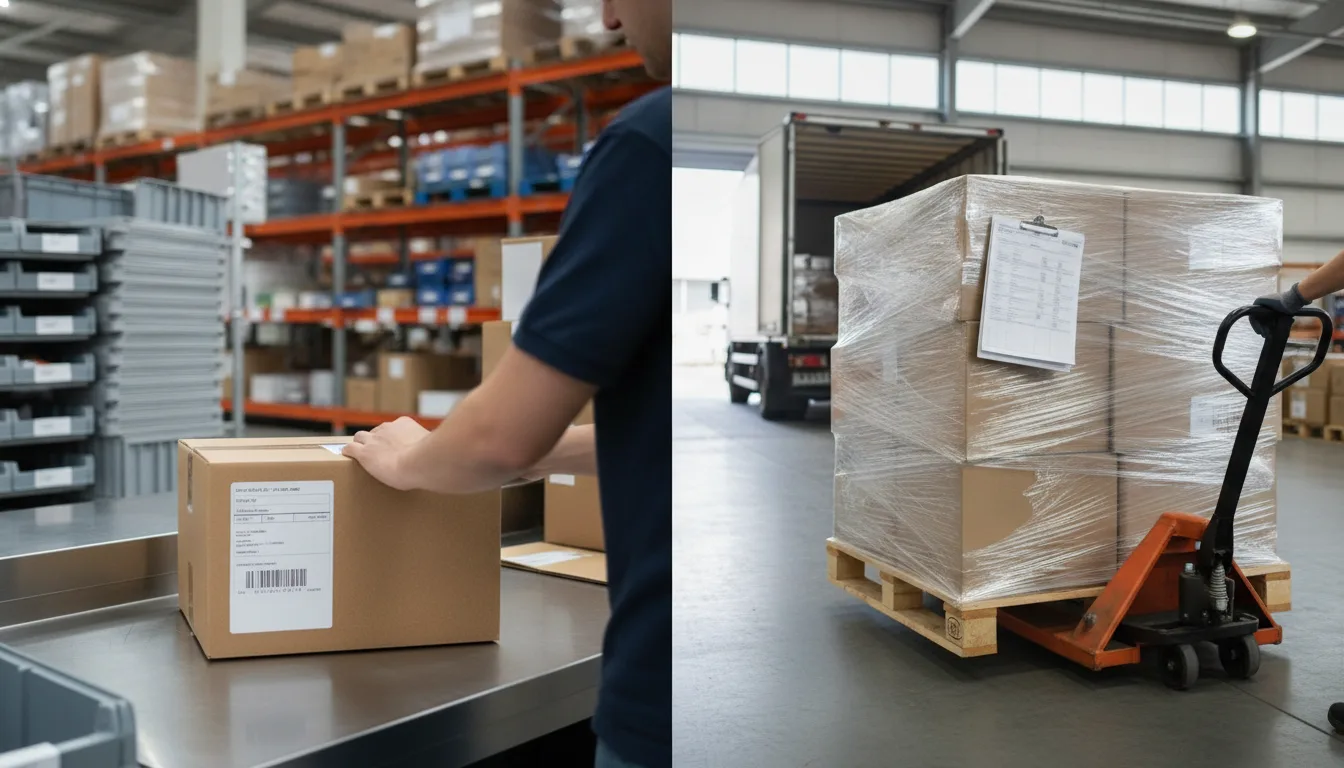
DTC fulfillment, by contrast, centers on the individual consumer order: usually one to five units, shipped in a corrugated carton or polybag, tracked at the parcel level, and delivered to a residential or business address without any pre-arranged appointment. The processes are genuinely different at almost every step, from how inventory is slotted in the warehouse to which carrier service gets selected and what paperwork travels with the shipment.
Brands that expand from DTC into wholesale often underestimate that gap. Running both channels through a single fulfillment partner who understands both is one of the most reliable ways to avoid the compliance penalties and operational confusion that come from treating a retail purchase order like an oversized consumer order.
For a broader look at how the fulfillment process works end to end, see YouParcel ecommerce fulfillment services.
Order Structure: Parcels vs Cases vs Pallets
The unit of measure is the most immediate difference between DTC and b2b order fulfillment.
- DTC parcel: typically one to five units per shipment, picked individually, packed in a branded or plain carton, and handed to a parcel carrier such as USPS, FedEx, or UPS.
- Case pack: a pre-defined inner quantity, for example 12 or 24 units per master carton, picked as a complete case. Retail buyers often specify minimum order quantities in cases.
- Pallet: a standard 48 x 40 inch (GMA) or 42 x 42 inch pallet loaded with stacked cases, stretch-wrapped, and labeled for LTL (less-than-truckload) or FTL (full truckload) freight. A single wholesale purchase order may call for 10, 50, or several hundred pallets.
Warehouse slotting (the physical location assigned to each SKU) reflects this difference. DTC inventory is often forward-picked from shelving in pick-and-pack zones. Wholesale inventory may live in pallet-racking positions and be replenished by the full pallet rather than the individual unit. A fulfillment center set up only for parcel picking will struggle with the floor space, labor workflow, and equipment needed for pallet assembly.
Delivery Logistics: Doorstep vs Dock Appointment
Consumer parcels are delivered by carrier drivers who leave packages at the door or in a parcel locker with no pre-arrangement. Retail and wholesale deliveries work differently.
What Is an Appointment-Based Delivery?
An appointment-based delivery (sometimes called a scheduled dock appointment) is a time window, usually two to four hours, reserved by the retailer's distribution center or store-level receiving team. The carrier or driver must arrive within that window; arriving outside it can result in refusal of the load or a missed-appointment chargeback. National retailers typically require appointments to be booked through a carrier management portal or directly with their traffic team, and the confirmation number must appear on the bill of lading (BOL).
This requirement has direct implications for which carriers and service levels can be used. Standard parcel services do not support dock appointments. LTL carriers such as those in the XPO, Estes, or Old Dominion networks do, but each has its own appointment booking process. Working with a 3PL that already has established freight relationships and knows how to coordinate this scheduling saves a significant amount of back-and-forth for a brand entering retail distribution for the first time.
Advance Ship Notices (ASNs)
An advance ship notice (ASN) is an electronic document, commonly transmitted as an EDI 856 transaction, that tells the retailer exactly what is on its way: SKUs, quantities, lot numbers, pallet and carton counts, carrier details, and expected delivery date. Most major retailers require an ASN to be transmitted before or within hours of the shipment leaving the warehouse. Failure to send a timely and accurate ASN is one of the most common sources of compliance chargebacks in wholesale fulfillment.
EDI (electronic data interchange) is the standard communication protocol between suppliers and retail trading partners for documents including purchase orders (EDI 850), ASNs (EDI 856), and invoices (EDI 810). YouParcel supports EDI and retailer compliance requirements, including routing guides and labeling, for brands in retail and wholesale distribution.
Retailer Paperwork and Compliance Requirements
Retail buyers publish routing guides: supplier handbooks that specify exactly how shipments must be packaged, labeled, and tendered. Requirements vary by retailer, but a routing guide typically covers the following areas.
| Requirement area | Typical DTC approach | Typical B2B/wholesale approach |
|---|---|---|
| Carton labeling | Carrier shipping label only | GS1-128 compliant barcode labels with specific placement, content fields (PO number, item, quantity, vendor), and sometimes a second label format for the pallet |
| Pallet configuration | Not applicable | Specific stacking pattern, max height (usually 60 inches), corner boards, stretch-wrap layers, pallet label placement on two or four sides |
| Documentation | Packing slip inside the box | Commercial invoice, packing list, bill of lading (BOL), and sometimes a certificate of origin or compliance letter |
| Carrier selection | Brand or 3PL selects carrier by cost or speed | Retailer often mandates specific carriers or routing by origin zip code; use of an unauthorized carrier triggers a chargeback |
| Timing | Ship within 1-2 business days of order | Must-arrive-by date (MABD) or delivery window specified on the PO; early or late delivery can result in deductions |
| Charge-back risk | Low (consumer disputes handled separately) | High: labeling errors, late ASNs, unauthorized carriers, and quantity discrepancies each trigger financial deductions from the invoice |
GS1 standards (the global barcode and data standard) underpin most retail labeling requirements. The GS1-128 barcode encodes application identifiers such as GTIN (Global Trade Item Number), lot number, quantity, and ship-to location into a single scannable symbol. Retailers reject shipments that do not conform to these standards because their own receiving systems depend on clean scan data. For reference on GS1 labeling specifications, see the GS1-128 standard documentation published by GS1.
Inventory Management Differences Between DTC and Wholesale
DTC inventory management focuses on real-time unit-level tracking to prevent stockouts on a SKU-by-SKU basis. Wholesale inventory management adds a layer of lot control and purchase-order allocation. When a retailer places a purchase order, that quantity is typically reserved (soft-allocated) in the warehouse management system (WMS) so it cannot be inadvertently shipped to a DTC customer filling a concurrent web order.
Brands running both channels simultaneously need a WMS and an order management system (OMS) that can handle channel-level allocation rules. Without them, overselling on one channel or under-fulfilling a wholesale PO is a routine risk. YouParcel integrates with Shopify, Amazon, Salesforce, Tableau, and 70+ other platforms, so inventory positions stay synchronized across channels in real time.
Kitting and Assembly in Wholesale Orders
Many wholesale purchase orders include kitting requirements: combining two or more SKUs into a single retail-ready unit with custom packaging, stickers, or hang tags applied before shipment. A gift set, a promotional bundle, or a planogram-compliant display unit are common examples. Kitting that happens at the fulfillment center, rather than at the factory, gives brands the flexibility to respond to retailer requests without holding finished-kit inventory. YouParcel offers kitting and assembly services as part of its retail distribution capability.
How Freight Moves in B2B Fulfillment
DTC parcel carriers (USPS, FedEx, DHL, and similar) quote rates per package based on actual weight or dimensional weight, whichever is greater, with dimensional weight calculated by dividing length x width x height (in inches) by a divisor, typically 139 for most domestic parcel carriers. B2b and wholesale freight operates under a different pricing structure entirely.
LTL (less-than-truckload) freight is priced by freight class (the National Motor Freight Classification, or NMFC, system in the US), weight, and origin-to-destination lane. Freight class is determined by density, stowability, handling, and liability. A pallet of consumer electronics will carry a different class, and therefore a different rate, than a pallet of paper towels. The National Motor Freight Traffic Association (NMFTA) publishes the NMFC classification guide used throughout the US trucking industry.
FTL (full truckload) freight bypasses class-based pricing and is quoted as a flat rate per load for a 53-foot dry van trailer. It becomes cost-effective when a shipment fills roughly 10 or more standard pallets, depending on the lane.
YouParcel works with carriers including FedEx, DHL, Aramex, USPS, and EasyPost, and coordinates freight across LTL and FTL services for retail distribution shipments from its warehouse network in New Jersey, California, and Illinois.
Returns in B2B vs DTC
Consumer returns (reverse logistics) involve individual units coming back to the warehouse, typically inspected, graded, and either restocked or disposed of. Wholesale returns follow a different path.
Retailer-initiated returns, sometimes called vendor-chargeback returns or RA (return authorization) returns, often come back in full case quantities and may arrive on pallets, sometimes mixed with other vendors' goods at a retailer's consolidation point. The condition varies widely, particularly after a retail season. The receiving, inspection, and disposition process for wholesale returns is slower and more labor-intensive per unit than consumer return processing, and the documentation requirements, including RA (return authorization) numbers and retailer-specific packaging, must be followed precisely to avoid further deductions.
Brands entering retail distribution for the first time are often unprepared for the volume and complexity of end-of-season or promotional-clearance returns. Building a clear return disposition policy, with defined thresholds for restock, liquidation, or destruction, before the first retail PO ships will save significant cost later.
Choosing a Fulfillment Partner That Handles Both Channels
The operational case for a single fulfillment partner across DTC and wholesale is straightforward: one inventory pool, one integration layer, one set of carrier relationships, and one team that understands the compliance requirements of both channels. Splitting DTC and wholesale across two separate 3PLs introduces inventory reconciliation complexity, doubles onboarding and integration work, and creates gaps in visibility when a retailer's purchase order draws on the same SKUs as an active DTC promotion.
When evaluating a partner for b2b fulfillment alongside DTC, the practical questions to ask include: Can the WMS allocate inventory by channel and by purchase order? Does the team have direct experience with the routing guides of your target retail accounts? Can the facility handle both parcel pick-and-pack and pallet assembly on the same floor? Does the partner support EDI transmission, or will you need to manage that separately through a third-party EDI provider?
YouParcel's B2B fulfillment capability is built to handle these requirements. For detail on how the service is structured for wholesale and retail distribution, see the YouParcel B2B fulfillment overview.
Key Operational Differences at a Glance
| Dimension | DTC fulfillment | B2B/wholesale fulfillment |
|---|---|---|
| Order size | 1 to 5 units per order | Dozens to thousands of units per PO, in case or pallet quantities |
| Delivery method | Parcel carrier to residential or business address | LTL or FTL freight to retailer DC or store receiving dock |
| Delivery scheduling | No appointment; carrier delivers within service window | Mandatory dock appointment; MABD specified on PO |
| Documentation | Shipping label, packing slip | GS1-128 carton and pallet labels, BOL, ASN (EDI 856), commercial invoice |
| Labeling standard | Carrier-specific label format | Retailer routing guide specifies barcode type, label placement, and content fields |
| Compliance risk | Carrier surcharges, delivery exceptions | Retailer chargebacks for labeling errors, late ASNs, wrong carrier, quantity discrepancies |
| Inventory allocation | First-come, first-served by channel | PO-level reservation required to prevent cross-channel overselling |
| Returns process | Individual unit returns, graded and restocked or disposed | Case or pallet returns with RA documentation, often end-of-season in bulk |
Frequently Asked Questions
What is the difference between b2b fulfillment and DTC fulfillment?
B2b fulfillment ships orders in case or pallet quantities to retailers or business buyers using LTL or FTL freight, with appointment-based delivery and retailer-specific documentation. DTC fulfillment ships individual consumer orders via parcel carriers like USPS or FedEx, with no appointment required and minimal compliance paperwork.
What is a routing guide in wholesale fulfillment?
A routing guide is a document published by a retail buyer that specifies exactly how a supplier must pack, label, and ship each order, including which carriers to use, how pallets must be configured, and what barcodes and data fields must appear on each carton. Deviating from these instructions results in financial chargebacks deducted from the supplier's invoice.
Can a single 3PL handle both DTC and wholesale orders?
Yes, provided the 3PL has a warehouse management system capable of channel-level inventory allocation, the floor space and equipment for both parcel picking and pallet assembly, and experience with retail compliance requirements. YouParcel is built to handle both channels from the same warehouse network.
What is an ASN and why does it matter for wholesale fulfillment?
An ASN, or advance ship notice, is an electronic document (typically transmitted via EDI 856) that notifies a retailer of an incoming shipment before it arrives, including SKU, quantity, carrier, and pallet details. Most major retailers require a timely and accurate ASN; a missing or incorrect ASN is one of the most common sources of compliance chargebacks in wholesale fulfillment.
Does YouParcel support both LTL freight and parcel shipping from the same warehouse?
Yes. YouParcel operates fulfillment centers in New Jersey, California, and Illinois and works with carriers including FedEx, DHL, USPS, Aramex, and EasyPost, coordinating both parcel and LTL/FTL freight for brands running DTC and wholesale channels concurrently.
Ready to run DTC and wholesale from one fulfillment partner? Talk to an expert about how YouParcel can support your retail distribution and b2b order fulfillment requirements.