

DDP shipping (Delivered Duty Paid) is an Incoterm under which the seller pays all import duties, taxes and customs clearance costs before the parcel reaches the buyer. For cross-border sellers sending goods to US customers, DDP has become the operationally required approach since the United States suspended duty-free de minimis treatment for all countries on 29 August 2025, forcing carriers and postal operators to collect duties on every parcel. YouParcel works with brands navigating these requirements through its international shipping solutions.
- US de minimis duty-free entry was suspended for all countries under Executive Order 14324 and CBP CSMS notice #66065494, effective 29 August 2025: duties now apply to all inbound parcels regardless of value.
- Royal Mail launched a Postal DDP (PDDP) service and paused standard US-bound postal acceptance from 26 August 2025; Australia Post partially suspended US-bound postal goods from the same date, with a resumption timeline announced for around 25 September 2025.
- Under DDP, the seller calculates and collects duties and taxes at checkout as part of the landed cost, so there are no surprise charges on delivery and no refused parcels at the border.
- Sellers who have not moved to a DDP or prepaid-duty model face stranded parcels, refused deliveries and significant cash-flow exposure. Working with a licensed customs broker alongside a shipping partner is the recommended first step.
What happened on 29 August 2025?
Executive Order 14324 ended the US de minimis exemption for all countries. Before that date, goods valued under $800 could enter the United States duty-free under Section 321 of the Tariff Act of 1930. That treatment is now suspended. US Customs and Border Protection formalized the operational rules in CBP CSMS notice #66065494, instructing carriers and postal operators to present all inbound commercial parcels for formal or informal entry and to collect applicable duties and taxes. The notice is published at the CBP GovDelivery bulletin #66065494.
The practical effect is that every parcel sent to a US address from outside the United States now requires a customs entry. The importer of record (IOR) is responsible for duties and applicable excise taxes. Because most cross-border ecommerce parcels name the end consumer as the IOR, that consumer would, under a DDU (Delivered Duty Unpaid) model, receive a duty demand from the carrier or customs broker before receiving their order. That experience generates refusals, disputes and returns.
Why did postal operators pause US-bound shipments?
Postal operators worldwide use a simplified customs channel called the International Postal System, which routes parcels through postal exchanges rather than the standard commercial freight channels. That system was not built to process formal customs entries at scale. When the de minimis exemption was removed, postal operators faced a legal requirement to collect duties on parcels that their infrastructure could not process quickly enough.
Royal Mail responded by pausing standard US-bound postal acceptance from 26 August 2025 and launching a new Postal DDP service (sometimes abbreviated PDDP). Under PDDP, Royal Mail collects duties and taxes from the sender at the point of lodgement, prepays them into the US customs clearance process, and delivers the parcel to the US consumer duty-paid. The operational detail on Royal Mail PDDP is covered by Value Added Resource's Royal Mail PDDP overview.
Australia Post partially suspended US-bound postal goods from 26 August 2025. As of early September 2025, Australia Post had announced a planned resumption by approximately 25 September 2025, using a duty-prepaid mechanism powered by Zonos to calculate and collect landed costs on behalf of Australian senders. That development was reported by The New Daily on 9 September 2025.
Other postal operators across Europe, Asia and the Middle East responded similarly: some paused acceptance, others added temporary surcharges, and several began evaluating DDP or PDDP services of their own. The common thread is that the postal channel to the United States now requires a duty solution baked into the shipping workflow, not bolted on afterward.
What does DDP mean in shipping?
DDP, or Delivered Duty Paid, is one of eleven Incoterms 2020 published by the International Chamber of Commerce. It places maximum responsibility on the seller. Under DDP, the seller:
- Exports the goods from the origin country and clears them for export.
- Arranges and pays for international transport to the named destination.
- Files the import customs entry in the destination country (or appoints a customs broker to do so).
- Pays all applicable import duties, VAT or GST, and any other taxes or levies due on arrival.
- Delivers the parcel to the buyer's address without any additional charges outstanding.
The buyer's total cost is fully transparent at the time of purchase. There are no "duty collect" fees, no carrier disbursement fees and no customs holds that require the buyer to act. This is the model that the post-de minimis environment now demands for US-bound ecommerce shipments.
DDU (Delivered Duty Unpaid, also sometimes labeled DAP, Delivered At Place, in Incoterms 2020) transfers customs clearance responsibility to the buyer. That was workable when the de minimis threshold meant most low-value parcels were exempt. It is no longer workable as a default model for the United States.
For a detailed side-by-side comparison of DDP and DDU across carrier, cost and consumer-experience dimensions, see the YouParcel explainer on DDP vs DDU shipping and its practical implications for ecommerce.
What is landed cost and why does it matter at checkout?
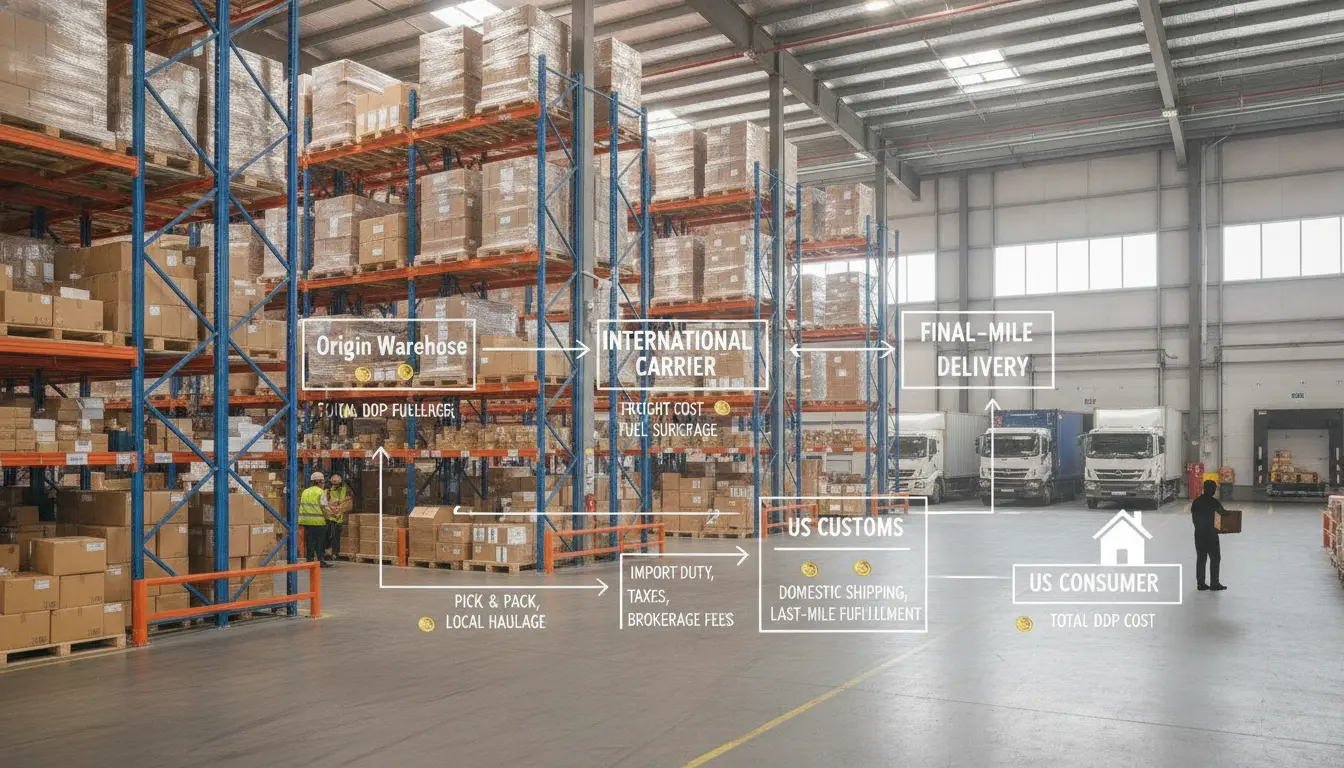
Landed cost is the total cost to get a product from the seller's origin warehouse to the buyer's door, including product cost, international freight, insurance, customs duties, taxes, and any carrier handling fees. Under a DDP model, the seller must calculate landed cost accurately before quoting a price to the buyer, because the seller absorbs every component.
Landed cost has three main variable inputs for US-bound shipments:
| Cost component | How it is determined | Who pays under DDP |
|---|---|---|
| Import duty | HTS (Harmonized Tariff Schedule) code for the product, multiplied by the customs value (typically transaction value: price paid + international freight) | Seller |
| Merchandise Processing Fee (MPF) | CBP fee charged on most formal entries; for informal entries the rate is 0.3464% of the entered value, subject to minimum and maximum thresholds set by CBP | Seller |
| Carrier customs handling fee | Fixed per-shipment fee charged by the express carrier or postal operator for disbursing duties; often $5 to $20 per parcel depending on carrier and service level | Seller under DDP; buyer under DDU |
Note: unlike most countries, the United States does not apply a federal VAT or GST at the import stage. Some states levy a use tax on imported goods, but collection from individual consumers at the parcel level is inconsistent. Import duty and MPF are the primary landed cost variables sellers must model.
To price DDP correctly at checkout, sellers need their product HTS codes. The correct 10-digit HTS code determines the duty rate. Many apparel categories carry duty rates of 12 to 32 percent. Electronics often carry lower rates of 0 to 3 percent. Consumer goods vary widely. The US International Trade Commission publishes the full Harmonized Tariff Schedule at hts.usitc.gov. Working with a licensed customs broker to classify products correctly is strongly recommended before committing to a landed cost figure at checkout.
What does the suspension mean operationally for cross-border sellers?
Sellers who were shipping DDU or relying on de minimis entry now face a set of concrete operational decisions.
Postal channel vs. express carrier channel
Many small-parcel cross-border flows used postal channels (Royal Mail, Australia Post, national postal operators feeding into USPS) because they were cost-effective for low-value goods. Those channels are disrupted. Express carriers such as DHL, FedEx and UPS were already operating formal customs clearance workflows and can process DDP shipments, but at a higher base cost per parcel than postal rates. Sellers need to model whether the express channel unit economics make sense for their average order value, or whether moving inventory closer to the US customer is a better structural answer.
Stocking inventory in the United States
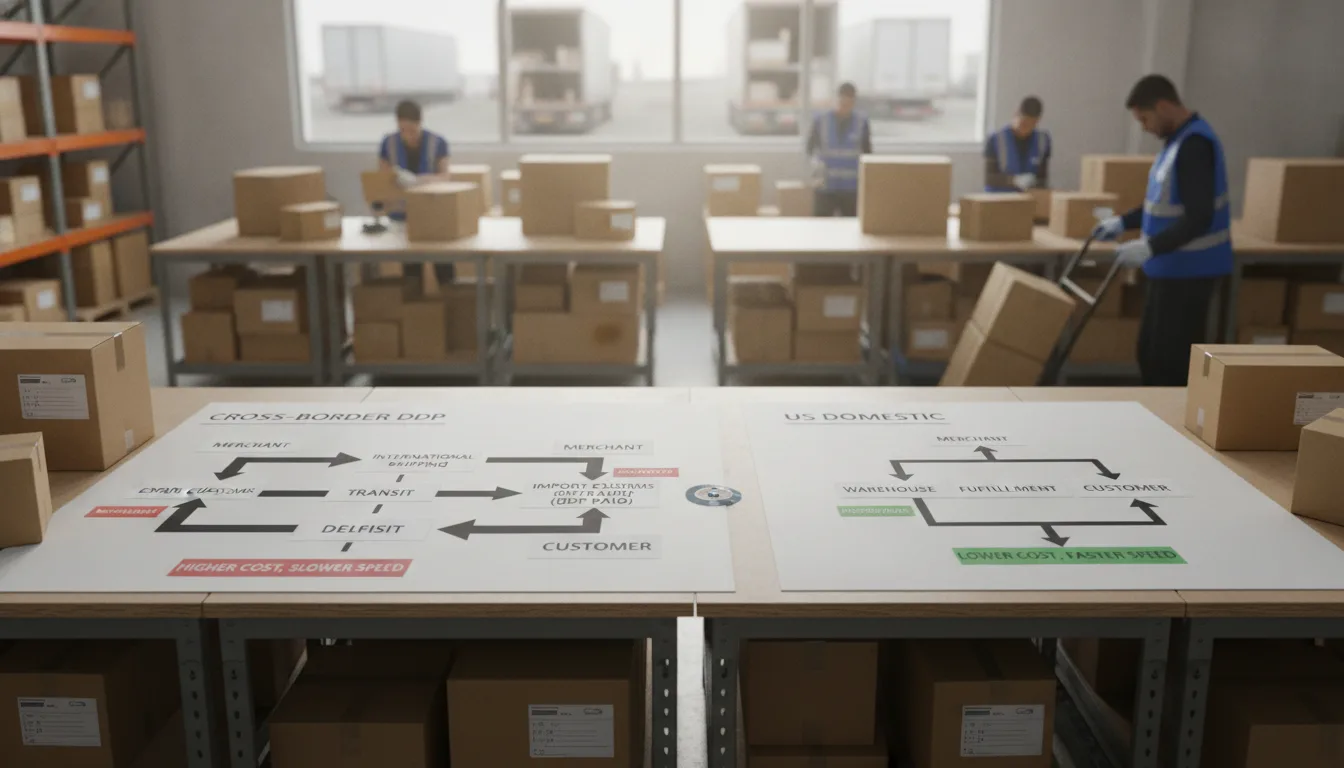
Moving inventory to a US fulfillment center before selling it eliminates the cross-border customs calculation on every parcel. The seller pays import duties once on the inbound freight shipment (typically an ocean or air freight container or pallet), clears customs at the port of entry, and ships domestically to US customers from a US warehouse. This model is now increasingly attractive given the administrative load of per-parcel DDP calculations.
YouParcel operates fulfillment centers in New Jersey (20 Farinella Dr, East Hanover, NJ 07936) and Southern California (3700 S. Riverside Ave, Rialto, CA 92324), processing more than 10,000 orders a day across multiple marketplaces, and integrating with Shopify, Amazon and 70+ other platforms. For international brands evaluating this shift, the YouParcel shipping solutions team can model both the cross-border DDP workflow and the inventory-in-US approach against each other.
Importer of record considerations
Under DDP, the seller takes on the customs entry and duty payment, but someone must be named as the importer of record (IOR) in US customs filings. The IOR is legally responsible for the accuracy of the entry and the payment of duties. For sellers without a US legal entity, this can be a significant compliance hurdle. Options include appointing the customs broker as a nominal IOR (some brokers offer this as a service), establishing a US entity, or working with a third-party IOR service provider. YouParcel does not act as importer of record; this is provided as information only. A licensed customs broker can advise on the correct IOR structure for a specific business situation.
Duty drawback and returns
When a DDP parcel is refused or returned, the seller has already paid import duties to CBP. Recovering those duties requires a duty drawback claim, which is a formal CBP process with specific timeframes and documentation requirements. This makes the returns rate a material financial variable under DDP that it was not under a de minimis model. Sellers should factor their historical return rates into DDP unit economics.
How should sellers adapt their checkout and pricing?
Accurate duty calculation at checkout is now a customer-experience requirement, not an optional upgrade. The practical steps are:
- Classify every SKU with an HTS code. Work with a customs broker to verify the 10-digit HTS classification for each product. Incorrect classification leads to underpayment (CBP liability) or overpayment (margin erosion).
- Integrate a landed cost engine into your checkout. Several ecommerce platforms and shipping platforms support real-time duty calculation using the product HTS code, declared value, and destination country rules. The duty and tax amount must be displayed to the buyer and collected at the time of purchase.
- Choose a DDP-capable shipping lane. Confirm that your carrier or postal operator explicitly supports DDP to the United States and that they will file the customs entry and remit duties to CBP on your behalf as the named importer of record or as your customs broker. PDDP services from operators like Royal Mail work this way.
- Reprice your products if needed. If duty rates materially increase the landed cost, evaluate whether your US price points need adjustment or whether US-based inventory (which removes per-parcel duty from the equation) is the more sustainable model.
- Update your returns policy. Communicate clearly to US customers how returns work under the new duty environment, including whether the seller or buyer bears return shipping costs and how refunds are handled for the duty component.
What does this mean for UK and Australian sellers specifically?
UK sellers had been among the heaviest users of the postal cross-border channel to the US, particularly for fashion, beauty and home goods. Royal Mail's PDDP service provides a path forward for UK sellers who want to continue shipping from the UK, but it requires sellers to provide HTS codes and declared values accurately and to accept that the postal DDP cost per parcel will be higher than pre-suspension rates.
Australian sellers face a similar transition. The planned resumption of Australia Post US-bound services by approximately 25 September 2025, via a Zonos-powered duty calculation layer, means Australian sellers will need to register for that service, provide product classification data, and collect landed cost from buyers at checkout. Sellers who cannot adapt their checkout to display and collect duties upfront will have limited compliant options for direct postal shipment to US customers.
For both UK and Australian brands, the medium-term question is whether the volume of US sales justifies moving to a US-stocked fulfillment model, which simplifies operations, removes per-parcel customs complexity, and delivers faster transit times to US customers through domestic carrier networks.
Frequently asked questions
What is DDP shipping in simple terms?
DDP shipping means the seller pays all shipping costs, import duties and taxes so that the buyer receives the parcel with nothing extra to pay at delivery. The total price the buyer sees at checkout is the final price, including all customs costs.
Are there still any low-value parcels that enter the US duty-free?
No. As of 29 August 2025, the US de minimis exemption has been suspended for all countries under Executive Order 14324. Every commercial parcel entering the United States is now subject to applicable import duties and customs fees regardless of its declared value.
Why did Royal Mail and Australia Post pause US-bound shipments?
Both operators paused or restricted US-bound postal acceptance because the postal infrastructure was not set up to process formal customs entries and collect duties on every parcel at the volume and speed required after de minimis was removed. They subsequently launched or announced duty-prepaid postal services to resume compliant shipments.
What is the difference between DDP and DDU for ecommerce?
Under DDP the seller pays all import duties and taxes upfront, and the buyer pays nothing extra on delivery. Under DDU (or DAP) the buyer is responsible for paying duties and customs handling fees before receiving the parcel, which often results in delivery refusals and a poor customer experience, especially in a post-de minimis environment.
Should I move my inventory to a US warehouse instead of shipping DDP from overseas?
It depends on your order volume, average order value and product duty rates. Moving inventory to a US fulfillment center means you pay import duties once on the inbound freight shipment and then ship domestically, which removes per-parcel duty complexity and typically speeds up delivery. For brands with consistent US demand, this is often the more scalable model; a logistics partner can model the unit economics for your specific situation.
To discuss your cross-border shipping setup and landed cost options with a specialist, talk to a YouParcel shipping expert and get a plan tailored to your routes, SKU mix and order volume.