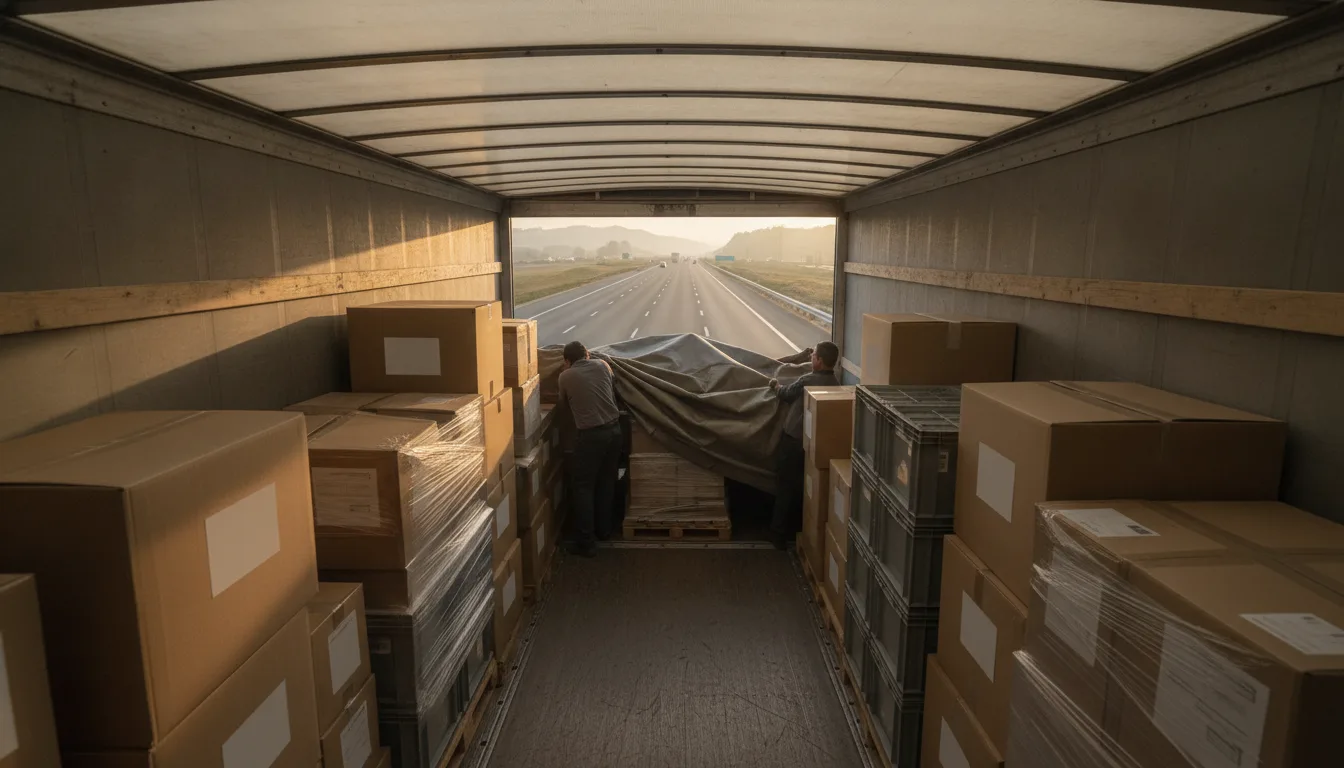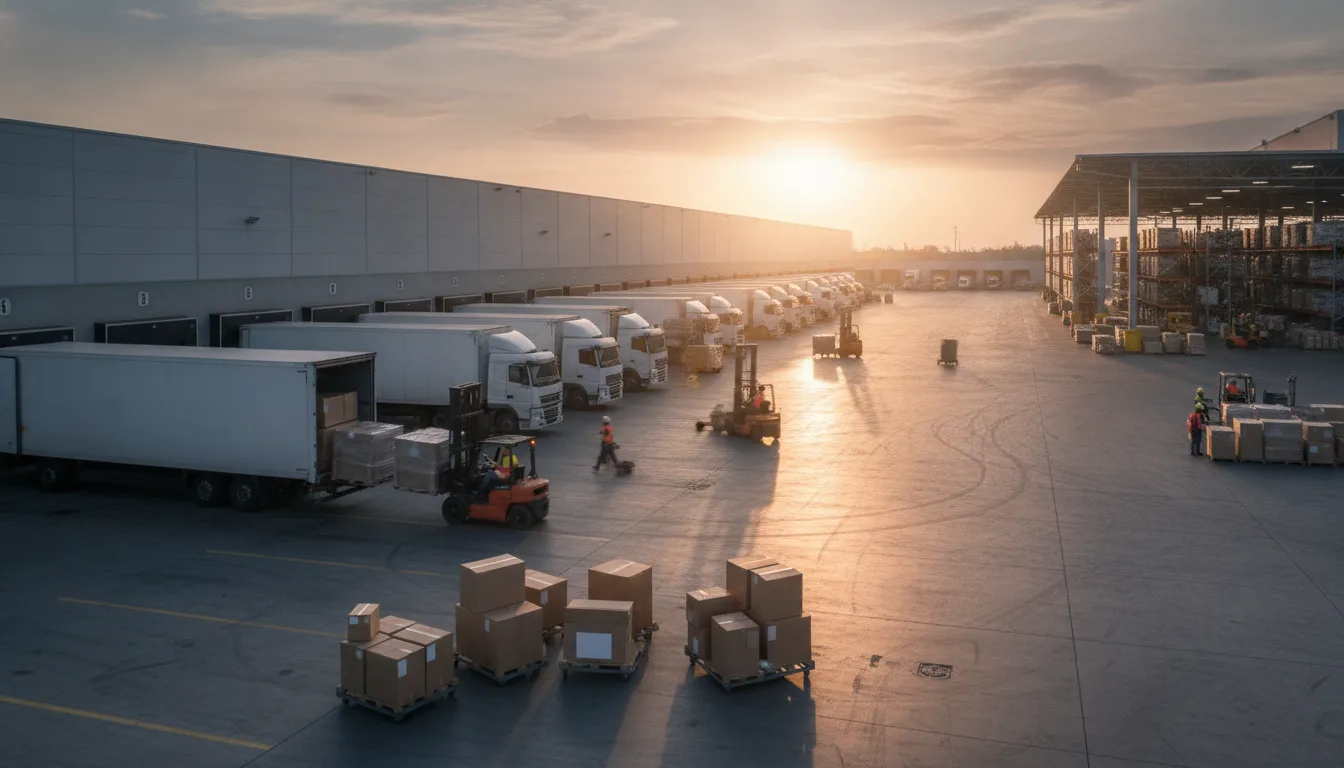


Choosing between an east coast 3PL and a west coast fulfillment center comes down to three variables: where your customers live, where your inbound freight arrives, and how many shipping zones separate your warehouse from each buyer's door. YouParcel operates fulfillment centers in East Hanover, NJ and Rialto, CA, covering both coasts and letting brands split or stage inventory based on real demand data.
- Shipping zones directly affect ground-service cost and speed: every zone added between origin and destination typically increases the parcel rate by a measurable step.
- The US Northeast corridor holds a disproportionate share of consumer purchasing power, making a New Jersey fulfillment location advantageous for brands with east-coast-heavy customer bases.
- West coast fulfillment centers near the Ports of Los Angeles and Long Beach reduce drayage distance and inbound lead time for Asia-sourced goods.
- A two-node strategy, one east coast and one west coast node, can reduce the average shipping zone across all orders, potentially lowering per-unit carrier cost across the network.
What are shipping zones and why do they matter so much?
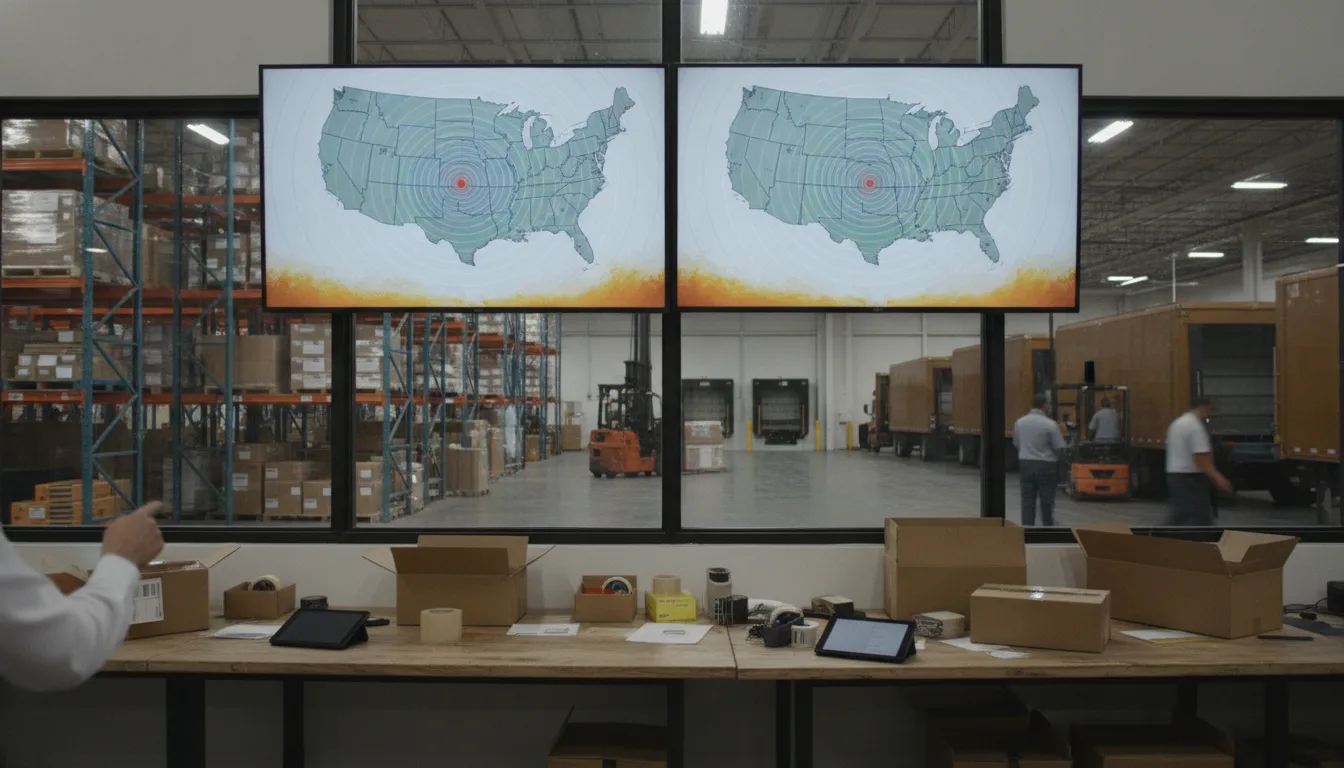
A shipping zone is the numeric distance band a carrier assigns between a parcel's origin ZIP code and its destination ZIP code. The major US carriers (USPS, FedEx, UPS) use zones 1 through 8 for continental US ground services, with Zone 1 covering the shortest distance and Zone 8 the farthest. Each zone step up adds cost to a base ground rate. For a lightweight 1 lb parcel, the difference between Zone 2 and Zone 8 can be more than double the carrier's published ground rate, and for heavier parcels in the 5 to 20 lb range the spread is wider still.
Because zone pricing compounds across volume, a brand shipping 500 orders a day can see a material cost difference from moving its average zone down by even one step. That is the core financial logic behind inventory placement strategy.
Where do US consumers actually live?
US Census Bureau data consistently shows the highest concentration of consumer households in the Northeast and Southeast. The combined statistical areas of New York, Philadelphia, Boston and Washington DC represent a dense purchasing cluster within roughly 300 miles of northern New Jersey. A fulfillment center in New Jersey reaches this corridor at Zone 1 or Zone 2 for most addresses, and can reach the entire eastern seaboard in Zone 3 or Zone 4 for ground services.
The West Coast population centers, primarily Los Angeles, the San Francisco Bay Area and Seattle, represent a significant but proportionally smaller share of national consumer volume. Southern California alone is a large regional market in its own right, which is why a Rialto, CA location serves both that market at short zone and the broader western US.
Where does inbound inventory enter the US?
For brands sourcing from Asia, the Ports of Los Angeles and Long Beach handle a significant portion of US-bound container traffic. The Port of Los Angeles is consistently ranked among the busiest container ports in North America. Receiving inventory at a California fulfillment center after ocean transit avoids a costly transcontinental domestic freight leg that would be required to reach a New Jersey warehouse.
Brands sourcing from Europe, the UK or the US domestic supply chain often find the East Coast the natural inbound point. The Port of Newark and the Port of New York handle substantial European-origin container volumes, and a New Jersey warehouse positioned near those ports shortens the drayage run from port to racking.
East coast 3PL: the case for New Jersey
YouParcel's New Jersey fulfillment center is located at 20 Farinella Dr, East Hanover, NJ 07936. Northern New Jersey's position in the broader New York metro area gives it a few structural advantages.
Proximity to the highest-density consumer markets
Roughly 100 million people live within a one-day ground-service radius of northern New Jersey, depending on carrier routing. The I-95 corridor from Boston to Washington is one of the most densely populated freight lanes in the country. For a brand where the majority of orders ship to ZIP codes in that band, a New Jersey origin means low zone numbers and lower per-parcel ground rates on the bulk of volume.
Port of New York and Newark proximity
The Port of New York and New Jersey is the third-largest container port in the US by volume and the busiest on the East Coast. Brands receiving FCL (full container load) or LCL (less than container load) shipments from European or trans-Atlantic origins can move containers from port to warehouse with a short drayage move, reducing inland freight cost and clearing customs closer to the point of storage.
Returns flow
Because so many customers are geographically close to a New Jersey warehouse, return parcels travel shorter distances before arriving back at the facility for grading and restocking. Shorter return transit reduces the time inventory is out of sellable stock, which matters for fast-moving SKUs.
West coast ecommerce fulfillment: the case for California
YouParcel's Southern California fulfillment center is located at 3700 S. Riverside Ave, Rialto, CA 92324. The Inland Empire, the warehouse district east of Los Angeles, is one of the most established logistics corridors in North America.
Direct access to the largest US container ports
Rialto sits in the heart of the Inland Empire, the region that serves as the primary staging and distribution zone for cargo arriving through the San Pedro Bay port complex (Ports of Los Angeles and Long Beach). Brands sourcing from East Asia, Southeast Asia or South Asia can receive containers at the port and move them to Rialto under a relatively short drayage run, avoiding the cost and time of transloading onto domestic rail or truck for a cross-country move before goods are even stocked.
Reaching the western third of the US at low zone
California, Arizona, Nevada, Oregon and Washington State are all reachable at Zone 1 through Zone 3 from a Rialto origin. For brands with strong West Coast, Southwest or Pacific Northwest customer concentrations, fulfilling from California keeps zone numbers, and therefore carrier costs, low for those orders.
International e-commerce and cross-border receipts
Some brands use a California node specifically to receive international inbound parcels from Asian suppliers for quality control, kitting, or repackaging before domestic distribution. The proximity to major air cargo hubs (LAX) and the sea port complex makes this practical.
One node or two? A framework for the decision
Not every brand needs two fulfillment locations. The decision should start with data, not assumptions. The table below outlines the primary decision factors and what each scenario typically favors.
| Decision factor | Favors single east coast node (NJ) | Favors single west coast node (CA) | Favors two-node split (NJ + CA) |
|---|---|---|---|
| Customer ZIP concentration | 60%+ of orders ship to eastern US (east of the Mississippi) | 60%+ of orders ship to western US | Roughly balanced east-west split |
| Inbound origin | European or trans-Atlantic suppliers; domestic US supply chain | Asian-origin containers through LA/Long Beach | Mixed origins; some European, some Asian |
| Average order weight and size | Heavy or bulky items where zone cost is highest; ship close to customer | Heavy or bulky items concentrated in the West | High per-unit zone sensitivity makes split attractive |
| Daily order volume | Lower volume brands where split-inventory complexity outweighs savings | Lower volume brands with clear west-coast focus | Higher volume brands (typically 300+ orders/day) where per-unit savings compound |
| SKU count and inventory value | High-SKU catalogs where holding safety stock in two locations ties up working capital | Same consideration applies | Manageable SKU count; core SKUs split, long-tail held at one node |
| Carrier service preference | USPS, FedEx and UPS ground from NJ reach East Coast in fewer zones | USPS, FedEx and UPS ground from CA reach West Coast in fewer zones | Both nodes achieve shorter zone spans across the full US map |
How to calculate your current average shipping zone
Before committing to a location strategy, run a zone analysis on your historical order data. The process works as follows.
- Export the destination ZIP codes from your last 90 to 180 days of orders.
- Apply zone lookup tables from your primary carrier (USPS, FedEx and UPS each publish zone charts by origin ZIP on their websites) to map every destination ZIP to a zone number from a hypothetical New Jersey origin.
- Repeat step 2 from a hypothetical California origin, using a Rialto or Ontario, CA origin ZIP.
- Calculate the order-weighted average zone for both origin scenarios.
- Estimate the per-zone rate increment for your average parcel weight, then multiply by total monthly volume to project potential annual savings from moving to the lower-zone origin, or from splitting inventory between both.
- Compare projected carrier savings against the incremental warehousing and inventory holding costs of running a second node. A two-node strategy adds receiving fees, storage fees, and safety-stock requirements at the second location.
This analysis will not give a precise number without actual carrier contract rates, but it will show whether the zone reduction is large enough to justify the operational complexity. YouParcel's team can help run this analysis against your data and your specific carrier mix. Talk to a fulfillment expert to request a zone analysis consultation.
Dimensional weight and its interaction with zone strategy
Dimensional weight (also called DIM weight) is the volumetric equivalent weight a carrier assigns to a parcel when the calculated figure exceeds actual weight. The standard DIM divisor used by FedEx and UPS for domestic ground services is 139 (length x width x height in inches, divided by 139, yielding a DIM weight in pounds). USPS uses a divisor of 166 for Priority Mail parcels. Supply Chain Dive has tracked how carrier DIM policy changes have increased effective per-parcel costs for lightweight, bulky goods over successive annual rate cycles.
This matters for zone strategy because DIM weight amplifies the per-zone cost step. A lightweight but bulky item rated at a high DIM weight pays the full zone-based rate on that inflated weight, so reducing its average zone has a larger dollar impact than reducing zones for a genuinely heavy, compact item. Brands selling bulky, light products (home goods, apparel, bedding) typically benefit most from locating inventory close to their customers.
Inbound freight strategy: aligning port of entry with fulfillment location
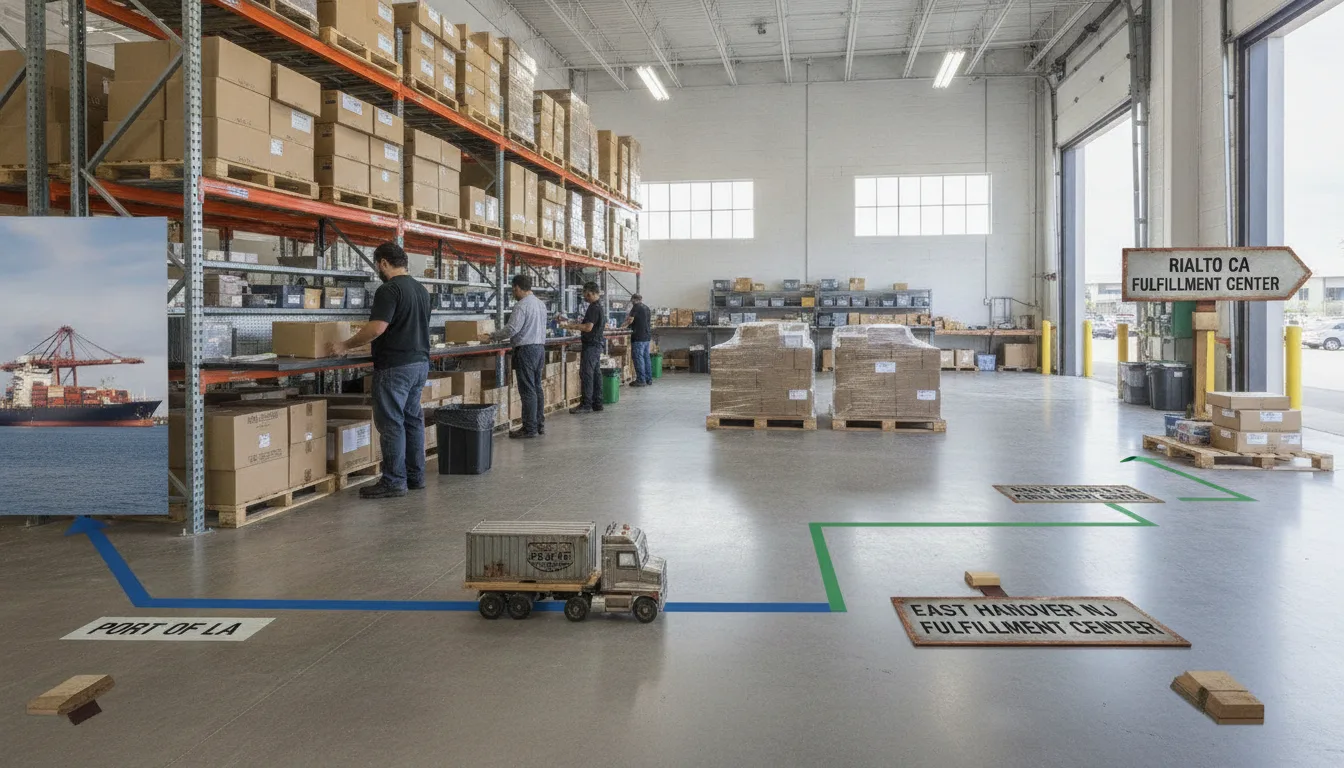
Separating the inbound freight decision from the outbound fulfillment decision is a common and costly mistake. If you place inventory in New Jersey but your supplier ships containers through Los Angeles, you pay for a transcontinental domestic freight leg (whether truck or intermodal rail) before a single customer order ships. That adds cost, time and risk of damage or delay at the transload point.
The practical guidance is to align your primary fulfillment node with your primary port of entry when possible, then use the second node for overflow or demand-based replenishment. For Asia-sourced brands, that often means California as the primary receiving node, with cross-docking or periodic truck transfers to New Jersey to keep east-coast safety stock replenished. For European-sourced brands the logic reverses.
YouParcel's warehousing and storage services at both locations support short-term and longer-term inventory staging, so inbound containers can be received, broken down, and either stored or immediately forwarded to the outbound fulfillment flow.
Retail and wholesale distribution considerations
Brands selling through retail channels (big-box, specialty, regional chains) rather than direct-to-consumer have an additional factor: retailer distribution center locations. Major US retailers run regional DCs that accept replenishment shipments on strict routing-guide compliance schedules. If your primary retail partners' DCs are concentrated on the East Coast, a New Jersey node reduces LTL (less-than-truckload) freight cost and simplifies retailer compliance routing. EDI-based order management, labeling requirements and routing guides can be handled from either YouParcel location.
For omnichannel brands managing both DTC and wholesale from a single inventory pool, YouParcel's ecommerce fulfillment services handle both outbound parcel and pallet-level shipments, with EDI integration for retail partners and real-time inventory visibility across channels.
What about brands new to US fulfillment?
International brands entering the US market for the first time often do not have enough historical US order data to run a meaningful zone analysis. In that situation, the practical approach is to start with one node based on the best available proxy for customer geography. That proxy might be website traffic by US state, pre-launch survey data, or the geographic profile of a comparable competitor in the US market.
Northern New Jersey is frequently the default starting point for international brands without strong geographic signal, because the Northeast concentrates buying power and because a single NJ node can still reach the continental US at reasonable zone numbers, even if it is not optimal for the far West. As US order volume grows and ZIP code data accumulates, the brand can add a California node and begin splitting inventory.
YouParcel's leadership team brings more than 50 years of combined experience in US logistics and can help international brands structure their initial inventory placement without overcommitting capital to a two-node setup before the data supports it.
Frequently asked questions
Is a New Jersey fulfillment center good for reaching New York customers?
Yes. YouParcel's East Hanover, NJ location ships into New York City and the surrounding metro area at Zone 1 or Zone 2 depending on the specific destination ZIP, which is typically the lowest zone increment available for ground carrier services. The NY/NJ metro is one of the highest-density consumer markets in the country, so the short zone range covers a large share of potential order volume.
How does a California fulfillment center help with imports from Asia?
Inventory arriving by ocean freight through the Ports of Los Angeles or Long Beach can be trucked to YouParcel's Rialto, CA facility under a short drayage move. This avoids paying for a cross-country domestic freight leg before goods are stored and ready to ship, reducing inbound lead time and cost compared to routing Asian-origin containers to an East Coast warehouse.
At what order volume does a two-node strategy start to make sense?
There is no universal threshold, but most operations specialists begin evaluating a two-node split when daily order volume reaches roughly 300 to 500 or more shipments and when the customer ZIP analysis shows a materially balanced east-west split. Below that volume, the fixed overhead of running safety stock at two locations often exceeds the carrier savings from the lower average zone.
Can I run different SKUs at each fulfillment center?
Yes. Brands commonly hold their full catalog at one primary node and stock only their highest-velocity SKUs at the second node. This limits the safety-stock carrying cost at the secondary location while still capturing zone savings for the most frequently ordered products. YouParcel's inventory management system provides real-time visibility across both locations.
Does YouParcel handle both outbound shipping and inbound freight at the same locations?
Yes. YouParcel manages inbound receiving (from domestic truck, LTL, or ocean container transloads) and outbound parcel and pallet shipping from both the East Hanover, NJ and Rialto, CA facilities, using carriers including USPS, FedEx, DHL, Aramex and EasyPost for outbound parcels.
Ready to map your customer ZIP codes against YouParcel's east and west coast nodes? Talk to an Expert and get a network placement review tailored to your order data, or create an account to get started today.