


B2B fulfillment for retail channels requires a 3PL that can send and receive EDI documents, follow retailer-specific routing guides, produce compliant carton and pallet labels, and do all of this at the speed and accuracy that large retail buyers demand. YouParcel supports EDI and retailer compliance as part of its retail and wholesale distribution services, giving brands a single partner for the full flow from inbound freight to store delivery.
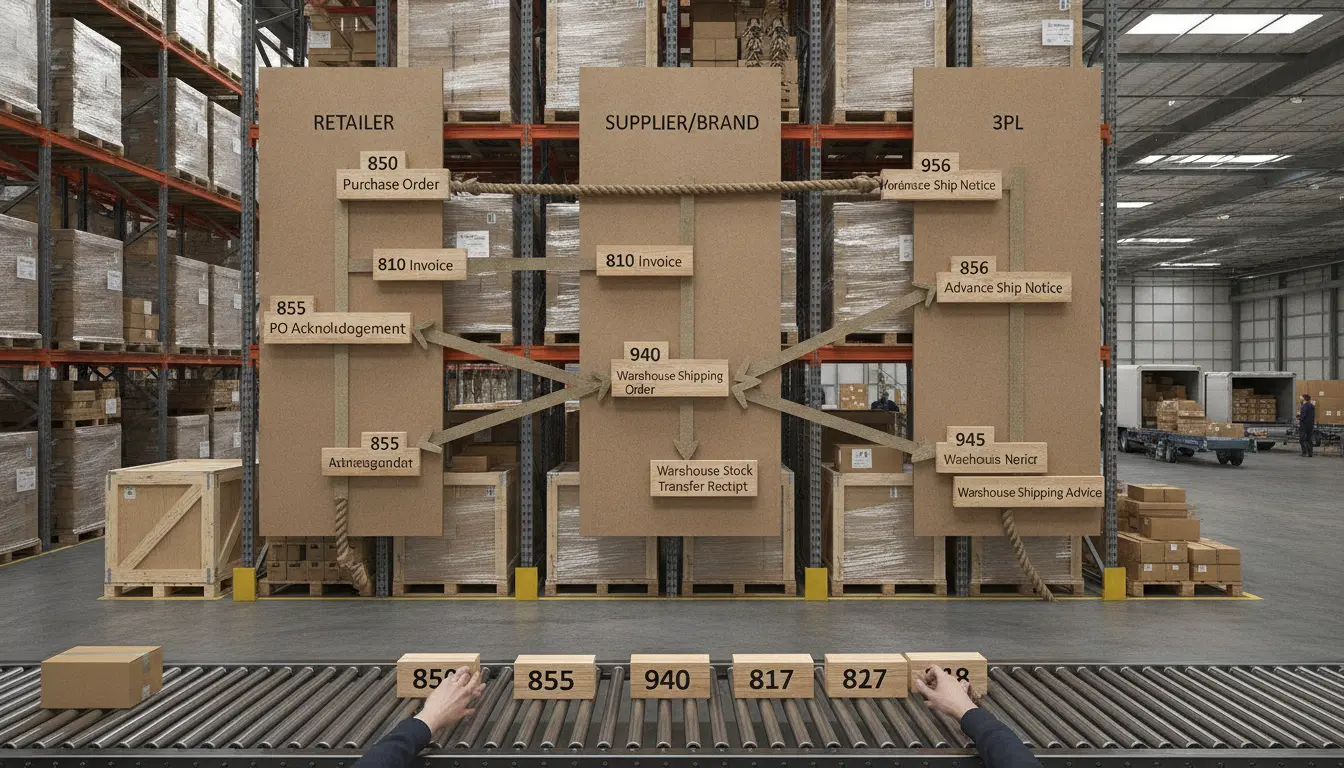
- Three EDI transaction sets drive most retail purchase order cycles: the 850 (purchase order), 856 (advance ship notice) and 810 (invoice).
- Retailer routing guides dictate carrier selection, packaging, labeling and delivery appointment requirements; non-compliance typically triggers chargebacks or rejected shipments.
- A capable 3PL handles EDI translation, label generation and routing guide execution so your team does not have to manage each retailer's rules manually.
- Before the first retail PO arrives, ask your 3PL specific questions about EDI ownership, compliance history, label capabilities and retailer-specific experience.
What Is EDI in Retail Fulfillment?
Electronic Data Interchange (EDI) is a standardized method for exchanging business documents between trading partners as structured electronic files, replacing paper orders, faxes and email attachments. In a retail context, EDI connects a brand (the supplier), a retailer (the buyer) and the 3PL executing the shipment. The American National Standards Institute (ANSI) X12 standard defines the transaction sets used in US retail; most major retailers reference X12 transaction sets in their vendor portals and routing guides.
EDI is not optional for most retail channels. Big-box retailers, department stores, regional chains and many grocery and specialty buyers require EDI-capable suppliers before they will issue a purchase order. Without EDI, a brand cannot receive orders, confirm shipments or submit invoices in the format the retailer expects.
The Three Core EDI Transaction Sets
While dozens of X12 transaction sets exist, three documents form the backbone of a typical retail purchase order cycle.
850: Purchase Order
The 850 is the retailer's electronic purchase order sent to the supplier. It specifies item numbers (usually the retailer's internal SKU and the supplier's UPC), ordered quantities, ship-to and bill-to locations, requested ship and delivery dates, price, and any special instructions. When a retailer transmits an 850, your EDI system or 3PL must acknowledge receipt and pass the order details into the warehouse management system (WMS) so picking can begin.
Key fields to map correctly on the 850: the retailer's purchase order number (used on all subsequent documents), the department number (required on GS1-128 labels for many retailers), and the must-arrive-by date (MABD), which is the hard delivery deadline that drives chargeback calculations when missed.
856: Advance Ship Notice
The 856, also called the ASN, is sent by the supplier to the retailer before or at the time of shipment. It tells the retailer exactly what is on each pallet, in each carton and on each line item, along with the carrier, tracking number, PRO number (for LTL shipments) or bill of lading number. Retailers use the ASN to pre-receive inventory in their distribution center systems, which means a late, missing or inaccurate 856 can delay their receiving process and trigger a compliance chargeback even if the physical shipment arrived on time.
The 856 must be sent within a retailer-defined window, commonly two to four hours after the carrier picks up the shipment. The carton-level detail in the 856 must match the GS1-128 shipping labels physically affixed to those cartons. Any discrepancy between the 856 data and the label data is a compliance failure.
810: Invoice
The 810 is the electronic invoice sent by the supplier to the retailer after shipment. It references the original 850 purchase order number and must match the quantities and prices on that order. Discrepancies between the 850 and the 810 are a common source of payment deductions. Many retailers auto-match the 810 against their receiving records; if the quantities differ from what was received, the retailer adjusts the payment and may issue a deduction notice.
How the EDI Document Flow Works in Practice
- Retailer sends 850 to supplier: The retailer's ordering system transmits the purchase order through an EDI network (also called a VAN, or value-added network) or a direct AS2 connection. Your EDI provider or 3PL receives the file and translates it into a readable order.
- Supplier acknowledges with 855 (optional but common): The 855 Purchase Order Acknowledgment confirms receipt and signals whether the order is accepted, partially accepted or rejected. Some retailers require this within 24 hours.
- 3PL picks, packs and labels the shipment: The WMS generates a pick list from the 850 data. The 3PL picks the goods, produces compliant GS1-128 carton labels and palletizes according to the routing guide.
- 3PL books the carrier and ships: Following the routing guide's carrier and service requirements, the 3PL schedules pickup or books a delivery appointment at the retailer's DC.
- Supplier sends 856 to retailer: As soon as the carrier picks up, the EDI system generates and transmits the ASN with shipment, pallet and carton details.
- Supplier sends 810 to retailer: After shipment, the invoice is transmitted. Payment is processed according to the retailer's terms, typically net 30 to net 60 days.
- Retailer may send 820 or 824: The 820 (Payment Remittance) confirms payment details; the 824 (Application Advice) flags EDI errors the retailer found in your documents. Both require a response from the supplier.
What Is a Retailer Routing Guide?
A routing guide (sometimes called a vendor compliance guide or supplier manual) is the retailer's operational rulebook for every aspect of how a supplier must prepare and ship goods to that retailer's distribution centers or stores. Routing guides are typically 20 to 100 pages long and cover carrier requirements, packaging specifications, labeling standards, pallet configuration, appointment scheduling and documentation.
Retailers update routing guides periodically. A supplier that was compliant six months ago may fall out of compliance if the guide changes and no one at the brand or the 3PL monitors those updates.
Carrier and Service Level Requirements
Most large retailers designate specific carriers and service levels for inbound shipments. For LTL (less-than-truckload) shipments, the routing guide names the preferred LTL carrier. For parcel shipments under a certain weight or unit count, it may specify a particular carrier and service tier. Using an unauthorized carrier is one of the most common routing guide violations and typically generates a chargeback. The routing guide will also specify whether the brand pays freight (prepaid) or the retailer pays (collect), and which freight terms apply.
Packaging and Pack Configuration
Routing guides specify inner pack quantities (the number of units in a consumer inner pack), master case quantities, and sometimes pallet build requirements including height limits, weight limits and whether mixed-SKU cases are permitted. If you sell a product in a twelve-count inner pack but the retailer requires a six-count inner pack, you need to reconfigure your packing before shipping. This is where kitting and assembly capabilities at the 3PL level become directly relevant to retail compliance.
Labeling Requirements: GS1-128 and Pallet Labels
GS1-128 (formerly UCC-128) is the barcode standard used on shipping cartons for retail. A compliant GS1-128 label contains application identifiers (AIs) that encode the SSCC (Serial Shipping Container Code), ship-to location, purchase order number, item number, quantity and department number, among other fields. The exact AIs required, label size (typically 4 inches by 6 inches), placement on the carton, and whether a label is required on all four sides or just two, are all specified in the routing guide.
Pallet labels use a similar GS1-128 structure but identify the pallet as a whole. Some retailers require a placard-style pallet label on all four sides; others require it on two sides. The GS1 US organization publishes the technical specifications for GS1-128 labels and SSCCs, and those specifications underpin what every retailer routing guide references. For current GS1 US standards, the authoritative source is GS1 US.
Delivery Appointments and DC-Level Rules
Many retailers require a confirmed delivery appointment before a truck can enter their distribution center. Miss the appointment window and the shipment may be turned away, rescheduled at additional cost and flagged as a compliance failure. The routing guide specifies how to book appointments, how far in advance appointments must be made, and what happens on a missed appointment.
What Happens When Routing Guide Compliance Fails
Retailers enforce compliance through chargebacks: deductions from invoice payments that correspond to specific violations. Each retailer publishes its chargeback schedule in its routing guide or compliance documents. Common chargeback triggers include missing or incorrect ASN, late ASN, non-compliant labels, wrong carrier, incorrect pack configuration, missing packing slip, and shipment arriving outside the MABD window.
Chargeback amounts are set by the retailer and vary by violation type and retailer. Some are flat fees per shipment; others are a percentage of the PO value. The practical impact is that a brand can win shelf space with a retailer and still lose margin on every PO if its 3PL cannot execute compliance consistently. For the authoritative X12 transaction set specifications that underpin retailer EDI requirements, the X12 organization publishes the full standards library.
Where the 3PL Fits in EDI and Retail Compliance
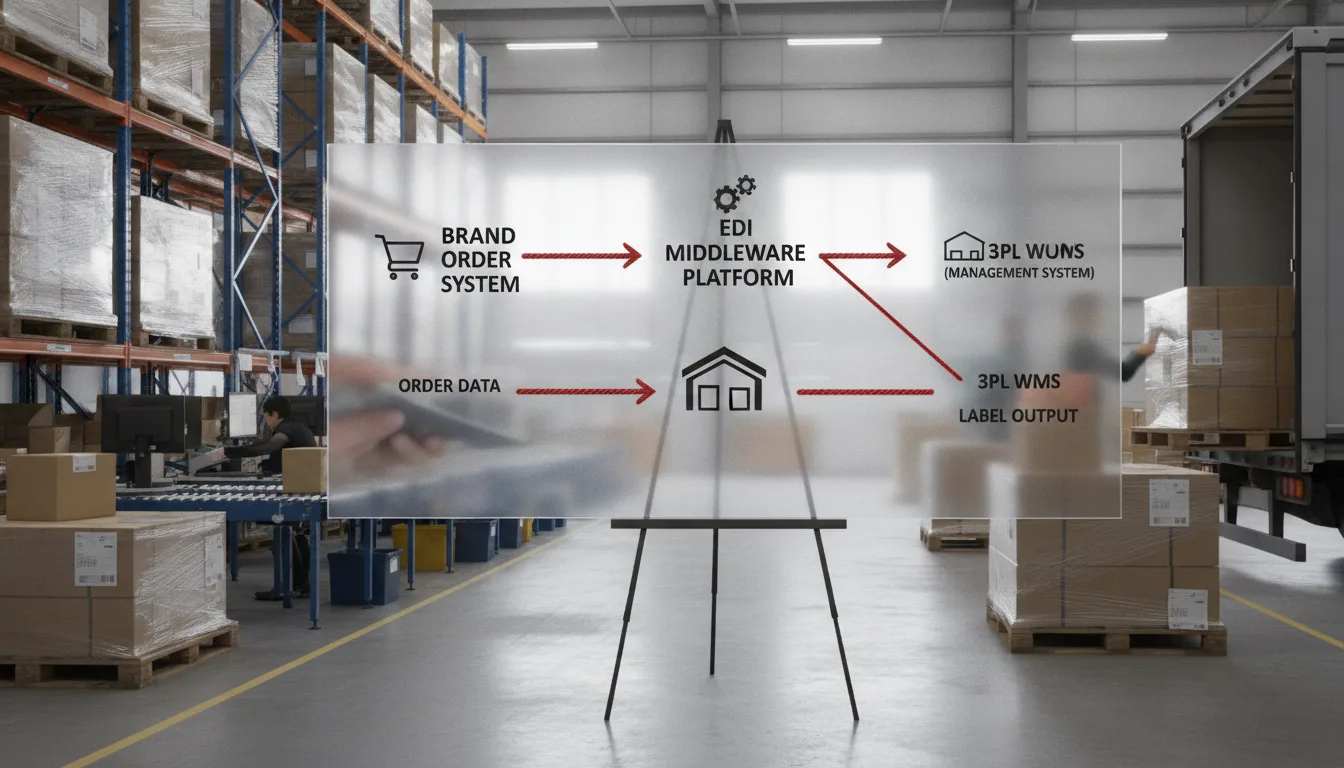
A brand working with a 3PL for retail fulfillment can structure EDI ownership in two ways. In the first model, the brand owns the EDI connection with the retailer and passes order data to the 3PL via its WMS integration or a middleware platform. In the second model, the 3PL manages the full EDI relationship on the brand's behalf, including the trading partner setup, testing and ongoing document exchange.
YouParcel supports EDI-enabled B2B and retail fulfillment, including routing guide compliance and retailer-specific labeling. For brands that use an EDI middleware provider, YouParcel integrates with platforms including SPS Commerce, enabling automated order flow from retailer PO through to ASN without manual rekeying.
The 3PL's WMS must be able to receive order data at the SKU and line-item level from the 850, generate GS1-128 compliant labels with the correct AIs for each retailer, produce packing lists in the retailer-required format, build pallets to spec, and transmit 856 ASN data back through the EDI channel at the moment of carrier pickup. If any of these steps require manual intervention, the error rate rises and the chargeback exposure increases.
Questions to Ask a 3PL Before Your First Retail Purchase Order
Choosing a 3PL for retail and ecommerce fulfillment is different from choosing one for DTC parcel shipping. The following questions reveal whether a 3PL can genuinely execute retail compliance or whether it is learning on your POs.
1. Who owns the EDI connection with our retail partners?
Ask explicitly whether the 3PL has its own EDI connections to your target retailers, or whether you are expected to bring an EDI provider. Understand who is responsible for trading partner testing, map updates when the retailer changes its guide, and 824 error resolution.
2. Which EDI transaction sets does your WMS support natively?
At minimum, confirm support for 850, 856, 810 and 855. Ask whether the WMS generates the 856 automatically at carrier scan or whether staff must trigger it manually. Manual triggering is a risk factor for late ASN chargebacks.
3. How do you manage routing guide updates?
Routing guides change. Ask who monitors the retailer's supplier portal for guide updates, how changes are communicated to the warehouse floor and label templates, and what the turnaround time is for implementing a label change before it affects a live PO.
4. Can you show us a GS1-128 label sample for one of our target retailers?
A 3PL with real retail compliance experience can produce a sample label for a specific retailer on request. The label should show correct AI placement, the SSCC structure, retailer-required fields (department number, PO number, item number) and barcode quality. If the 3PL cannot produce a sample, that is a signal.
5. What is your chargeback history with retail clients?
Ask the 3PL to describe, in general terms, how often compliance chargebacks occur and how they are resolved. You want to know whether the 3PL tracks chargebacks by root cause (label error, late ASN, wrong carrier) and whether it has a process for identifying and fixing recurring issues. No 3PL has a zero-chargeback record, but a good one knows exactly why chargebacks happen and can demonstrate improvement over time.
6. How do you handle same-retailer, different-DC routing?
Large retailers may have ten or more distribution centers with different routing guide requirements for each. Ask whether the 3PL's WMS stores DC-level routing profiles and whether label templates, carrier accounts and appointment processes are configured per DC or per retailer.
7. What kitting and assembly capabilities do you have for retail pack configurations?
If your product must be repackaged into a retailer-specific inner pack, ask whether the 3PL can perform this in-house, what the lead time is for a new pack configuration, and whether it can be triggered by the 850 data automatically or requires a manual work order.
8. Which retail partners have you shipped to in the past 12 months?
You are looking for overlap with your own target retail partners. A 3PL that has an active, tested EDI connection and known routing guide for a retailer you are targeting will execute your first PO with far fewer errors than one setting up that connection for the first time on your behalf.
B2B Fulfillment vs DTC Fulfillment: Key Operational Differences
| Dimension | DTC / Ecommerce Fulfillment | B2B / Retail Fulfillment |
|---|---|---|
| Order size | 1 to 10 units per order, high volume of small orders | Dozens to thousands of units per PO, lower order frequency |
| Destination | Consumer home address | Retailer DC or store, with specific dock and appointment requirements |
| Labeling | Carrier shipping label (USPS, FedEx, UPS) | GS1-128 carton and pallet labels with retailer-specific field requirements |
| EDI requirement | Not required; order management via platform API | Mandatory for most major retail buyers; 850, 856, 810 at minimum |
| Packing format | Polybag, mailer or box per order | Inner packs, master cases and pallets to routing guide spec |
| Compliance risk | Carrier surcharges, dimensional weight adjustments | Retailer chargebacks, rejected shipments, potential vendor removal |
| Carrier selection | Brand or 3PL selects for cost and speed | Retailer routing guide dictates carrier and service level |
| Receiving method | Consumer opens parcel | Retailer DC scans SSCC, matches to ASN, receives into inventory system |
Preparing Your First Retail PO: A Pre-Shipment Checklist
- Obtain the current routing guide from the retailer's vendor portal and confirm the version date.
- Verify your GS1 Company Prefix is active and your UPCs are registered. GS1 US manages prefix assignment and product registration.
- Confirm your 3PL has completed trading partner testing with the retailer for the 850, 855, 856 and 810 transaction sets.
- Provide the 3PL with your complete item master: each SKU, UPC, inner pack quantity, case quantity and case weight/dimensions.
- Review the routing guide's label requirements with the 3PL and obtain a test label for approval before the first live PO.
- Confirm the carrier account to be used matches the routing guide's designated carrier and service level.
- Set up delivery appointment access for the target retailer DC; confirm the 3PL knows the booking lead time required.
- Define the 856 transmission trigger: confirm it fires at carrier scan, not at manual dispatch.
- Review packing and palletization specs for height, weight and mixed-SKU rules; align with the 3PL's packing team.
- Establish a chargeback monitoring process: know which party reviews deduction notices and within what timeframe disputes must be filed.
Frequently Asked Questions
What does a 3PL need to handle EDI for retail fulfillment?
The 3PL needs a WMS that can ingest 850 purchase order data and generate GS1-128 compliant labels, as well as the ability to transmit 856 advance ship notices automatically at carrier pickup. It also needs EDI connections to your trading partners, either through its own VAN or AS2 setup or through a middleware provider like SPS Commerce, and documented processes for following each retailer's routing guide.
What is an advance ship notice (856) and why does it matter?
An 856 is an EDI document sent by the supplier to the retailer that describes exactly what is in the shipment, down to the pallet, carton and unit level. Retailers use it to pre-receive inventory in their systems; a late or inaccurate 856 triggers chargebacks even if the physical goods arrived on time and in full.
Can a brand outsource EDI management entirely to a 3PL?
Yes, in many cases. A 3PL with full EDI capabilities can own the trading partner setup, document exchange and error resolution on behalf of the brand. The brand needs to supply its item master, GS1 UPCs and routing guide access, but the 3PL manages the technical document flow and label compliance from that point forward.
What is the difference between a routing guide and a vendor compliance guide?
The terms are used interchangeably by most retailers. Both refer to the retailer's supplier-facing documentation that specifies carrier requirements, packaging and labeling standards, pallet configuration, delivery appointment procedures and chargeback policies. Some retailers publish a single document; others separate operational routing instructions from broader vendor compliance requirements.
How does EDI work for brands selling to both retailers and direct-to-consumer?
EDI handles the retail channel; DTC orders typically flow through platform APIs such as Shopify or Amazon. A 3PL supporting both channels needs to run separate fulfillment workflows for each: compliance-driven pick-pack-label for retail POs and speed-optimized individual-order fulfillment for DTC. The same warehouse can run both, but the WMS must keep the workflows and label sets distinct.
Ready to move your retail and wholesale fulfillment to a 3PL that handles EDI, routing guide compliance and GS1-128 labeling end to end? Talk to an Expert at YouParcel and get a clear picture of how your first retail PO would flow through our system.
To see how EDI-enabled b2b fulfillment connects to your broader ecommerce operations, visit our ecommerce fulfillment services overview.