


When brands search for ShipBob alternatives or the best ecommerce fulfillment companies, the instinct is to compare prices first. That instinct is understandable but costly: a 3PL that quotes low but sits in one warehouse, supports three integrations and answers tickets in 48 hours will cost far more in chargebacks, stockouts and lost customers than one with a slightly higher pick-and-pack fee. YouParcel uses the multi-dimensional framework below to help brands evaluate their options clearly.
- Location is usually the highest-leverage variable. A single warehouse in the wrong region can add one to two days of transit to half your customer base.
- Integration depth determines operational risk. A missing connector to your storefront or marketplace forces manual work that grows with every order.
- Service scope must match your growth path. A provider that handles DTC today but cannot support B2B, wholesale or returns at scale will force a second migration.
- Support quality is a hidden cost driver. Slow issue resolution compounds into inventory write-offs, carrier claims and customer refunds.
Why "ShipBob alternatives" is the wrong starting question
The search phrase "ShipBob alternatives" is shorthand for a broader question: which 3PL fulfillment companies are actually worth evaluating for my situation? Naming a specific incumbent frames the search around that provider's feature set, which may not match yours at all. A brand shipping 200 Shopify orders a day has different requirements from one running 1,000-plus orders across Amazon, Walmart and a wholesale account with EDI compliance obligations.
Start with requirements, not brand names. Build a requirements matrix first, then map providers to it. That is the structure this article follows.
Step 1: Map your warehouse footprint requirements
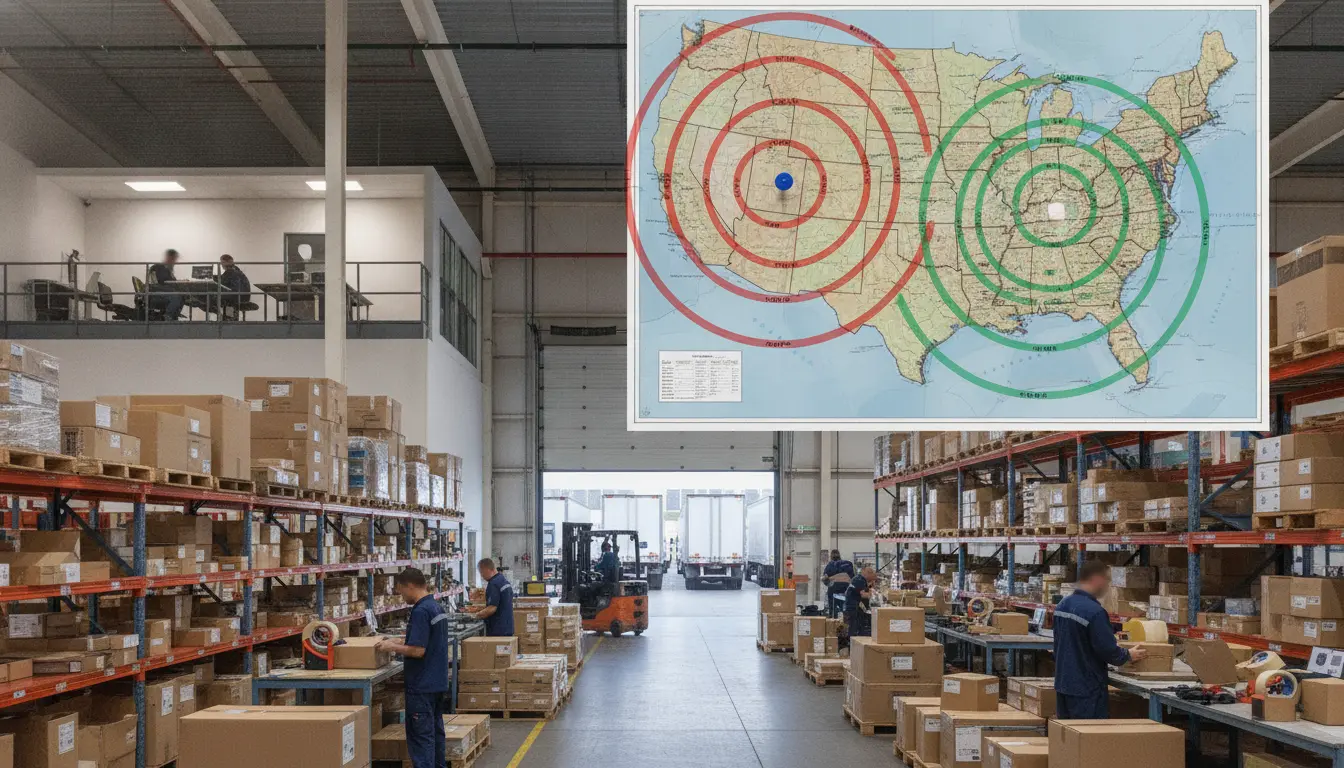
Warehouse location directly controls ground-transit time, which controls customer satisfaction and return rates. The United States spans six time zones. A fulfillment center in a single metro can reach roughly 30 to 40 percent of the US population within two ground-shipping days, depending on carrier routing. Covering 90 percent of the continental US in two days typically requires at least two strategically placed nodes: one on the East Coast and one on the West Coast or in the Midwest.
When evaluating any provider, ask for a zip-code-level transit-time map, not a marketing claim. Then overlay your own order geography from your existing analytics.
Questions to ask about warehouse footprint
- How many fulfillment centers does the provider operate, and in which metro areas?
- Can inventory be split across multiple nodes, and does the provider handle replenishment transfers automatically?
- What is the actual receiving capacity at each location during peak periods (Q4, promotional events)?
- Does each facility handle the same service mix, or are some sites DTC-only?
YouParcel operates fulfillment centers in New Jersey, California and Illinois, covering the major population corridors on both coasts and the Midwest. The East Hanover, NJ facility (20 Farinella Dr, East Hanover, NJ 07936) and the Rialto, CA facility (3700 S. Riverside Ave, Rialto, CA 92324) serve as the primary East and West Coast nodes. YouParcel handles 10,000-plus orders per day across multiple marketplaces, which means its receiving and processing infrastructure is built for real production volume, not just pilot programs.
Step 2: Audit integration coverage
An integration, in fulfillment context, is a live data connection between the 3PL's warehouse management system (WMS) and an external platform, such as a storefront, marketplace, ERP or analytics tool. When a 3PL says it "integrates" with a platform, that claim covers a wide spectrum: a simple webhook that pushes tracking numbers is not equivalent to a bidirectional sync that also updates available inventory, fires purchase orders and feeds a reporting dashboard.
How to compare integration depth
| Integration type | Minimum viable | What to expect from a mature 3PL |
|---|---|---|
| Storefront (Shopify, etc.) | Order import + tracking pushback | Bidirectional inventory sync, order editing, return triggers |
| Marketplace (Amazon, Walmart) | Order download + shipment confirm | Multi-channel inventory pooling, MCF support, FBA prep workflows |
| ERP / OMS | Manual export/import | Native or certified connector (Salesforce, NetSuite, etc.) |
| Analytics / BI | Static CSV reports | Live dashboard feed (Tableau, Power BI) with SKU-level velocity data |
| EDI (retail and wholesale) | Not supported | Full EDI compliance: 850, 856, 810 documents; routing guide adherence |
YouParcel integrates with Shopify, Amazon, Salesforce, Tableau and 70-plus other platforms. For B2B and wholesale channels, it supports EDI and retailer compliance including routing guides and labeling requirements, which many DTC-first 3PLs do not offer at all.
When comparing providers, request a formal integration catalog and ask specifically which integrations are native versus which rely on third-party middleware such as Zapier. Middleware adds latency and an extra point of failure.
Step 3: Evaluate service scope against your full growth roadmap
Most brands start a 3PL search focused on their current channel mix. That is a mistake. A provider you have to leave in 18 months because it cannot support wholesale, returns or international shipping costs you a full migration cycle, including the operational disruption, re-labeling inventory and retraining your team. Evaluate providers against your two-year roadmap, not only your current state.
Service scope checklist
| Service area | Why it matters | Provider question |
|---|---|---|
| DTC ecommerce fulfillment | Core requirement for most brands | What is the minimum order volume? What is peak daily capacity per site? |
| B2B and wholesale distribution | Revenue diversification; retail buyers require EDI and compliance | Does the provider support EDI 850/856/810 and retailer routing guides? |
| Amazon FBA prep | Avoids costly FBA non-compliance fees | Does the provider do FNSKU labeling, case packs, poly-bagging and carton marking? |
| Kitting and assembly | Needed for subscription boxes, bundles and promotional sets | Is kitting done at the fulfillment center or outsourced? What is the per-unit cost? |
| Returns processing | Return rates in ecommerce average 15 to 30 percent depending on category (NRF, 2024) | Does the provider grade returned items, restock sellable units and dispose of unsellable stock? |
| International shipping | Cross-border sales require DDP/DDU options and customs documentation | Which countries does the provider ship to? Which carriers are used for international parcels? |
| Subscription box fulfillment | Requires burst capacity and batch pick-and-pack workflows | How is a 10,000-unit monthly batch managed? What is the assembly timeline? |
YouParcel's ecommerce fulfillment services cover all of the above: DTC, B2B/wholesale, Amazon FBA prep, kitting and assembly, returns, subscription boxes, crowdfunding campaigns and international shipping to 100-plus countries via carriers including USPS, FedEx, DHL, Aramex and EasyPost.
Step 4: Assess carrier relationships and rate access
A 3PL's carrier mix directly affects your shipping cost and service reliability. Providers that rely on a single carrier expose your fulfillment operation to service failures, rate increases and peak-season capacity crunches. Evaluate providers on three dimensions: breadth of carrier relationships, the service levels available within each carrier (ground, express, overnight, parcel select), and whether the provider uses carrier rate shopping to select the lowest-cost or fastest option per shipment.
For international shipments, also confirm whether the provider can support Delivered Duty Paid (DDP) shipping, where import duties and taxes are collected at checkout and paid by the shipper before delivery. DDP typically improves conversion rates and reduces parcel rejection at the border compared with Delivered Duty Unpaid (DDU) arrangements, where the recipient must pay customs fees on delivery. For a full breakdown of these Incoterms and their cost implications, see the YouParcel fulfillment expert team.
Step 5: Evaluate technology and visibility
Technology in 3PL evaluation covers three layers: the WMS used internally, the client-facing portal and the reporting and analytics environment. Each layer affects how much operational visibility you have and how quickly you can act on problems.
What good fulfillment technology looks like
- Real-time inventory visibility: Current on-hand counts, in-transit units and committed inventory per SKU, updated continuously, not in nightly batches.
- Order-level tracking: Real-time tracking events pushed to your storefront and to customers, with proactive alerts when shipments are delayed or exceptions occur.
- BI and analytics: SKU velocity reports, fill rates, receiving turnaround times and return reason codes fed into a dashboard you can query yourself, not just static monthly PDFs.
- Exception management: Automated alerts for inventory below reorder threshold, failed deliveries and returns requiring disposition decisions.
YouParcel provides real-time tracking and alerts, plus BI and analytics accessible through native dashboards and integrations with Tableau and Salesforce. For enterprise operations running multiple warehouses, those data feeds are critical for allocation decisions across nodes. Learn more about how those capabilities serve complex operations on the enterprise solutions page.
Step 6: Score support quality and account structure
Support quality is the most underevaluated variable in 3PL selection. During a sales process, every provider describes its support as responsive and dedicated. The only reliable way to assess support before signing is to ask the right questions and to speak directly with the team that will own your account post-onboarding, not only the sales representative.
Support questions that reveal real quality
- Who is my named account manager, and what is their average number of accounts?
- What is the documented escalation path for a receiving error or a carrier claim?
- How are peak-period support resources managed (Q4, Cyber Monday)?
- Can you provide a sample SLA (Service Level Agreement) showing resolution time targets by issue type?
- How are custom or non-standard requests handled, for example a one-time promotional kit or an unusual packaging requirement?
YouParcel's leadership brings 50-plus years of combined experience in logistics and fulfillment. Its teams handle custom solutions for complex, non-standard problems, which matters when your brand runs a crowdfunding campaign, a retail launch or a seasonal surge that falls outside routine DTC workflows.
Step 7: Build a weighted scorecard
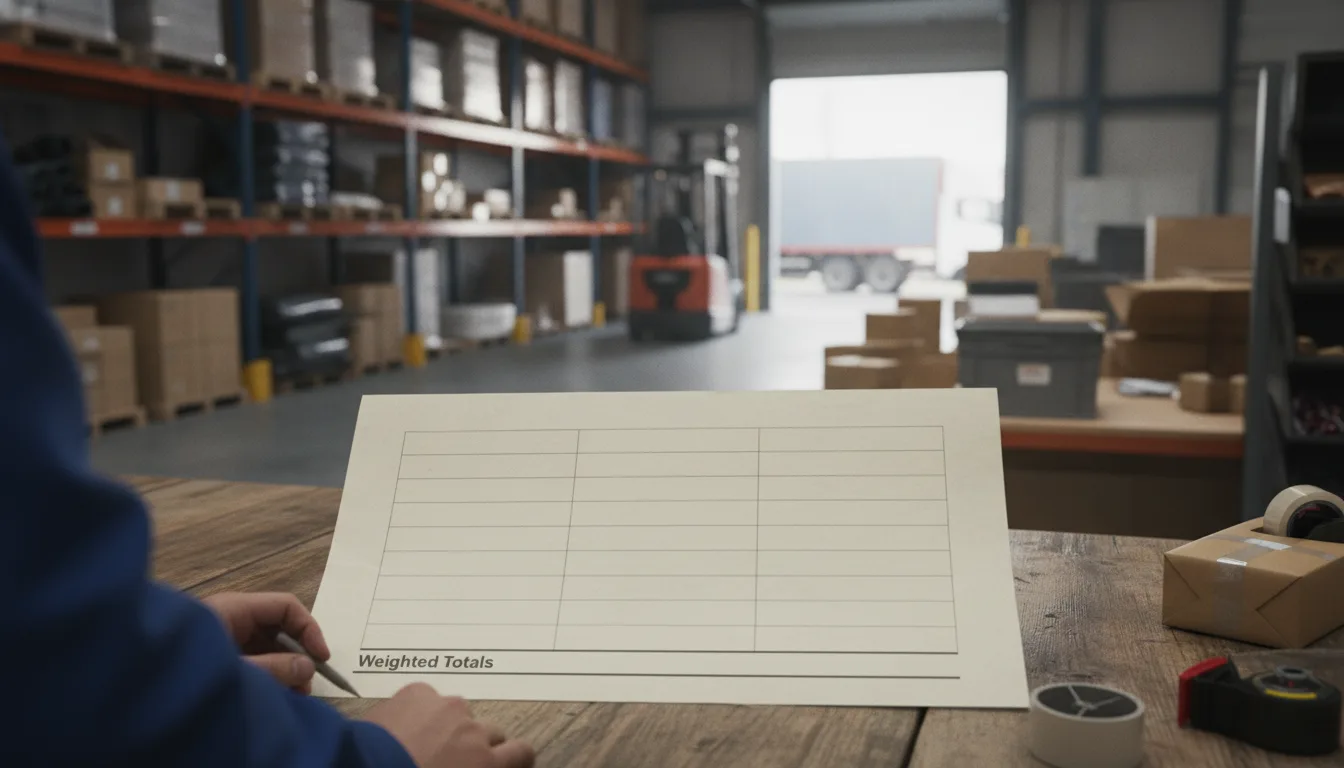
Once you have gathered data on each provider across the dimensions above, a weighted scorecard converts qualitative impressions into a defensible decision. Assign weights to each dimension based on your specific priorities. A pure DTC brand may weight integrations heavily; a brand entering wholesale may weight EDI and service scope more. Below is a starting template.
| Dimension | Suggested weight (DTC-first brand) | Suggested weight (omnichannel brand) |
|---|---|---|
| Warehouse footprint and transit coverage | 25% | 20% |
| Integration breadth and depth | 25% | 20% |
| Service scope (B2B, returns, kitting, international) | 15% | 25% |
| Carrier mix and rate access | 15% | 15% |
| Technology and visibility | 10% | 10% |
| Support quality and account structure | 10% | 10% |
Score each provider from 1 to 5 on each dimension, multiply by the weight, and sum the totals. The provider with the highest weighted score, not the lowest rate card, should be your shortlist leader. Price is then a tiebreaker or a negotiation lever, not the primary filter.
What the transition process actually looks like
Switching 3PL providers is a supply chain migration. Even when the decision is clear, the execution requires careful sequencing to avoid a stockout or a service gap. The general steps for a provider transition are as follows.
- Parallel onboarding period: Sign with the new provider and begin the integration setup and configuration before you send any inventory. Most integrations take one to three weeks to test fully.
- Inbound shipment to new facilities: Send a portion of inventory to the new provider while the existing provider continues to ship. This protects order flow while you validate the new operation.
- Soft launch on a single channel: Route one storefront or marketplace to the new provider first. Monitor fill rates, ship times and tracking accuracy for two to four weeks before switching all channels.
- Full cutover: Once performance is validated, redirect all channels. Begin running down safety stock at the old provider.
- Closeout and reconciliation: Retrieve or dispose of remaining inventory at the old provider, reconcile billing statements and close the account per the contractual notice period.
Attempting to cut over all channels simultaneously increases the risk of a stockout or a double-ship. A phased approach adds two to four weeks to the transition timeline but significantly reduces operational risk.
Frequently asked questions
What is the most important factor when comparing ShipBob alternatives?
Warehouse footprint is usually the highest-leverage factor because it directly determines ground-transit time for your customer base. After footprint, evaluate integration depth and service scope, since gaps in either area compound into manual work and forced migrations as your brand scales.
How many 3PL fulfillment companies should I shortlist before making a decision?
Three to five providers is a practical shortlist. Fewer than three limits your negotiating position; more than five creates evaluation overhead without meaningfully improving the final decision. Use the weighted scorecard framework to narrow from a long list to three finalists, then conduct facility tours or reference calls before signing.
How long does it take to switch 3PL providers?
A phased transition typically takes six to ten weeks from signed contract to full cutover, covering integration setup, inventory inbound, soft-launch validation and final channel migration. Brands that try to cut over in under two weeks run a materially higher risk of stockouts and service failures.
Do 3PL fulfillment companies support both DTC and wholesale from the same inventory pool?
Many do, but not all. Wholesale and B2B distribution require EDI support, retailer compliance (routing guides, case-pack labeling) and sometimes different packaging workflows from DTC. Confirm that the provider supports both channels from a single inventory pool before assuming they are equivalent capabilities.
How should I evaluate a 3PL if I plan to expand internationally?
Confirm the provider's carrier mix for cross-border shipments, its ability to offer DDP (Delivered Duty Paid) shipping to your target markets and whether it can generate compliant commercial invoices and customs documentation. Also ask how the provider handles international returns, since the reverse logistics process for cross-border parcels is significantly more complex than domestic returns.
Ready to put this framework to work? The YouParcel fulfillment team can walk you through a requirements assessment, map your order geography against our warehouse footprint and demonstrate our integration catalog in a single conversation. Talk to an expert to get started.