

Last-mile delivery is the final stage of a parcel's journey through the supply chain, covering the movement from a carrier's local sortation or delivery hub to the end customer's address. For ecommerce brands, it is the single most expensive segment of the shipping process, routinely representing 40 to 53 percent of total delivery cost according to industry estimates tracked by Supply Chain Dive. YouParcel manages this leg daily across its U.S. fulfillment network, working with carriers including USPS, FedEx, DHL, Aramex and EasyPost to move 10,000-plus orders per day.
- Last-mile delivery covers the final movement from a local hub to the customer's door and is the highest-cost leg in the parcel delivery network.
- Cost is driven by low delivery density, residential surcharges, failed delivery attempts and the sheer number of individual stops a driver or carrier must make.
- Carrier mix, meaning the deliberate selection of different carriers for different zones, weight classes and service levels, is one of the most effective levers ecommerce brands have to reduce last-mile spend.
- Warehouse location directly shortens the last-mile distance to your customers, cutting both transit time and cost per shipment.
What is last-mile delivery?
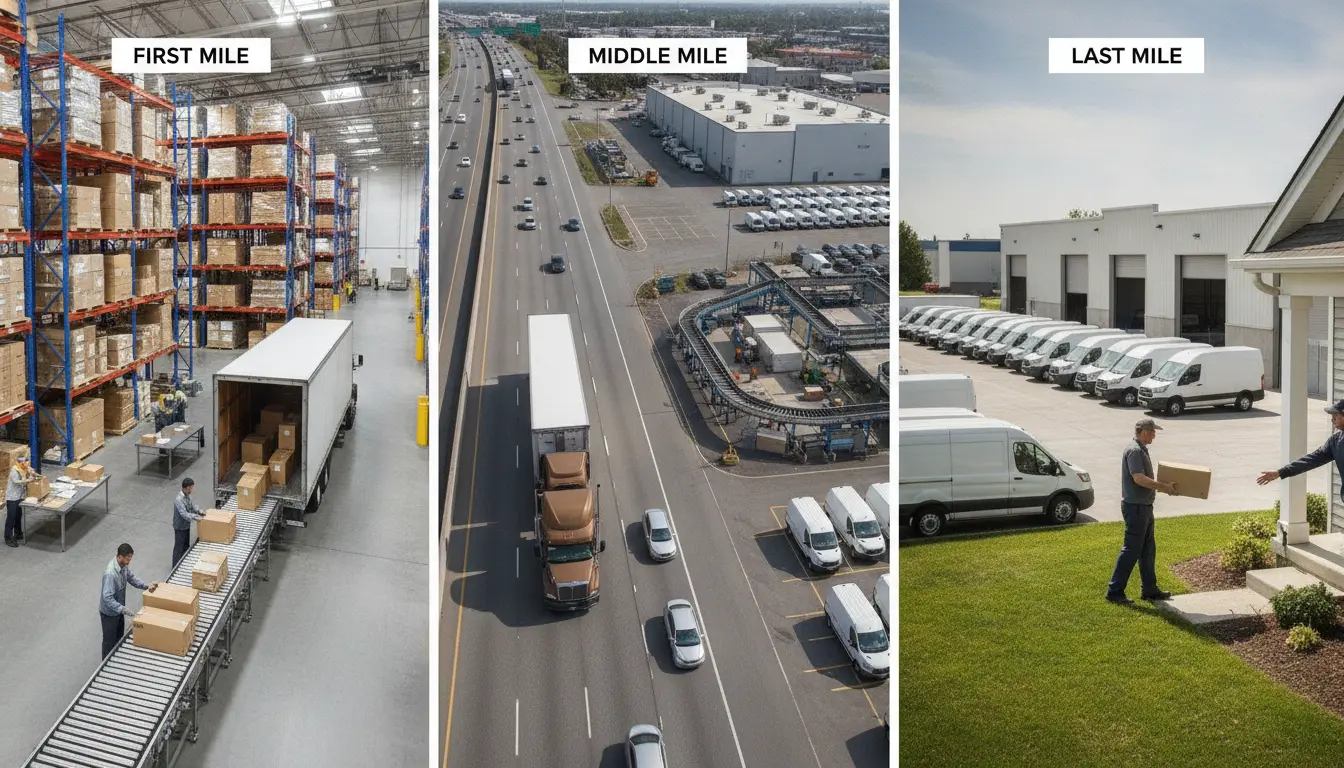
In logistics, the supply chain is typically divided into three broad movements: first mile (product leaves the manufacturer or supplier), middle mile (freight moves through consolidation hubs, ports and regional distribution centers) and last mile (a single parcel or small consignment travels from a local facility to the recipient). The term "last mile" is a convention; the actual distance can range from two miles in a dense urban area to 60 or more miles in a rural zone.
The last-mile leg is where the parcel delivery network transitions from bulk, high-density freight movement to individual, dispersed delivery stops. That transition is what makes it expensive. A long-haul truck might carry thousands of parcels to a regional hub in a single efficient run. A delivery van completing the last mile in a suburban neighborhood might carry 80 to 150 parcels and make a separate stop for every single one.
How the parcel delivery network is structured
Understanding the full network helps explain why last-mile costs are hard to compress. A typical U.S. parcel moves through these stages after leaving a fulfillment center:
- Carrier pickup: The parcel is collected from the fulfillment center and scanned into the carrier's network at an origin facility.
- Sortation hub (origin): Parcels are sorted by destination region and loaded onto linehaul transport, typically overnight truck or air.
- Linehaul: Freight moves in bulk between major carrier hubs, often crossing one or more regional sortation facilities.
- Delivery unit (destination): The parcel arrives at the carrier's local delivery station or post office closest to the recipient's address. For USPS this is a Sectional Center Facility (SCF) or a local post office; for FedEx and UPS it is a local delivery station.
- Last-mile delivery: A driver loads the parcel onto a delivery vehicle and drives to the customer's address. This is the last-mile leg.
Every step before the last mile benefits from economies of scale. The last mile does not. Each stop is unique, each address presents its own access constraints, and there is no guarantee the recipient will be present to accept the parcel.
Why last-mile delivery is the costliest leg
The cost structure of last-mile delivery is fundamentally different from bulk freight. Several factors combine to make it disproportionately expensive relative to the distance covered.
Low delivery density
Delivery density refers to the number of successful stops a driver completes per route mile. In a dense urban area, density can be high: a carrier might make 15 to 25 deliveries per mile. In suburban and rural areas, density collapses. When a driver travels five miles to deliver one parcel, that parcel absorbs the entire fuel and labor cost of the route segment. Rural deliveries are particularly expensive for this reason, and many carriers apply rural or extended delivery area surcharges to reflect the real cost.
Residential surcharges
Major carriers including FedEx and UPS apply a residential delivery surcharge to parcels delivered to home addresses, as opposed to commercial addresses. This reflects the lower density and longer dwell time (waiting for a signature, navigating driveways, leaving safe-place notices) associated with residential stops. USPS, by contrast, is mandated to deliver to every U.S. address regardless of density, which is part of why USPS rates for lightweight residential parcels are often lower than those of private carriers for the same zone.
Failed delivery attempts and re-delivery
When no one is home and a parcel cannot be left safely, the carrier must attempt re-delivery on a subsequent day. Each failed attempt adds labor and fuel cost without generating a successful outcome. For high-value or signature-required shipments, the re-delivery rate can materially increase the effective cost per delivered parcel. Some carriers pass this cost through as an additional attempt fee.
Dimensional weight pricing
Carriers price parcels on the greater of actual weight and dimensional weight (also called dim weight). Dimensional weight is calculated by multiplying a package's length, width and height in inches, then dividing by a divisor. FedEx and UPS use a divisor of 139 for domestic ground shipments as of their published rate cards. USPS uses 166 for Priority Mail parcels above one cubic foot. A lightweight but bulky product, such as a pillow or an assembled gift set, will often be billed on dimensional weight rather than actual weight, which inflates the effective per-parcel cost in the last mile where individual package economics matter most. For more on how this calculation works, see YouParcel's shipping services overview.
Carrier surcharges and accessorial fees
Beyond base rates, carriers layer accessorial charges onto last-mile shipments: delivery area surcharges (DAS) for ZIP codes outside the carrier's dense network, additional handling fees for irregular-sized parcels, peak and demand surcharges during high-volume periods, and address correction fees when a shipper provides an incomplete or incorrect address. These surcharges are not trivial. FedEx and UPS publish their surcharge schedules annually and have increased DAS coverage in recent years, meaning more ZIP codes now attract a premium. Reviewing carrier rate filings directly on the FedEx rates and surcharges page is the most reliable way to verify current surcharge levels, as they change with each annual General Rate Increase (GRI).
How carrier mix shapes last-mile cost and reliability
No single carrier is the lowest cost or the most reliable option for every parcel, every zone and every product type. Ecommerce brands that treat carrier selection as a strategy rather than a default configuration consistently achieve better cost and service outcomes than those that rely on a single carrier for all shipments.
Carrier mix, in practical terms, means routing different orders to different carriers based on a defined set of criteria. The most common criteria are:
| Routing criterion | Typical logic | Example carrier advantage |
|---|---|---|
| Destination zone | Zone 1 to 3 (short distance): carrier A may be cheapest; Zone 7 to 8 (long distance): carrier B may win on cost or speed | USPS Priority Mail is often competitive for zones 7 and 8 lightweight parcels |
| Parcel weight and dimensions | Lightweight parcels under one pound: USPS First Class or Priority; heavier parcels: FedEx or UPS Ground | USPS First Class Package Service carries no fuel surcharge and no residential surcharge |
| Delivery speed requirement | Standard (5 to 7 business days): ground; expedited (2 days): air express or ground express | FedEx and UPS offer published day-definite ground transit for shorter zones |
| Destination type (rural vs. urban) | Rural ZIP codes: USPS avoids rural DAS; urban high-density: private carriers may offer better tracking and delivery confirmation | USPS delivers to PO Boxes and military APO/FPO addresses where private carriers do not |
| Product value and insurance needs | High-value items: carrier with declared value and signature confirmation; standard items: least-cost carrier | FedEx and UPS offer higher declared value coverage limits than USPS |
| International last mile | Cross-border parcels need a carrier with a local delivery network in the destination country | DHL Express and Aramex have strong last-mile networks in markets where USPS and FedEx have limited reach |
YouParcel integrates with USPS, FedEx, DHL, Aramex and EasyPost, giving brands access to multi-carrier rate shopping at the point of label generation. EasyPost itself functions as a carrier API aggregator, meaning it can surface rates from dozens of regional and national carriers in a single call, allowing the system to select the least-cost compliant option for each shipment automatically.
Regional carriers and final-mile specialists
Beyond the national carriers, a category of regional carriers and final-mile specialists operates in specific geographies. These carriers often offer lower rates than national carriers within their coverage areas because their networks are purpose-built for density in those regions. For high-volume brands with significant order concentrations in specific states, adding a regional carrier to the mix can generate meaningful cost savings without sacrificing transit time.
Carrier mix and the customer experience
Carrier mix is not purely a cost exercise. Each carrier delivers a different customer experience: different tracking granularity, different delivery notification systems, different handling standards and different claims processes. A brand that ships through multiple carriers needs consistent tracking and alert visibility across all of them. YouParcel provides real-time tracking and alerts regardless of which carrier handles a given shipment, so the customer-facing experience remains consistent even when the underlying carrier varies by order.
How warehouse location shapes last-mile distance and cost
The geographic starting point of the last-mile leg matters as much as the carrier that runs it. A parcel shipped from a fulfillment center in New Jersey to a customer in Philadelphia enters the last mile in Zone 2 or Zone 3 (roughly 150 to 300 miles). The same SKU shipped from a facility in California enters the last mile in Zone 7 or Zone 8 for that same Philadelphia customer. The difference in base rate between Zone 2 and Zone 8 can easily exceed several dollars per parcel for a standard 2-pound ground shipment.
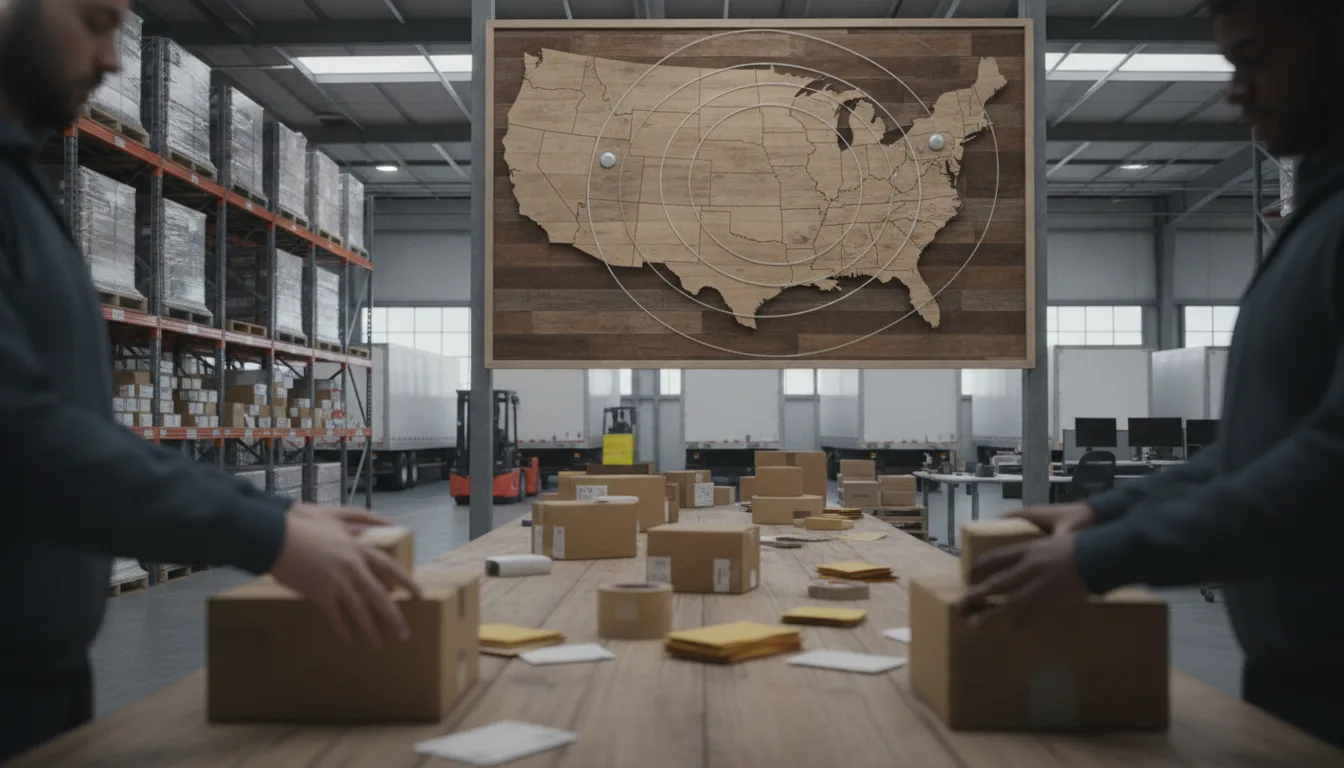
This is the core logic behind multi-node fulfillment: by holding inventory in multiple geographically distributed warehouses, a brand reduces the average zone distance to its customers, which reduces the base rate and often the transit time for a large share of orders.
YouParcel's U.S. fulfillment network
YouParcel operates fulfillment centers in New Jersey, California and Illinois. The New Jersey facility at 20 Farinella Dr, East Hanover, NJ 07936 serves the high-density northeast corridor, covering New York, New Jersey, Connecticut, Pennsylvania and neighboring states. The California facility at 3700 S. Riverside Ave, Rialto, CA 92324 serves the western United States. The third facility covers the midwest, reducing zone distance for orders shipping to the central U.S. population corridor.
For a brand selling primarily to customers on the East Coast, fulfilling from New Jersey means a large percentage of orders ship in Zone 2 to Zone 4, where ground transit is typically one to three business days and base rates are at the lower end of the zone pricing curve. For a brand with a more geographically distributed customer base, splitting inventory between New Jersey and California moves a significant share of western orders into Zone 2 to Zone 4 from the California facility instead of Zone 7 to Zone 8 from the East Coast.
Calculating the zone-distribution benefit
To assess whether adding a second or third fulfillment node is economically justified, brands typically follow this process:
- Pull order-level ship-to ZIP codes from the past 90 to 180 days of sales data.
- Map each ZIP to a carrier zone from each potential fulfillment location using the carrier's zone chart (available on FedEx, UPS and USPS websites).
- Calculate the weighted average zone across all orders for each fulfillment configuration (single node vs. two nodes vs. three nodes).
- Apply the carrier's published rate table for the relevant service (for example, FedEx Ground or USPS Ground Advantage) to the weighted average zone, using the actual weight or dimensional weight of the brand's most common SKU profile.
- Compare the per-order rate savings against the incremental cost of splitting inventory (additional storage fees, inbound freight to the second node, inventory carrying costs).
- Identify the break-even order volume at which the per-order savings exceed the additional fixed and variable costs of the second node.
This analysis is straightforward for brands with a single main SKU profile. For brands with highly varied SKU weights and dimensions, the analysis should be run separately for the top volume SKUs, since dimensional weight behavior differs by product.
Last-mile delivery for international shipments
When a U.S. ecommerce brand ships a parcel internationally, the last-mile leg occurs in the destination country and is handled by a local postal operator, a local carrier partner, or an international carrier's proprietary network. The structure of international last-mile delivery varies significantly by country and directly affects both cost and delivery reliability.
Carriers like DHL Express operate their own last-mile networks in many countries, providing end-to-end delivery with consistent tracking. Aramex specializes in last-mile delivery across the Middle East, North Africa, South Asia and other regions where mainstream U.S. carriers have thinner coverage. For shipments destined for markets where DHL and Aramex have limited reach, the parcel is typically handed off to the local postal operator for final delivery, which introduces variability in tracking granularity and delivery confirmation.
Duty and tax obligations also interact with last-mile delivery internationally. When a parcel arrives in a destination country, it may be held at customs if the recipient has not prepaid duties and taxes, or if documentation is incomplete. A hold at customs is effectively a last-mile disruption: the parcel is physically in-country but not moving to the door. Shipping on Delivered Duty Paid (DDP) terms, where the shipper collects and remits duties and taxes at checkout, eliminates this friction and improves the last-mile experience for the customer. For more on DDP and its alternative Delivered Duty Unpaid (DDU), see YouParcel's logistics resources.
It is also worth noting that the U.S. de minimis threshold, which previously allowed low-value imports to enter the United States duty-free under Section 321, has been suspended as of 2025. Brands receiving returns from international customers, or receiving inbound stock shipments, should factor this into their cost modeling. For outbound shipments from the U.S. to other countries, each destination country's de minimis rules apply and vary widely.
Last-mile visibility: tracking, alerts and customer communication
Visibility into the last-mile leg has become a baseline expectation for ecommerce customers. Carriers vary in the granularity of their tracking events: a national carrier like FedEx or UPS typically provides scan events at every facility and at the delivery attempt, while some regional carriers or postal operators may provide only an "in transit" status and a final "delivered" event.
For ecommerce brands, last-mile visibility serves two purposes. First, it reduces inbound "where is my order" (WISMO) contacts from customers, which consume customer service capacity. Second, it provides early warning of delivery exceptions, such as address issues or repeated failed attempts, that can be resolved before they result in a return-to-sender. YouParcel's real-time tracking and alert system aggregates scan events across its carrier network, surfacing delivery exceptions so they can be acted on before the parcel is returned.
For brands using the YouParcel shipping solutions platform, tracking data is available through integrations with Shopify, Amazon, Salesforce and 70-plus other platforms, so order status updates flow back to the brand's storefront and CRM without manual intervention.
Last-mile delivery and returns: the reverse last mile
Returns are sometimes called the "reverse last mile" because the same distance and density challenges apply in the opposite direction. A customer initiates a return, hands the parcel to a carrier at a drop-off point or accepts a home pickup, and the parcel moves back through the carrier network to the fulfillment center for receiving, inspection and restocking or disposal.
The reverse last mile is typically less expensive than the outbound last mile on a per-parcel basis, partly because the pickup location is not as dispersed as a residential delivery address (many customers use carrier retail locations or drop boxes), and partly because there is no urgency pressure on the inbound leg. However, the reverse last mile adds to the total cost of a return, and brands that do not account for it in their return cost models tend to underestimate the true cost of their return rate.
Warehouse location matters for the reverse last mile too. A U.S. fulfillment center that is geographically close to a large share of your customers is also geographically close to where most of your returns originate, which reduces the carrier cost on the inbound return leg.
Practical levers for reducing last-mile delivery cost
Based on the factors described above, the most practical cost levers available to ecommerce brands in the last mile are:
| Lever | Mechanism | Considerations |
|---|---|---|
| Carrier mix optimization | Route each parcel to the least-cost compliant carrier for its zone, weight and destination type | Requires multi-carrier integration and rate-shopping capability |
| Warehouse network placement | Position inventory closer to customers to reduce average zone distance | Requires inventory split analysis; adds storage and inbound freight cost |
| Packaging optimization | Reduce dimensional weight by right-sizing cartons and minimizing void fill | Requires SKU-level packaging review and potentially custom carton sizes |
| Address validation at checkout | Catch address errors before the label is printed to avoid address correction surcharges and re-delivery costs | Address validation APIs integrate with most ecommerce platforms |
| Delivery experience design | Offer delivery instructions, safe-place options and proactive notifications to reduce failed attempts | Dependent on carrier capabilities; more available with FedEx and UPS than with postal operators |
| DDP for international shipments | Prepay duties and taxes to eliminate customs holds in the last mile | Requires landed cost calculation at checkout; adds upfront cost but reduces exceptions and abandoned deliveries |
Frequently asked questions
What percentage of total shipping cost does last-mile delivery represent?
Last-mile delivery typically accounts for 40 to 53 percent of total end-to-end shipping cost, according to supply chain industry analysis. The exact share varies by carrier, zone distance, parcel weight and whether the destination is residential or commercial. Residential deliveries in low-density areas sit at the higher end of that range.
Which carrier is best for last-mile ecommerce delivery in the U.S.?
No single carrier is best for every shipment. USPS is often the lowest-cost option for lightweight residential parcels, especially in rural zones, because it carries no residential surcharge and delivers to every U.S. address. FedEx Ground and UPS Ground are typically competitive for heavier parcels and shorter zones. A carrier mix strategy that routes each order to the best-fit carrier for its specific attributes usually outperforms a single-carrier approach on both cost and reliability.
How does warehouse location affect last-mile delivery cost?
Fulfillment center location determines the carrier zone for every outbound shipment. Zone distance is the primary driver of the base shipping rate on most carrier rate cards. Moving a fulfillment center, or adding a second node, closer to a large share of your customers reduces the average zone, lowers the base rate and often shortens transit time without changing the carrier or service level.
What is a residential delivery surcharge and how can I reduce its impact?
A residential delivery surcharge is a fee that FedEx and UPS apply to parcels delivered to home addresses, reflecting the lower delivery density and higher per-stop cost of residential routes compared to commercial deliveries. USPS does not apply this surcharge, which is one reason USPS is often the preferred carrier for lightweight residential parcels in a carrier mix strategy.
Does last-mile delivery apply to international shipments?
Yes. For international shipments, the last-mile leg occurs in the destination country and is handled by the international carrier's local network or a local postal operator. Customs clearance happens before the last mile, and any customs hold effectively delays or blocks last-mile delivery. Shipping on DDP terms, where duties and taxes are paid upfront, is the most reliable way to prevent customs-related last-mile delays.
To discuss how carrier mix and warehouse placement can reduce last-mile costs for your brand, talk to a YouParcel shipping expert.