

An inventory placement strategy for a US warehouse determines which physical location, or combination of locations, holds your stock so that orders reach customers at the lowest shipping cost and shortest transit time. For brands working with YouParcel, that decision comes down to its New Jersey and California fulfillment centers: stocking in one or both directly controls how many USPS, FedEx and UPS shipping zones you cross on every parcel.
- Shipping zones are the single biggest lever on per-parcel cost: a Zone 8 shipment from New Jersey to Los Angeles can cost two to three times more than a Zone 2 shipment from a California warehouse to the same address.
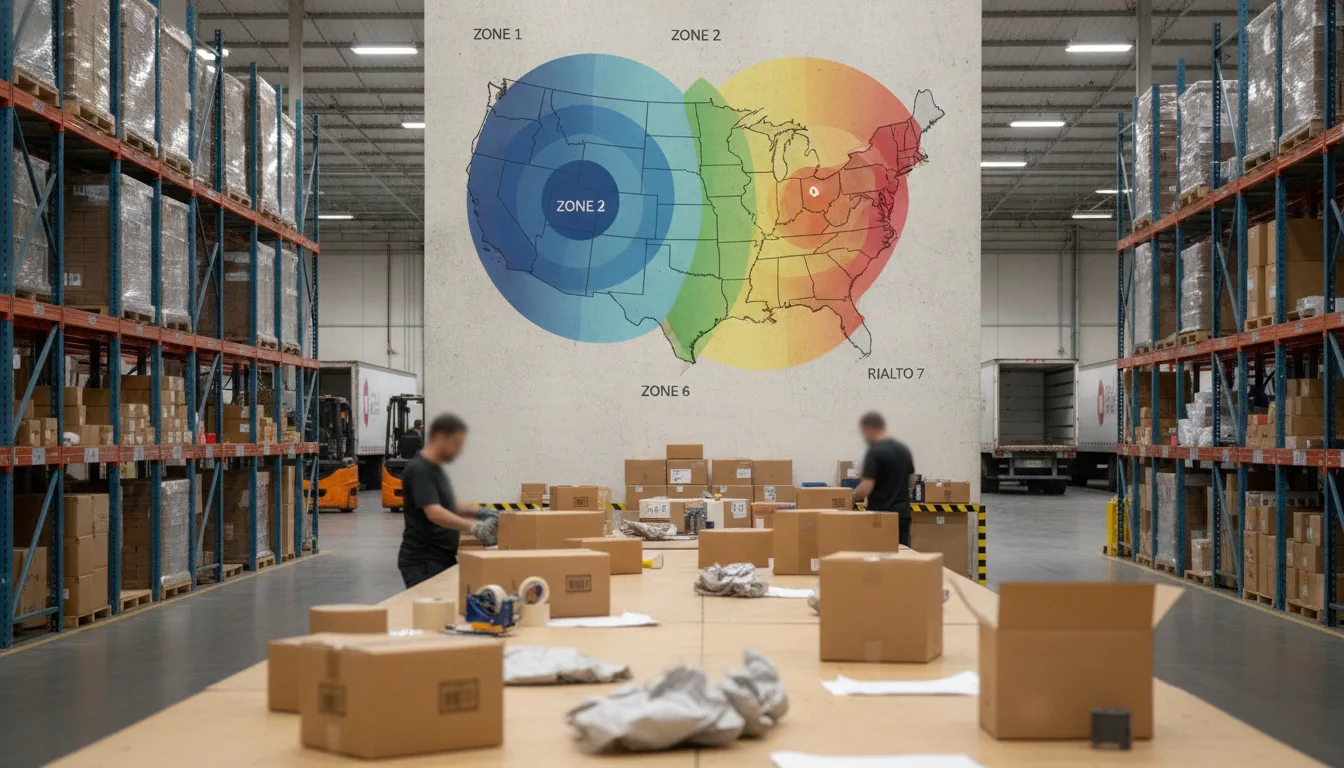
- A single East Coast node covers roughly 60 to 65 percent of the US population within Zones 1 to 4; a single West Coast node covers a different 25 to 30 percent efficiently, with significant overlap in the middle of the country.
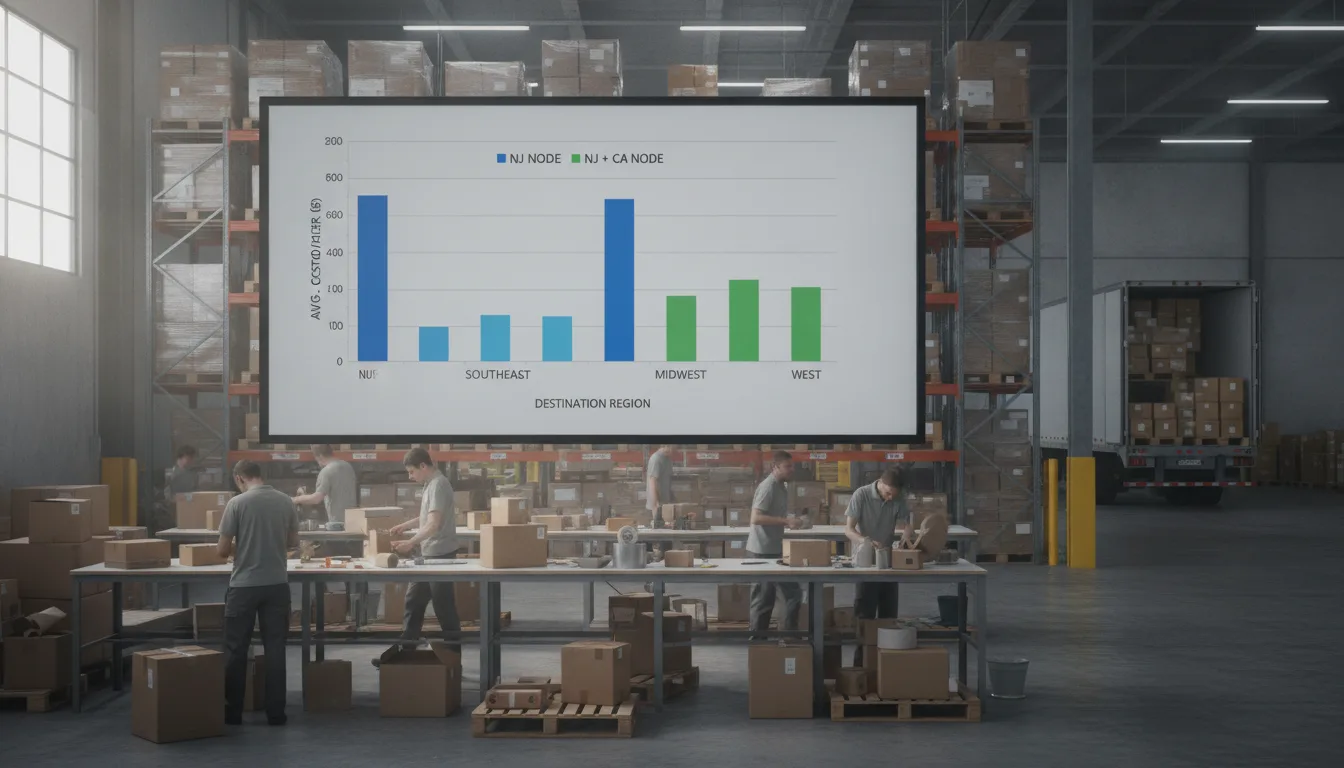
- Splitting inventory across NJ and CA reduces your average shipping zone by one to two steps for most catalogs, which typically translates to a measurable drop in blended carrier cost and a one-to-two-day improvement in transit for western customers.
- The decision is not purely geographic: order mix by state, SKU velocity, inbound freight origin and storage cost per unit all feed the math before you commit to a two-node network.
Why shipping zones drive the placement decision
US domestic carriers, including USPS, FedEx and UPS, divide the continental US into zones numbered roughly 1 through 8 from any origin point. Zone 1 means the parcel travels within the same local area; Zone 8 means it crosses the country. Each step up adds cost. The exact increments depend on carrier, service level and package weight, but the directional math is consistent: the further the zone, the higher the rate.
Dimensional weight (dim weight) compounds this. Carriers calculate billable weight as the greater of actual weight and dimensional weight, where dimensional weight equals length times width times height divided by a divisor. FedEx and UPS use a divisor of 139 for domestic shipments. A lightweight but bulky item, say a 12 x 10 x 8-inch box weighing 1 lb, has a dim weight of 6.9 lbs. At Zone 7, that extra billable weight matters far more than at Zone 2. So brands with large or lightweight products gain proportionally more from placing inventory closer to their customers.
What each YouParcel location gives you geographically
YouParcel operates a fulfillment center at 20 Farinella Dr, East Hanover, NJ 07936, covering the New York and New Jersey metro area and the broader Northeast and Mid-Atlantic. It operates a second fulfillment center at 3700 S. Riverside Ave, Rialto, CA 92324, in the Inland Empire east of Los Angeles, one of the highest-density freight corridors in the country.
| Factor | East Hanover, NJ (East Coast) | Rialto, CA (West Coast) |
|---|---|---|
| Primary zone footprint (Zones 1-4) | Northeast, Mid-Atlantic, Southeast, Midwest | Pacific Coast, Southwest, Mountain West |
| Share of US population within Zone 4 | Approximately 60-65% | Approximately 40-45% |
| Zone to Los Angeles (from NJ) | Zone 7-8 | Zone 1-2 |
| Zone to New York (from CA) | Zone 1-2 | Zone 7-8 |
| Zone to Chicago | Zone 3-4 | Zone 5-6 |
| Zone to Dallas | Zone 5-6 | Zone 4-5 |
| Zone to Miami | Zone 3-4 | Zone 6-7 |
| Zone to Seattle | Zone 7-8 | Zone 3-4 |
| Proximity to major import ports | Port of New York/New Jersey | Ports of Los Angeles and Long Beach |
| Inbound freight advantage | Atlantic ocean freight, air via JFK/EWR | Pacific ocean freight, air via LAX/ONT |
Zone figures above are directional estimates based on USPS zone charts and standard carrier zone maps. Exact zones vary by origin ZIP and carrier service level. You can verify any origin-to-destination zone using the USPS Zone Chart tool.
The distribution math: how to calculate your weighted average zone
Before deciding on one node or two, run a weighted average zone (WAZ) analysis on your last 90 days of orders. The result tells you what your current blended shipping cost looks like from each candidate origin, and what it would look like if you split inventory.
- Export your order history with ship-to ZIP codes and order counts (Shopify, Amazon Seller Central, or your WMS export will include this).
- Map each ship-to ZIP to a carrier zone from both East Hanover, NJ and Rialto, CA using the USPS or FedEx zone lookup tools.
- Calculate the percentage of orders falling into each zone from each origin. For example: 18% Zone 1-2, 32% Zone 3-4, 28% Zone 5-6, 22% Zone 7-8, all from NJ.
- Multiply each zone percentage by the typical carrier rate for your average parcel weight and dimensions at that zone. Use your actual negotiated rates if available, or the carrier published rate card as a baseline.
- Sum the weighted costs to get your WAZ cost per shipment from each single origin.
- Now model a split: assign western state orders (CA, OR, WA, NV, AZ, UT, CO and so on) to the California node, and eastern and central state orders to the NJ node. Recalculate the WAZ from each origin for its assigned order pool.
- Compare the blended cost of the split scenario against the single-node scenarios. Factor in the incremental storage and handling cost of maintaining two inventory pools before drawing a conclusion.
In practice, most brands with more than 20 percent of orders destined for California, Oregon, Washington, Arizona and Nevada find that the per-shipment savings from a West Coast node outweigh the added storage and replenishment cost once daily order volume reaches a few dozen shipments to that region.
When a single New Jersey node is the right starting point
Not every brand needs two warehouses from day one. A single NJ fulfillment node makes sense when:
- The majority of your US customers are in the Northeast, Mid-Atlantic or Southeast. For many DTC brands, New York, New Jersey, Pennsylvania, Massachusetts, Florida and Virginia together account for 45 to 55 percent of domestic orders, and all sit in Zone 1 to 4 from East Hanover.
- Your average order value is high enough that shipping cost is a small percentage of revenue, so the savings from a split do not justify the operational complexity of managing two inventory pools.
- You are launching in the US for the first time and want to validate demand before committing to a two-node network. The NJ location is YouParcel's original fulfillment facility and is well positioned for this use case.
- Your inbound freight arrives primarily from Europe or via Atlantic ports, making a New Jersey receipt and storage location the natural first stop in the supply chain.
- Your SKU count is small or your inventory turns are fast enough that splitting stock would create frequent stockouts at one node while the other holds excess.
When a single California node fits better
A West Coast-only placement suits brands where:
- The majority of your orders come from California, the Pacific Northwest, the Southwest or Hawaii. California alone is the most populous US state, accounting for roughly 12 percent of the US population, and neighboring western states push that addressable pool well above 20 percent.
- Your supply chain originates in Asia. Ocean freight from China, Japan, South Korea and Southeast Asia arrives at the Ports of Los Angeles and Long Beach. Receiving directly into Rialto avoids a cross-country rail or truck leg before the first pick-and-pack.
- You are an Australian brand or sell heavily to US customers in Pacific time zones, and you have explored the analysis in our California warehouse guide for Australian brands.
- You run Amazon FBA replenishment out of the same facility. Proximity to Amazon's large network of Inland Empire fulfillment centers simplifies FBA prep and inbound shipments.
When two nodes beat one: the split-inventory case
Adding a second node is a capital and operational decision, not just a geography question. The benefits compound when several conditions are true at the same time.
| Condition | Why it supports a two-node network |
|---|---|
| Orders are geographically spread: more than 20% destined for western states from an East-only node, or vice versa | Zone savings on a large share of orders produce meaningful per-unit cost reductions |
| Average parcel weight exceeds 2 lbs and volume is bulky (high dim weight) | Zone rate differentials are larger in absolute dollar terms for heavier or larger parcels |
| Daily order volume exceeds roughly 50 to 100 orders per region | Fixed costs of a second node (storage, minimum handling fees) are amortized across enough shipments to be justified |
| Customer delivery expectations are 2 to 3 days or fewer (Prime-like standards) | Zone 7-8 ground shipments can take 5 to 7 business days; two-day service from a distant node requires expensive air, while a closer node reaches the same customer on ground in 1 to 3 days |
| You sell on Amazon, Walmart or TikTok Shop alongside your own DTC channel | Marketplace performance metrics penalize slow shipping; a local node improves carrier scan times and delivery confirmation |
| Your inbound freight has natural split origins (some from Asia, some from Europe) | CA receives Pacific freight; NJ receives Atlantic freight; each node is replenished from its natural port, reducing drayage and inland freight cost |
The hidden cost of splitting: inventory across two nodes
Running two nodes is not simply twice the storage cost of one. There are real operational challenges that the WAZ savings need to cover:
- Inventory imbalance: If demand shifts regionally, you can end up with excess stock at one node and a stockout at the other. Safety stock (the buffer held against demand variability) needs to be maintained at each location independently, increasing total inventory investment. For a worked example on safety stock calculations, see our safety stock and reorder points guide.
- Replenishment complexity: Each node needs its own inbound freight schedule and receiving workflow. Errors at one receiving dock affect only half your stock, which limits exposure, but doubles the number of inbound processes you must monitor.
- SKU rationalization: You cannot always split every SKU. Low-velocity SKUs may not warrant holding units at both nodes. A common approach is to hold your top 20 percent of SKUs by velocity at both locations and stock the long tail only at the primary node, shipping long-tail orders as single-node cross-country shipments.
- WMS and integration overhead: Your warehouse management system must handle two location codes per SKU, and your Shopify or Amazon integration must route orders to the correct node based on ship-to ZIP. YouParcel integrates with Shopify, Amazon and 70-plus other platforms, so order routing logic can be automated, but you still need to configure and test it.
- Returns flow: Returns from western customers come back to California; returns from eastern customers come back to New Jersey. If you do quality grading and restocking centrally, you need a plan for how returns at the secondary node get processed or transferred.
Inbound freight and the port connection
Inventory placement is not only about outbound shipping. Where your inbound freight lands matters equally, particularly for international brands shipping container loads or air freight into the US.
The Port of New York and New Jersey handles roughly 4 million TEUs (twenty-foot equivalent units, the standard measure of container volume) per year and is the largest port on the US East Coast. Port Authority of New York and New Jersey data shows it regularly ranks as the second busiest US port overall. For brands importing from Europe, the UK, Turkey or India's western coast, an Atlantic routing into New Jersey is often the most direct and cost-efficient path to the East Coast node.
The Ports of Los Angeles and Long Beach together form the busiest port complex in the Western Hemisphere, processing over 20 million TEUs annually. For brands importing from China, Southeast Asia, Japan and South Korea, a Pacific routing into Southern California and drayage (the short-haul truck move from port to warehouse) to Rialto is a natural fit. Rialto sits in San Bernardino County within the Inland Empire, the primary distribution corridor for goods arriving through the LA gateway.
Aligning your inbound freight origin with your storage node reduces a drayage or rail leg that can add both cost and lead time. For international brands working through this decision, the US fulfillment for international brands service page covers how YouParcel handles freight-in, customs entry, receipt and ongoing fulfillment as one connected workflow.
A worked example: apparel brand with bicoastal demand
Consider a DTC apparel brand shipping an average parcel of 1.5 lbs actual weight, 12 x 10 x 4 inches (dim weight: 12 x 10 x 4 / 139 = 3.45 lbs billable at FedEx Ground). The brand ships 300 orders per day across the US. Its order geography from the past 90 days breaks down as follows:
- Northeast and Mid-Atlantic (NY, NJ, CT, MA, PA, MD, VA): 28%
- Southeast (FL, NC, SC, GA, TN, AL): 18%
- Midwest (IL, OH, MI, IN, MO, MN): 20%
- South Central (TX, OK, AR, LA): 10%
- Mountain and Southwest (CO, AZ, NV, UT, NM): 8%
- Pacific Coast (CA, OR, WA): 16%
From a single NJ node, the Pacific Coast and Mountain/Southwest orders, totaling 24 percent of volume, face Zone 7 to 8 rates. At 300 orders per day, that is 72 parcels per day crossing the country. If the zone differential between Zone 4 (central) and Zone 7 is around $3.50 for a 3.45-lb parcel on a standard commercial rate, and the differential between Zone 4 and Zone 8 is around $5.00, then the blended excess cost of shipping those 72 orders from NJ versus from CA is roughly $250 to $340 per day, or $90,000 to $125,000 per year before any volume discounts.
That figure needs to be weighed against the cost of holding a second inventory pool in California: storage fees, handling, replenishment freight and the safety stock overhead described above. For most apparel brands at 300 orders per day with a reasonable SKU count, the math favors splitting. For a brand at 50 orders per day, the savings are roughly $15,000 to $20,000 annually, which may or may not clear the incremental cost depending on average storage volume and SKU complexity.
These numbers are directional illustrations using published carrier rate structures. Your actual rates, weight profile and order mix will produce different results. A YouParcel expert can run this analysis against your real data before you commit.
How to run the placement decision in practice
- Pull 90 days of ship-to ZIP data from your Shopify, Amazon or WMS export. Include order count per ZIP and average parcel weight and dimensions.
- Zone-map the data from both East Hanover, NJ (07936) and Rialto, CA (92324) using the USPS zone chart or FedEx zone locator. Count what percentage of orders fall into each zone bracket from each origin.
- Estimate the per-zone rate for your typical parcel. Use your current carrier rate card or a carrier's online rate estimator. Calculate a weighted average rate per shipment from each single origin and from the split scenario.
- Model incremental storage cost for the second node. Estimate the number of SKUs you would split, the average units on hand per SKU, and the resulting cubic footage or pallet positions at the second location. Apply warehousing cost per pallet position to get a monthly storage estimate.
- Add safety stock overhead. If your current safety stock covers 7 days of demand variability per SKU, running two nodes means roughly doubling that buffer for split SKUs, since each node carries its own independent safety stock. Calculate the carrying cost of the incremental inventory.
- Compare total annual cost of single-node versus two-node scenarios. If the per-shipment savings exceed the incremental storage and inventory carrying cost by a comfortable margin, two nodes are justified.
- Define the routing rule. The standard rule is to route orders with ship-to ZIPs west of a cut line (typically the Mountain Time zone boundary, covering ZIP ranges roughly 800xx to 998xx) to the California node, and all others to the NJ node. Your exact cut line should be tuned to your order geography.
- Configure the integration. With YouParcel's Shopify and Amazon integrations, order routing by ZIP can be automated so that the correct fulfillment node receives each order without manual intervention.
What about brands that sell B2B, wholesale or through retail distributors?
The zone math above applies to parcel shipments. B2B and wholesale orders move on pallets via LTL (less-than-truckload) or FTL (full truckload), where pricing is based on freight class, weight, origin-destination lane and whether the shipment qualifies for a volume discount rather than a simple per-zone rate. For LTL shipments, the cost difference between originating in NJ versus CA to a central destination like Dallas or Chicago is smaller in percentage terms than it is for parcel, but it still exists and compounds over hundreds of pallet moves per year.
For retail distribution involving EDI and retailer compliance, including routing guides and labeling requirements, YouParcel supports both East and West Coast outbound to retail DCs. Retailers such as major department stores and big-box chains often have their own distribution center locations that may favor one origin over the other. Reviewing the retailer's routing guide, which specifies carrier, service level and origin requirements, is a necessary step before finalizing node placement for wholesale accounts. For more on retail compliance logistics, see the B2B and wholesale fulfillment EDI guide.
Special considerations for international brands placing first US inventory
For a brand outside the US evaluating its first US warehouse node, the choice between NJ and CA often comes down to three factors before the zone math even runs:
- Freight origin: Where does your inbound container or air freight shipment land? If your factory is in China or Vietnam, LA is likely the natural gateway. If your factory is in Europe, Turkey or the UK, New York/New Jersey is typically more direct.
- Importer of record (IOR): To clear customs at a US port, the shipment needs an importer of record, the legal entity responsible for duties and compliance. YouParcel does not act as importer of record. International brands typically work with a licensed US customs broker who can serve as or coordinate the IOR function. Your customs broker will often have operational ties to specific port communities, which can influence the most practical entry point. For a full overview of this topic, see the importer of record and US warehouse guide.
- US customer geography at launch: Early US customers for international brands often skew toward one coast based on where initial marketing investment lands. If you are launching via Amazon US, review the demand by state for comparable ASINs (Amazon Standard Identification Numbers) in your category before choosing a node, since Amazon's own placement recommendations for FBA will reflect where customer demand is concentrated.
Frequently asked questions
How many shipping zones does a New Jersey warehouse cover for US domestic orders?
From East Hanover, NJ, the Northeast and Mid-Atlantic states fall in Zones 1 to 3, the Southeast and Midwest in Zones 3 to 5, the South Central region in Zones 5 to 6, and the Pacific Coast in Zones 7 to 8. Roughly 60 to 65 percent of the US population sits within Zones 1 to 4 from that origin, making it the stronger single node for brands with eastern-skewing demand.
Is it more cost-effective to start with one warehouse and add a second later?
For most brands, yes. Starting with a single node lets you validate US demand, build order volume and gather the ZIP-level data needed to run a sound split analysis. Adding a second node once you have 90 days of order data is far less risky than splitting inventory on a demand assumption. The transition is straightforward when your 3PL operates both locations, as you avoid a carrier transfer between unrelated facilities.
What is the typical minimum order volume to justify two US warehouse nodes?
There is no universal threshold because it depends on your average parcel weight, dim weight, carrier rate negotiation and storage costs. As a rough working guide, brands shipping more than 50 to 100 orders per day to western states from an East Coast origin often find the per-shipment savings cover the incremental storage cost. Below that volume, the fixed costs of a second inventory pool tend to outweigh the zone savings. Running the weighted average zone analysis against your own data produces a more reliable answer than any general rule.
Can I route orders automatically between New Jersey and California based on the customer's ZIP code?
Yes. YouParcel integrates with Shopify, Amazon and 70-plus other platforms. Order routing rules based on ship-to ZIP or state can be configured so that each order is automatically directed to the nearest or most cost-efficient node without manual intervention. This is a standard setup step during onboarding.
Does the inventory placement decision change for B2B or retail distribution versus DTC?
It can. DTC parcel economics are driven by carrier zones, so the zone math above applies directly. For B2B and wholesale orders on pallets, LTL lane pricing matters more than zone maps, and retailer routing guides may specify which origin location or carrier service level to use. For retail distribution, review your key retail accounts' routing guides before finalizing node placement, since non-compliance can result in chargebacks even if the goods arrive on time.
Ready to model the right US warehouse placement for your brand? Create a YouParcel account to get started, or talk to an expert for a data-driven analysis of your order geography before you commit to a node configuration.