


Omnichannel distribution is the operational model in which a brand fulfills DTC parcel orders, marketplace orders and wholesale or retail replenishment from a single shared inventory network, rather than splitting stock across siloed facilities. YouParcel runs this model across warehouses in New Jersey, California and Illinois, handling 10,000-plus orders a day across multiple channels, so brands can serve every endpoint without maintaining separate stock pools or separate 3PL relationships.
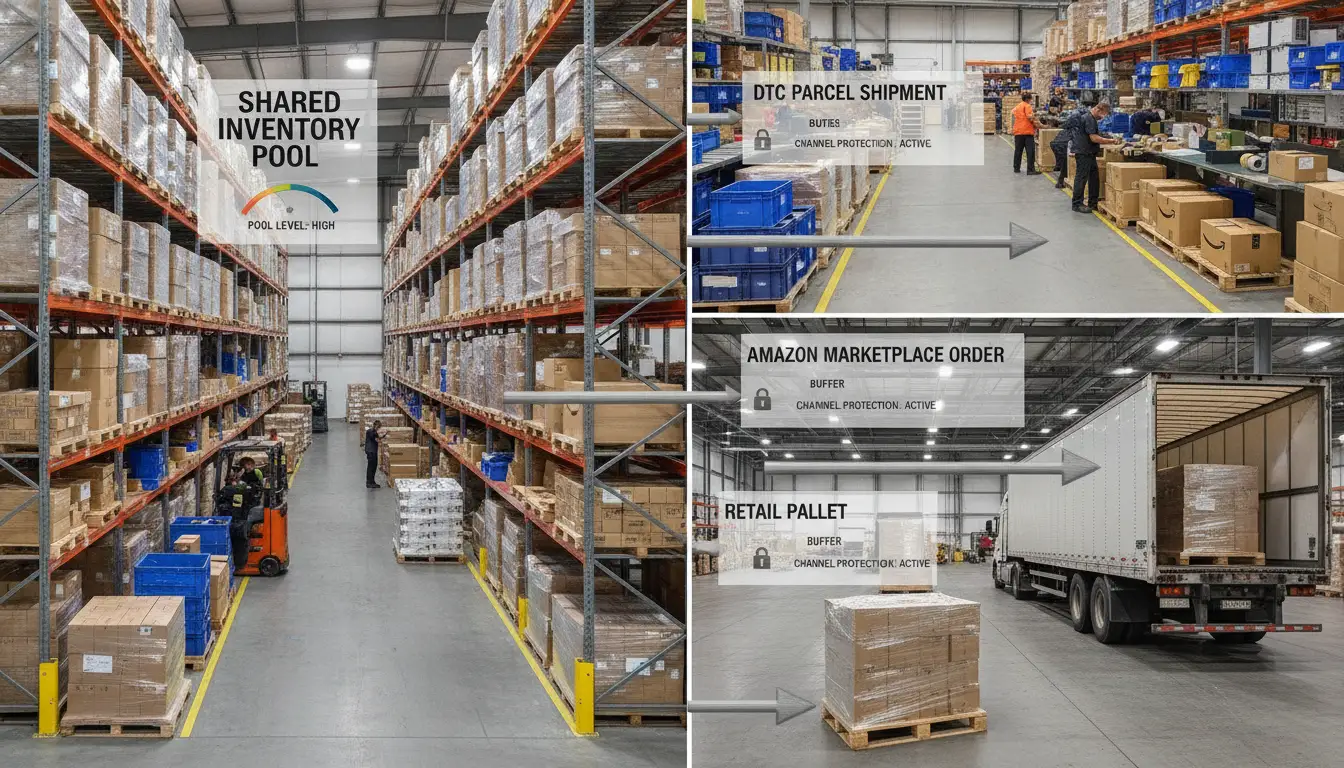
- One inventory pool, many channels: shared stock across DTC, Amazon, wholesale and retail avoids the safety-stock duplication that separate silos require.
- Channel rules prevent starvation: allocation logic, minimum reserve quantities and order-type priority settings protect each channel when demand spikes in one place.
- Parcel and pallet from the same facility: YouParcel picks single units for DTC, builds pallets for retail replenishment and handles EDI compliance, all under one roof.
- Integration is the connective tissue: real-time inventory visibility across 70-plus platform integrations keeps channel-level stock counts accurate before overselling can occur.
What omnichannel distribution actually means for operations
Many brands use the word "omnichannel" to describe their sales strategy. Operationally, it means something more specific: a single warehouse management system (WMS) that holds one master inventory record and allocates units to whichever channel places an order first, subject to any channel-protection rules the brand configures.
The alternative, which is still common, is channel-siloed fulfillment: a DTC 3PL holds one batch of stock, an Amazon FBA allocation sits in an Amazon fulfillment center, and a wholesale third-party manages retail replenishment separately. Each silo carries its own safety stock, so the same SKU may be over-stocked in one location while another channel back-orders it. Omnichannel distribution eliminates that redundancy, but it introduces a different problem: without deliberate channel-protection logic, the fastest-moving channel can drain shared inventory and leave slower channels empty.
The core tension: speed versus allocation fairness
DTC and marketplace orders arrive in real time, often in high volumes, and expect next-day or two-day ship windows. Wholesale purchase orders (POs) may arrive weekly or monthly, but they represent large committed quantities that a retail buyer expects to be honored. When both draw from the same pool, a weekend DTC spike can eat stock that was implicitly committed to an upcoming wholesale PO. Managing that tension is the central planning challenge in omnichannel distribution.
How YouParcel structures a shared fulfillment network
YouParcel operates fulfillment centers in New Jersey (20 Farinella Dr, East Hanover, NJ 07936) and Southern California (3700 S. Riverside Ave, Rialto, CA 92324), with additional capacity in Illinois. The dual-coast footprint matters for omnichannel brands because retail buyers on the West Coast and DTC customers in the Northeast both expect competitive transit times, and a single-node network cannot serve both without paying premium shipping rates on every cross-country parcel.
Within each facility, the same physical inventory is available to whichever order type the WMS routes next. The pick-and-pack workflow for a single-unit DTC order, the kitting line that assembles a retail display pack, and the pallet-build station that stages a wholesale shipment all draw from the same bin locations. The difference is in the work instruction: a DTC order gets a poly mailer or branded box, a carrier label for USPS, FedEx or DHL, and a real-time tracking event. A retail replenishment order gets case-pack labeling to the retailer routing guide, an EDI-compliant advance ship notice (ASN 856 transaction set) and a pallet formatted to the buyer's specific label requirements.
EDI compliance and retailer routing guides
EDI (Electronic Data Interchange) is the structured data format that most major US retailers and distributors use to exchange purchase orders, invoices and shipping confirmations. A retailer routing guide specifies exactly how inbound pallets must be built, labeled, ticketed and delivered. Non-compliance typically results in chargebacks that can reach several hundred dollars per violation, so operational accuracy is a direct revenue protection issue.
YouParcel supports EDI transactions and retailer compliance requirements including routing guides and labeling specifications. This means a brand scaling from DTC-only to a wholesale or big-box retail channel does not need a second 3PL to handle the pallet side of its business. The same inventory pool, the same operations team, handles both order types.
For brands that are new to B2B and wholesale fulfillment, the YouParcel B2B fulfillment overview covers the specific requirements in detail.
Channel-protection planning: keeping channels from starving each other
Shared inventory is only an advantage if the brand has thought through allocation rules before a demand event exposes the gap. The following planning steps are what operationally mature omnichannel brands put in place before they go live on a shared network.
- Set hard reserves by channel: for any SKU with committed wholesale POs, reserve the PO quantity as unavailable-to-promise (ATP) for DTC and marketplace orders. The reserve is released only after the PO ships or is cancelled.
- Define channel priority order: when unallocated stock is limited, decide in advance which channel takes priority. Many brands rank wholesale commitments first (because chargebacks are punitive), then DTC (because customer experience is a brand asset), then marketplace (because marketplace penalties for late shipment are also material).
- Set reorder points per channel segment: rather than a single SKU-level reorder point, calculate the reorder trigger as the sum of each channel's safety stock requirement. A SKU that moves 50 units a day on DTC and 200 units a week on wholesale needs a reorder point that covers both lead times simultaneously.
- Build inbound freight around wholesale cycles: wholesale POs often follow a buyer's promotional calendar. Plan inbound freight and production releases so that stock arrives at the fulfillment center at least two weeks before the PO ship window, leaving time for receiving, quality inspection and location assignment.
- Align marketing promotions with inventory state: a DTC promotional email that drives a 3x demand spike will drain shared inventory in hours if the marketing and operations teams are not in sync. An inventory-aware promotional calendar is not optional in omnichannel distribution; it is a prerequisite for avoiding stock-outs.
- Monitor channel-level ATP in real time: YouParcel provides real-time tracking and BI and analytics tools that surface inventory positions by channel. When ATP in one channel drops below threshold, the operations team can adjust allocation rules before a stock-out occurs rather than after.
Parcel versus pallet: the operational differences in one network
| Attribute | DTC parcel | Marketplace fulfillment | Wholesale / retail pallet |
|---|---|---|---|
| Order trigger | Consumer checkout, real-time | Marketplace order, near real-time | EDI purchase order, scheduled |
| Units per shipment | 1 to 5 units, typically | 1 to 10 units, typically | Dozens to thousands of units per PO |
| Packaging | Brand-specified box or mailer | Carrier-compliant or marketplace spec | Case packs, master cartons, pallets |
| Labeling | Carrier shipping label | Marketplace label (e.g. Amazon FBA label) | Retailer-specific GS1 pallet and case labels |
| Compliance document | Packing slip or none | Marketplace packing slip | EDI ASN (856), commercial invoice |
| Carrier type | Parcel: USPS, FedEx, DHL, Aramex | Parcel: same carrier pool | LTL or FTL freight carrier |
| Chargeback risk | Low (consumer dispute) | Marketplace seller performance penalty | High (retailer routing-guide violations) |
| Kitting requirement | Occasional (bundles, subscription) | Occasional (multipacks) | Common (display packs, floor-ready retail) |
The key operational insight is that parcel and pallet workflows require different labor skills and equipment, but they do not require different facilities or separate inventory. A well-structured fulfillment center zones its floor so that high-velocity DTC picks and pallet-build stations do not compete for the same aisle space at the same time. YouParcel manages this through wave planning, which groups orders by ship deadline and work type and sequences them through the floor to maximize throughput without creating congestion.
Integration: the layer that makes shared inventory visible
Omnichannel distribution breaks down without integration. If the DTC Shopify store, the Amazon Seller Central account and the EDI purchase-order feed each update inventory in separate systems, the master ATP count drifts out of sync within hours. Oversells follow, and each oversell creates a customer-service event or a retailer chargeback.
YouParcel integrates with Shopify, Amazon, Salesforce, Tableau and 70-plus other platforms. In practice, this means that when a Shopify order ships, the inventory position updates in real time and that updated figure is what Amazon sees when it checks availability for the same SKU. When a wholesale PO is received via EDI, the reserve quantity is immediately reflected in the DTC-available pool.
Brands that want to understand the full scope of what a shared network looks like in practice can start with the YouParcel omnichannel fulfillment overview, which covers the platform connections and service scope in detail.
What to audit before going live on a shared network
Switching from siloed to shared fulfillment is a migration, not a plug-in. Before inventory moves into a shared pool, brands should confirm the following:
- Every sales channel has a confirmed integration to the WMS and that the inventory feed is bidirectional, not one-way.
- SKU master data is clean: one SKU per sellable unit, no duplicate or legacy codes, correct dimensions and weights for dimensional weight billing. (Carriers such as FedEx and DHL calculate shipping cost as the greater of actual weight and dimensional weight, using a divisor of 139 cubic inches per pound for domestic FedEx ground as of mid-2026.)
- Retailer routing guides have been reviewed and all packaging, labeling and delivery-appointment requirements are documented and loaded into the WMS before the first wholesale PO is processed.
- Channel allocation rules are configured and tested in a staging environment before live orders flow.
The Council of Supply Chain Management Professionals (CSCMP) defines omnichannel distribution in its Supply Chain and Logistics Terms and Glossary as the integration of inventory and fulfillment across all customer-facing channels, which aligns directly with the operational model described here.
Kitting and assembly in an omnichannel context
Kitting, which is the process of combining multiple individual SKUs into a single sellable unit, appears in all three channel types but in different forms. For DTC, a brand might kit a core product with a sample and a branded insert. For a marketplace, a multipack is a kit. For retail, a floor-ready display unit that includes product, header card, security tag and price sticker is a more complex assembly job.
YouParcel supports kitting and assembly across all three contexts. When kitting is part of an omnichannel workflow, the WMS needs to track both the component SKUs and the finished kit SKU in the shared inventory pool. A common mistake is managing kit inventory only at the finished-kit level, which creates a situation where the system shows a kit in stock but the components have been consumed by a parallel DTC order. Component-level tracking with kit explosion logic avoids this problem.
Returns in an omnichannel network
Omnichannel distribution creates a matching challenge on the reverse side. A consumer who bought through a marketplace may return via a DTC portal. A retail buyer may return unsold inventory in a format that does not match the original inbound receipt. Without a unified returns process, returned units can sit in a quarantine location for weeks before being re-integrated into the shared ATP pool.
YouParcel handles returns and reverse logistics as part of its fulfillment service. When a returned unit is received, it goes through a grading process: serviceable units are restocked into the shared inventory, units requiring repackaging or reconditioning are routed to a value-recovery workflow, and units that cannot be resold are disposed of according to the brand's instructions. The goal is to minimize the time between return receipt and the point at which the unit contributes to ATP again, which directly affects the brand's effective inventory availability across all channels.
Scaling omnichannel distribution: common decision points
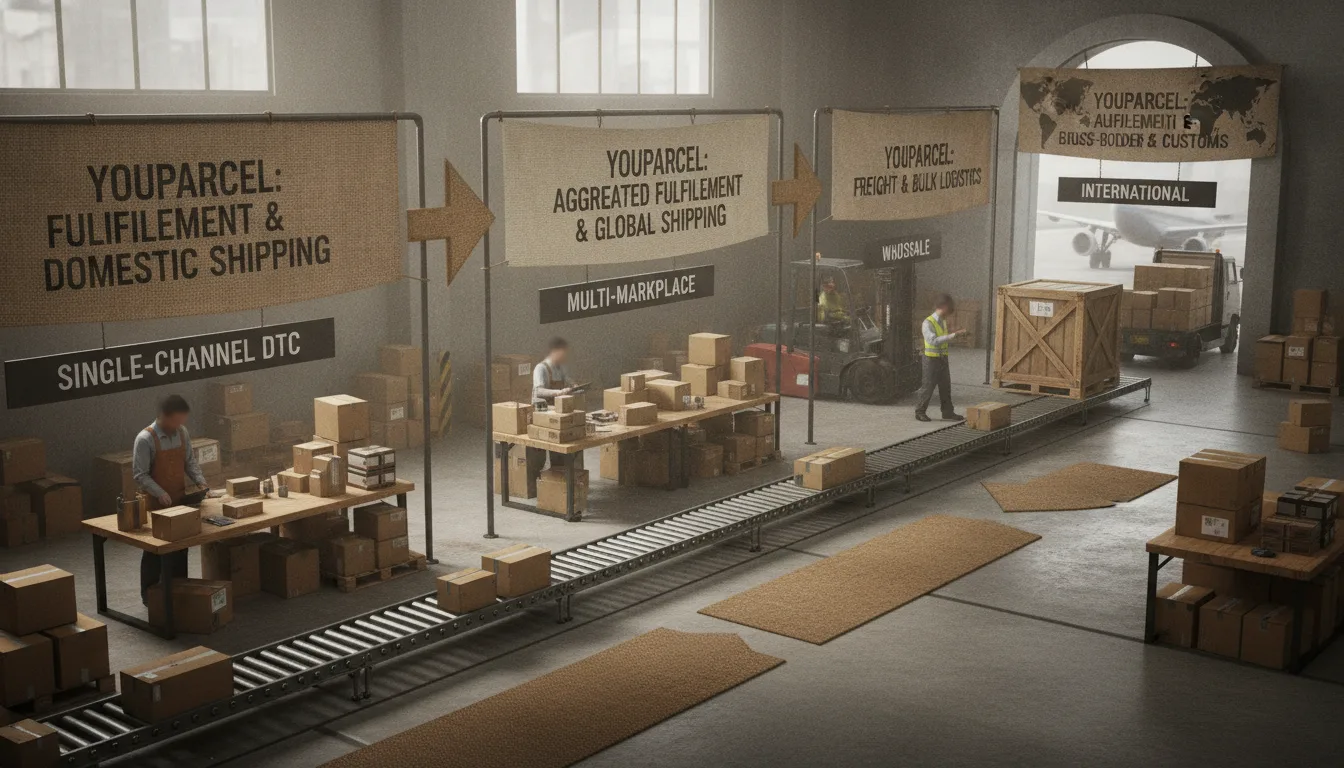
Brands that start with DTC-only fulfillment and add channels face a predictable sequence of scaling decisions. The following are the most common, in roughly the order they tend to arise.
- Adding a second US marketplace: the first expansion is usually from one marketplace (Amazon) to a second (Walmart Marketplace or Target Plus). This is relatively straightforward if the fulfillment partner already has the integration, because the inventory pool and the parcel workflow are essentially the same.
- Adding a wholesale or retail channel: this is the step that most often exposes gaps in the current fulfillment setup, because it introduces EDI, routing-guide compliance, pallet builds and chargeback risk. Many brands discover at this point that their DTC 3PL is not equipped for wholesale, and they attempt a two-3PL model, which reintroduces the inventory-silo problem.
- Adding a second fulfillment node: once daily order volume justifies a second geography, the brand needs to decide how to split inventory between nodes. A common approach is to split by region (East Coast node handles orders east of the Mississippi, West Coast node handles the remainder) with dynamic rebalancing when one node runs low. YouParcel's multi-warehouse network supports this model.
- Adding international channels: YouParcel ships to 100-plus countries, so expanding to international marketplace channels or DTC international shipping does not require a separate partner. The same shared inventory pool can supply both domestic and international orders, with carrier selection (DHL, Aramex, FedEx international, EasyPost) determined by destination and service level.
What brands frequently get wrong in omnichannel distribution
Based on the operational patterns YouParcel sees across a network that processes thousands of orders daily, the following mistakes are the most common and the most costly.
- Treating inventory allocation as a technology problem only: software enforces rules, but someone has to write the rules. Brands that implement a shared WMS without defining channel-priority and reserve-quantity logic quickly discover that the system optimizes for speed, not for channel balance.
- Underestimating the compliance burden of retail channels: a single routing-guide violation can generate a chargeback that exceeds the margin on the entire PO. Compliance setup takes more time than most brands expect before the first wholesale shipment.
- Running promotions without inventory sign-off: a 48-hour flash sale can clear shared inventory in a few hours. If the operations team is not in the loop before the promotion launches, the wholesale reserve may be drained before anyone notices.
- Ignoring returns velocity in ATP calculations: if returns are running at 15 percent and the brand does not account for expected return receipts in its ATP model, it will consistently under-order replenishment and experience preventable stock-outs.
- Delaying the integration audit until after inventory moves: SKU data problems and integration gaps are far cheaper to fix before shared inventory goes live than after the first batch of oversells or mispicks.
Frequently asked questions
What is omnichannel distribution?
Omnichannel distribution is the fulfillment model in which a brand serves DTC, marketplace and wholesale or retail channels from a single shared inventory pool and a connected fulfillment network. It eliminates the safety-stock duplication of siloed fulfillment but requires deliberate allocation rules to prevent faster channels from draining stock that slower channels depend on.
How does one fulfillment network handle both parcel and pallet orders?
A shared facility uses the same bin locations and inventory records for all order types. DTC and marketplace orders generate pick-and-pack workflows that produce labeled parcels. Wholesale orders generate pallet-build workflows that produce EDI-compliant pallet shipments. The difference is in the work instruction the WMS sends, not in the physical location of the inventory.
How do brands prevent their retail wholesale channel from being starved by DTC demand?
The standard method is to reserve the committed wholesale PO quantity as unavailable-to-promise for DTC and marketplace channels as soon as the PO is confirmed. The reserve is released only after the PO ships or is cancelled. Brands also set channel-priority rules so that when unallocated stock is limited, the system knows which channel to protect first.
Does YouParcel handle EDI compliance for retail replenishment?
Yes. YouParcel supports EDI transactions and retailer compliance requirements including routing guides and labeling specifications, so brands do not need a separate wholesale 3PL when they add a retail distribution channel to an existing DTC or marketplace operation.
Can a single fulfillment partner handle both domestic and international omnichannel orders?
Yes, when the partner has the carrier relationships and international shipping capability to do so. YouParcel ships to 100-plus countries, using carriers including USPS, FedEx, DHL, Aramex and EasyPost, so domestic and international orders can draw from the same shared inventory pool without routing international orders to a separate operator.
If you are ready to consolidate your DTC, marketplace and wholesale channels into one fulfillment network, talk to a YouParcel fulfillment expert about how to structure allocation rules, EDI compliance and multi-node inventory for your specific channel mix.