


International shipping for ecommerce brands means moving parcels from a US warehouse to buyers in other countries, collecting or paying destination duties correctly, and choosing a carrier service that matches buyer expectations on speed and cost. YouParcel ships to 100+ countries from warehouses in New Jersey, California and Illinois, covering the full range of service levels and landed-cost arrangements a growing brand needs.
- Every parcel leaving the US for most destinations triggers a duty and tax event at the destination border; the question is who pays and when.
- DDP (Delivered Duty Paid) means you collect duties and taxes from the buyer at checkout and remit them to the destination authority; DAP (Delivered at Place, also called DDU) leaves the bill with the buyer on arrival.
- Carrier choice between express and economy affects landed cost, transit time, tracking depth and dispute rates more than almost any other variable.
- A licensed customs broker should review your specific duty obligations; nothing in this guide is legal or tax advice.
Why outbound international shipping from US stock differs from domestic fulfillment
When you sell domestically, the product is already inside the US customs territory and no border crossing happens at the parcel level. The moment you ship a parcel to a buyer in Canada, the UK, Germany or Australia, two regulatory systems come into play: US export controls on the outbound side, and the destination country's import rules on the inbound side.
US export compliance is relatively light for most consumer goods. The Export Administration Regulations (EAR), administered by the Bureau of Industry and Security, govern controlled goods. For most apparel, supplements, electronics accessories and home goods, no export license is required, but you should verify your product's Export Control Classification Number (ECCN) or confirm it falls under the EAR99 catch-all category. The Bureau of Industry and Security publishes the full EAR for reference.
On the destination side, every shipment above a country's de minimis threshold (the value below which no duty applies) generates a formal or informal customs entry. Those thresholds vary significantly by country and are set by each country's own legislation, not by the US.
What are the key Incoterms for international parcel shipping?
Incoterms (International Commercial Terms) define who bears cost and risk at each point in a shipment's journey. For cross-border parcel shipments from a US warehouse, two Incoterms matter most.
| Term | Full name | Who pays destination duties and taxes | Risk transfer point | Common use case |
|---|---|---|---|---|
| DDP | Delivered Duty Paid | Seller (you) | Buyer's door | Premium DTC brands; marketplaces that require pre-collected VAT/GST |
| DAP | Delivered at Place (also called DDU: Delivered Duty Unpaid) | Buyer pays on arrival | Named destination, before unloading | Low-AOV categories where adding duty at checkout would hurt conversion; B2B shipments where the importer is known |
DDP is generally the better customer experience for DTC. When a buyer in the UK or Australia receives a parcel and is then asked to pay an unexpected customs bill before it is released, cart abandonment on future orders and negative reviews follow. The tradeoff is that you must calculate and collect the correct duty and VAT amount at checkout, which requires a landed-cost engine or a carrier that pre-calculates duties (many express carriers offer this).
DAP works in B2B contexts where the recipient is a registered importer, or in categories where your buyer expects to handle customs themselves. It also avoids the complexity of pre-collecting foreign VAT, though many destination countries now require marketplace facilitators or sellers to register and remit VAT regardless of Incoterms.
Destination duties and taxes: a country-by-country snapshot
Duty rates, VAT rates and de minimis thresholds differ in every country. The table below covers the most common destination markets for US ecommerce brands. All figures are sourced from official government publications and are presented as background information only. Consult a licensed customs broker for advice on your specific goods and situation.
| Destination | Standard VAT / GST rate | Approximate de minimis (duty-free threshold) | Key notes |
|---|---|---|---|
| United Kingdom | 20% VAT | GBP 135 (duty); no VAT de minimis for imports | Sellers above GBP 85,000 annual UK revenue must register for UK VAT. IOSS/OSS does not apply; UK has its own scheme. HMRC guidance on overseas sellers and VAT. |
| European Union | Varies by member state; Germany 19%, France 20% | EUR 150 (customs duty); no VAT de minimis (repealed July 2021) | EU OSS/IOSS schemes allow VAT pre-collection and remittance through a single portal. Mandatory for sub-EUR 150 B2C parcels. |
| Canada | 5% GST federally; provincial HST/PST varies | CAD 40 (gift); CAD 20 (commercial) for formal entry | CUSMA preferential rates apply to goods meeting rules of origin; most finished consumer goods manufactured in the US qualify. |
| Australia | 10% GST | AUD 1,000 (duty and tax combined de minimis); GST collected by overseas sellers above AUD 75,000 annual Australian revenue | Australia's Low Value Importation scheme requires registration and self-remittance of GST for high-volume sellers. |
| Mexico | 16% IVA | USD 50 (commercial); gifts up to USD 300 | Mexico has significantly tightened cross-border parcel rules; many carriers require formal import data for all commercial shipments. |
One important distinction for US brands: none of the thresholds above have anything to do with the US de minimis rule. The US de minimis exemption (Section 321) governed imports into the US. It was suspended for all countries on 2025-08-29 and is being repealed by statute from 2027-07-01. That change affects what your overseas suppliers ship into the US, not what you ship out. Each destination country applies its own threshold independently.
Express vs economy: choosing the right international parcel service level
The carrier service level you select affects far more than speed. It determines tracking depth, customs clearance method, liability limits and your ability to resolve delivery exceptions. Here is how the main options compare from a US warehouse.
| Service level | Typical transit range | Tracking depth | Customs clearance | Best for |
|---|---|---|---|---|
| International express (FedEx International Priority, DHL Express) | 1 to 5 business days to major markets | Full end-to-end, event-level updates | Carrier-managed; pre-clearance data submitted electronically | High-AOV goods, time-sensitive orders, premium brands, B2B samples |
| International economy / deferred express (FedEx International Economy, DHL Economy Select) | 4 to 8 business days to major markets | Full tracking with some gaps at last-mile handoff | Carrier-managed; slightly longer dwell at sort facilities | Mid-AOV DTC; brands with established buyer trust; promotional shipments |
| Postal and postal consolidation (USPS First-Class Package International, EasyPost postal network, Aramex postal) | 7 to 21+ business days depending on destination and last-mile postal operator | Tracking available but last-mile scan coverage varies by destination postal operator | Destination postal customs handling; informal entry in most cases below threshold | Low-AOV goods, non-urgent replenishments, small parcels under 2 kg where cost per shipment must be minimized |
YouParcel works with USPS, FedEx, DHL, Aramex and EasyPost, so brands can access multiple service levels from the same warehouse without changing fulfillment partners. The right mix depends on your average order value, the tolerance your buyers have for transit time, and whether your checkout engine pre-collects duties.
How dimensional weight affects international shipping cost
Dimensional weight (also called DIM weight) is the volumetric weight of a parcel calculated by multiplying its length, width and height in inches, then dividing by a standard divisor. Carriers charge whichever is greater: actual weight or dimensional weight.
For international express shipments, the standard divisor used by FedEx and DHL is 139 (when measuring in inches, with the result in pounds). A parcel measuring 18 x 14 x 10 inches has a dimensional weight of (18 x 14 x 10) / 139 = 18.1 lb. If the actual weight is 6 lb, the carrier bills the dimensional weight of 18 lb.
This matters enormously for international shipping because express rates already carry a base surcharge over domestic. Brands shipping bulky, light products (apparel, pillows, packaging-heavy beauty sets) often pay two to three times more than they expect if packaging has not been optimized for DIM weight before international lanes are opened.
DDP in practice: how landed cost collection works
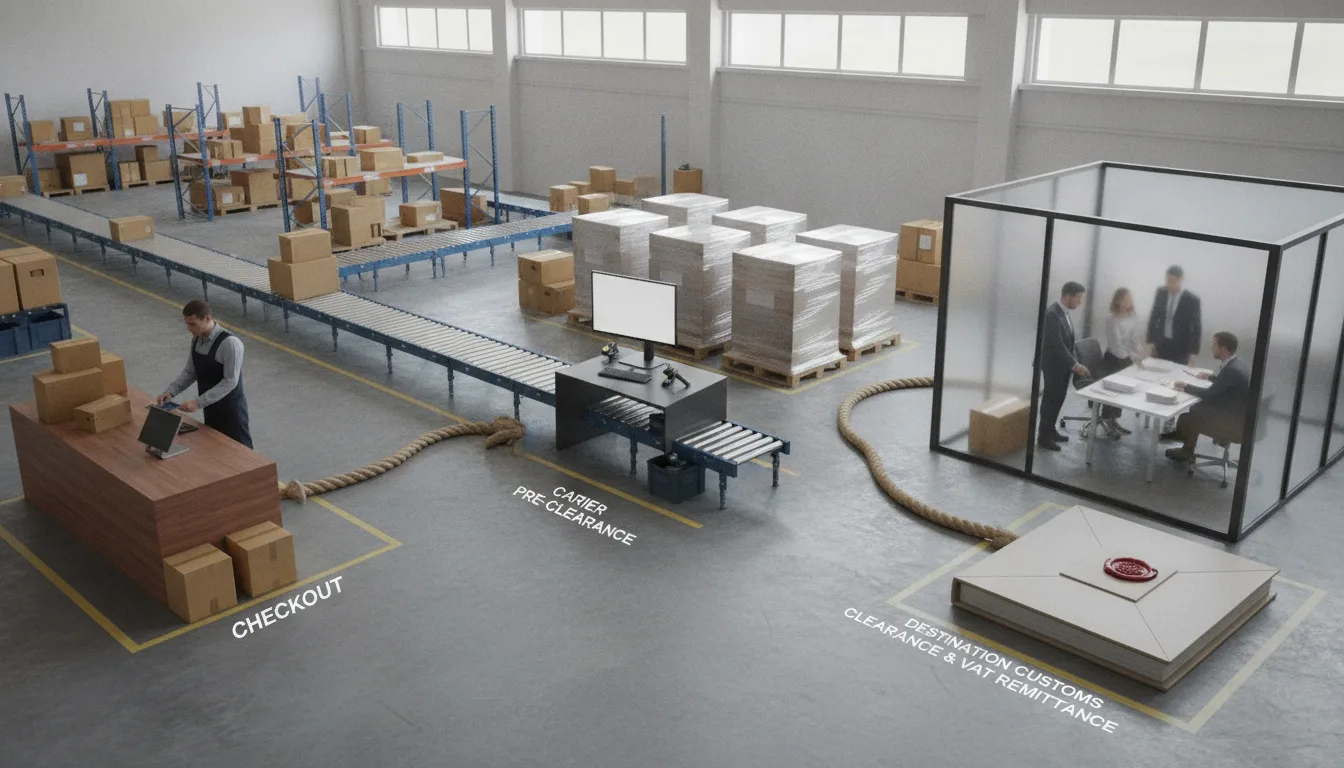
Running DDP shipments from a US warehouse requires three things working together: a duty and VAT calculation at checkout, a mechanism to collect and hold those funds, and a carrier or customs broker relationship that handles remittance to the destination authority.
- Classify your products with HS codes. Every product needs a Harmonized System (HS) code, the six-digit international product classification that customs authorities use to look up duty rates. For example, cotton T-shirts fall under HS 6109.10. The first six digits are universal; destination countries add further digits for their national tariff schedule.
- Calculate landed cost at checkout. A landed-cost engine takes the HS code, the declared value, the destination country and the shipping cost, then returns the duty amount and applicable VAT or GST. The buyer sees the full cost and pays it in one transaction.
- Transmit pre-clearance data to the carrier. Modern express carriers accept electronic advance data (EAD) for customs pre-clearance. Submitting the HS code, item value, quantity and shipper details before the parcel reaches the border reduces clearance dwell time and rejection risk.
- Remit collected taxes to the destination authority. For EU shipments under EUR 150, IOSS (Import One Stop Shop) registration lets you file a single monthly VAT return. For UK shipments, a UK VAT registration is required above the GBP 85,000 threshold. For Australia, the Low Value Importation GST scheme applies. Each country has its own mechanism; a licensed customs broker or VAT agent should handle registration and filing.
- Issue a commercial invoice with the correct declared value. Under-declaring value to avoid duties is customs fraud in every destination country. All commercial invoices should reflect the actual transaction value the buyer paid, net of any duties and taxes you have pre-collected.
DAP and the buyer experience: managing expectations
DAP (DDU) shipments are simpler operationally. You ship the parcel, the carrier delivers it to the destination border, and the buyer deals with the customs bill. The problems arise when buyers are surprised by that bill.
In most destination countries, the carrier holds the parcel until the buyer pays duties and brokerage fees. Those brokerage fees, charged by the carrier's customs agent in the destination country, are often as much as or more than the actual duty. A buyer who ordered a USD 60 item and then receives a notice demanding USD 25 in duties plus USD 15 in carrier brokerage fees before delivery is a buyer who disputes the charge, leaves a negative review, or simply refuses delivery.
Refused deliveries on international DAP shipments are expensive. The parcel returns to the origin at the sender's cost (or is abandoned), and the original outbound shipping cost is not recovered. Brands with high DAP dispute rates should model whether switching to DDP, even with the operational overhead, produces a better net unit economics outcome.
Prohibited and restricted goods for international shipments
Every destination country maintains a list of goods that cannot be imported at all (prohibited) and goods that require a license, certificate or additional documentation (restricted). Common categories that create problems for US ecommerce brands include:
- Dietary supplements and nutraceuticals: many countries require import licenses, label translation or proof of regulatory approval (Australia's TGA, Canada's Health Canada, the EU's EFSA framework).
- Lithium batteries and electronics with embedded batteries: subject to IATA dangerous goods regulations for air carriage; must comply with UN 38.3 test certification and packaging requirements regardless of carrier used.
- Cosmetics and personal care: some formulations are restricted in the EU under Cosmetics Regulation (EC) No 1223/2009; ingredients permitted in the US may be banned in EU markets.
- Agricultural products, food and perishables: most destination countries require phytosanitary certificates or health certificates issued by a US government agency for food and plant-based products.
- Firearms, parts and accessories: subject to both US export licensing and strict destination-country import rules; many carrier services will not accept them at all.
Carriers will reject or seize non-compliant shipments at origin or at the destination border. For categories that sit near restricted territory, verifying compliance with a licensed customs broker before opening an international lane saves significant downstream cost.
How YouParcel handles international shipping from US warehouses
YouParcel fulfills 10,000+ orders per day across multiple marketplaces from warehouses in New Jersey, California and Illinois. For brands shipping internationally from US stock, the operational workflow looks like this:
- Orders flow in through one of YouParcel's 70+ platform integrations, including Shopify and Amazon, in real time.
- The warehouse picks, packs and weighs the parcel, applying the carrier label generated by routing logic based on destination country, service level and parcel characteristics.
- Pre-clearance data (HS code, declared value, shipper and consignee details) is transmitted electronically to the carrier before the parcel reaches the outbound sort.
- Real-time tracking events are passed back through the integration to the brand's storefront and to the end buyer via alerts.
- YouParcel's BI and analytics layer flags shipments that encounter customs holds, delays or delivery exceptions, so the operations team can act before a buyer dispute escalates.
YouParcel's leadership team brings 50+ years of combined experience across carrier relationships, customs compliance and cross-border operations. That depth means brands can get practical guidance on carrier selection, packaging optimization and service-level mix before going live on a new international lane, rather than learning through expensive trial and error.
For more detail on the carrier options and service levels available from YouParcel's US warehouses, visit the international and domestic shipping services page.
Choosing between express and economy for different product categories
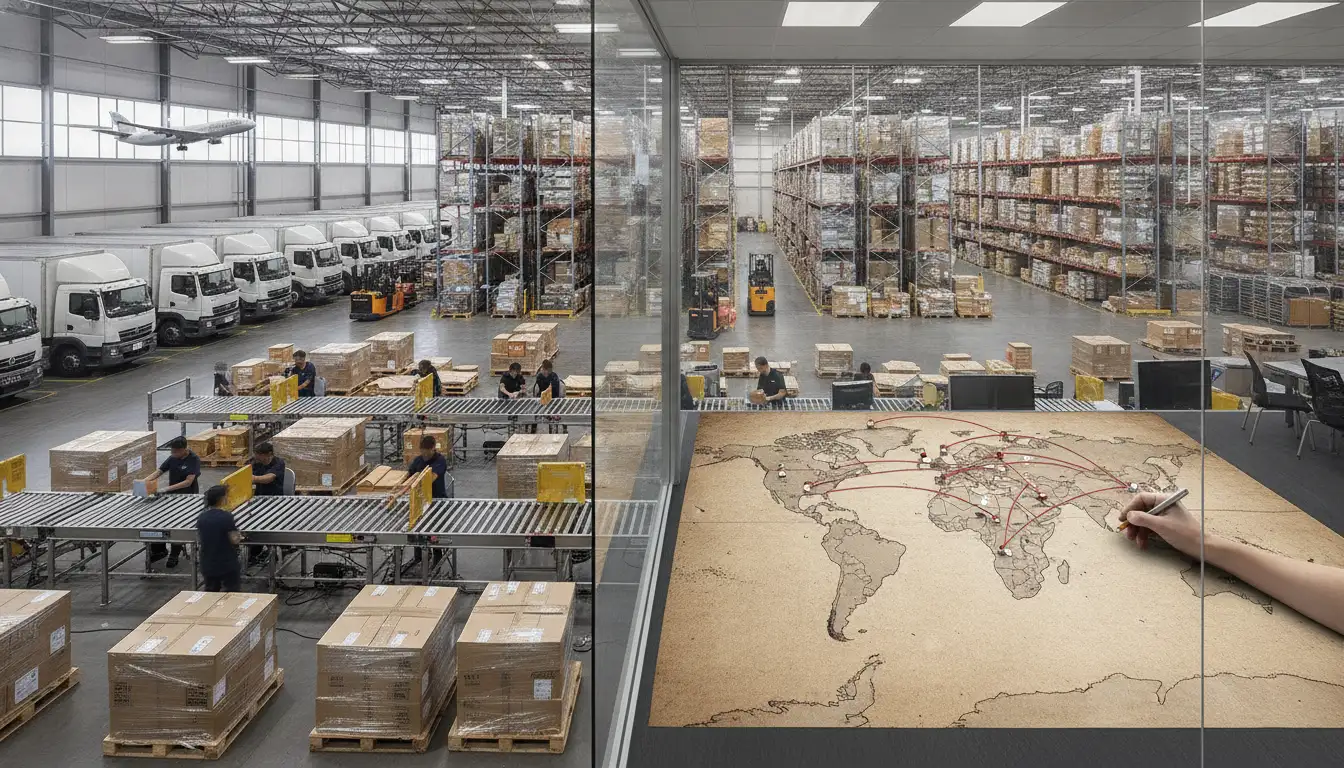
There is no universal right answer. The decision is a function of your average order value, your margin per unit, your buyers' expectations and the competitive landscape in your category in the destination market.
| Product category | Typical AOV | Recommended service level | Rationale |
|---|---|---|---|
| Luxury apparel, jewelry, premium electronics accessories | USD 150+ | International express | Buyer expectation aligns with express speed; insurance and liability limits are more protective; DDP clearance is cleaner with express carriers |
| Mid-market apparel, beauty, supplements | USD 40 to USD 150 | Economy express or postal consolidation | Speed is secondary to cost; buyer tolerance for 7 to 10 days is higher when product is non-urgent |
| Low-AOV consumables, refills, accessories | Under USD 40 | Postal consolidation | Shipping cost must be minimized to preserve margin; last-mile tracking gaps are acceptable for buyers who are repeat purchasers |
| B2B samples and wholesale replenishment | Varies | Express, possibly with formal entry documentation | Time-sensitive; recipient is typically a registered importer; DAP terms are acceptable because buyer handles customs |
What about returns on international shipments?
International returns add a layer of complexity that many brands underestimate when setting up outbound lanes. When a buyer in Germany returns a product to a US warehouse, the parcel crosses the US border as an import. That import may trigger a formal customs entry and potentially duties, depending on how the return is documented and what classification the goods fall under.
For brands generating meaningful international return volume, the options include: a local return address in the destination region (YouParcel's shop-and-ship warehouse in the UK can play a role for UK-originated returns), a returns consolidation service that batches returns before transatlantic shipment, or a donate-and-refund policy for low-value items where the economics of physical return do not work.
The broader context on building an international ecommerce operation is covered in the beginner's guide to international ecommerce, which addresses inbound and outbound flows together.
The role of a customs broker in international ecommerce shipping
YouParcel is not an importer of record (IOR) and does not act as one. For brands shipping outbound from the US, the customs broker relationship is on the destination side: an agent licensed in the destination country who files entries, calculates duties, and handles any holds or examinations.
Many express carriers include a brokerage service in their DDP product, covering the destination customs entry as part of the shipping fee. That is convenient but not always the cheapest or most flexible option. For brands with high volume into a specific country, a dedicated customs broker in that country often produces lower duty calculations (through accurate HS classification and applicable trade agreement preference claims) and faster clearance through established relationships with the local customs authority.
The US CBP broker licensing database can help verify the credentials of any US-side customs broker; for destination-country brokers, verification should be done through the relevant national customs authority.
Frequently asked questions
What is the difference between DDP and DAP for international ecommerce shipping?
DDP (Delivered Duty Paid) means the seller collects duties and taxes from the buyer at checkout and remits them to the destination customs authority; the buyer receives the parcel without any additional payment. DAP (Delivered at Place, also called DDU) means the buyer pays duties and any carrier brokerage fees directly to the destination carrier or customs authority before the parcel is released for delivery.
Which international parcel carriers does YouParcel work with?
YouParcel ships internationally using USPS, FedEx, DHL, Aramex and EasyPost, covering express, economy and postal consolidation service levels from warehouses in New Jersey, California and Illinois. The right carrier and service level for each brand depends on destination markets, parcel weight, declared value and buyer expectations.
Do I need to register for VAT or GST in destination countries?
It depends on the country and your sales volume. The EU requires IOSS registration for sub-EUR 150 B2C parcels; the UK requires VAT registration for sellers above GBP 85,000 in annual UK revenue; Australia requires GST registration above AUD 75,000 in annual Australian revenue. Each country's rules differ, so consult a licensed tax adviser or customs broker in each market where you sell.
How does dimensional weight affect international shipping costs from a US warehouse?
International express carriers charge the greater of actual weight or dimensional weight, calculated by multiplying the parcel's length, width and height in inches and dividing by 139. Light but bulky parcels can cost two to three times more than expected if packaging has not been optimized, so DIM weight analysis should happen before any international lane goes live.
What happens if a buyer refuses an international shipment?
A refused international parcel typically returns to the origin at the sender's cost, or is abandoned at the destination carrier's facility, with the original outbound shipping cost unrecoverable. High refusal rates on DAP shipments, where buyers are surprised by unexpected customs bills, are a strong signal to evaluate switching to DDP terms or improving duty disclosure at checkout.
Ready to open international shipping lanes from your US warehouse or optimize the ones you already run? Talk to an Expert at YouParcel to discuss carrier options, DDP setup and destination duty strategy for your specific markets and product categories. Or create an account to get started.