


When comparing UPS vs USPS vs FedEx for ecommerce ground shipping in 2026, no single carrier wins every shipment. USPS Ground Advantage tends to be cheapest for lightweight packages under two pounds going short distances, UPS Ground and FedEx Ground compete closely on heavier parcels and longer zones, and all three carriers have raised rates meaningfully for 2026. YouParcel works with all three, plus DHL, Aramex and EasyPost, to route each order to the right carrier at the right cost.
- USPS Ground Advantage rates rise 7.8% on January 18, 2026, the steepest increase of the three carriers this cycle.
- UPS and FedEx both announced 5.9% average general rate increases (GRIs), effective December 22, 2025 and January 5, 2026 respectively.
- The cheapest carrier for a given shipment depends on weight, dimensions, origin-to-destination zone and any accessorial surcharges, not on the GRI headline alone.
- Multi-carrier shipping through a 3PL like YouParcel lets brands benchmark all three rates per order and shift volume automatically when one carrier becomes uncompetitive.
What changed in January 2026 and why it matters
Three separate rate actions land within weeks of each other, compressing what would normally be spread-out budget planning into a single crunch period.
UPS filed its 2026 general rate increase (GRI) on October 30, 2025, announcing a 5.9% average increase across domestic ground and air services, effective December 22, 2025. Loop reported the UPS GRI announcement on October 30, 2025.
FedEx followed its own 5.9% average GRI, effective January 5, 2026, announced on September 12, 2025. AFMS documented the FedEx 2026 rate increase announcement in September 2025.
USPS then announced its own price changes for January 18, 2026, with increases that vary by service: Ground Advantage up 7.8%, Priority Mail up 6.6%, Priority Mail Express up 5.1%, and Parcel Select up 6.0%. Supply Chain Dive reported the USPS 2026 price increase details on November 17, 2025.
The practical effect: a brand that budgeted shipping costs in mid-2025 may be looking at combined rate exposure that is 6% to 8% higher by mid-January 2026, depending on its carrier mix. That gap is large enough to shift carrier allocation decisions, especially for high-volume shippers running thin margins.
How the three ground services are structured
Before comparing costs, it helps to understand what each service actually is. Ground shipping from all three carriers is zonal: the continental US is divided into zones (typically 2 through 8, based on distance from the origin facility), and the published rate table combines zone with weight to produce a base price. Accessorial charges, fuel surcharges and residential delivery fees are added on top.
USPS Ground Advantage
USPS Ground Advantage (launched 2023, consolidating several legacy services) covers packages up to 70 lbs with delivery in 2 to 5 business days. It does not apply dimensional weight pricing to packages under one cubic foot (1,728 cubic inches), which is a meaningful cost advantage for bulky-but-light items. There is no residential surcharge and no fuel surcharge structure like UPS or FedEx, though USPS does apply its own rate design. USPS serves every US address, including PO boxes and military APO/FPO addresses, which the private carriers do not cover without additional routing.
UPS Ground
UPS Ground covers packages up to 150 lbs with transit times of 1 to 5 business days depending on zone. UPS applies a dimensional weight divisor of 139 (in cubic inches per pound) for all packages, meaning oversized-but-light parcels are priced on their volume rather than their actual weight. Residential delivery carries a per-package surcharge. Additional handling, oversize and peak surcharges can add substantially to the base rate on certain package profiles.
FedEx Ground
FedEx Ground covers packages up to 150 lbs and uses a dimensional weight divisor of 139 as well, matching UPS. Transit times are 1 to 5 business days. FedEx Home Delivery is the residential variant of FedEx Ground, running Tuesday through Sunday, and it carries its own rate table with a residential surcharge. Like UPS, FedEx applies fuel surcharges and accessorial fees that fluctuate weekly.
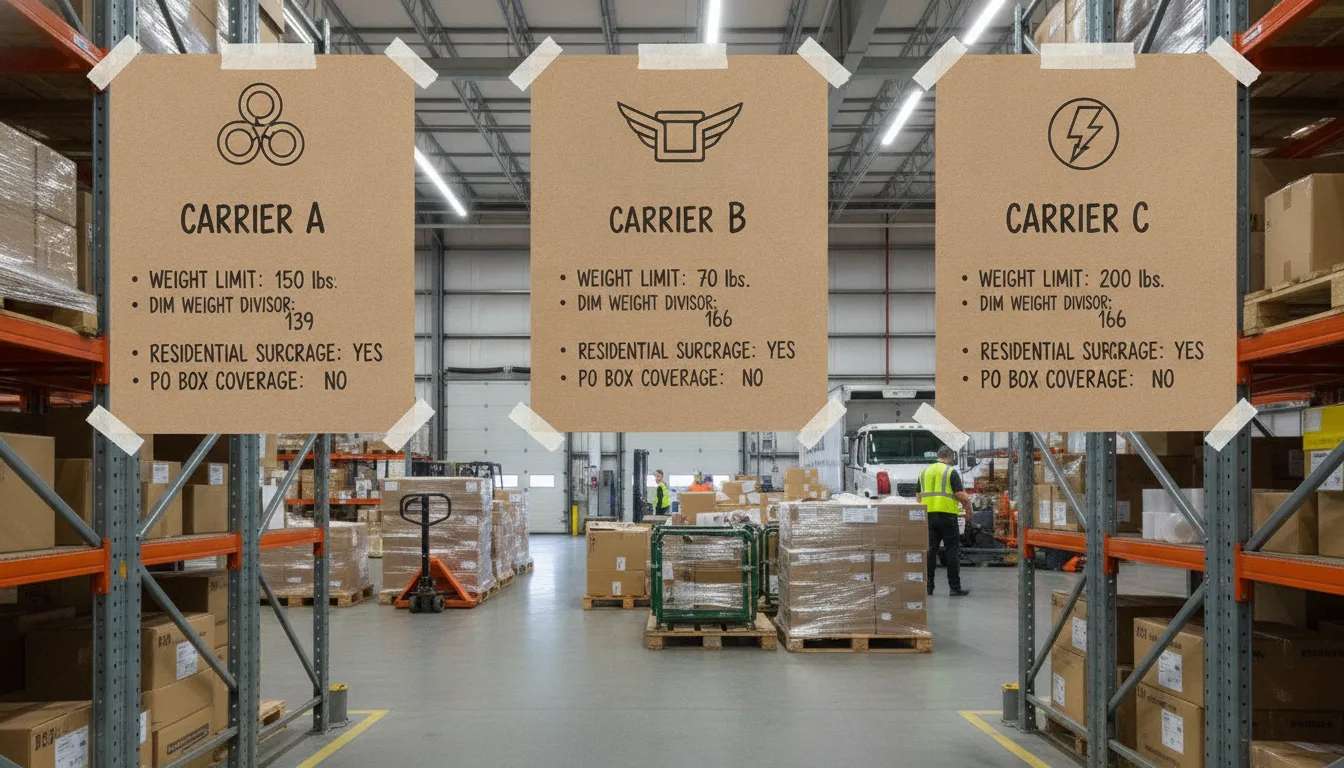
UPS vs USPS vs FedEx: a ground service comparison by package profile
The table below shows how the three carriers generally position against each other across common ecommerce package profiles. It uses directional guidance, not published rate tables (which change with the GRIs above), because the right answer always depends on your negotiated rates, surcharge exposure and zone mix. Use this as a starting framework, then validate against actual quotes.
| Package profile | Typical weight | USPS Ground Advantage | UPS Ground | FedEx Ground / Home Delivery |
|---|---|---|---|---|
| Small, lightweight parcel (apparel, cosmetics, supplements) | Under 2 lbs | Often lowest base rate; no dim weight under 1 cu ft; no residential surcharge | Residential surcharge adds cost; dim weight can apply to padded mailers over threshold | Similar to UPS; Home Delivery surcharge applies to residential stops |
| Mid-weight parcel (electronics, home goods, multi-unit orders) | 2 to 10 lbs | Competitive on shorter zones (2-4); less competitive on zones 6-8 | Competitive across all zones with negotiated rates; surcharges erode savings at residential | Comparable to UPS; FedEx One Rate flat-rate boxes can offer savings on predictable sizes |
| Heavy or oversized parcel (furniture parts, fitness equipment) | Over 30 lbs | USPS 70 lb limit; not suitable for items over that threshold | Handles up to 150 lbs; additional handling and oversize surcharges significant above 50 lbs | Handles up to 150 lbs; similar surcharge structure to UPS; worth comparing both |
| Lightweight but bulky (pillows, packaging foam, pet supplies) | Under 5 lbs, over 1 cu ft | Dim weight applies above 1 cu ft (1,728 cu in); advantage narrows | Dim weight divisor 139 applies; actual vs dim weight comparison required | Same dim weight divisor 139; identical structural position to UPS |
| PO boxes and APO/FPO military addresses | Any | Supported; only viable option | Not supported | Not supported |
| Rural or remote residential | Any | Standard rate; USPS serves all US addresses uniformly | Remote area surcharge may apply; residential delivery surcharge always applies | Remote area surcharge may apply; residential delivery surcharge always applies |
Is FedEx or UPS cheaper for ecommerce?
At published list rates, UPS Ground and FedEx Ground are structured so similarly that neither is consistently cheaper across all zones and weights. Both use a 139 cubic-inch dimensional weight divisor. Both charge residential delivery surcharges. Both apply weekly-adjusted fuel surcharges and a nearly identical menu of accessorial fees. The practical difference is usually found in negotiated contract rates rather than list rates, and in service-specific products: FedEx One Rate flat-rate pricing can win on specific box sizes, while UPS has its own flat-rate and simple rate products.
For most ecommerce brands shipping to residential addresses in a mix of zones, the decision between UPS and FedEx should be driven by:
- Your zone distribution (where your customers are relative to your fulfillment location).
- Your average package weight and dimensions, because surcharge exposure differs on specific package types.
- Your negotiated discount tier, which shifts the actual rate more than the list-rate comparison does.
- Service reliability in your specific lanes, based on your own delivery performance data.
UPS Ground vs USPS Ground Advantage: the lightweight threshold
The most practically useful comparison for DTC and Shopify sellers is UPS Ground vs USPS Ground Advantage on lightweight packages, because that is where the structural difference is sharpest.
USPS Ground Advantage does not apply dimensional weight to packages under 1,728 cubic inches (one cubic foot). That means a padded poly mailer or a small box containing apparel, cosmetics, supplements or accessories is priced entirely on actual weight, without the volume penalty. For packages in the one-ounce to two-pound range, USPS is frequently the lower-cost option before negotiated rates, particularly on shorter zones where transit times are acceptable.
UPS applies its 139-divisor dim weight formula to all packages. For a box measuring 12 x 10 x 6 inches (720 cubic inches), the dimensional weight is 720 divided by 139, which equals approximately 5.2 lbs. If the actual weight is 1.5 lbs, UPS prices the shipment at 5.2 lbs. USPS prices it at 1.5 lbs if the box measures under 1,728 cubic inches. That difference in billable weight often represents several dollars per shipment at scale.
The tradeoff is transit time certainty and tracking depth. UPS Ground provides tighter delivery windows and more granular parcel-level tracking that integrates cleanly into branded customer communications. USPS Ground Advantage has improved its tracking significantly since the service consolidation in 2023, but private-carrier tracking integrations are generally more reliable for customer-facing alerts.
To learn more about how dimensional weight affects your total shipping cost, see the YouParcel ecommerce shipping services overview and the related guide on small business shipping options for growing brands.
What the 2026 GRIs actually mean for your shipping budget
A 5.9% or 7.8% headline GRI does not translate directly into a 5.9% or 7.8% increase in your invoice. Here is why.
GRIs are averages across the full rate table. The increase on a specific zone and weight combination may be higher or lower than the headline. Surcharges, which are listed separately from base rates, often increase by different percentages. Carriers apply GRIs to list rates, while negotiated discounts are typically expressed as a percentage off list, so a 20% discount off a list rate that just went up 5.9% still leaves you paying more in absolute dollars.
The practical exercise is to take your actual shipment history from the past 90 days, apply the new rate tables to those same packages and zones, and compare the total cost. Many brands find their realized increase is between 4% and 9% depending on their mix, because surcharges and accessorials move independently.
Fuel surcharges deserve separate attention. Both UPS and FedEx adjust fuel surcharges weekly based on the US Energy Information Administration index. USPS applies fuel surcharges differently and updates them on its own schedule. When fuel prices rise after a GRI has locked in base rates, your effective per-shipment cost can increase further without any additional GRI announcement.
When to use each carrier: a practical decision framework
Use USPS Ground Advantage when:
- Your average package weighs under two pounds and fits in a standard poly mailer or small box under one cubic foot.
- You ship to PO boxes, APO/FPO addresses or rural addresses where UPS and FedEx apply remote surcharges.
- You ship primarily to zones 2 through 4 (shorter distances) where USPS transit times are competitive.
- Your customers are price-sensitive and a 2-to-5 day delivery window is acceptable.
Use UPS Ground or FedEx Ground when:
- Your packages weigh more than two pounds or regularly exceed one cubic foot in volume.
- You need tighter, more predictable delivery windows across zones 5 through 8.
- Your customers expect granular, branded tracking updates throughout transit.
- You are shipping commercial (business-to-business) addresses, which avoid the residential surcharge entirely.
- You have negotiated contract rates that make the private carriers competitive at your volume tier.
When a multi-carrier strategy outperforms any single carrier:
- Your order profile is mixed: some lightweight, some heavy, some rural, some commercial.
- You operate from multiple fulfillment locations across different regions.
- You want carrier redundancy for peak periods, weather disruptions or service failures.
- You ship above 500 orders per month and can generate meaningful data to optimize carrier selection per shipment.
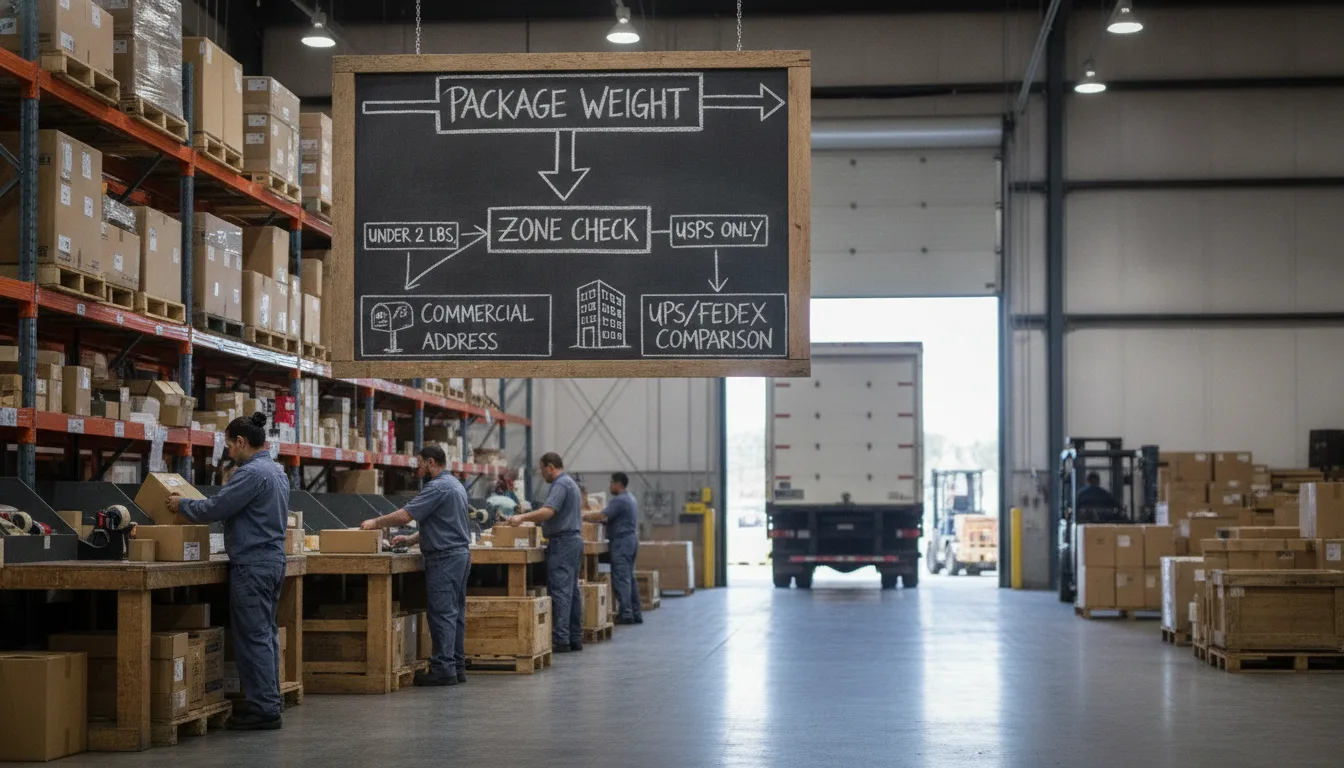
How fulfillment location affects carrier economics
The cheapest carrier for zone 2 (a short haul) may be a poor choice for zone 7 (a long haul). Because zone pricing is calculated from the origin zip code, the location of your fulfillment center directly determines how many of your orders fall into short versus long zones.
A brand that fulfills from a single warehouse in New Jersey reaches the Northeast in zones 2 and 3, but ships to California in zone 7 or 8. The same carrier that is cheapest on the Northeast orders may be significantly more expensive on West Coast deliveries. Splitting inventory across an East Coast and West Coast facility, as YouParcel does with its New Jersey and California fulfillment centers, reduces the average zone across the full order book. That structural reduction in average zone lowers the base rate and transit time simultaneously, independent of which carrier you use.
This is one reason why carrier comparison is inseparable from fulfillment network design. The right carrier at the right rate is partly a function of where your inventory sits when the order is placed.
Surcharges: the cost items that the GRI headline does not capture
Residential delivery surcharges, additional handling surcharges, delivery area surcharges and peak/demand surcharges all sit outside the base rate table. For many ecommerce brands, these surcharges represent 15% to 30% of the total carrier invoice. They are also the items most likely to increase at a different rate than the GRI headline, and they reset at different calendar dates.
Key surcharges to audit when comparing UPS Ground vs USPS Ground Advantage vs FedEx Ground:
| Surcharge type | USPS Ground Advantage | UPS Ground | FedEx Ground / Home Delivery |
|---|---|---|---|
| Residential delivery | Not applicable (included in rate) | Per-package fee; applies to all residential addresses | Per-package fee via Home Delivery; applies to all residential addresses |
| Fuel surcharge | Separate schedule; updated periodically | Weekly adjustment tied to EIA diesel index | Weekly adjustment tied to EIA diesel index |
| Additional handling | Applies to packages that exceed certain size thresholds | Applies when longest side exceeds 48 in, second longest exceeds 30 in, or actual weight exceeds 50 lbs | Similar thresholds to UPS; check current FedEx surcharge schedule |
| Delivery area surcharge | Not structured the same way; rural coverage is standard | Applies to specific extended delivery area zip codes | Applies to specific extended delivery area zip codes |
| Peak/demand surcharge | Not typically applied the same way | Applied during peak seasons; dates vary by year | Applied during peak seasons; dates vary by year |
Auditing your surcharge exposure before the January 2026 rate changes take effect is more valuable than comparing base rates in isolation. A package that looks cheaper on USPS but triggers an oversize surcharge, or a residential delivery on UPS that adds a fixed fee, can reverse the apparent cost advantage within a single line item.
What multi-carrier shipping through a 3PL looks like in practice
YouParcel integrates with USPS, FedEx, UPS, DHL, Aramex and EasyPost, and connects to shipping operations through 70+ platform integrations including Shopify, Amazon and Salesforce. In practice, that means rate shopping happens at the order level: when a Shopify order comes in, the system compares available carrier rates for that specific package weight, dimensions and destination zone, and routes it to the lowest-cost qualified option that meets the required delivery window.
For brands processing 1,000+ orders a day across multiple warehouses and marketplaces, manual carrier selection is not practical. Automated carrier selection, combined with real-time tracking and BI reporting on carrier performance by lane, gives operations teams the data they need to negotiate better rates and shift volume when a carrier's performance or pricing changes.
This is especially relevant after a GRI cycle. When all three carriers raise rates simultaneously, the relative spread between them shifts. A brand that allocated 70% of its volume to USPS because Ground Advantage was cheapest in 2024 may find that the 7.8% increase on USPS combined with a lower increase from a negotiated UPS or FedEx contract changes the optimal split in January 2026.
Frequently asked questions
Is USPS Ground Advantage the same as USPS ground shipping?
Yes. USPS Ground Advantage, launched in 2023, replaced several legacy ground services including USPS Retail Ground, First-Class Package Service and Parcel Select Ground for most retail use cases. It is the primary USPS ground option for ecommerce parcels up to 70 lbs.
Is UPS or USPS cheaper for packages under two pounds?
USPS Ground Advantage is generally cheaper for packages under two pounds, particularly because USPS does not apply dimensional weight pricing to packages under one cubic foot (1,728 cubic inches), while UPS applies its 139-divisor formula to all packages regardless of size. The specific answer depends on the zone and the package dimensions, so comparing actual rates for your shipment profile is essential.
How does FedEx compare to UPS for ecommerce ground shipping?
FedEx Ground and UPS Ground are structurally very similar: both use a 139 dimensional weight divisor, both charge residential delivery surcharges, and both announced 5.9% average GRIs for 2026. The practical difference usually comes down to negotiated contract rates, specific surcharge exposure and service performance in your highest-volume lanes.
When do the 2026 carrier rate increases take effect?
UPS's 2026 GRI took effect December 22, 2025. FedEx's 2026 GRI takes effect January 5, 2026. USPS's 2026 price changes take effect January 18, 2026, with Ground Advantage rising 7.8%, Priority Mail rising 6.6%, Priority Mail Express rising 5.1% and Parcel Select rising 6.0%.
Can I use all three carriers through a single fulfillment partner?
Yes. A 3PL like YouParcel integrates with USPS, UPS, FedEx and other carriers, enabling rate shopping at the order level so each shipment routes to the best carrier for its profile. This eliminates the need to manage separate carrier accounts and contracts while still accessing competitive rates across all three networks.
To see how YouParcel can benchmark carrier rates across your actual order volume and package mix, talk to an expert.