


A return merchandise authorization (RMA), sometimes called a return material authorization, is a pre-approved reference document that a seller issues before a customer ships a product back. It assigns a unique RMA ID to the return, records why the item is coming back, and gives the warehouse the information it needs to receive, grade, and restock or dispose of the goods without delay. YouParcel issues and processes RMAs as part of its reverse logistics service for US brands.
- An RMA ID is a unique reference number that ties a physical return to an order record and a disposition instruction before the parcel arrives.
- RMAs speed warehouse receiving by pre-loading expected SKUs, quantities, and return reasons into the warehouse management system (WMS).
- A complete RMA record cuts the time between parcel arrival and customer refund because no one has to research the original order after the fact.
- Missing or incomplete RMAs are one of the most common causes of returns backlogs and inventory discrepancies at fulfillment centers.
What does RMA stand for, and why does the name vary?
RMA stands for return merchandise authorization. In hardware, industrial, and B2B contexts you will also see the phrase return material authorization, which covers raw materials and components rather than finished goods. Both terms describe the same control mechanism: a seller-issued approval that opens a return and captures the data needed to process it correctly. This guide uses "RMA" throughout, but the logic applies equally to either variant.
Why RMAs exist: the warehouse receiving problem
Without an RMA, a warehouse receiving dock sees an unmarked or poorly labeled parcel and has to work backwards: find the original order, confirm the item matches what was shipped, determine whether the customer has permission to return it, and decide what to do with the unit. Each of those steps adds minutes per parcel. At scale, that adds up to hours of labor per day and a refund queue that grows faster than it shrinks.
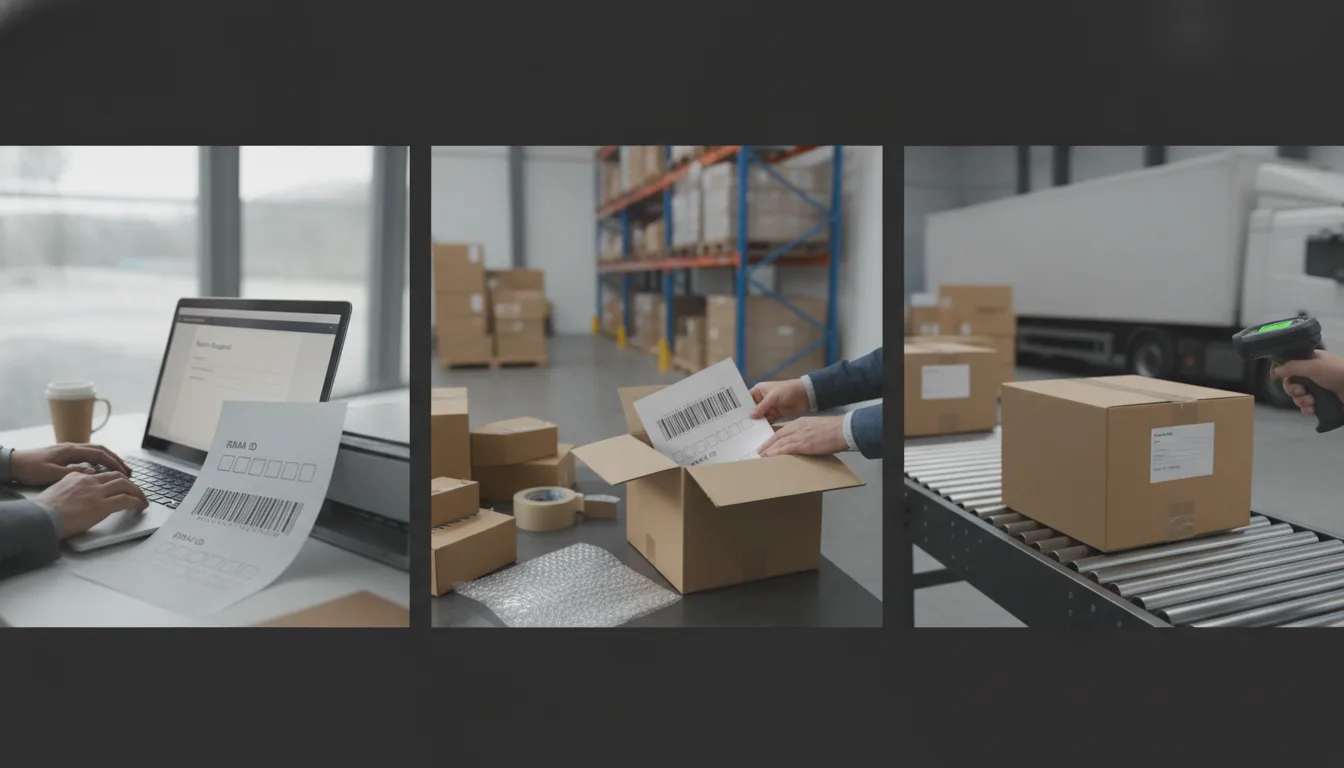
An RMA flips that sequence. The return is registered in the WMS before the parcel leaves the customer. When the box arrives, a scan of the RMA barcode or QR code pulls up the order record, expected SKU, quantity, return reason, and disposition rule in seconds. Receiving time drops, and the refund or exchange trigger fires as soon as the scan happens rather than after a manual review.
What data should every RMA carry?
A well-structured RMA is both a customer-facing document and a warehouse instruction sheet. The fields below are the minimum a 3PL receiving team needs to process a return without stopping to investigate.
| Field | What it records | Why the warehouse needs it |
|---|---|---|
| RMA ID | Unique alphanumeric reference (e.g., RMA-20251211-00847) | Links the physical parcel to the WMS record on first scan |
| Original order number | The sales order or marketplace order ID | Confirms purchase history and warranty eligibility |
| Customer information | Name, email, and optionally address | Required for refund or exchange routing and fraud checks |
| SKU and product description | Exact SKU(s) and human-readable product name | Enables visual verification against expected item |
| Quantity authorized | Number of units approved for return | Flags overages or shortages at receiving |
| Return reason code | Standardized code (e.g., DEFECTIVE, WRONG-ITEM, NO-LONGER-NEEDED) | Drives disposition rule and feeds returns analytics |
| Customer-supplied description | Free-text explanation from the customer | Provides context for grading and quality-control notes |
| Disposition instruction | Restock, quarantine, refurbish, or destroy | Tells receiving which bin or workflow to route the unit to |
| Return window expiry date | Date by which the parcel must arrive | Allows the team to reject or flag late returns automatically |
| Return shipping label reference | Tracking number of the return label provided to the customer | Enables proactive tracking before parcel arrives at dock |
| Refund or exchange trigger | Whether the refund fires on scan or after grading | Sets customer expectations and prevents premature credits |
| Merchandise condition at approval | Declared condition (sealed, opened, damaged) | Baseline for grading comparison and dispute resolution |
RMA ID format: what actually works in practice
The RMA ID is the keystone field. A scannable barcode or QR code encoding the RMA ID must appear on the packing slip or label insert that travels inside or on the parcel. Readable formats vary by WMS, but a common convention combines a prefix, a date segment, and a sequential counter: for example, RMA-20251211-00847. Some operations append the original order number after a hyphen for instant human readability at the dock.
What matters more than the format is consistency. Every RMA ID must be unique, must match exactly one WMS record, and must be scannable with the same scanner used for inbound shipments. If your returns software and WMS use different ID schemas, a middleware mapping step is required before go-live, otherwise the scan produces no match and the parcel falls into a manual exception queue.
How an RMA speeds the refund cycle, step by step
- Customer submits a return request. The customer logs in to the brand portal, selects the order, chooses a return reason, and submits. The returns management system (RMS) or 3PL portal validates eligibility against the return policy (return window, excluded SKU list, condition requirements).
- RMA record is created in the WMS. On approval, the system writes the RMA record to the WMS with all fields from the table above. The expected return now exists as a pending inbound line before the parcel ships.
- Return label is issued. A prepaid label or a QR code for a carrier drop-off is sent to the customer. The label tracking number is written back to the RMA record so the warehouse can monitor inbound transit.
- Parcel arrives at the fulfillment center. Receiving staff scan the RMA barcode. The WMS matches it to the pending record and displays expected SKU, quantity, and disposition instruction on screen.
- Physical inspection and grading. The receiver opens the parcel and grades the item against the declared condition and return reason. Grading typically uses a tiered scale: Grade A (factory-sealed or unused), Grade B (opened but resalable), Grade C (damaged or incomplete), Scrap (unsalable). The grade is recorded against the RMA ID.
- Disposition is executed. Based on grade and the pre-set disposition rule, the unit is routed to a restock bin, a quarantine shelf pending brand review, a refurbishment workflow, or a destruction/recycling lane. YouParcel supports restocking, return-to-origin (RTO), and disposal or recycling as disposition options.
- Refund or exchange is triggered. If the RMA is configured for a scan-on-receipt trigger, the refund or exchange order fires the moment the barcode is scanned. If it requires grading confirmation, the trigger fires after the grade is recorded. Either way, the timestamp is captured in the WMS and surfaced to the brand via integration.
- Inventory is updated. Restocked units are added back to available inventory in real time. Scrapped or quarantined units are moved to a non-sellable location code so they do not inflate available stock.
- Returns data is reported. SKU-level return reason codes, grading outcomes, and processing times are aggregated in the brand dashboard. This data feeds decisions about product quality, packaging changes, and return policy adjustments.
RMA vs. no-RMA returns: what breaks without one
Some brands, particularly early-stage DTC sellers, tell customers to ship returns to a warehouse address without requiring an RMA. The problems surface quickly at any meaningful volume.
| Scenario | With RMA | Without RMA |
|---|---|---|
| Receiving time per unit | Seconds (scan to match) | Minutes (manual order lookup) |
| Inventory accuracy | Updated on scan, traceable to source | Requires manual count reconciliation |
| Refund speed | Triggered automatically on scan or grade | Dependent on staff research and manual entry |
| Return fraud exposure | Reduced: quantity and SKU are pre-authorized | Higher: no pre-authorization check |
| Returns analytics | Return reason codes feed reporting automatically | Little or no structured data for analysis |
| Carrier claim support | Tracking number linked to RMA and order | Difficult to link loss or damage to a specific order |
Return reason codes: the data layer most brands under-use
Return reason codes are short standardized labels attached to the RMA at the point of customer request. Common codes include: DEFECTIVE, WRONG-ITEM-SHIPPED, NOT-AS-DESCRIBED, SIZE-FIT, CHANGED-MIND, ARRIVED-LATE, DAMAGED-IN-TRANSIT, and DUPLICATE-ORDER. The exact taxonomy is brand-defined, but keeping the list short (eight to twelve codes) is better than a long list that customers pick arbitrarily.
These codes are valuable because they distinguish problems the brand caused (wrong item shipped, not as described) from problems outside its control (changed mind, duplicate order) and from carrier or packaging failures (damaged in transit). SKU-level reason code reporting, available through tools like Loop Returns or through a 3PL dashboard, lets operations and product teams spot patterns before they become large-scale quality or margin problems. Loop Returns, for example, publishes documentation on how reason code data surfaces in its analytics dashboard, illustrating the reporting value of structured codes at the RMA stage. For a broader look at the software that manages this workflow, see the guide to return management software.
RMA data requirements for international returns
International returns add a customs layer to the RMA data requirements. When a customer outside the US ships a product back to a US fulfillment center, the return parcel is a dutiable import. The customs declaration must match the original export record, and the commercial invoice attached to the return shipment should reference the original order number and RMA ID.
Key additional fields for international RMAs include: country of origin of the goods, Harmonized System (HS) code (the six-digit international classification that determines duty rates), declared value in USD, and an indication that the goods are being returned (not sold), which affects how customs authorities assess duty liability. The importer of record (IOR) for the return parcel is typically the brand or the 3PL acting on its behalf; this is a legal designation with tax and compliance implications, and brands should confirm IOR arrangements with their customs broker before accepting international returns at scale. YouParcel does not act as importer of record but can connect brands with the right resources for that decision.
Carriers such as DHL and FedEx offer specific international returns services with pre-printed customs documentation, but the data flowing into those labels still originates from the RMA record. A complete RMA that includes HS code and declared value dramatically reduces customs clearance delays on inbound returns.
How 3PLs handle RMAs at the warehouse level
At a 3PL like YouParcel, the RMA workflow is embedded in the warehouse management system and surfaced to the brand through an integrated dashboard. When a brand's store (Shopify, Amazon, or any of the 70+ platform integrations YouParcel supports) generates an RMA, that record is pushed to the WMS via API. The receiving team at the fulfillment center in East Hanover, NJ or Rialto, CA sees the pending return before the parcel arrives, pre-stages the correct bin location, and can track inbound transit in real time.
Brands that process a high daily volume of returns benefit from dedicated returns lanes at the fulfillment center, where grading, repackaging, and restocking happen in a continuous flow rather than batched at end of day. For brands that need items assessed before restocking, a quarantine hold flag in the RMA record pauses the unit in an inspection zone until a brand representative reviews photos or approves the disposition remotely. YouParcel's reverse logistics service covers returns and exchanges, return shipping management, international returns, return-to-origin (RTO), and recycling and disposal, all traceable back to the original RMA ID. Learn more about how those services fit together at YouParcel reverse logistics.
Common RMA mistakes that slow down returns
Knowing what goes wrong is as useful as knowing what should go right. These are the most frequent RMA-related failures at the operational level.
- No RMA barcode in the parcel. The customer prints the label but forgets or omits the packing slip. The parcel arrives at the dock with no scannable reference, and a staff member must open it, find the product, and manually research the order.
- RMA ID not written to the WMS before the parcel ships. The RMA is generated in the returns portal but the API sync to the WMS has a delay or failure. The scan produces no match and the parcel goes to an exceptions queue.
- Wrong SKU on the RMA. The customer selects the correct order but the wrong item from a multi-SKU order. Receiving sees a mismatch, flags the parcel, and the brand has to review manually.
- No disposition rule set. The RMA arrives at the warehouse with no instruction on what to do with the unit. The item sits in a holding area while someone contacts the brand, tying up dock space and delaying refund.
- Return window not enforced at request time. Customers submit RMAs after the return window has closed. If the system does not block these at the point of request, the warehouse receives parcels it has no policy basis to process.
- Free-text reason only, no reason code. Without a standardized code, reason data cannot be aggregated into reports, and the brand loses the feedback loop that would identify systemic product or packaging problems.
Frequently asked questions
What is an RMA number, and where do I find it?
An RMA number (also called an RMA ID) is the unique reference assigned to an approved return request. You will find it in the confirmation email sent after your return request is approved, on the packing slip included with your return label, and in the returns portal where you submitted the request. When shipping a return, always include the packing slip with the RMA number inside the parcel.
Is an RMA the same as a return label?
No. A return label is the carrier shipping document that moves the parcel from the customer back to the warehouse. An RMA is the authorization record that tells the warehouse what to expect when that parcel arrives. The two are related: the return label tracking number is usually recorded on the RMA, but they serve different purposes.
What happens if a customer returns a product without an RMA?
The warehouse receives an unexpected parcel with no matching WMS record. Staff must open the parcel, identify the product, search for the original order, and determine whether a return was authorized. This manual process slows receiving, delays refunds, and increases the risk of inventory errors. Most 3PLs will process uninstructed returns but charge additional handling fees for the extra labor.
How long should an RMA be valid?
Most brands set RMA validity to match their return window, typically 14 to 30 days from issuance. The expiry date should be encoded in the RMA record so the WMS can automatically flag or reject parcels that arrive after the window closes. Setting a hard expiry at the WMS level prevents manual exceptions and keeps returns policy consistent.
Can a 3PL handle RMAs for international returns?
Yes, but the RMA must carry additional data: HS code, declared value, country of origin, and an indication that the goods are a return rather than a purchase. The brand or its customs broker must also confirm importer of record arrangements for the return shipment before the first international parcel is dispatched. A 3PL with reverse logistics capability, such as YouParcel, can receive and process internationally originated returns at its US fulfillment centers once the customs and IOR framework is in place.
Ready to put a structured RMA process in place for your brand? Talk to an expert at YouParcel about reverse logistics options that fit your volume and return policy.